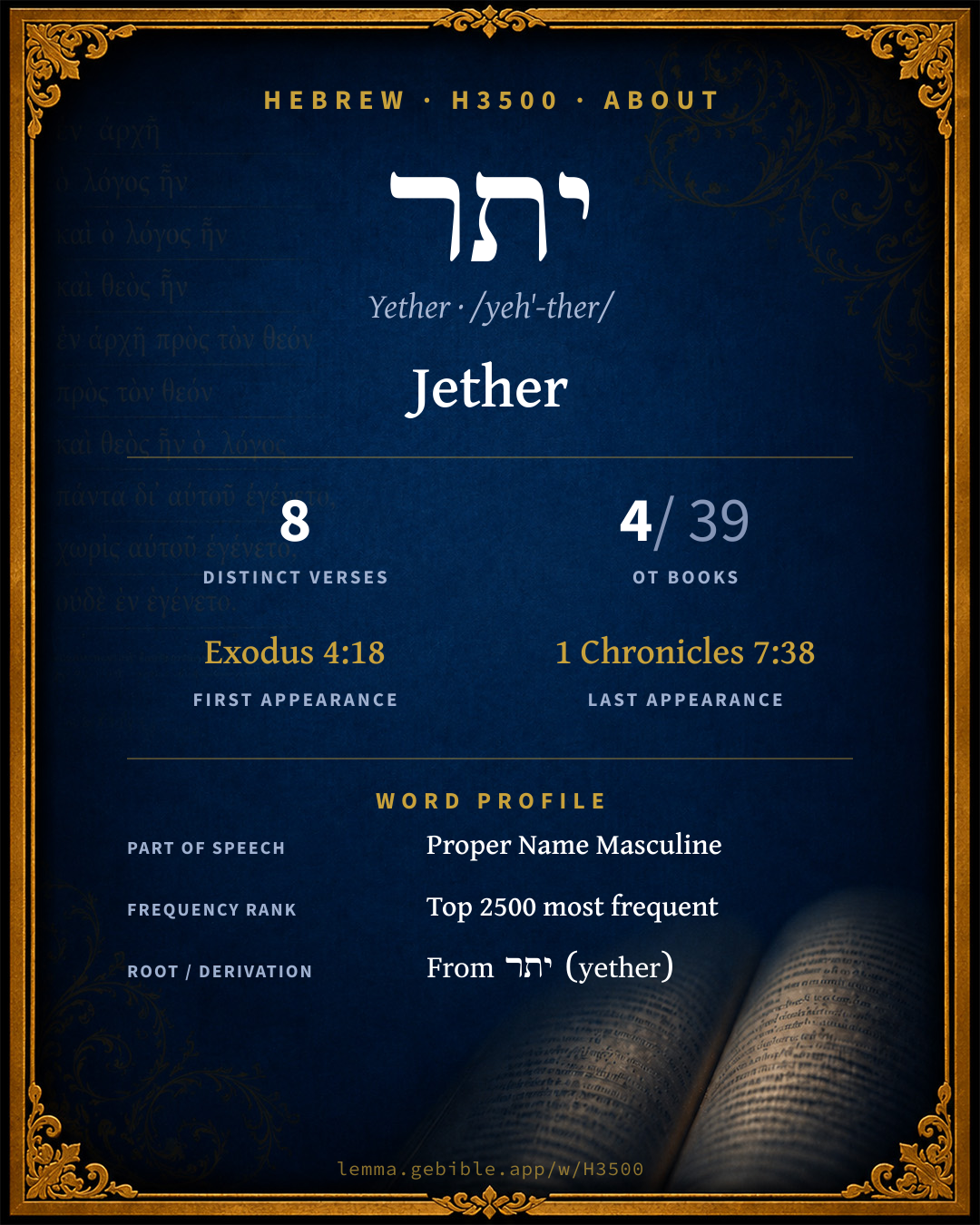
יֶ֫תֶר
Jether
BDB lists 7 entries for ‘Jether’ fuller range ↓
Full lexicon entry — Brown-Driver-Briggs (BDB)
From Brown-Driver-Briggs (BDB)
Where this word appears
Grammar key — what these labels mean
Part of speech
- Noun
- A naming word — a person, place, thing, or idea.
Noun type
- Proper
- A name of a specific person, place, or people (e.g. Abraham, Zion, Israel).
Every verse where H3500 appears — 8 distinct verses across 4 books. Click any verse to open its interlinear word-by-word view. Verse text shown in the World English Bible for context — . Each verse’s Hebrew form is shown with its reference; the English is not keyword-highlighted, since the data carries no word-level English alignment. Use “Compare translations” on any verse to read it across multiple English versions. This concordance covers the Hebrew Bible; Septuagint (Greek Old Testament) occurrences are not indexed here.
Exodus 1 verse
Judges 1 verse
1 Kings 2 verses
- 1 Kings 2:5 יֶ֨תֶר֙ n Proper Moreover you know also what Joab the son of Zeruiah did to me, even what he did to the two captains of the hosts of Israel, to Abner the son of Ner, and to Amasa the son of Jether, whom he killed, and shed the blood of war in peace, and put the blood of war on his sash that was about his loins, and in his shoes that were on his feet.
- 1 Kings 2:32 יֶ֖תֶר n Proper Yahweh will return his blood on his own head, because he fell on two men more righteous and better than he, and killed them with the sword, and my father David didn't know it, [to wit], Abner the son of Ner, captain of the host of Israel, and Amasa the son of Jether, captain of the host of Judah.
1 Chronicles 4 verses
- 1 Chronicles 2:17 יֶ֖תֶר n Proper Abigail bore Amasa; and the father of Amasa was Jether the Ishmaelite.
- 1 Chronicles 2:32 יֶ֖תֶר יֶ֖תֶר n Proper n Proper The sons of Jada the brother of Shammai: Jether, and Jonathan; and Jether died without children.
- 1 Chronicles 4:17 יֶ֥תֶר n Proper The sons of Ezrah: Jether, and Mered, and Epher, and Jalon; and she bore Miriam, and Shammai, and Ishbah the father of Eshtemoa.
- 1 Chronicles 7:38 יֶ֑תֶר n Proper The sons of Jether: Jephunneh, and Pispa, and Ara.
About this entry
At a glance — auto-summarized from this page’s data, not written by a person. Every figure links to its source below. This summary describes the numbers; it doesn’t interpret them.
The Hebrew name יתר centers on the idea of “Jether.” 1 Chronicles dominates its distribution — 4 of 8 verses. The Hebrew Bible uses it across 8 verses — uncommon. Its earliest occurrence is Exodus 4:18. Dig into 8-verse concordance and the renderings breakdown below.
Gloss history
Strong's 1890 vs modern scholarship
About this word
Strong's H3500 catalogs a Hebrew word from the Hebrew Old Testament.
These counts are not copied from any lexicon or concordance. They are computed here, from the morphology-tagged Hebrew Old Testament. What Lemma adds →
- 8
- distinct verses
- The word appears in 8 distinct verses.
- 4 / 39
- OT books
- The word appears in 4 of 39 Old Testament books.
- #2,481
- by frequency
- Top 2500 most frequent Hebrew words (rank 2,481 of 8,640 Hebrew words by occurrence).
View all 8 occurrences in the concordance →
Most concentrated in
- 1 Chronicles 4 verses 50%
- 1 Kings 2 verses 25%
- Exodus 1 verse 13%
By section of the Old Testament
By traditional corpus
Conventional, traditional groupings — biblical authorship is debated, so this is a traditional corpus grouping, not an authorship claim. Each share is this word’s portion of its verses in that division of the Hebrew canon. Each figure is a share of the word’s 8 distinct verses.
- Writings (Ketuvim) 4 verses · 50%
- Prophets (Nevi'im) 3 verses · 38%
- Torah (Pentateuch) 1 verse · 13%
How translations render this word
Counts come from each version’s own published word-to-Strong’s tagging or interlinear alignment — an approximate guide to how each version renders this word, not a word-level alignment the data otherwise carries. Because each total is that version’s own tagged count, the per-version totals vary from one another and need not match the appearance or distinct-verse counts above. These counts may also differ from a printed concordance because Lemma counts each distinctly tagged rendering and does not collapse phrase taggings into a single head-word total. This is a fixed set of word-tagged versions (KJV, ASV, BSB, ULT) and does not change with the reading translation you choose elsewhere. Each version’s license is shown beside its name below (and on Sources).
BDB lists this Strong’s number as 3 distinct words (homographs). Each count above pools all of them and is not split by sense — see the Senses section below. A low-frequency rendering may belong to a different one of those words, not the primary meaning.
- King James Version†: Jether 6×
- American Standard Version†: Jether 7×
- Berean Standard Bible†: Jether 7×
- unfoldingWord Literal Text†: Jether 7×
King James Version Public Domain
Renders H3500 across 9† tagged occurrences — most commonly:
Plus 3 renderings that appear only once — usually multi-word phrases or single function words the recovered tagging swept in, not distinct renderings.
American Standard Version Public Domain
Renders H3500 across 9† tagged occurrences — most commonly:
Plus 2 renderings that appear only once — usually multi-word phrases or single function words the recovered tagging swept in, not distinct renderings.
Berean Standard Bible Public Domain
Renders H3500 across 9† tagged occurrences — most commonly:
Plus 2 renderings that appear only once — usually multi-word phrases or single function words the recovered tagging swept in, not distinct renderings.
unfoldingWord Literal Text CC BY-SA 4.0
Renders H3500 across 9† tagged occurrences — most commonly:
Plus 2 renderings that appear only once — usually multi-word phrases or single function words the recovered tagging swept in, not distinct renderings.
13 senses and sub-senses in the full BDB
What do BDB’s symbols mean?
BDB uses these scholarly abbreviations:
| Symbol | Meaning |
|---|---|
| 𝔊 | the Septuagint (the ancient Greek translation, LXX) |
| 𝔙 | the Vulgate (the Latin translation) |
| 𝔖 | the Syriac version (the Peshitta) |
| 𝔗 | the Targum (the Aramaic translation) |
| ψ | the Psalms |
| √ | root (the underlying root or stem) |
| ‖ | parallel passage (a synonymous or contrasted parallel) |
| † | the dagger: every passage where the word occurs is cited |
The 13 senses and sub-senses the full Brown-Driver-Briggs lexicon distinguishes for this word, in lexicon order (not ranked by frequency), with BDB’s own verbatim wording and sub-sense lettering. Shown in Hebrew script with BDB’s own scholarly abbreviations. The condensed entry is in the Lexicon Entry tab. See also the Forms in the corpus table below.
יתר I
- 1.
- a. remainder, remnant (with implied inferiority in number or quality), of crops, etc. יִתְרָם Ex 23:11 (JE), their remnant, i.e. what they (the enemy) leave, so יֶתֶר הַגָּזָם Jo 1:4; יֶתֶר הָאַרְבֶּה v 4; יֶתֶר הַיֶּלֶק v 4; יֶתֶר הַפְּלֵטָה הַנִּשְׁאֶרֶת EX 10:5 (J); of vessels, יֶתֶר הַכֵּלִים הַנּוֹתָרִים Je 27:19; of a tree Is 44:19 (= שְׁאֵרִית v 17); elsewhere of pers. Dt 3:11 = Jos 12:4; 13:12 (both D), Dt 28:54 Jos 23:12 (D), 2 S 21:2 2 K 25:11 = Je 52:15, Ez 34:18; of a rescued remnant of Israel (Judah) Mi 5:2 Zp 2:9 (‖ שְׁאֵרִית), Zc 14:2; יֶתֶר הַקָּדֵשׁ אֲשֶׁר נִשְׁאַר 1 K 22:47; יֶתֶר הָעָם הַנִּשְׁאָרִים Je 36:9(×2) 2 K 25:11 = Je 52:15†. e.g. Exodus 23:11
- b. remainder, rest, other part of people, elders, etc., 2 S 10:10 = 1 Ch 19:11, 2 S 12:28 1 K 12:23 Je 29:1 Hb 2:8 Ez 48:23; sometimes incl. a majority Ju 7:6 1 S 13:2; of common people (opp. rulers) Ne 2:16; 4:8, 13, cf. 6:1; of land Dt 3:13 Jos 13:27 (P); of other inanimate things Lv 14:17 (P), Nu 31:32 (id.), of years Is 38:10; elsewhere in phr. יֶתֶר דִּבְרֵי the rest of the affairs of, in summaries of reigns of kings of Israel and Judah 1 K 11:41 + 41 times K Ch; יֶתֶר כָּל־דִּבְרֵי 1 K 15:23; יֶתֶר דְּבָרָיו 2 Ch 28:26. e.g. 2 Samuel 10:10
- 2.
- a. excess, שְׂפַת יָ֑תֶר Pr 17:7 a lip of excess = arrogant speech (see VB). e.g. Proverbs 17:7
- b. in adv. phrases, עַל יֶתֶר ψ 31:24 on the basis of abundance = abundantly, as adv. accus. גָּדוֹל יֶתֶר מְאֹד Is 56:12 great, in abundance, exceedingly, Dn 8:9 וַתִּגְדַּל־יֶתֶר and grew great in excess, exceedingly (cf. ܝܰܬܻܝܪ much, ܝܰܬܻܝܪ ܡܶܢ more than). e.g. Psalms 31:24
- c. specif. what is over and above immediate necessities, abundance, affluence Jb 22:20 ψ 17:14. e.g. Job 22:20
- 3. superiority, pre-eminence יֶתֶר שְׂאֵת וְיֶתֶר עָ֑ז Gn 49:3.—On Jb 4:21 v. ii. יֶתֶר. e.g. Genesis 49:3
יתר II m. (abundance
- 1. father of Moses’ wife Ex 4:18 a (E; prob. textual error, elsewhere יִתְרוֹ, q.v.) e.g. Exodus 4:18
- 2. eldest son of Gideon Ju 8:20, 𝔊 Ιεθερ. e.g. Judges 8:20
- 3. father of Amasa 1 K 2:5, 32 1 Ch 2:17, 𝔊 Ιεθερ; = יִתְרָא 2 S 17:25, 𝔊 Ιοθερ, Ιοθορ; 𝔊L Ιεθερ. e.g. 1 Kings 2:5
- 4. men of Judah, 𝔊 Ιεθερ:
- a. 1 Ch 2:32(×2). e.g. 1 Chronicles 2:32
- b. 1 Ch 4:17. e.g. 1 Chronicles 4:17
- 5. a man of Asher 1 Ch 7:38 (= יִתְרָן v 37), 𝔊 Ιεθερ, A Ιεθηρ, 𝔊L [v 39] Εθραν. e.g. 1 Chronicles 7:38
Senses from the full Brown-Driver-Briggs lexicon (Brown, Driver, Briggs; Oxford 1906 — public domain), digitized via Sefaria, supplemented by the OpenScriptures HebrewLexicon (CC BY 4.0). Full attribution on Sources.
Word origin
I. n.m. Ne 2:16 remainder, excess, pre-eminence;—abs. יֶ֫תָר Ne 2:16 + 2times; יָתֶ֑ר Pr 17:7; cstr. יֶתֶ֫ר Gn 49:3 + 84 times; יֶ֫תֶר Is 56:12 (vid. Baer’s note); sf. יִתְרוֹ Is 44:19; יִתְרָם Ex 23;11 + 2 times (not Jb 4:21, q.v. sub ii. יֶתֶר);—
II. n.m. Ju 16:7 cord (proposes as hanging over or down; Aramaic יַתְרָא part of the intestines, 𝔗 יְתָרַיָּא ropes, ܝܰܬܪܳܐ cord, rope, chord of arc; Arabic وَتَرٌ bow-string, lute-string; Ethiopic ወትር sinew, cord; ወተረ stretch bowstring, strain (eyes), be intent, eager, etc.)—יֶתֶ֑ר ψ 11:2 + 5times; sf. יִתְרוֹ Kt Jb 30:11 (יִתְרִי Qr); יִתְרָם Jb 4:21;—cord, for binding a man Ju 16:7, 8, 9; bowstring ψ 11:2 Jb 30:11 (according to Qr, opp. 29:20 b; Kt = his cord, with which he reins in my assailants; cf. Di Da). Jb 4:21 tent-cord Ew De Di RV; yet read perhaps יְתֵדָם their tent-peg, so Ol Hi Sgfr (> AV their excellency, from i. יֶתֶר).
III. n.pr.m. (abundance; on form and meaning of this and the foll. n.pr. v. LagBN52, 198)—
— Brown-Driver-Briggs (Oxford 1906, public domain), digitized via Sefaria, supplemented by the OpenScriptures HebrewLexicon (CC BY 4.0). See Sources.
Derived from יתר (yether) (H3499) — remainder.
Jastrow Dictionary
A second Hebrew/Aramaic lexicon for comparison, covering Aramaic and post-biblical (Talmudic, Targumic, Midrashic) usage that the biblical-Hebrew BDB does not. Matched by lemma rather than by Strong’s number, so a lemma may carry more than one Jastrow headword (shown separately below), and the entries cover usage well beyond the Bible.
יָתַר
- [to be strong; denom. יֶתֶר cord, v. יִתְרָא I,] to be rich, plentiful.
- to be left over.—Part. נוֹתָר m. portions of sacrifices left over beyond the legal time and bound to be burnt. Kerith. III, 4 והיה נ׳ מן וכ׳ and it was an overdue remnant of sacrifices. Ib. I, 1 דם נ׳ blood of overdue sacrifices. Meïl. I, 3, a. fr. משום נ׳ as coming under the law of nothar; a. v. fr.—Pl. נוֹתָרִים, נוֹתָרוֹת. Sifré Aḥăré Par. 5, ch. VII.—Cant. R. to V, 14 כמה נ׳ how many laws about nothar. Num. R. s. 11 שלא לפסול … בנ׳ not to unfit any of the sacrifices by allowing them to become overdue.
- to leave over; to go beyond; to be more. Mekh. Bo s. 6 אם ה׳ if he left a part of the Passover lamb over until morning. Sifra Tsav, Par. 7, ch. XII אם ה׳ ה׳ if he has left over, he has left over (and it may be eaten). Ib. אם הוֹתִירוּ כולו if they left the whole of it over (for the second day); a. fr.—Ber. 34ᵇ לא חסרתם ולא הוֹתַרְתֶּם you stated the time neither too early nor too late. B. Bath. VII, 2 ה׳ כל שהוא if it was somewhat more (than the stated measure).—b) הִתִּיר (cmp. הִצִּיק fr. יָצַק), v. infra.
- (denom. of יָתֵר) to add; to do too much. Erub. 13ᵃ שמא אתה … מְיַיתֵּר for if thou omit one letter or write one too many; Sot. 20ᵃ תַּתִּיר Hif. (v. supra). Ex. R. s. 27; Tanḥ. Yithro 4 his name was Jether (Jethro) שֶׁיִּ׳ פרשה וכ׳ because he gave rise to an additional chapter (about judges) in the Law; Mekh. ib., Amalek, s. 1 שהוֹתִיר.—Ib. שיי׳ במעשים טובים because he did more (than ordinary men, was liberal in) good deeds. [Y. Keth. IV, end, 29ᵇ וייתר, v. יָתַר.]—Part. pass. מְיוּתָּר, pl. מְיוּתָּרִין added, superfluous. Koh. R. to V, 8 (ref. to ויתרון, ib.) דברים שתראה (ש)הן מי׳ לתורה (not בתורה) things which thou wouldst regard as additions to the Law. Ib. אפי׳ דברים … מי׳ בעולם even things in nature which thou wouldst believe to be superfluous (useless); Ex. R. s. 10; (Gen. R. s. 10 יְתֵירָה); a. e.
- to be left over. Yoma 46ᵃ איברי עולה שנִתּוֹתְרוּ parts of a burnt-offering which remained over (failed to be entirely burnt). Pes. 59ᵇ כשנִיתּוֹתְרוּ when they were left over (unoffered).
יְתַר
- [Targ. Ruth II, 16, a. e. מיתר, v. נְתַר.]
- 1. to leave over. Targ. II Kings IV, 43; a. e.—Y. Peah VII, 20ᵃ bot. ואַיְיתְרוּן.
- 2. to bless with plenty. Targ. O. Deut. XXVIII, 11; XXX, 9.
- , as preced. Pi.—Part. pass. מְיַיתַּר, f. מְיַיתְּרָא larger. Meg. 19ᵃ מחסרא או מיי׳ smaller in size or larger.
- 1. to be left over; (in legal interpret.) to be superfluous in the Bible text and therefore available for interpretation. Targ. O. Ex. XXXVI, 7 וִיתָּרַת (= ואִיתָּ׳, ed. Berl. וְיִתַּרַת, corr. acc.).—Ber. 35ᵃ, v. הִילּוּל. Men. 93ᵃ אִיַּיתְּרוּ ליה תרי קראי two verses remain for interpretation; Arakh. 2ᵇ אייתרי להו תרי (v. Rabb. D. S. to Men. l. c. note).—
- *2. to be added, included. Sabb. 64ᵃ אִיַּיתּוּר ליה (some ed. אייתר) they are now included (Ms. M. אייתי they include it, v. אֲתָא).
יָתֵר
- (preced. wds.)
- 1. additional, a person having an additional limb. Bekh. VII, 6 י׳ בידיו וכ׳ if one has an additional finger (or toe) on each of his hands and feet. Ib. 45ᵇ.—Ib. 40ᵃ חסר וי׳ ביד having one toe less or one too many on the forefoot. Ib. כל יתיר כנטול דמי every addition is considered equal to the entire absence of the respective limb; Ḥull. 58ᵇ כל יתר וכ׳. B. Bath. VII, 2, sq. הן י׳ (יתיר a. יתר interchanging), v. הֵן; a. fr.—Fem. יְתֵרָה, יְתֵירָה; (as noun also) יְתֶרֶת, יְתֶירֶת. Bekh. VII, 6 (45ᵃ) היתה (בה) בו יתרת וכ׳ (Rashi יתירה; Ib. יתירת) if there has been an additional limb and he had it cut off. Ib. 40ᵃ י׳ על של משה וכ׳ (a cubit measure) larger than the Mosaic by &c. Ḥull. III, 6 (as a sign of clean birds) כל שיש לו אצבע י׳ that which has an additional toe (on top of those in a line). Keth. 76ᵃ יתירת a woman having an additional limb. Erub. 83ᵃ י׳ על מדברית וכ׳ one sixth larger than &c.; a. fr. [V. יְתֵירָה.]—Pl. יְתֵרִים, יְתֵרִין, יְתֵי׳; f. יְתֵירוֹת. Macc. 23ᵃ יְתֵירֵי מדע men of more than ordinary knowledge; י׳ כח of more than common physical strength.—[Gen. R. s. 98 הניחו יתירות left remants of the conquered nations, prob. to be read: יְתֵידוֹת, v. יָתֵד.]—Esp. יְתֶרֶת an additional lobe of the lungs. Ḥull. 47ᵃ (not יות׳).
- 2. a word written plene, with vowel letters.—Pl. יְתֵירוֹת. Erub. 13ᵃ, a. e., v. חָסֵר II.
יֶתֶר I
- v. יָתַר)
- 1. cord, bow-string. Lev. R. s. 5 (ref. to Ps. XI, 2), v. מִתְחָא.—2) = יוֹתֵר addition, (adv.) more. Bekh. VII, 1 (43ᵃ) וי עליהן וכ׳ Bab. ed. (Mish. יותר עליהן באדם וכ׳) to these must be added, with reference to blemishes of human beings, the wedge-shaped head &c. Erub. 83ᵇ י׳על כן more than that. Gitt. III, 1 י׳מכן nay, even more; a. fr. e.g. Psalms 11:2
יֶתֶר II
- (b. h.) pr. n. m. Jether, v. יִתְרוֹ a. יִתְרָא II.
A Dictionary of the Targumim, the Talmud Babli and Yerushalmi, and the Midrashic Literature (Marcus Jastrow; London, Luzac, 1903) — Public Domain. Digitized via Sefaria. Digitized via Sefaria. Full attribution on Sources.
Forms in the corpus
The 6 distinct written forms H3500 takes in the Hebrew Bible, most frequent first — each parse links to that state’s occurrences in the concordance. Hebrew forms include their vowel points and cantillation, so a single lemma takes many written forms.
| Form | Parsing | Example | Uses |
|---|---|---|---|
| יֶ֖תֶר | Noun, Proper | 1 Chronicles 2:17 | 4 |
| יֶ֑תֶר | Noun, Proper | 1 Chronicles 7:38 | 1 |
| יֶ֣תֶר | Noun, Proper | Exodus 4:18 | 1 |
| יֶ֥תֶר | Noun, Proper | 1 Chronicles 4:17 | 1 |
| יֶ֨תֶר֙ | Noun, Proper | 1 Kings 2:5 | 1 |
| לְ/יֶ֣תֶר | Noun, Proper | Judges 8:20 | 1 |
Same root — word family
Other BDB entries built from the same root as H3500, grouped by Strong’s listed origin. These share a root / origin per the lexicon — not necessarily a shared meaning. Each links to that word’s own entry.
Derives from
Shares the same root
Proper names from this root
People and places named from this root — a name, not an additional meaning of the word.
Compare all same-root words → Showing 4 of 6 — not the complete family. 3 of the same-root words are proper names (people or places). They share a root, not necessarily a meaning.
Bible dictionary
Public-domain dictionary articles matched to this entry by name (Jether). A biblical name can be shared by more than one person or place, so an article may treat several.
Easton's Bible Dictionary · M. G. Easton, 1897
Surplus; excellence. (1.) Father-in-law of Moses (Ex. 4:18 marg.), called elsewhere Jethro (q.v.).
(2.) The oldest of Gideon's seventy sons (Judg. 8:20).
(3.) The father of Amasa, David's general (1 Kings 2:5, 32); called Ithra (2 Sam. 17:25).
(4.) 1 Chr. 7:38.
(5.) 1 Chr. 2:32; one of Judah's posterity.
(6.) 1 Chr. 4:17.
Smith's Bible Dictionary · William Smith, 1863
(his excellence).
+ Jethro, the father-in-law of Moses. (Exodus 4:18) (B.C. 1530.) + The first-born of Gideon's seventy sons. (Judges 8:20) (B.C. 1256.) + The father of Amasa, captain-general of Absalom's army. (B.C. 1023.) Jether is another form of Ithra. (2 Samuel 17:25) He is described in (1 Chronicles 2:17) as an Ishmaelite, which again is more likely to be correct than the "Israelite" of the Hebrew in (2 Samuel 17:1) ... + The son of Jada, a descendant of Hezron, of the tribe of Judah. (1 Chronicles 2:32) + The son of Ezra. (1 Chronicles 2:32) + The chief of a family of warriors of the line of Asher, and father of Jephunneh. (1 Chronicles 7:38) He is probably the same as Ithran in the preceding verse.
Hitchcock's Bible Names Dictionary · Roswell D. Hitchcock, 1869
he that excels
Classic public-domain reference works; full attribution on Sources.
Septuagint verse parallels
This word appears in 8 verses that also exist in the Greek Old Testament (Septuagint), out of the 8 Hebrew verses it occurs in. You can read those verses in Greek by switching the Old Testament edition to the Septuagint.
Read these verses in the Septuagint
This is a verse-level parallel only — the same verses exist in both the Hebrew and Greek Old Testaments. No word-level Hebrew↔Greek correspondence is claimed: the data carries no such alignment, so no Greek word is shown as this Hebrew word’s translation. Coverage is not total — the Septuagint omits the deuterocanon and renumbers the Psalms, so some Hebrew verses have no direct Greek parallel.