1 Kings 17:15

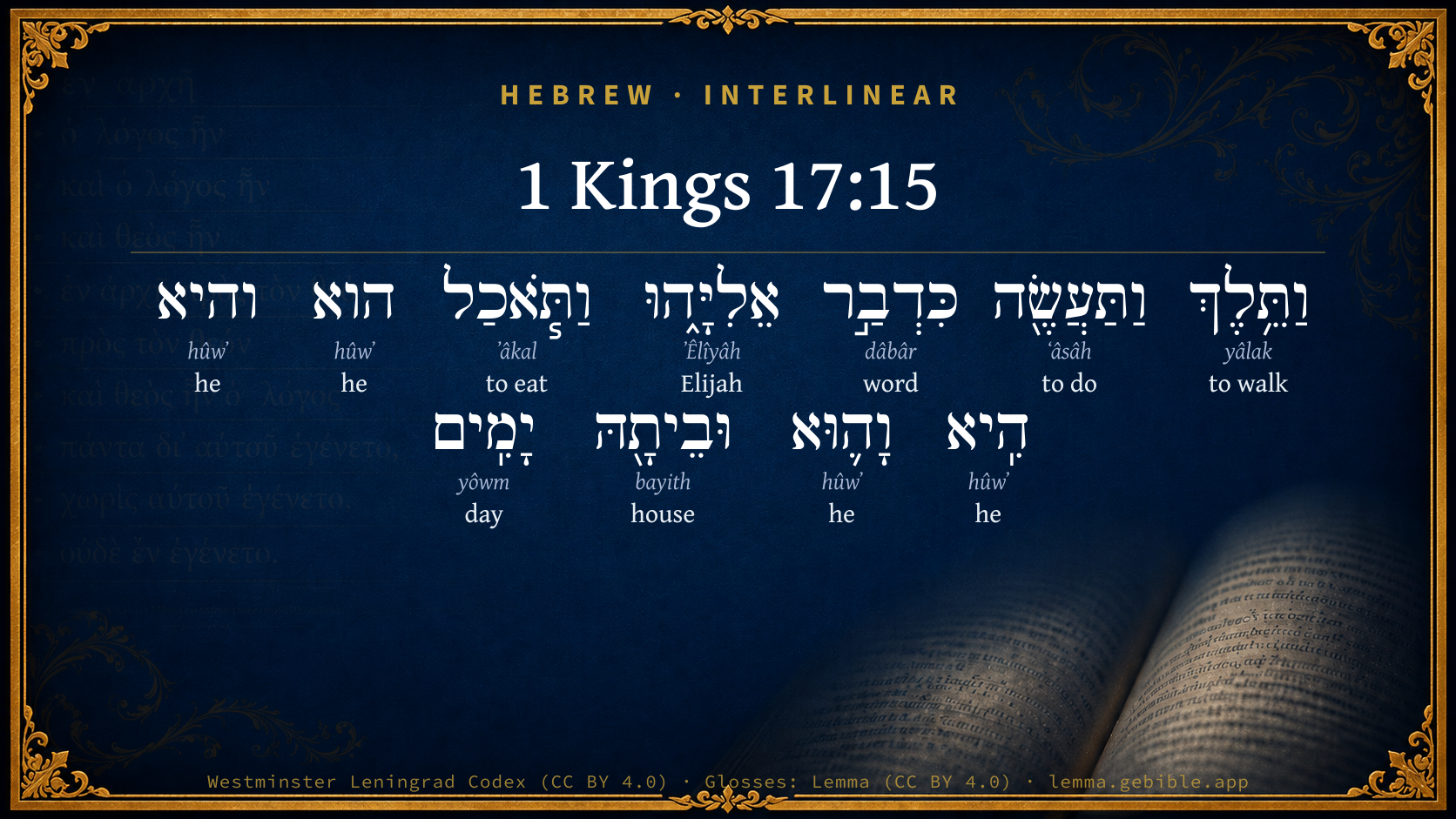
Hebrew (Westminster Leningrad Codex) 1 Kings 17:15 appears in the Hebrew Old Testament. The text above is from the Westminster Leningrad Codex. Each word links to its Strong’s number, a concise gloss, and parsing drawn from the Open Scriptures Hebrew Bible morphology. Click any word for its full Brown-Driver-Briggs (BDB) entry.
Download image
Cite this verse

1 Kings 17:15 (World English Bible). Public Domain. Lemma interlinear Bible study tool, https://lemma.gebible.app/v/1-kings/17/15.

Show BibTeX & RIS
BibTeX
RIS
English Translation
She went and did according to the saying of Elijah: and she, and he, and her house, ate [many] days.
World English Bible · Public Domain
Download a study sheet

One document with this verse’s original text, its word-by-word gloss line, the meaning frame, cross-references with their text, attributed commentary, and full source and license credits — printable, and it pastes into notes with its structure intact.

This verse Autodidact and up

Study sheet (.html) Plain text (.txt)

A passage Seminary Student

Up to 50 verses in one chapter. A passage sheet keeps up to 6 commentary sources and 12 cross-references per verse, in the order this page ranks them, and says so on the sheet whenever that leaves anything out. Ask for a single verse and you get the Autodidact verse sheet above.

Everything on this page stays free to read, with no account — the sheet is a download of what is already on screen, not access to it.

Want to remove ads? Support Godless Engineer
Compare translations 3

The same verse in 3 English versions, stacked beneath the original-language interlinear above. Click any original word for its lexicon entry.

Each is an independent rendering of the whole verse — the interlinear is not word-aligned to these translations.

Highlighted words mark where these versions differ — a whole-verse word diff, not a word-by-word alignment.

  • World English Bible Public Domain
    She went and did according to the saying of Elijah: and she, and he, and her house, ate [many] days.
  • King James Version Public Domain
    And she went and did according to the saying of Elijah: and she, and he, and her house, did eat many days.
  • unfoldingWord Literal Text CC BY-SA 4.0
    And she went and did according to the word of Elijah. And she ate, he and she and her house, days.

unfoldingWord Literal Text — © unfoldingWord, licensed CC BY-SA 4.0. Word-aligned USFM3 via Door43 (git.door43.org/unfoldingWord/en_ult).

Versions to compare (up to 4)

3 of 4 selected

Show all 18 translations

Every available English version of this verse, each an independent rendering of the whole verse.

  • World English Bible Public Domain
    She went and did according to the saying of Elijah: and she, and he, and her house, ate [many] days.
  • Berean Standard Bible Public Domain
    So she went and did according to the word of Elijah, and there was food every day for Elijah and the woman and her household.
  • Majority Standard Bible Public Domain
    So she went and did according to the word of Elijah, and there was food every day for Elijah and the woman and her household.
  • King James Version Public Domain
    And she went and did according to the saying of Elijah: and she, and he, and her house, did eat many days.
  • American Standard Version (1901) Public Domain
    And she went and did according to the saying of Elijah: and she, and he, and her house, did eat `many' days.
  • Revised Version (1885) Public Domain
    And she went and did according to the saying of Elijah: and she, and he, and her house, did eat many days.
  • Geneva Bible (1599) Public Domain
    So she went, and did as Eliiah sayd, and she did eate: so did he and her house for a certaine time.
  • Douay-Rheims (1899) Public Domain
    She went and did according to the word of Elias: and he ate, and she, and her house: and from that day
  • Young's Literal Translation Public Domain
    And she goeth, and doth according to the word of Elijah, and she eateth, she and he, and her household -- days;
  • Literal Standard Version CC BY-SA 4.0
    And she goes, and does according to the word of Elijah, and she eats, she and he and her household [for many] days;
  • Unlocked Literal Bible CC BY-SA 4.0
    So she did as Elijah had told her. She and Elijah, along with her household, ate for many days.
  • unfoldingWord Literal Text CC BY-SA 4.0
    And she went and did according to the word of Elijah. And she ate, he and she and her house, days.
  • Darby Bible Public Domain
    And she went and did according to the word of Elijah; and she, and he, and her house, ate a whole year.
  • World Messianic Bible Public Domain
    She went and did according to the saying of Elijah; and she, he, and her household ate many days.
  • Webster's Bible Public Domain
    And she went and did according to the saying of Elijah: and she, and he, and her house, did eat many days.
  • Free Bible Version CC BY-SA 4.0
    She went and did as Elijah had told her, and Elijah, the widow, and her household were able to eat for many days.
  • Bible in Basic English Public Domain
    So she went and did as Elijah said; and she and he and her family had food for a long time.
  • JPS Tanakh (1917) Public Domain
    And she went and did according to the saying of Elijah; and she, and he, and her house, did eat many days.

Literal Standard Version (2020), Covenant Press — licensed CC BY-SA 4.0. Text via the HelloAO Bible API (eBible.org). Unlocked Literal Bible (unfoldingWord) — licensed CC BY-SA 4.0. Text via the HelloAO Bible API (eBible.org). unfoldingWord Literal Text — © unfoldingWord, licensed CC BY-SA 4.0. Word-aligned USFM3 via Door43 (git.door43.org/unfoldingWord/en_ult). Free Bible Version, Dr. Jonathan Gallagher — licensed CC BY-SA 4.0. Text via the HelloAO Bible API (eBible.org).

Word by word

More ways to search: Search by grammar → Find every occurrence → Compare this word →

Practice this passage: Drill this verse → Learn its vocabulary →

אֵלִיָּ֑הוּ
ʼÊlîyâh
H452
“Elijah”
Noun, Proper
Part of Speech
Noun
Type
Proper
Full BDB Definition

Origin: from H410 and H3050

TWOT: None

Elijah or Eliah = "my God is Jehovah" or " Yah(u) is God" - the great prophet of the reign of Ahab - Benjamite son of Jeroham - a son of Elam with foreign wife during exile - a son of Harim, and priest, with foreign wife during exile
  1. וַתֵּ֥לֶךְ yâlak H3212 “and · to walk” Conjunction + Verb, Qal, Sequential Imperfect, 3rd Person, Feminine, Singular
  2. וַתַּעֲשֶׂ֖ה ʻâsâh H6213 “and · to do” Conjunction + Verb, Qal, Sequential Imperfect, 3rd Person, Feminine, Singular
  3. כִּדְבַ֣ר dâbâr H1697 “like/as · word of” Preposition + Noun, Common, Masculine, Singular, Construct
  4. וַתֹּ֧אכַל ʼâkal H398 “and · to eat” Conjunction + Verb, Qal, Sequential Imperfect, 3rd Person, Feminine, Singular
  5. הוא hûwʼ H1931 “he” Pronoun, Personal, 3rd Person, Masculine, Singular
  6. והיא hûwʼ H1931 “and · he” Conjunction + Pronoun, Personal, 3rd Person, Feminine, Singular
  7. הִֽיא hûwʼ H1931 “he” Pronoun, Personal, 3rd Person, Feminine, Singular
  8. וָה֛וּא hûwʼ H1931 “and · he” Conjunction + Pronoun, Personal, 3rd Person, Masculine, Singular
  9. וּבֵיתָ֖הּ bayith H1004 “and · house · her” Conjunction + Noun, Common, Masculine, Singular, Construct + Suffix, Personal, 3rd Person, Feminine, Singular
  10. יָמִֽים yôwm H3117 “days” Noun, Common, Masculine, Plural, Absolute

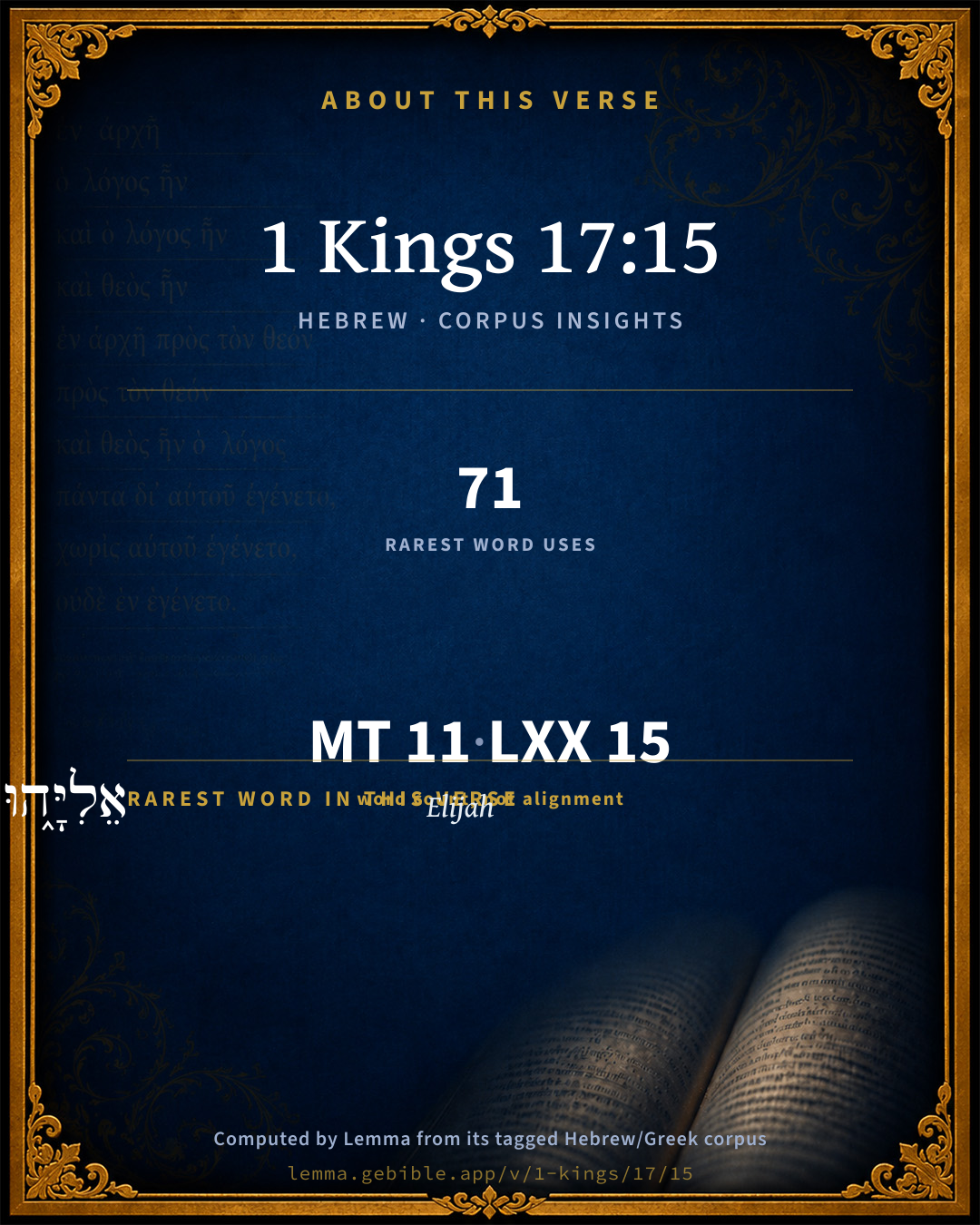
About this verse

These counts appear in no published source. They are computed here, from the morphology-tagged text and Lemma’s own curated glosses. What Lemma adds →

11
words
8
distinct lemmas
Historical
section

Grammatical profile

  • 3 verbs
  • 4 nouns
  • 4 pronouns

Verb forms

  • וַתֵּ֥לֶךְ Qal · Sequential Imperfect
  • וַתַּעֲשֶׂ֖ה Qal · Sequential Imperfect
  • וַתֹּ֧אכַל Qal · Sequential Imperfect

Repetition

A word recurs within this verse — often emphatic in Hebrew:

Hebrew & Septuagint length

In English translation the verse runs 20 words from the Hebrew and 16 from the Septuagint (LXX English) — closely comparable.

A rough comparison of the two English renderings, which tokenize alike — not a word-level alignment.

Word counts can differ between the Hebrew and the Greek without any difference in meaning — e.g. the Hebrew direct-object marker אֵת has no separate Greek word, and Greek often adds the article ὁ.

In the original languages it is 11 Hebrew tokens and 15 Greek tokens — but the two are counted differently (Hebrew bundles its prefixes and suffixes into one token; the Greek is in lemma form), so that isn’t a like-for-like length.

Cross-references

9

Topical passages linked to 1 Kings 17:15 in the Treasury of Scripture Knowledge — connected by theme and wording, ordered by reader-vote popularity; previews shown in the World English Bible.

  • Genesis 6:22 Thus Noah did. According to all that God commanded him, so he did.
  • Matthew 15:28 Then Jesus answered her, "Woman, great is your faith! Be it done to you even as you desire." And her daughter was healed from that hour.
  • Mark 12:43 He called his disciples to himself, and said to them, "Most assuredly I tell you, this poor widow gave more than all those who are giving into the treasury,
  • Hebrews 11:17 By faith, Abraham, being tested, offered up Isaac. Yes, he who had gladly received the promises was offering up his one and only son;
  • Genesis 22:3 Abraham rose early in the morning, and saddled his donkey, and took two of his young men with him, and Isaac his son. He split the wood for the burnt offering, and rose up, and went to the place of which God had told him.
  • 2 Chronicles 20:20 They rose early in the morning, and went forth into the wilderness of Tekoa: and as they went forth, Jehoshaphat stood and said, Hear me, Judah, and you inhabitants of Jerusalem: believe in Yahweh your God, so shall you be established; believe his prophets, so shall you prosper.
  • John 11:40 Jesus said to her, "Didn't I tell you that if you believed, you would see God's glory?"
  • Romans 4:19–20 Without being weakened in faith, he didn't consider his own body, already having been worn out, (he being about a hundred years old), and the deadness of Sarah's womb.
  • Hebrews 11:7–8 By faith, Noah, being warned about things not yet seen, moved with godly fear, prepared an ark for the saving of his house, through which he condemned the world, and became heir of the righteousness which is according to faith.

Cross-references courtesy of OpenBible.info (CC BY 4.0).

Hebrew and Greek witnesses Masoretic Hebrew ↔ Greek Septuagint

The same verse in the two great witnesses to the Old Testament, shown verse-for-verse.

These are two independent witnesses, not word-aligned to each other, and the Septuagint is shown in lemma (dictionary) form.

Hebrew 1 Kings 17:15 Masoretic · Westminster Leningrad Codex

וַתֵּ֥לֶךְ וַתַּעֲשֶׂ֖ה כִּדְבַ֣ר אֵלִיָּ֑הוּ וַתֹּ֧אכַל הוא והיא הִֽיא וָה֛וּא וּבֵיתָ֖הּ יָמִֽים

She went and did according to the saying of Elijah: and she, and he, and her house, ate [many] days.

World English Bible · Public Domain

Greek LXX 1 Kings 17:15 Septuagint · lemma form

καί πορεύομαι ὁ γυνή καί ποιέω καί ἐσθίω αὐτός καί αὐτός καί ὁ τέκνον αὐτός

And the woman went and did so, and did eat, she, and he, and her children.

LXX2012 (modern English Septuagint) · Public Domain

Hebrew: Westminster Leningrad Codex (CC BY 4.0). Greek: Septuagint (public domain); English from LXX2012 (modern English Septuagint) (Public Domain). How the Septuagint differs from the Hebrew →

Targum (Aramaic paraphrase)

1

The Targum is the ancient Jewish Aramaic paraphrase of the Hebrew Scriptures — an interpretive translation, not the Hebrew text itself. Onkelos (literal) and Pseudo-Jonathan (expansive) render the Torah, and Jonathan the Prophets. Coverage is partial: where no permissively-licensed English translation exists for a verse, only the Aramaic is shown. This is verse-level text, not a word-by-word alignment to the Hebrew.

  1. Targum Jonathan Prophets (Joshua–Malachi)
    וַאֲזָלַת וַעֲבָדַת כְּפִתְגָמָא דְאֵלִיָהוּ וַאֲכַלַת הִיא וְהוּא וֶאֱנַשׁ בֵּיתָא יוֹמִין:

    (no public-domain English translation for this verse)

    Targum Jonathan — Aramaic: “Mikraot Gedolot” (public domain). English: “Sefaria Community Translation” (CC0 1.0 (public-domain dedication)); “London "Chaldee Paraphrase," 1871” (public domain). Text via Sefaria.

Commentary

Notes on 1 Kings 17:15 from classic Christian and Jewish commentators (each source and its license shown beneath its notes). The classic Christian expositions comment on the surrounding passage and are grouped to its opening verse, so a note may address several verses; the Jewish commentaries on the Tanakh (Rashi and others) are per-verse, so they appear only where the commentator wrote on this verse.

Lemma curates 59 commentaries, every one of them public domain or Creative Commons licensed, each selected and text-cleaned for this edition rather than reprinted as found. About our sources →

Trapp's Complete Commentary

John Trapp

1Ki 17:15 And she went and did according to the saying of Elijah: and she, and he, and her house, did eat [many] days.

Ver. 15. And her house.] Which till now we read not of, more than of a son only. See on 1Ki 17:12.

Many days,] viz., Till the Lord gave rain, and the earth returned to its former fertility. When means may be had and used, miracles are not to be expected.

John Trapp, A Commentary or Exposition upon All the Books of the Old and New Testament (1647–1656) — public domain. Text from a community e-Sword module.

The Biblical Illustrator

Joseph S. Exell

1Ki_17:15

She went and did according to the saying of Elijah.

Modern liberality, and the widow of Zarephath

I. The treatment he received was verily the manifestation of the womans mind towards god himself. Were it otherwise, it would be hard to point out anything in which we could be pronounced as doing it for, or contrary to the will of Almighty God. He has Himself, however, placed this matter beyond all dispute, for He has said, He that giveth to the poor leadeth to the Lord; and Christ represents the judgment scene in telling you that He will welcome His people with the assurance, Inasmuch as ye did a deed of charity unto one of these My brethren, ye did it unto Me.

II. This gift is to be no act of necessity, but one of pure oblation To grudge while you give, or to give because the necessity of fashion, or custom, or demand is laid upon you, is to spoil the gift altogether. That is but half a gift which is not brought freely home. It is one thing to give of our substance in obedience to a reiterated request; it is another thing to bring it unto God freely and with delight.

III. Observe what it is which God demands? Satan, the world, or vanities, let these obtain your service, and you are speedily enhanced in their thraldom, and all is sure to be at length drawn into and swallowed in their insatiable vortex. You cannot, even if you would try deliberately to make the compromise, arrange for the bestowment of a certain portion of your means, or time or thought, upon unhallowed pursuits. All absorbing is the power of sin. The energies of body and mind insensibly flow into its channel, and the votary becomes the slave, and ultimately the ruined victim. But what is His demand of you, whose service is perfect freedom? Not so much as He has a right to demand; far less than many, moved by His grace, are willing to bestow. Sin, which absorbs all if it can, is but a robber at the best, for it can lay claim to no sort of right whatever, while God, who has a right to all, demands but little. What I do here claim, however, is, that though the requirements of God be comparatively small, they are, nevertheless, universal.

IV. No act for God is performed without his favour, and the blessing of the Lord it maketh rich, and He addeth no sorrow with it. (G. Venables.)

The Biblical Illustrator, edited by Joseph S. Exell (c. 1880s–1900s) — public domain. Text from a community e-Sword module.

Joseph Benson's Commentary

1Ki 17:15. She did according to the saying of Elijah — Giving glory to the God of Israel, by believing his prophet. O woman, great was thy faith! One has not found the like, no not in Israel. All things considered, it exceeded that of the widow, who, when she had but two mites, cast them into the treasury. She took the prophet’s word that she should not lose by it, but it should be repaid with interest. “Those that can venture upon the promise of God,” says Henry, “will make no difficulty of exposing and emptying themselves in his service, and giving him his dues out of a little, and giving him his part first. They that deal with God, must deal on trust; seek first the kingdom of God, and then other things shall be added. Surely,” adds he, “the increase of this widow’s faith to such a degree as to enable her thus to deny herself, and to depend upon the divine promise, was as great a miracle in the kingdom of grace, as the increase of her oil was in the kingdom of providence. Happy they that can thus, against hope, believe and obey in hope.” She and her house did eat many days — A long time, even above two years before the following event about her son happened, and the rest of the time of the famine. See how the reward answered the service! She generously made one cake for the prophet, and was repaid with many for herself and son! What is laid out in charity, is set out to the best interest, upon the best security. One poor meal’s meat this poor widow gave the prophet, and in recompense of it she and her son did eat many days, and probably some of her kindred too, here included in the term her house, an expression which would hardly have been used of her one son.

Joseph Benson's Commentary on the Old and New Testaments (1811–1818) — public domain. Text from a community e-Sword module.

Tyndale Open Study Notes

Tyndale Open Resources

17:15-16 She did as Elijah said, and God rewarded her act of faith. The fresh supply of the widow’s daily necessities reminded her of God’s faithfulness and goodness (Lam 3:22-24; Phil 4:19).

Tyndale Open Study Notes — © Tyndale Open Resources, licensed CC BY-SA 4.0. Text via the HelloAO Bible API.

Geneva Bible (1599)

Geneva Bible translators

That is, till he had rain and food on the earth.

Geneva Bible (1599) marginal notes — public domain. Text via Bolls.life.

Ellicott's Commentary for English Readers

(15) The barrel of meal wasted not.—The miracle is doubly remarkable. First, in this instance, as in the similar miracles of Elisha and of our Lord Himself, we see that God’s higher laws of miracle, like the ordinary laws of His providence, admit within their scope the supply of what we should consider as homely and trivial needs—in this respect perhaps contradicting what our expectation would have suggested. Next, that it is a miracle of multiplication, which is virtual creation—not necessarily out of nothing—doing rapidly and directly what, under ordinary laws, has to be done slowly and by indirect process.

A Bible Commentary for English Readers, edited by Charles John Ellicott (1878–1897) — public domain. Text from a community e-Sword module.

The Cambridge Bible for Schools and Colleges

gen. ed. J. J. S. Perowne

15. her house] She had enough for all their own needs and something over, which she could give to poorer relations. The whole history of the woman shews that she knew much of the religion of the God of Israel, though we are not told how she had been brought to the knowledge.

many days] There is no word for ‘many’ as the italics shew. The Hebrews used ‘days’ for a long time. Thus the same word is rendered in Gen_40:4 ‘a season;’ in Num_9:22 ‘a year,’ i.e. the complete round of days. The margin of A.V. has ‘a full year’ in the present verse.

The Cambridge Bible for Schools and Colleges (gen. ed. J. J. S. Perowne; Cambridge University Press, 1878–1918) — public domain. Text from a community e-Sword module.

John Gill's Exposition

And she went, and did according to the saying of Elijah,..... Made a cake for him first, and brought it to him, which showed great faith in the word of the Lord by him:

and she, and he, and her house, did eat; many days, a year at least, if not two years, see Kg1 17:7 the widow, the prophet, and her family, lived upon the meal and oil so long; we read but of one son, but she might have more.

John Gill's Exposition of the Whole Bible (1746–1763) — public domain (CC PDM 1.0). Text via the HelloAO Bible API.

Matthew Poole's English Annotations

She did according to the saying of Elijah; giving glory to the God of Israel, by believing his prophet.

Many days, i.e. a long time, even above two years: see 1Ki 18:1. Heb. days, i.e. a full year; as 1Ki 17:7; namely, before the following event about her son happened, and the rest of the time of the famine after it.

Matthew Poole's English Annotations on the Holy Bible (1683–1685) — public domain. Text from a community e-Sword/MySword module.

Whedon's Commentary on the Bible

Daniel D. Whedon

15. She went and did according to the saying of Elijah — “It was one of those sudden recognitions of unknown kindred souls — one of those cross purposes of Providence — which come in with a peculiar charm to checker the commonplace course of ecclesiastical history. The Phenician mother knew not what great destinies lay in the hand of that gaunt figure at the city gate, worn with travel, and famine, and drought. But she listened to his cry, and saved in him the deliverer of herself and her son. It may be that this incident is the basis of the sacred blessing of the Prophet of prophets on those who, even by a cup of cold water, receiving a prophet in the name of a prophet, shall receive a prophet’s reward.” — Stanley.

And her house — There were others, then, in that household besides herself and son.

Daniel D. Whedon (gen. ed.), Commentary on the Old and New Testaments (1874–1909) — public domain. Text from a community e-Sword module.

The Pulpit Commentary

And she went and did according to the saying of Elijah the echo of ver. 13, "Go and do according to thy saying": and she, and he, or he and she, according to Chethib and her house probably her friends or poor relatives who came to partake of her plenty (Bahr), did eat many days. Heb. days, i.e., an indefinite period. See note on ver. 7. The word does not refer to the first baking (ver. 13), but it is to be explained by the next verse.

The Pulpit Commentary (1880–1919), ed. H.D.M. Spence-Jones & Joseph S. Exell — public domain. Text from a community e-Sword module.

John Wesley's Explanatory Notes

Many days - A long time, even above two years, before the following event about her son happened. And surely the increase of her faith to such a degree, as to enable her thus to deny herself and trust the promise, was as great a miracle in the kingdom of grace, as the increase of her oil in the kingdom of providence. Happy are they who can thus against hope believe and obey in hope.

John Wesley, Explanatory Notes Upon the Whole Bible (1754–1765) — public domain. Text via the GEBible commentary corpus.

Lesson kit

Teaching starters — assembled from the data on this page, not authored interpretation. Every prompt links to the verse data it draws on. Edit before teaching.

1 Kings, in the Historical, opens this verse with 11 words (8 distinct Hebrew lemmas). Its most distinctive word is ʼÊlîyâh (“Elijah”). A historical commentator’s framing appears above. Read the whole chapter for the surrounding context.

Discussion questions

  1. The word ʼÊlîyâh carries the sense “Elijah.” How does it shape the verse?
  2. How does Genesis 6:22, which shares this passage’s theme, read alongside this verse?
  3. What does the repetition of “he” (4× in this one verse) do in this verse?
  4. These translations render this verse differently. What is at stake in choosing one wording over another?
  5. «וַתֵּ֥לֶךְ» is a Qal Sequential Imperfect verb. How does that grammatical form shape the action described?
  6. Compare how Trapp's Complete Commentary and The Biblical Illustrator read this verse. Where do they agree or differ?

Things to notice

Reading settings

Reading text

Shown beneath each verse's original-language words.

Old Testament
Old Testament edition

Read the OT as the Masoretic Hebrew (MT) or the Greek Septuagint (LXX).

English shown for the Greek Septuagint (in the Hebrew ↔ Greek comparison).

Comparing translations? Open the Compare panel on any verse page to stack up to four side by side.