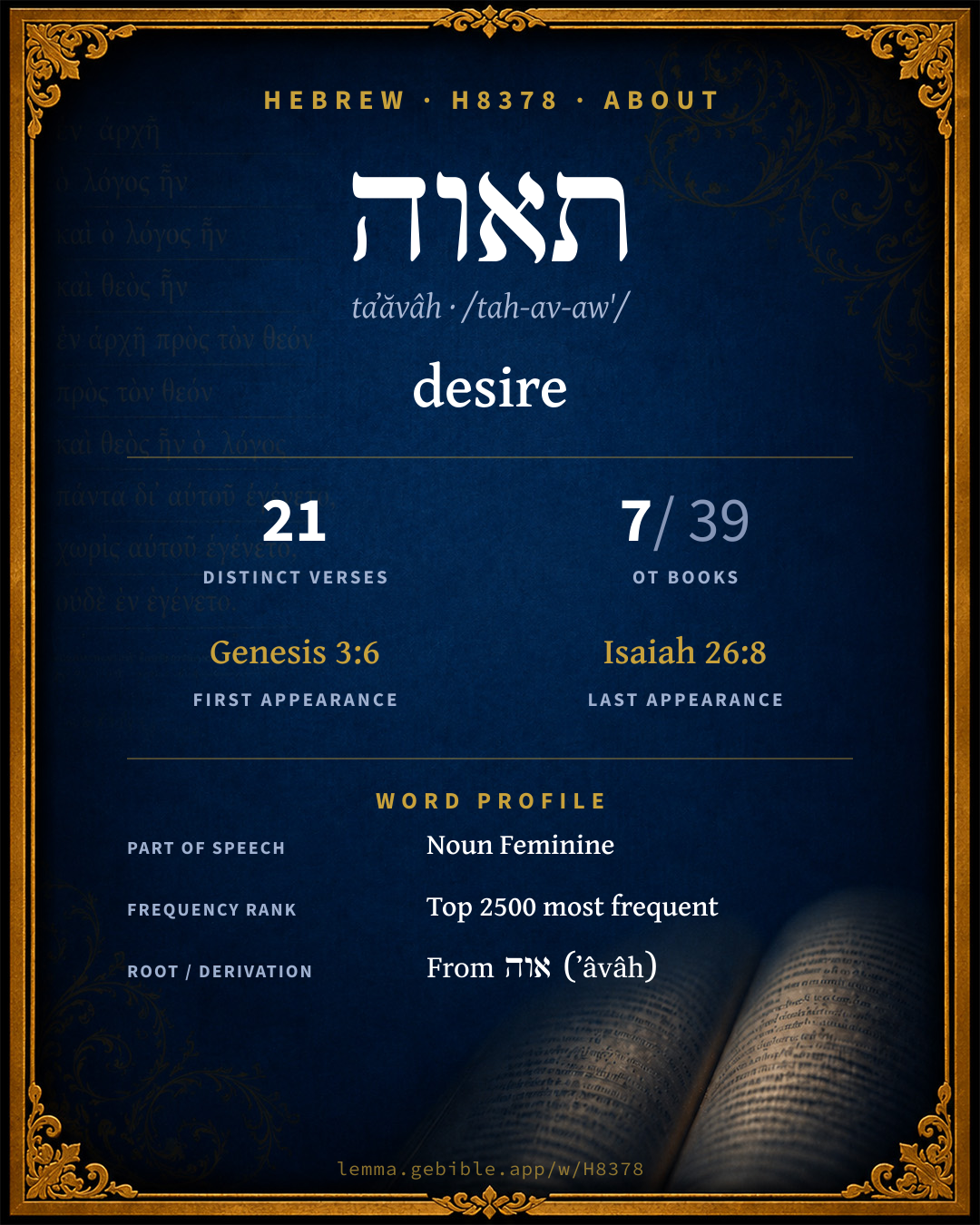
תַּאֲוָה
desire
‘desire’ is one of 3 main senses fuller range ↓
Full lexicon entry — Brown-Driver-Briggs (BDB)
From Brown-Driver-Briggs (BDB)
Where this word appears
See every Construct-state word in the Hebrew Bible →
Grammar key — what these labels mean
Part of speech
- Noun
- A naming word — a person, place, thing, or idea.
- Verb
- An action or state-of-being word.
Noun type
- Common
- A common noun — a general class of person, place, or thing (“king,” “city,” “water”), not a specific name.
Stem
- Piel
- An intensive or resultative active stem.
Form
- Imperfect
- An incomplete, ongoing, or future action (“he will / would write”).
State
- Construct
- A noun bound to a following noun in a possessive / “of” relationship (the construct chain).
- Absolute
- The independent form of a noun, not bound to a following word.
Person
- 3rd Person
- The one spoken about (“he / she / it / they”).
Gender
- Feminine
- Grammatically feminine.
Number
- Singular
- One.
12 distinct verses where H8378 appears in the Construct state, across 3 books. Filtered view — show all forms. Click any verse to open its interlinear word-by-word view. Verse text shown in the World English Bible for context — . Each verse’s Hebrew form is shown with its reference; the English is not keyword-highlighted, since the data carries no word-level English alignment. Use “Compare translations” on any verse to read it across multiple English versions. This concordance covers the Hebrew Bible; Septuagint (Greek Old Testament) occurrences are not indexed here.
Psalms 7 verses
- Psalms 10:3 תַּאֲוַ֣ת n c fs cs For the wicked boasts of his heart's cravings, He blesses the greedy, and condemns Yahweh.
- Psalms 10:17 תַּאֲוַ֬ת n c fs cs Yahweh, you have heard the desire of the humble. You will prepare their heart. You will cause your ear to hear,
- Psalms 21:2 תַּאֲוַ֣ת n c fs cs You have given him his heart's desire, And have not withheld the request of his lips. Selah.
- Psalms 38:9 תַּאֲוָתִ֑/י n c fs cs + sfx pers 1cs Lord, all my desire is before you. My groaning is not hidden from you.
- Psalms 78:29 וְ֝/תַֽאֲוָתָ֗/ם conj + n c fs cs + sfx pers 3mp So they ate, and were well filled. He gave them their own desire.
- Psalms 78:30 מִ/תַּאֲוָתָ֑/ם prep + n c fs cs + sfx pers 3mp They didn't turn from their cravings. Their food was yet in their mouths,
- Psalms 112:10 תַּאֲוַ֖ת n c fs cs The wicked will see it, and be grieved. He shall gnash with his teeth, and melt away. The desire of the wicked will perish.
Proverbs 4 verses
- Proverbs 10:24 וְ/תַאֲוַ֖ת conj + n c fs cs What the wicked fear, will overtake them, But the desire of the righteous will be granted.
- Proverbs 11:23 תַּאֲוַ֣ת n c fs cs The desire of the righteous is only good. The expectation of the wicked is wrath.
- Proverbs 19:22 תַּאֲוַ֣ת n c fs cs That which makes a man to be desired is his kindness. A poor man is better than a liar.
- Proverbs 21:25 תַּאֲוַ֣ת n c fs cs The desire of the sluggard kills him, For his hands refuse to labor.
Isaiah 1 verse
About this entry
At a glance — auto-summarized from this page’s data, not written by a person. Every figure links to its source below. This summary describes the numbers; it doesn’t interpret them.
The Hebrew noun תאוה centers on the idea of “desire.” First canonically at Genesis 3:6, it enters the text early. It turns up in 21 verses across 7 books, an uncommon footprint. The word gravitates to Psalms (38%), then Proverbs and Genesis. Its meaning spans more than one sense — see its full sense range. For the data behind this summary, explore the sense tree and the renderings breakdown below.
Gloss history
Strong's 1890 vs modern scholarship

About this word
Strong's H8378 catalogs a Hebrew word from the Hebrew Old Testament.
These counts are not copied from any lexicon or concordance. They are computed here, from the morphology-tagged Hebrew Old Testament. What Lemma adds →
- 21
- distinct verses
- The word appears in 21 distinct verses.
- 7 / 39
- OT books
- The word appears in 7 of 39 Old Testament books.
- #1,462
- by frequency
- Top 2500 most frequent Hebrew words (rank 1,462 of 8,640 Hebrew words by occurrence).
View all 21 occurrences in the concordance →
By section of the Old Testament
By traditional corpus
Conventional, traditional groupings — biblical authorship is debated, so this is a traditional corpus grouping, not an authorship claim. Each share is this word’s portion of its verses in that division of the Hebrew canon. Each figure is a share of the word’s 21 distinct verses.
- Writings (Ketuvim) 17 verses · 81%
- Torah (Pentateuch) 2 verses · 10%
- Prophets (Nevi'im) 2 verses · 10%
How translations render this word
Counts come from each version’s own published word-to-Strong’s tagging or interlinear alignment — an approximate guide to how each version renders this word, not a word-level alignment the data otherwise carries. Because each total is that version’s own tagged count, the per-version totals vary from one another and need not match the appearance or distinct-verse counts above. These counts may also differ from a printed concordance because Lemma counts each distinctly tagged rendering and does not collapse phrase taggings into a single head-word total. This is a fixed set of word-tagged versions (KJV, ASV, BSB, ULT) and does not change with the reading translation you choose elsewhere. Each version’s license is shown beside its name below (and on Sources).
BDB lists this Strong’s number as 2 distinct words (homographs). Each count above pools all of them and is not split by sense — see the Senses section below. A low-frequency rendering may belong to a different one of those words, not the primary meaning.
- King James Version†: Desire 10×
- American Standard Version†: Desire 6×, 's desire 2×, Own desire 2×
- Berean Standard Bible†: Desire 8×
- unfoldingWord Literal Text†: Desire 7×, Desire of 7×, Craving 3×
King James Version Public Domain
Renders H8378 across 19† tagged occurrences — most commonly:
Plus 9 renderings that appear only once — usually multi-word phrases or single function words the recovered tagging swept in, not distinct renderings. Not rendered by a distinct English word in 1 further occurrence.
American Standard Version Public Domain
Renders H8378 across 19† tagged occurrences — most commonly:
Plus 9 renderings that appear only once — usually multi-word phrases or single function words the recovered tagging swept in, not distinct renderings.
Berean Standard Bible Public Domain
Renders H8378 across 19† tagged occurrences — most commonly:
Plus 11 renderings that appear only once — usually multi-word phrases or single function words the recovered tagging swept in, not distinct renderings. Not rendered by a distinct English word in 1 further occurrence.
unfoldingWord Literal Text CC BY-SA 4.0
Renders H8378 across 22† tagged occurrences — most commonly:
Plus 5 renderings that appear only once — usually multi-word phrases or single function words the recovered tagging swept in, not distinct renderings.
Senses in the full BDB
What do BDB’s symbols mean?
BDB uses these scholarly abbreviations:
| Symbol | Meaning |
|---|---|
| 𝔊 | the Septuagint (the ancient Greek translation, LXX) |
| 𝔙 | the Vulgate (the Latin translation) |
| 𝔖 | the Syriac version (the Peshitta) |
| 𝔗 | the Targum (the Aramaic translation) |
| ψ | the Psalms |
| √ | root (the underlying root or stem) |
| ‖ | parallel passage (a synonymous or contrasted parallel) |
| † | the dagger: every passage where the word occurs is cited |
The 2 senses and sub-senses the full Brown-Driver-Briggs lexicon distinguishes for this word, in lexicon order (not ranked by frequency), with BDB’s own verbatim wording and sub-sense lettering. Shown in Hebrew script with BDB’s own scholarly abbreviations. The condensed entry is in the Lexicon Entry tab. See also the Forms in the corpus table below.
תאוה I desire
- 1. desire, wish Pr 13:12, 19; 18:1; of physical appetite, longing for dainty food מַאֲכַל ת׳ Jb 33:20; distinctly good sense ψ 10:17; 38:10 Pr 11:23, 19:22 (? cf. infr.) Is 26:8 (לְשִׁמְךָ וּלְזִכְרְךָ ת׳־נָ֑פֶשׁ); bad sense, lust, appetite, covetousness ψ 10:3 (ת׳ נַפְשׁוֹ) 112:10; Pr 21:25, 26 (as acc. cogn.); particularly of longing for dainties of Egypt Nu 11:4 ψ 106:14 (both acc. cogn.) 78:30 & in n.pr. given to place where it occurred קִבְרוֹת הַתַּאֲוָה (q.v.) Nu 11:34, 35; 33:16, 17 Dt 9:22. e.g. Proverbs 13:12
- 2. thing desired, in good sense Pr 10:24 so ת׳ לִבּוֹ ψ 21:3; bad sense ψ 78:29; thing desirable (to senses) Gn 3:6 (ת׳ לְעֵינַיִם); perhaps also Pr 19:22 the ornament of a man is his kindness (Ra Ki, etc. but cf. supr.)* e.g. Proverbs 10:24
תאוה II boundary (as described by a mark?)
Senses from the full Brown-Driver-Briggs lexicon (Brown, Driver, Briggs; Oxford 1906 — public domain), digitized via Sefaria, supplemented by the OpenScriptures HebrewLexicon (CC BY 4.0). Full attribution on Sources.
Word origin
I. n.f. desire—abs. Gn 3:6 +; cstr. תַּאֲוַת ψ 10:3 + etc.;—
III. n.f. boundary (as described by a mark?);—cstr. תַּאֲוַת גִּבְעֹת עוֹלָם Gn 49:26 (this meaning AV RV Ew§ 186b [√ תָּאָה] De Gn √ אוה, תאה, תוה), but desire = desirable things, so most.
— Brown-Driver-Briggs (Oxford 1906, public domain), digitized via Sefaria, supplemented by the OpenScriptures HebrewLexicon (CC BY 4.0). See Sources.
Derived from אוה (ʼâvâh) (H183) — to desire.
Jastrow Dictionary
A second Hebrew/Aramaic lexicon for comparison, covering Aramaic and post-biblical (Talmudic, Targumic, Midrashic) usage that the biblical-Hebrew BDB does not. Matched by lemma rather than by Strong’s number, so a lemma may carry more than one Jastrow headword (shown separately below), and the entries cover usage well beyond the Bible.
תַּאֲוָה
- , v. אָוָה I) desire, appetite. Midr. Till. to Ps. CXX עושה תַאֲוַת נפשו לשעה he satisfies the lust of his soul for the moment; עושה תַאֲוָתוֹ לשעה. Erub. 54ᵃ (ref. to Ps. XXI, 3) זכה תאות לבו וכ׳ if he is worthy, thou grantest him the desire of his heart (without prayer), if he is not worthy, thou refusest him not the prayer of his lips. Sot. 47ᵃ תאותו מיהא וכ׳ his desire at least was to curse. Pirké d’R. El. ch. XXXVII לא עלתה בידו תאותו he did not succeed in doing what he had desired to do. Tosef. Ber. V, 1; Y. Pes. X, beg. 37ᵇ בת׳ with an appetite for food, v. תָּאֵב; [Bab. ib. 99ᵇ כשהוא ת׳, v. תָּאַב]; Y. Succ. II, 53ᵃ bot.; a. fr.—בשר ת׳, v. בָּשָׂר.—Esp. sexual desire. Y. Meg. IV, 75ᵃ מכניס אהבה ומוציא ת׳ it (garlic) causes love to enter, and the sexual desire to come forth. Lev. R. s. 18; Koh. R. to XII, 5 (ref. to אביונה, ib.) זו הת׳ this means the sexual desire. Gen. R. s. 85 מלאך … הת׳ the angel that is appointed over marital life. Ab. IV, 21 הקנאה והת׳ וכ׳ envy, voluptuousness, and ambition take man away from this world (accelerate his death); a. fr. e.g. Psalms 21:3
A Dictionary of the Targumim, the Talmud Babli and Yerushalmi, and the Midrashic Literature (Marcus Jastrow; London, Luzac, 1903) — Public Domain. Digitized via Sefaria. Digitized via Sefaria. Full attribution on Sources.
Forms in the corpus
The 17 distinct written forms H8378 takes in the Hebrew Bible, most frequent first — each parse links to that state’s occurrences in the concordance. Hebrew forms include their vowel points and cantillation, so a single lemma takes many written forms.
Same root — word family
Other BDB entries built from the same root as H8378, grouped by Strong’s listed origin. These share a root / origin per the lexicon — not necessarily a shared meaning. Each links to that word’s own entry.
Derives from
Shares the same root
- אוה ʼavvâh H185 desire
- אוי ʼôwy H188 woe
- אי ʼîy H339 island
- הוא hâvâʼ H1933 to be
- מאוי maʼăvay H3970 desire
Proper names from this root
People and places named from this root — a name, not an additional meaning of the word.
Compare all same-root words → Showing 4 of 8 — not the complete family. 1 of the same-root words is a proper name (a person or place). They share a root, not necessarily a meaning.
Septuagint verse parallels
This word appears in 17 verses that also exist in the Greek Old Testament (Septuagint), out of the 21 Hebrew verses it occurs in. You can read those verses in Greek by switching the Old Testament edition to the Septuagint.
Read these verses in the Septuagint
This is a verse-level parallel only — the same verses exist in both the Hebrew and Greek Old Testaments. No word-level Hebrew↔Greek correspondence is claimed: the data carries no such alignment, so no Greek word is shown as this Hebrew word’s translation. Coverage is not total — the Septuagint omits the deuterocanon and renumbers the Psalms, so some Hebrew verses have no direct Greek parallel.