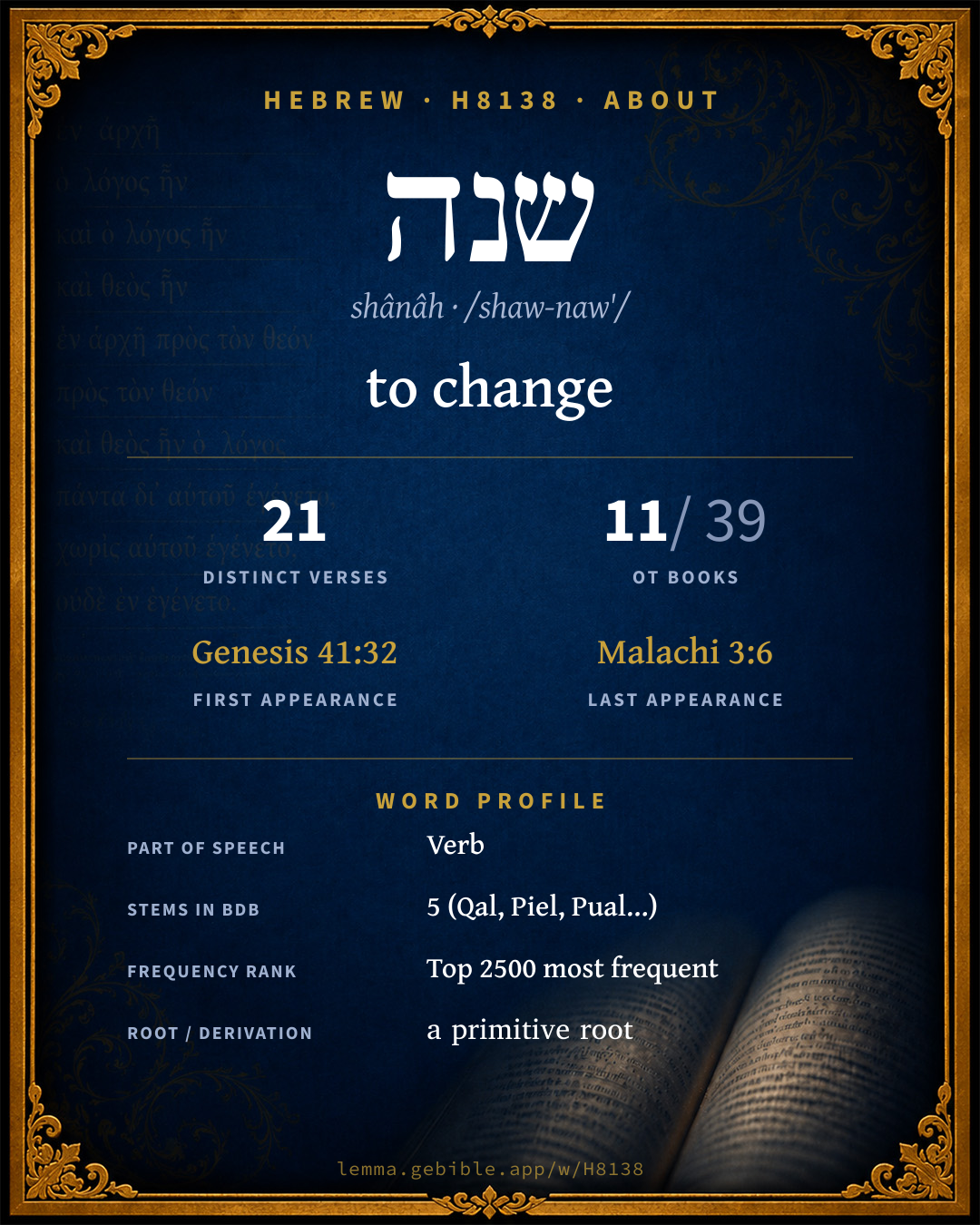
שָׁנָה
to change
‘to change’ is one of 5 main senses fuller range ↓
Full lexicon entry — Brown-Driver-Briggs (BDB)
From Brown-Driver-Briggs (BDB)
Where this word appears
See every Piel verb in the Hebrew Bible →
Grammar key — what these labels mean
Part of speech
- Verb
- An action or state-of-being word.
Stem
- Qal
- The basic, simple active stem — the plain form of the verb (“he wrote”).
- Piel
- An intensive or resultative active stem. Here: ‘transit.’
- Hithpael
- The reflexive or reciprocal stem (the subject acts on itself).
- Niphal
- Usually the simple passive or reflexive of the Qal (“he was written”).
Form
- Participle Active
- A verbal adjective expressing ongoing or characteristic action (“writing / one who writes”).
- Imperfect
- An incomplete, ongoing, or future action (“he will / would write”).
- Sequential Perfect
- A perfect with prefixed waw continuing a preceding imperfect or command (waw-consecutive perfect).
- Sequential Imperfect
- An imperfect with prefixed waw — the standard past-narrative form (waw-consecutive imperfect).
- Perfect
- A completed action or state — Hebrew marks aspect (completeness) more than strict tense (“he wrote”).
- Infinitive Construct
- A bound verbal noun, frequently with prepositions (“to write / in writing”).
- Imperative
- A direct command (“write!”).
State
- Absolute
- The independent form of a noun, not bound to a following word.
Person
- 3rd Person
- The one spoken about (“he / she / it / they”).
- 2nd Person
- The one addressed (“you”).
- 1st Person
- The speaker (“I / we”).
Gender
- Masculine
- Grammatically masculine.
- Feminine
- Grammatically feminine.
- Common
- Either gender — not distinguished for this form.
Number
- Plural
- More than one (in Hebrew, generally three or more).
- Singular
- One.
1 verse where H8138 appears in the Piel stem in the Book of 1 Samuel. Filtered view — show all forms. Click any verse to open its interlinear word-by-word view. Verse text shown in the World English Bible for context — . Each verse’s Hebrew form is shown with its reference; the English is not keyword-highlighted, since the data carries no word-level English alignment. Use “Compare translations” on any verse to read it across multiple English versions. This concordance covers the Hebrew Bible; Septuagint (Greek Old Testament) occurrences are not indexed here.
1 Samuel
About this entry
At a glance — auto-summarized from this page’s data, not written by a person. Every figure links to its source below. This summary describes the numbers; it doesn’t interpret them.
The Hebrew verb שנה centers on the idea of “to change.” As a verb its force shifts by stem, across 5 stems (Qal, Piel, and more). The Hebrew Bible uses it across 21 verses — uncommon. First canonically at Genesis 41:32, it enters the text early. Related forms include משנה, שנה and שני. For the data behind this summary, explore the sense tree and the renderings breakdown below.
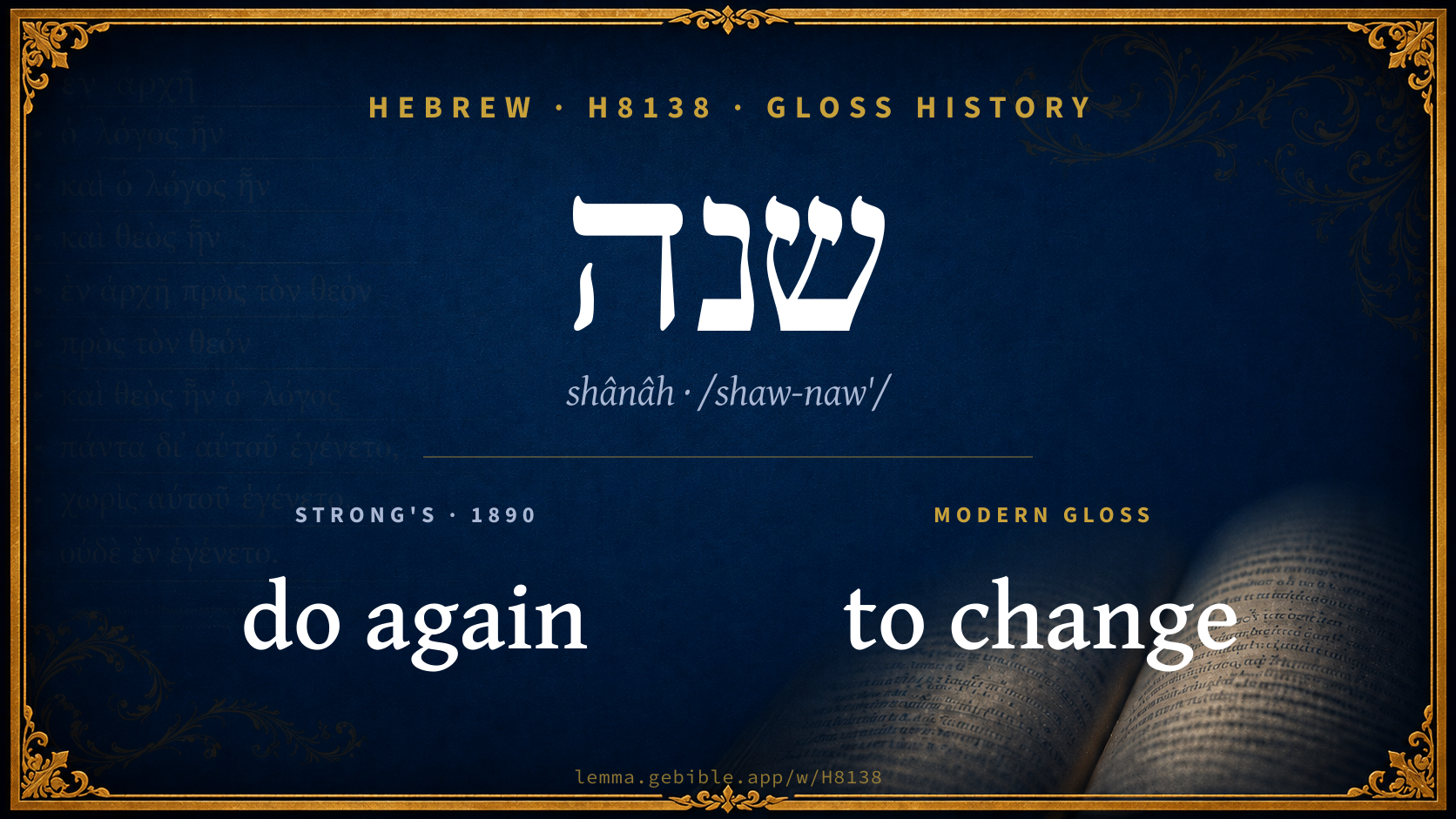
Gloss history
Strong's 1890 vs modern scholarship
About this word
Strong's H8138 catalogs a Hebrew word from the Hebrew Old Testament.
These counts are not copied from any lexicon or concordance. They are computed here, from the morphology-tagged Hebrew Old Testament. What Lemma adds →
- 21
- distinct verses
- The word appears in 21 distinct verses.
- 11 / 39
- OT books
- The word appears in 11 of 39 Old Testament books.
- #1,412
- by frequency
- Top 2500 most frequent Hebrew words (rank 1,412 of 8,640 Hebrew words by occurrence).
View all 21 occurrences in the concordance →
By section of the Old Testament
By traditional corpus
Conventional, traditional groupings — biblical authorship is debated, so this is a traditional corpus grouping, not an authorship claim. Each share is this word’s portion of its verses in that division of the Hebrew canon. Each figure is a share of the word’s 21 distinct verses.
- Writings (Ketuvim) 12 verses · 57%
- Prophets (Nevi'im) 8 verses · 38%
- Torah (Pentateuch) 1 verse · 5%
How translations render this word
Counts come from each version’s own published word-to-Strong’s tagging or interlinear alignment — an approximate guide to how each version renders this word, not a word-level alignment the data otherwise carries. Because each total is that version’s own tagged count, the per-version totals vary from one another and need not match the appearance or distinct-verse counts above. These counts may also differ from a printed concordance because Lemma counts each distinctly tagged rendering and does not collapse phrase taggings into a single head-word total. This is a fixed set of word-tagged versions (KJV, ASV, BSB, ULT) and does not change with the reading translation you choose elsewhere. Each version’s license is shown beside its name below (and on Sources).
BDB lists this Strong’s number as 3 distinct words (homographs). Each count above pools all of them and is not split by sense — see the Senses section below. A low-frequency rendering may belong to a different one of those words, not the primary meaning.
- King James Version†: He changed 2×
- American Standard Version†: Alter 1×, Are diverse 1×, Are given to change 1×
- Berean Standard Bible†: Alter 1×, Are different 1×, Change 1×
- unfoldingWord Literal Text†: Change 3×, Do again 2×, I will 2×
King James Version Public Domain
Renders H8138 across 22† tagged occurrences — most commonly:
Plus 20 renderings that appear only once — usually multi-word phrases or single function words the recovered tagging swept in, not distinct renderings.
American Standard Version Public Domain
Renders H8138 across 21† tagged occurrences — most commonly:
Plus other, less common renderings.
Berean Standard Bible Public Domain
Renders H8138 across 22† tagged occurrences — most commonly:
Plus other, less common renderings. Not rendered by a distinct English word in 1 further occurrence.
unfoldingWord Literal Text CC BY-SA 4.0
Renders H8138 across 27† tagged occurrences — most commonly:
Plus 20 renderings that appear only once — usually multi-word phrases or single function words the recovered tagging swept in, not distinct renderings.
Senses in the full BDB
Hebrew verbs can shift meaning by stem (binyan): Qal is the basic action, Niphal is often passive or reflexive, Piel often intensifies or makes it factitive, and Hiphil is typically causative. The senses below are grouped under the stem BDB assigns to each. This entry also uses Pual (the passive of Piel) and Hithpael (reflexive or reciprocal).
What do BDB’s symbols mean?
BDB uses these scholarly abbreviations:
| Symbol | Meaning |
|---|---|
| 𝔊 | the Septuagint (the ancient Greek translation, LXX) |
| 𝔙 | the Vulgate (the Latin translation) |
| 𝔖 | the Syriac version (the Peshitta) |
| 𝔗 | the Targum (the Aramaic translation) |
| ψ | the Psalms |
| √ | root (the underlying root or stem) |
| ‖ | parallel passage (a synonymous or contrasted parallel) |
| † | the dagger: every passage where the word occurs is cited |
The 6 senses and sub-senses the full Brown-Driver-Briggs lexicon distinguishes for this word, in lexicon order (not ranked by frequency), with BDB’s own verbatim wording and sub-sense lettering. Shown in Hebrew script with BDB’s own scholarly abbreviations. The condensed entry is in the Lexicon Entry tab. See also the Forms in the corpus table below.
שנה I change (NH Pi, etc.
Qal
- Pf. 1 s. לֹא שָׁנִיתִי Mal 3:6 I am י׳, I do not change; Impf. 3 ms. יִשְׁנֶא (Ges§ 77 rr) La 4:1 how is the fine gold changed (si vera l.; LöhrNow יִשָּׁנֵא; gloss on יוּעַם Bu Löhr); Inf. cstr. שְׁנוֹת יְמִין עֶלְיוֹן ψ 77:11 the right hand of the Highest is changed (𝔖 𝔙 𝔗 Aq Sym Theod Hup-Now RVm Bae Du We Buhl; AV RV Ew De Che al. years, usually ins. I will remember); Pt. שׁוֹנִים Est 1:7 differing, different, c. מִן, cf. 3:8 (so Ecclus 42:24); Pr 24:21 those who change (but dub., v. Toy). e.g. Malachi 3:6
Piel
- transit., change, alter: Pf. 3 ms. שִׁנָּה Je 52:33 c. acc. garments, = שִׁנָּא (Gesl.c.) 2 K 25:29; Impf. 3 ms. יְשַׁנֶּה דִּין Pr 31:5 lest he pervert the judgment; וַיְשַׁנּוֹ 1 S 21:14 (read וַיְשַׁן Ges§ 75bb, וַיְשַׁנֶּה We Dr (and reff.), cf. Bu HPS Now), c. acc. טַעְמוֹ (v טַעַם, and Assyrian šanê ṭêmi, madness); וַיְשַׁנֶּהָ Est 2:9, i.e. changed her place לְטוֹב בֵּית הַנָּשִׁים; 1 s. ψ 89:35 the utterance of my lips I will not change (‖ לֹא אֲחַלֵּל בְּרִיתִי); Inf. cstr. לְשַׁנּוֹת אֶת־דַּרְכֵּךְ Je 2:36 i.e. change thy political course; בְּשַׁנּוֹתוֹ אֶת־טַעְמוֹ ψ 34:1 (title; cf. 1 S 21:14 supr.); Pt. מְשַׁנֶּה פָנָיו Jb 14:20 altering his face, i.e. in death (subj. God). e.g. Jeremiah 52:33
Pual
- Impf. 3 ms. וְעֹז פָּנָיו יְשֻׁנֶּא (Ges§ 75rr) Ec 8:1, usually is changed, mollified, Siegf יִשָּׂנֵא is hated (on עֹז פ׳ v. עֹז 4, √ עזז). e.g. Ecclesiastes 8:1
Hithpael
- Pf. 2 fs. consec. קוּמִי נָא וְהִשְׁתַּנִּית 1 K 14:2 arise, pray, and disguise thyself. e.g. 1 Kings 14:2
שנה II (on appar. except v. AlbrZAW xvi (1896), 46), year (etym. v. √)
שנה III repeat, do again (NH id.
Qal
- Pf. 3 ms. שׁ׳ 2 S 20:10; Impf. 1 s. אֶשְׁנֶה 1 S 26:8, etc.; Imv. mpl. שְׁנוּ 1 K 18:34; Pt. שֹׁנֶה Pr 17:9; 26:11;—do again: וַיַּכֵּהוּ … וְלֹא שׁ׳ לוֹ 2 S 20:10, cf. 1 S 26:8; abs. 1 K 18:34(×2) Ne 13:21; = speak again Jb 29:22 + 40:5 according to many moderns (אשׁנה for MT אענה); שׁ׳ בְּדָבָר Pr 17:9 repeat with a thing, keep talking about it (שנות דבר Ecclus 42:1); 26:11 a dullard repeats with (ב) his folly, does it over agian (learns nothing by experience). e.g. 2 Samuel 20:10
Niphal
- Inf. cstr. וְעַל הִשָּׁנוֹת הַחֲלוֹם אֶל־פַּרְעֹה פַּעֲמָ֑יִם Gn 41:32 (E) concerning the dream’s being repeated, etc. e.g. Genesis 41:32
Senses from the full Brown-Driver-Briggs lexicon (Brown, Driver, Briggs; Oxford 1906 — public domain), digitized via Sefaria, supplemented by the OpenScriptures HebrewLexicon (CC BY 4.0). Full attribution on Sources.
Word origin
I. vb. change (NH Pi, etc.; Ecclus 42:24, etc.; Assyrian šanû, change, Aramaic שְׁנָא, Nab. Ethpa. Lzb379; Syriac ܫܢܳܐ, especially mentally = grow insane; cf. (prob.) NH שָׁנָה year, = Ph. שנת, שת; MI 2, 8 שת; Assyrian šattu (cf. Muss-ArnoltJBL xi (1892), 73 n.); Arabic سَنَةٌ; Aramaic שְׁנַא, שַׁתָּא, ܫܢܳܐ, ܫܰܢ݈ܬܳܐ; Old Aramaic, Nab., Palm. שנתא, שנת, שת, שנן Lzb379 f.; on year from changing seasons, v. PhilippiZMG xxxii (1878), 79 f. BaZMG xli (1887), 612, 621, 636 (especially against DHM VIme Orient. Congr. ii. 1, 452 who proposes bilit. √), cf. Thes; a daring suggestion by JenZA vii (1892), 177);—
II. n.f. (on appar. except v. AlbrZAW xvi (1896), 46), year (etym. v. √);—abs. שׁ׳ Am 2:10 +; cstr. שְׁנַת Gn 41:50 +; sf. שְׁנָתוֹ Ez 46:13 +, שְׁנָתָהּ Lv 14:10 + 2 times; du. שְׁנָתַיִם Am 1:1 +, -תָ֑יִם 1 K 15:25 +; pl. שָׁנִים Ex 21:2 +, cstr. שְׁנֵי Gn 23:1 + 24 times, שְׁנוֹת Dt 32:7 + 8 times (poet. and late); sf. שָׁנָיו Lv 25:52 + 4 times sf.; שְׁנוֹתַי Is 38:15 ψ 31:11, שְׁנוֹתָם 78:33 + 8 times sf.;—year, as division of time, Ex 23:14, 17 3 times בַּשָּׁנָה +, etc.; רֵשִׁית הַשּׁ׳ Dt 11:12, opp. אַחֲרִית הַשּׁ׳ v 12, צֵאת הַשּׁ׳ Ex 23:16, תְּקוּפַת הַשּׁ׳ 34:22 2 Ch 24:23, תְּשׁוּבַת הַשּׁ׳ 2 S 11:1 +, etc.; בָּא שָׁנָה 2 K 13:20, read כְּבֹא שׁ׳ 𝔊 Bur, בארץ שׁ׳ בְשׁ׳ Kit, cf. שׁ׳ בְשׁ׳ = year by year 1 S 1:7 +; בַּשָּׁנָה Benz, cf. Ne 10:33; so שׁ׳ שׁ׳ Dt 14:22, שׁ׳ אַחֲרֵי שׁ׳ 2 S 21:1, בְּכָל־שׁ׳ וְשׁ׳ Est 9:21, 27; especially of duration of life; (יְמֵי) שְׁנֵי חַיֵּי פ׳ Gn 23:1; 25:7 + (P); שְׁנֵיהֶם Jb 36:11 +, שְׁנוֹתַי ψ 31:11 (‖ חַיַּי), etc.; of God Jb 10:5 ψ 102:25, 28; in phr. of age, v. בֵּן 9, בַּת 9; indef. שָׁנִים Ez 38:17 = for years, לְקֵץ שׁ׳ Dn 11:6; זֶה־יָמִים אוֹ זֶה שָׁנִים 1 S 29:3; specif. בִּשְׁנַת מוֹת הַמֶּלֶךְ Is 6:1; 14:28, בִּשְׁנַת בֹּא תַּרְתָּן 20:1, שְׁנַת הַשְּׁמִטָה Dt 15:9; 31:10, שְׁנַת הַיּוֹבֵל Lv 25:13 +, etc.; שְׁנֵי שָׂכִיר Is 16:14; 21:16 (v. שָׂכִיר); שְׁנַת פְּקֻדָּתָם Je 11:23 + 2 times; שׁ׳ רָצוֹן לְי׳ Is 61:2, etc.; שְׁנוֹת דֹּר־וָדֹר Dt 32:7, cf. Jo 2:2; most often c. num. card.: pl. after units, appos., Ex 21:2 +, so also שְׁתַּיִם שָׁנִים 2 S 2:10 +, but du. שְׁנָתַיִם Am 1:1 + 4 times, שְׁנָתַיִם יָמִים Gn 41:1 + 4 times; very rarely c. num. (certainly) cstr. שְׁתֵּי שָׁנִים 1 S 13:1 (corrupt), שְׁלשׁ שׁ׳ Lv 25:21; 8 + שָׁנָה †2 K 22:1; before unit (rare, late) 2 Ch 11:17(×2); Dn 1:5; sg. after 11–19, tens, and hundreds Gn 5:3, 9; 14:4 + often; so 90 + 9 years 17:24 +, rarely 30 + 3 years 1 K 2:11, etc.; but אֶלֶפ שָׁנִים ψ 90:4 1000 years, so (+ פַּעֲמַיִם) Ec 6:6 1000 years twice over; with cp. num. often repeated, 900 year + 30 year Gn 5:5, etc.; 100 year + 70 year + 5 years 25:7, etc.; c. num. card. = ord., בִּשְׁנַת אַרְבַּע לְ 1 K 22:41 in the fourth year of, etc., also בִּשְׁנַת חֲמִשִּׁים שָׁנָה לְ 2 K 15:23, etc.; but בְּאַרְבַּע עֶשְׂרֵה שׁ׳ לְ 2 K 18:13, etc. (often), and בַּשָּׁנָה הָאַחַת עֶשְׂרֵה 1 K 6:38, etc.; also (c. units), בַּשָּׁנָה הָֽרְבִיעִת Lv 19:24 +, etc., + לְ 2 K 17:6 the ninth year of, etc.; and even (Ges§ 134 p) בִּשְׁנַת הַתְּשִׁיעִית לְ 2 K 25:1, cf. Ezr 7:8; Je 46:2; 51:59 + (Kt) 28:1; 32:1 (Qr בַּשָּׁנָה).
III. vb. repeat, do again (NH id.; Ecclus 42:1; Arabic ثَنَى bend, fold, double; Aramaic תְּנָא repeat, also teach, ܬܢܳܐ; Assyrian šanû, especially Pi. repeat, relate, cf. ScheilZA v (1890), 409 (Dl thinks denom.); on שׁ׳ as √ of שְׁנַיִם two, v. PhilippiZMG xxxii (1878), 77 Baib. xii (1887), 603);—
— Brown-Driver-Briggs (Oxford 1906, public domain), digitized via Sefaria, supplemented by the OpenScriptures HebrewLexicon (CC BY 4.0). See Sources.
Origin: a primitive root
Jastrow Dictionary
A second Hebrew/Aramaic lexicon for comparison, covering Aramaic and post-biblical (Talmudic, Targumic, Midrashic) usage that the biblical-Hebrew BDB does not. Matched by lemma rather than by Strong’s number, so a lemma may carry more than one Jastrow headword (shown separately below), and the entries cover usage well beyond the Bible.
שֵׁינָה
- sleep. Ber. 3ᵇ מעולם לא עבר … בש׳ midnight never found me asleep. Ib. 62ᵇ ש׳ בעמוד וכ׳ sleep at morning dawn (v. שֵׁינָא I). Meg. 15ᵇ שְׁנַת וכ׳, v. נָדַד. Succ. 26ᵃ שֵׁינַת, v. עַרְאַי. Ib. במוסר שֵׁינָתוֹ וכ׳ when he gives his sleep in charge of others (gives orders to wake him up). Yoma I, 4 המאכל מביא את הש׳ eating causes sleepiness. Tam. 28ᵃ אונס ש׳ being overcome by sleep. Snh. 93ᵇ שהיו אונסין … ומן הש׳ they forced themselves not to laugh, talk, or fall asleep. Kidd. 49ᵇ עשרה ש׳ וכ׳ ten measures of sleep have come down to the world, nine of which the slaves have taken &c.; a. fr.
שָׁנָה
- I, v. שני
שָׁנָה II
- , Revue des Et. Juives XI, 1885, p. 64) year. Ber. 55ᵃ שלשה … ש׳ טובה וכ׳ three things must be prayed for: a good king, a good year, and a good dream. R. Hash. I, 1, a. fr. ראש הש׳, v. רֹאשׁ. Ib. 2ᵃ עלתה לו ש׳ it is counted as one year of his reign (his second year begins). Y. Yoma V, 42ᶜ top; Bab. ib. 53ᵇ, v. גָּשַׁם. Ib. 39ᵇ אותה ש׳ … בש׳ זו הוא מת (on the Day of Atonement of) the year in which Simon the righteous died, he said to them, in this year he (euphem. for I) shall die. Snh. 97ᵃ; Ab. Zar. 9ᵃ ששת אלפים ש׳ וכ׳ the world will last six thousand years. Naz. 5ᵃ אותה ש׳ … שנת עשר וכ׳ the year in which they asked for a king was the tenth year of office of Samuel &c. Par. I, 1 בת שְׁנָתָהּ in her first year; a. v. fr.—Pl. שָׁנִים, constr. שְׁנוֹת (שְׁנֵי). Naz. l. c. ימים שאין עמהן ש׳ ‘days’ in the Scriptures to which the word ‘years’ is not attached; זה שיש עמו ש׳ this passage (Gen. XLI, 1) where ‘years’ is combined with days. Yoma 71ᵃ (ref. to Prov. III, 2) וכי יש ש׳ של חיים ויש ש׳ שאינן וכ׳ are there years of life, and years of no life? אלו שְׁנוֹתָיו של אדם וכ׳ those are a man’s years which are changed for him from evil to good. Sabb. 89ᵇ (ref. to כשנים, Is. I, 18) אם יהיו חטאיכם כש׳ הללו וכ׳ if your sins were as many as the years that have been arranged and have come down from the six days of creation until now, they shall become white &c.; Yalk. Is. 256; Y. Sabb. IX, 12ᵃ bot. כש׳ שבין וכ׳ as the years (required for travelling) between the heaven and the earth; כשְׁנֵי אבות as the years of the patriarchs; a. v. fr.—ברכת הש׳ (the blessing of the harvests of the year) birkhath hash-shanim, the ninth section of the Prayer of Benedictions (תְּפִלָּה). Ber. 29ᵃ, v. שְׁאֵלָה. Taan. 2ᵃ; a. fr. e.g. Genesis 41:1
שֵׁנָה
- , v. שֵׁינָה
שני
- (b. h.)
- 1. to repeat, do a second time. Yoma 86ᵇ ואם ש׳ בהן וכ׳ but if he committed the same sins again, he must confess them. Ib. כיון … וש׳ בה וכ׳ when a man commits a sin and repeats it, it appears to him permitted; M. Kat. 27ᵇ. Ib. 16ᵇ; Ber. 18ᵃ אם קרית לא שָׁנִיתָ ואם שנית וכ׳ if thou hast read (studied), thou hast not repeated, and if thou hast repeated, thou hast not reviewed a third time, and if thou hast done so, they have not explained it to thee (v. פָּרַשׁ). Sot. 9ᵃ (ref. to Mal. III, 6) לא … ושָׁנִיתִי לה וכ׳ I never struck a nation and had to do it a second time, but you, children of Israel, have not been consumed; Yalk. Deut. 825. Ib. שהיה מכה … ולא שֹׁונֶה לו who used to strike a man once and no more (killed with one stroke). Tosef. Toh. IV, 1 אומר לו שיִשְׁנֶה we say to him that he should do it again (when it will be seen whether it can be done without touching uncleanness); אין שֹׁונִין בטהרות we must not try again for the purpose of deciding in matters of levitical cleanness; Nidd. 5ᵇ אומרים לו שְׁנֵה ושונה we say to him, do it again, and he does it again; a. fr.—Part. pass. שָׁנוּי; f. שְׁנוּיָה &c. Meg. 31ᵃ; Ab. Zar. 19ᵇ, v. שָׁלַשׁ; a. e. e.g. Malachi 3:6
- 2. (denom. of מִשְׁנָה) to study the Mishnah; in gen. to study; to teach. Meg. 28ᵇ; Nidd. 73ᵃ כל השונה וכ׳ he who studies (reviews) traditional laws every day. Meg. 32ᵃ; Treat. Sof’rim III, 10 השונה בלא זמרה who studies (Mishnah and Gemarah) without chant. B. Mets. 44ᵃ שנית לנו … ותִשְׁנֶה לנו וכ׳ in thy earlier days thou taughtest us …, and again in thy old days, thou teachest us &c.?; Ab. Zar. 52ᵇ. Erub. 92ᵃ וכי רבי לא שְׁנָאָהּ וכ׳ but if Rabbi has not taught that, whence could R. Ḥiyya have it?; Yeb. 43ᵃ; Nidd. 62ᵃ רבי לא שנה וכ׳ Rabbi has not taught this? whence &c.? Yeb. 108ᵇ, a. e. מי שש׳ זו לא ש׳ זו he who taught this, has not taught that, i.e. the two clauses in the Mishnah are from different authors, v. תַּבְרָא. Ḥull. 85ᵃ ראה רבי … ושְׁנָאָן וכ׳ Ms. M. (ed. ושנאו) Rabbi approved of the opinion of R. …, and embodied it in the Mishnah as the opinion of ‘the scholars’. Pes. 3ᵇ; Ḥull. 63ᵇ לעולם יִשְׁנֶה אדם לתלמידו וכ׳ one should always teach his pupil the shortest way (use the briefest terms). Ib. 81ᵇ, a. fr. לא שָׁנוּ אלא וכ׳ they have taught this only with regard to a case &c., i.e. this is meant only when &c.; a. fr.—Part. pass. as ab. Nidd. 22ᵇ, a. fr. במחלוקת שנויה, v. מַחֲלוֹקֶת.
- 1. to be repeated. Snh. 59ᵃ ונִישְׁנֵית, v. נֹחַ. Ḥull. 63ᵇ למה נִשְׁנוּ בבהמה וכ׳ why are the laws of clean and unclean animals repeated (in Deut.)? With reference to quadrupeds, on account of hassh’suʿah (Deut. XIV, 7, which is not found in Lev. XI, 4) &c., v. שְׁסוּעָה; Bekh. 6ᵇ; a. e. e.g. Deuteronomy 14:7
- 2. to be taught. B. Mets. 33ᵇ; B. Kam. 94ᵇ, a. e. בימי רבי נשנית משנה זו this Mishnah was taught (originated) in Rabbi’s days. Ber. 28ᵃ, v. עֵדוּת; a. e.
- to teach (Mishnah &c.). Lam. R. to I, 6 הַשְׁנֵינִי פרק וכ׳, v. קָרָא II; a. e.
- 1. to repeat, to come a second time. Y. Snh. III, 21ᵇ bot. לְשַׁנֹּות, v. טַעֲנָה. Num. R. s. 420 ולא שִׁינְּתָה, v. שָׁלַשׁ.
- 2. to change, vary, modify; to make a distinction. B. Mets. VI, 2 כל המְשַׁנֶּה ידיו וכ׳, v. יָד. Snh. 92ᵇ אפי׳ … לא יְשַׁנֶּה אדם את עצמו וכ׳ even in time of danger (persecution) a man must not change himself from (disguise the insignia of) his office. Yeb. 65ᵇ מותר … לשנות וכ׳ one may modify (the report of a person’s utterances) in the interest of peace. Ib. גדול … הקב"ה ש׳ בו וכ׳ peace is a great thing, for even the Lord modified (Sarah’s words) for its sake (ref. to Gen. XVIII, 12 a. 13). Y. Pes. IV, 30ᵈ top אל תְּשַׁנּוּ מנהג וכ׳ change not the usage of your fathers &c. Gen. R. s. 48 זה אחד … שׁשִׁינּוּ וכ׳ this is one of the things which they (the seventy translators) changed for king Ptolemee. Sabb. 10ᵇ לעולם אל יְשַׁנֶּה אדם בנו בין הבנים a man must never distinguish his son among his sons (favor one son more than the others); Gen. R. s. 84. Bets. 30ᵃ אם אי אפשר לשנות if it is not possible to do the thing in a different manner (so as to be reminded that it is a Holy Day). Tanḥ. Nitsabim 3 כבר … שלא אֲשׁנֶּה בכם וכ׳ I have sworn to you that I will not change my relation to you &c. Yalk. Mal. 589 מי שי׳ במי which of us changed his conduct towards the other?; המקום לא שי׳ בישראל God has not changed his relation to Israel; a. fr.—Part. pass. מְשׁוּנֶּה; f. מְשׁוּנָּה. Y. Taan. I, end, 64ᵈ עורב יצא מש׳ מן הבריות the raven came out of the ark looking different from all other creatures (black). Shek. V, 2, v. רִצְפָה. Sabb. 56ᵃ (ref. to II Sam. XII, 9) מש׳ רעה זו וכ׳ this evil deed is different from all &c. Ib. 156ᵇ מיתה מש׳ a strange (unnatural, sudden) death; Sot. 35ᵃ; a. fr.—Deut. R. s. 9 ראה אותו מש׳ he saw him (the angel of death) looking strange (excited); מפני מה אתה מש׳ why art thou excited? e.g. Genesis 18:12
- to be changed, different. Snh. 38ᵃ בשלשה … מִשְׁתַּנֶּה מחבירו וכ׳ by three things one man is distinguishable from another: by his voice &c. Pes. X, 4 (116ᵃ) מה נ׳ הלילה וכ׳ why is this night different from all other nights? Snh. 71ᵇ [read:] הואיל ונ׳ דינו ונִשְׁתַּנֵית מיתתו because his (the proselyte’s) legal status is different, and the mode of capital punishment is different for him. Sabb. 53ᵇ נִשְׁתַּנּוּ לו סדרי וכ׳ the order of nature had to be changed for him. R. Hash. 19ᵃ מה נִישְׁתַּנִּינוּ מכל וכ׳ wherein are we different from any other nation or tongue that you decree for us such hard decrees?; a. e.
A Dictionary of the Targumim, the Talmud Babli and Yerushalmi, and the Midrashic Literature (Marcus Jastrow; London, Luzac, 1903) — Public Domain. Digitized via Sefaria. Digitized via Sefaria. Full attribution on Sources.
Forms in the corpus
The 22 distinct written forms H8138 takes in the Hebrew Bible, most frequent first — each parse links to that stem’s occurrences in the concordance. Hebrew forms include their vowel points and cantillation, so a single lemma takes many written forms.
Same root — word family
Other BDB entries built from the same root as H8138, grouped by Strong’s listed origin. These share a root / origin per the lexicon — not necessarily a shared meaning. Each links to that word’s own entry.
Derived from this word
Compare all same-root words → They share a root, not necessarily a meaning.
Septuagint verse parallels
This word appears in 19 verses that also exist in the Greek Old Testament (Septuagint), out of the 21 Hebrew verses it occurs in. You can read those verses in Greek by switching the Old Testament edition to the Septuagint.
Read these verses in the Septuagint
- Genesis 41:32
- 1 Samuel 21:13
- 2 Samuel 20:10
- 1 Kings 14:2
- Esther 1:7
- Job 14:20
- Psalms 34:1
- Proverbs 17:9
- Jeremiah 2:36
- Malachi 3:6
This is a verse-level parallel only — the same verses exist in both the Hebrew and Greek Old Testaments. No word-level Hebrew↔Greek correspondence is claimed: the data carries no such alignment, so no Greek word is shown as this Hebrew word’s translation. Coverage is not total — the Septuagint omits the deuterocanon and renumbers the Psalms, so some Hebrew verses have no direct Greek parallel.