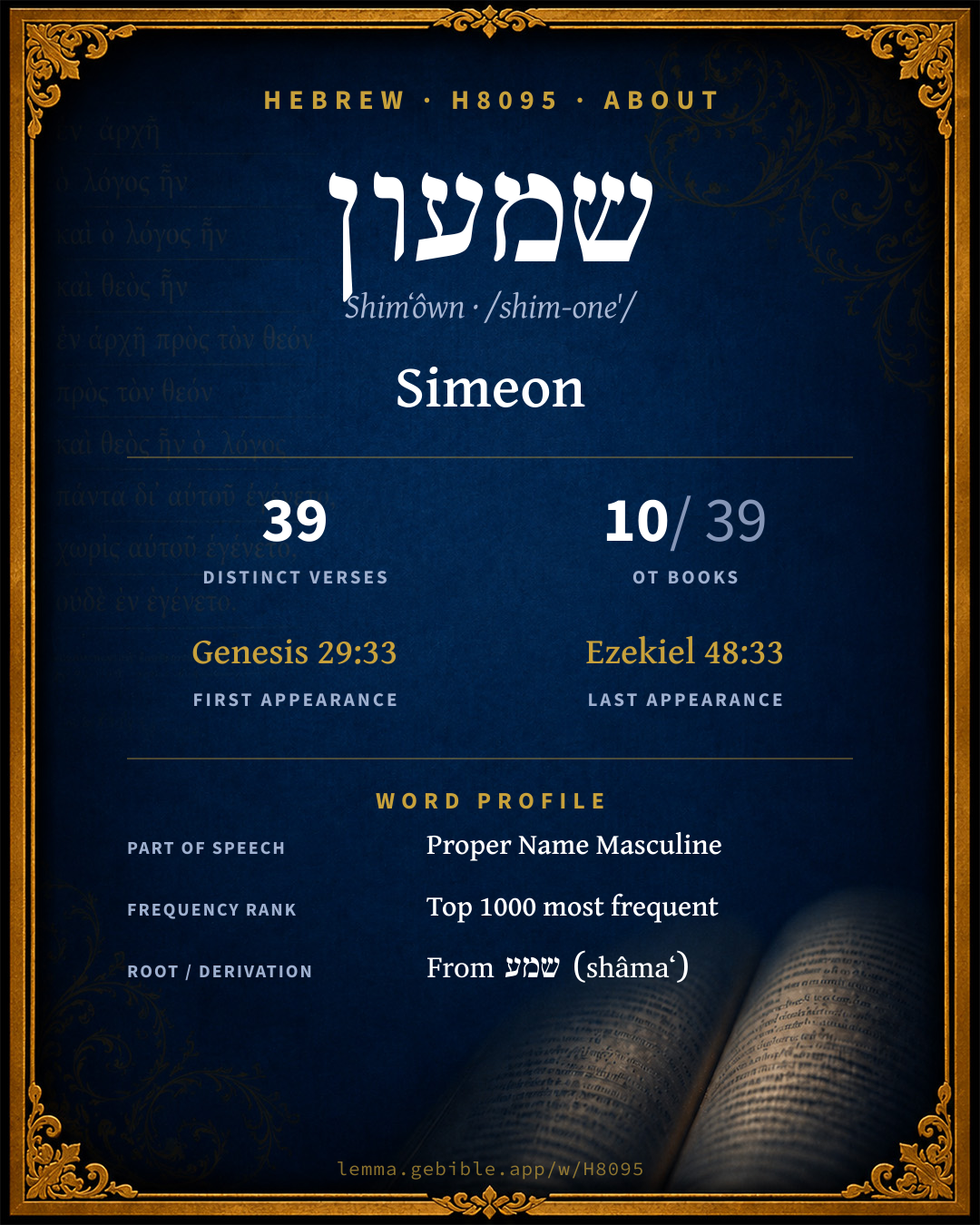
שִׁמְעוֹן
Simeon
BDB lists 3 entries for ‘Simeon’ fuller range ↓
Full lexicon entry — Brown-Driver-Briggs (BDB)
From Brown-Driver-Briggs (BDB)
Where this word appears
Grammar key — what these labels mean
Part of speech
- Noun
- A naming word — a person, place, thing, or idea.
Noun type
- Proper
- A name of a specific person, place, or people (e.g. Abraham, Zion, Israel).
Every verse where H8095 appears in the Book of Numbers — 9 distinct verses. Click any verse to open its interlinear word-by-word view. Verse text shown in the World English Bible for context — . Each verse’s Hebrew form is shown with its reference; the English is not keyword-highlighted, since the data carries no word-level English alignment. Use “Compare translations” on any verse to read it across multiple English versions. This concordance covers the Hebrew Bible; Septuagint (Greek Old Testament) occurrences are not indexed here.
Numbers
- Numbers 1:6 לְ/שִׁמְע֕וֹן prep + n Proper Of Simeon: Shelumiel the son of Zurishaddai.
- Numbers 1:22 שִׁמְע֔וֹן n Proper Of the children of Simeon, their generations, by their families, by their fathers' houses, those who were numbered of it, according to the number of the names, one by one, every male from twenty years old and upward, all who were able to go out to war;
- Numbers 1:23 שִׁמְע֑וֹן n Proper those who were numbered of them, of the tribe of Simeon, were fifty-nine thousand three hundred.
- Numbers 2:12 שִׁמְע֑וֹן שִׁמְע֔וֹן n Proper n Proper "Those who encamp next to him shall be the tribe of Simeon. The prince of the children of Simeon shall be Shelumiel the son of Zurishaddai.
- Numbers 7:36 שִׁמְע֑וֹן n Proper On the fifth day Shelumiel the son of Zurishaddai, prince of the children of Simeon
- Numbers 10:19 שִׁמְע֑וֹן n Proper Over the host of the tribe of the children of Simeon was Shelumiel the son of Zurishaddai.
- Numbers 13:5 שִׁמְע֔וֹן n Proper Of the tribe of Simeon, Shaphat the son of Hori.
- Numbers 26:12 שִׁמְעוֹן֮ n Proper The sons of Simeon after their families: of Nemuel, the family of the Nemuelites; of Jamin, the family of the Jaminites; of Jachin, the family of the Jachinites;
- Numbers 34:20 שִׁמְע֔וֹן n Proper Of the tribe of the children of Simeon, Shemuel the son of Ammihud.
About this entry
At a glance — auto-summarized from this page’s data, not written by a person. Every figure links to its source below. This summary describes the numbers; it doesn’t interpret them.
The Hebrew name שמעון centers on the idea of “Simeon.” First canonically at Genesis 29:33, it enters the text early. It turns up in 39 verses across 10 books, a moderately common footprint. The word gravitates to Genesis (26%), then Numbers and 1 Chronicles. For the data behind this summary, explore 39-verse concordance and the renderings breakdown below.
Gloss history
Strong's 1890 vs modern scholarship
About this word
Strong's H8095 catalogs a Hebrew word from the Hebrew Old Testament.
These counts are not copied from any lexicon or concordance. They are computed here, from the morphology-tagged Hebrew Old Testament. What Lemma adds →
- 39
- distinct verses
- The word appears in 39 distinct verses.
- 10 / 39
- OT books
- The word appears in 10 of 39 Old Testament books.
- #819
- by frequency
- Top 1000 most frequent Hebrew words (rank 819 of 8,640 Hebrew words by occurrence).
View all 39 occurrences in the concordance →
Most concentrated in
- Genesis 10 verses 26%
- Numbers 9 verses 23%
- 1 Chronicles 5 verses 13%
By section of the Old Testament
By traditional corpus
Conventional, traditional groupings — biblical authorship is debated, so this is a traditional corpus grouping, not an authorship claim. Each share is this word’s portion of its verses in that division of the Hebrew canon. Each figure is a share of the word’s 39 distinct verses.
- Torah (Pentateuch) 22 verses · 56%
- Prophets (Nevi'im) 9 verses · 23%
- Writings (Ketuvim) 8 verses · 21%
How translations render this word
Counts come from each version’s own published word-to-Strong’s tagging or interlinear alignment — an approximate guide to how each version renders this word, not a word-level alignment the data otherwise carries. Because each total is that version’s own tagged count, the per-version totals vary from one another and need not match the appearance or distinct-verse counts above. These counts may also differ from a printed concordance because Lemma counts each distinctly tagged rendering and does not collapse phrase taggings into a single head-word total. This is a fixed set of word-tagged versions (KJV, ASV, BSB, ULT) and does not change with the reading translation you choose elsewhere. Each version’s license is shown beside its name below (and on Sources).
- King James Version: Simeon 42×
- American Standard Version: Simeon 37×
- Berean Standard Bible: Simeon 31×, Simeonites 6×
- unfoldingWord Literal Text: Simeon 43×
King James Version Public Domain
Renders H8095 across 44 tagged occurrences — most commonly:
Plus 2 renderings that appear only once — usually multi-word phrases or single function words the recovered tagging swept in, not distinct renderings.
American Standard Version Public Domain
Renders H8095 across 44 tagged occurrences — most commonly:
Plus 7 renderings that appear only once — usually multi-word phrases or single function words the recovered tagging swept in, not distinct renderings.
Berean Standard Bible Public Domain
Renders H8095 across 39 tagged occurrences — most commonly:
Plus 2 renderings that appear only once — usually multi-word phrases or single function words the recovered tagging swept in, not distinct renderings. Not rendered by a distinct English word in 5 further occurrences.
unfoldingWord Literal Text CC BY-SA 4.0
Renders H8095 across 45 tagged occurrences — most commonly:
Plus 2 renderings that appear only once — usually multi-word phrases or single function words the recovered tagging swept in, not distinct renderings.
Senses in the full BDB
What do BDB’s symbols mean?
BDB uses these scholarly abbreviations:
| Symbol | Meaning |
|---|---|
| 𝔊 | the Septuagint (the ancient Greek translation, LXX) |
| 𝔙 | the Vulgate (the Latin translation) |
| 𝔖 | the Syriac version (the Peshitta) |
| 𝔗 | the Targum (the Aramaic translation) |
| ψ | the Psalms |
| √ | root (the underlying root or stem) |
| ‖ | parallel passage (a synonymous or contrasted parallel) |
| † | the dagger: every passage where the word occurs is cited |
The 3 senses and sub-senses the full Brown-Driver-Briggs lexicon distinguishes for this word, in lexicon order (not ranked by frequency), with BDB’s own verbatim wording and sub-sense lettering. Shown in Hebrew script with BDB’s own scholarly abbreviations. The condensed entry is in the Lexicon Entry tab. See also the Forms in the corpus table below.
- 1. second son of Jacob and Leah, Συμεων: Gn 29:33 (name expl. from שָׁמַע), 35:23 Ex 1:2 + 14 times (assoc. especially with Levi Gn 34:25, 30; 49:5). e.g. Genesis 29:33
- 2. tribal name Ju 1:3(×2), 17 Nu 1:6 +; so בְּנֵי שׁ׳ Nu 1:22 + 7 times, מַטֵּה שׁ׳ Nu 1:23; 2:12; 13:5; מַטֵּה בְנֵי שׁ׳ 10:19; 34:20 Jos 19:1, 8; 21:9 1 Ch 6:50. e.g. Judges 1:3
- 3. post-ex.. Jew with foreign wife Ezr 10:31. e.g. Ezra 10:31
Senses from the full Brown-Driver-Briggs lexicon (Brown, Driver, Briggs; Oxford 1906 — public domain), digitized via Sefaria, supplemented by the OpenScriptures HebrewLexicon (CC BY 4.0). Full attribution on Sources.
Word origin
n.pr.m. (cf. n.pr. שמעון in Palm. Lzb 378; meaning doubtful; RS al. cp. سِمْعٌ, said to mean offspring of hyena and wolf; v. HoggEB iv. 4531);—
— Brown-Driver-Briggs (Oxford 1906, public domain), digitized via Sefaria, supplemented by the OpenScriptures HebrewLexicon (CC BY 4.0). See Sources.
Derived from שמע (shâmaʻ) (H8085) — to hear.
Jastrow Dictionary
A second Hebrew/Aramaic lexicon for comparison, covering Aramaic and post-biblical (Talmudic, Targumic, Midrashic) usage that the biblical-Hebrew BDB does not. Matched by lemma rather than by Strong’s number, so a lemma may carry more than one Jastrow headword (shown separately below), and the entries cover usage well beyond the Bible.
שִׁמְעוֹן
- (b. h.) pr. n. m. Simeon, Simon,
- 1. the son of Jacob; the tribe of Simeon. Gen. R. s. 71 ש̇מ̇ע̇ון ש̇ומ̇ע בקול וכ׳ Simeon (listener), listening to the voice of his father in heaven. Num. R. s. 27 ש׳ פטדה the jewel in the high priest’s breastplate for the tribe of S. was a topaz. Num. R. s. 1319 נשיא ש׳ the prince of the tribe of S.; a. fr.
- 2. ש׳ הצדיק Simon the Just, a high priest. Yoma 69ᵃ כיון שראה לש׳ הצ׳ וכ׳ when he (Alexander the Great) saw Simon the Just, he alighted from his chariot &c. Ab. I, 2 ש׳ הצ׳ היה וכ׳ Simon the Just was one of the last members of the Great Assembly; a. fr.
- 3. name of several Tannaim, esp. a) S. son of Hillel. Sabb. 15ᵃ.—b) R. S. son of the Sagan. Shek. VIII, 5. Keth. II, 8; a. e.—c) S. ben Sheṭaḥ, chief of the Pharisees under Alexander Jannai. Ḥag. II, 2. Tosef. Keth. XII, 1. Kidd. 66ᵃ; a. fr.—d) R. S. ben Gamliel I (abbrev. רשב"ג) Ker. I, 7. Succ. 53ᵃ; Tosef. ib. IV, 4. Ab. Zar. 20ᵃ; (Y. ib. I, 40ᵃ bot.; Y. Ber. IX, 13ᵇ bot. רבן גמליאל); a. e.—e) Rabban S. ben Gamliel II. Hor. 13ᵇ. Keth. 77ᵃ, a. fr. כל מקום ששנה רשב"ג וכ׳ wherever R. S. b. G. is cited in the Mishnah, his opinion is the adopted law. Ib. VII, 9; a. v. fr.—f) ר׳ ש׳ ברבי R. S. son of R. Judah han-Nasi (B’ribbi). Ib. 103ᵇ. Ber. 13ᵇ; a. fr.—ש׳ בן זומא, v. זוֹמָא II.—ש׳ בן עזאי, v. עַזַּאי; a. many other Tannaim; v. Fr. Darkhé, Additamenta, p. 64–67.
- 4. name of several Amoraim, esp. a) R. S. bar Abba (Ba, Va), in Babli שִׁמָּן. Y. Sabb. VII, 8ᵃ bot.; Bab. Sabb. 61ᵃ. Y. Ber. V, 9ᵇ bot.; Bab. Ber. 33ᵃ; a. fr.—b) R. S. b. Laḳish (abbrev. רשב"ל, a. ריש לקיש, ר"ל). Keth. 54ᵇ. Gitt. 47ᵃ. Y. Yeb. VIII, 9ᵈ bot.; a. v. fr., v. לָקִישׁ I; a. other Amoraim; v. Fr. M’bo p. 127ᵃ–130ᵃ
A Dictionary of the Targumim, the Talmud Babli and Yerushalmi, and the Midrashic Literature (Marcus Jastrow; London, Luzac, 1903) — Public Domain. Digitized via Sefaria. Digitized via Sefaria. Full attribution on Sources.
Forms in the corpus
The 18 distinct written forms H8095 takes in the Hebrew Bible, most frequent first — each parse links to that state’s occurrences in the concordance. Hebrew forms include their vowel points and cantillation, so a single lemma takes many written forms.
| Form | Parsing | Example | Uses |
|---|---|---|---|
| שִׁמְע֑וֹן | Noun, Proper | 1 Chronicles 4:24 | 7 |
| שִׁמְע֔וֹן | Noun, Proper | Exodus 1:2 | 7 |
| שִׁמְע֗וֹן | Noun, Proper | Exodus 6:15 | 5 |
| שִׁמְעֽוֹן | Noun, Proper | Exodus 6:15 | 5 |
| שִׁמְע֖וֹן | Noun, Proper | Joshua 19:1 | 3 |
| וְ/שִׁמְע֖וֹן | Noun, Proper | Genesis 48:5 | 2 |
| שִׁמְע֣וֹן | Noun, Proper | Genesis 34:30 | 2 |
| שִׁמְע֥וֹן | Noun, Proper | Ezekiel 48:24 | 2 |
| שִׁמְעוֹן֙ | Noun, Proper | Deuteronomy 27:12 | 2 |
| וְ/שִׁמְע֣וֹן | Noun, Proper | Genesis 42:36 | 1 |
| וְ/שִׁמְעוֹן֙ | Noun, Proper | Genesis 35:23 | 1 |
| וּ/מִ/שִּׁמְע֑וֹן | Noun, Proper | 2 Chronicles 15:9 | 1 |
| לְ/שִׁמְע֔וֹן | Noun, Proper | Joshua 19:1 | 1 |
| לְ/שִׁמְע֕וֹן | Noun, Proper | Numbers 1:6 | 1 |
| לְ/שִׁמְע֨וֹן | Noun, Proper | Judges 1:3 | 1 |
| שִׁמְע֞וֹן | Noun, Proper | Ezekiel 48:33 | 1 |
| שִׁמְע֨וֹן | Noun, Proper | Genesis 34:25 | 1 |
| שִׁמְעוֹן֮ | Noun, Proper | Numbers 26:12 | 1 |
Same root — word family
Other BDB entries built from the same root as H8095, grouped by Strong’s listed origin. These share a root / origin per the lexicon — not necessarily a shared meaning. Each links to that word’s own entry.
Derives from
Shares the same root
- השמעות hashmâʻûwth H2045 report
- משמע mishmâʻ H4926 rumor
- שמע shᵉmaʻ H8086 to hear
- שמע shêmaʻ H8088 hearing
- שמע shômaʻ H8089 report
Proper names from this root
People and places named from this root — a name, not an additional meaning of the word.
- אשתמע ʼEshtᵉmôaʻ H851 Eshtemoh
- ישמעאל Yishmâʻêʼl H3458 Ishmael
- ישמעיה Yishmaʻyâh H3460 Ishmaiah
- שמואל Shᵉmûwʼêl H8050 Samuel
- שמע Shâmâʻ H8091 Shama
- שמעיה Shᵉmaʻyâh H8098 Shemaiah
- Σιμων Símōn G4613 Simon
- שמעני Shimʻônîy H8099 Simeonites
Compare all same-root words → Showing 4 of 15 — not the complete family. 8 of the same-root words are proper names (people or places). They share a root, not necessarily a meaning.
Bible dictionary
Public-domain dictionary articles matched to this entry by name (Simeon). A biblical name can be shared by more than one person or place, so an article may treat several.
Easton's Bible Dictionary · M. G. Easton, 1897
Hearing. (1.) The second son of Jacob by Leah (Gen. 29:33). He was associated with Levi in the terrible act of vengeance against Hamor and the Shechemites (34:25, 26). He was detained by Joseph in Egypt as a hostage (42:24). His father, when dying, pronounced a malediction against him (49:5-7). The words in the Authorized Version (49:6), "they digged down a wall," ought to be, as correctly rendered in the Revised Version, "they houghed an ox."
(2.) An aged saint who visited the temple when Jesus was being presented before the Lord, and uttered lofty words of thankgiving and of prophecy (Luke 2:29-35).
(3.) One of the ancestors of Joseph (Luke 3:30).
(4.) Surnamed Niger, i.e., "black," perhaps from his dark complexion, a teacher of some distinction in the church of Antioch (Acts 13:1-3). It has been supposed that this was the Simon of Cyrene who bore Christ's cross. Note the number of nationalities represented in the church at Antioch.
(5.) James (Acts 15:14) thus designates the apostle Peter (q.v.).
Smith's Bible Dictionary · William Smith, 1863
(heard).
+ The second of Jacob's son by Leah. His birth is recorded in (Genesis 29:33) The first group of Jacob's children consists, besides Simeon, of the three other sons of Leah--Reuben, Levi, Judah. Besides the massacre of Shechem, (Genesis 34:25) the only personal incident related of Simeon is the fact of his being selected by Joseph as the hostage for the appearance of Benjamin. (Genesis 42:19,24,36; 43:23) The chief families of the tribe of Simeon are mentioned int he lists of (Genesis 46:10) At the census of Sinai Simeon numbered 59,300 fighting men. (Numbers 1:23) When the second census was taken, at Shittim, the numbers had fallen to 22,200, and it was the weakest of all the tribes. This was no doubt partly due to the recent mortality following the idolatry of Peor, but there must have been other causes which have escaped mention. To Simeon was allotted a portion of land out of the territory of Judah, on its southern frontier, which contained eighteen or nineteen cities, with their villages, spread round the venerable well of Beersheba. (Joshua 19:1-8; 1 Chronicles 4:28-33) Of these places, with the help of Judah, the Simeonites possessed themselves, (Judges 1:3,17) and there they were found, doubtless by Joab, residing in the reign of David. (1 Chronicles 4:31) What part of the tribe took at the time of the division of the kingdom we are not told. The only thing which can be interpreted into a trace of its having taken any part with the northern kingdom are the two casual notices of (2 Chronicles 15:9) and 2Chr 34:6 Which appear to imply the presence of Simeonites there in the reigns of Asa and Josiah. On the other hand the definite statement of (1 Chronicles 4:41-43) proves that at that time there were still some of them remaining in the original seat of the tribe, and actuated by all the warlike, lawless spirit of their progenitor. + A devout Jew, inspired by the Holy Ghost, who met the parents of our Lord in the temple, took him in his arms, and gave thanks for what he saw and knew of Jesus. (Luke 2:25-35) There was a Simeon who succeeded his father Hillel as president of the Sanhedrin about A.D. 13, and whose son Gamaliel was the Pharisee at whose feet St. Paul was brought up. (Acts 22:3) It has been conjectured that he may be the Simeon of St. Luke.
Hitchcock's Bible Names Dictionary · Roswell D. Hitchcock, 1869
that hears or obeys; that is heard
Classic public-domain reference works; full attribution on Sources.
Septuagint verse parallels
This word appears in 39 verses that also exist in the Greek Old Testament (Septuagint), out of the 39 Hebrew verses it occurs in. You can read those verses in Greek by switching the Old Testament edition to the Septuagint.
Read these verses in the Septuagint
- Genesis 29:33
- Exodus 1:2
- Numbers 1:6
- Deuteronomy 27:12
- Joshua 19:1
- Judges 1:3
- 1 Chronicles 2:1
- 2 Chronicles 15:9
- Ezra 10:31
- Ezekiel 48:24
This is a verse-level parallel only — the same verses exist in both the Hebrew and Greek Old Testaments. No word-level Hebrew↔Greek correspondence is claimed: the data carries no such alignment, so no Greek word is shown as this Hebrew word’s translation. Coverage is not total — the Septuagint omits the deuterocanon and renumbers the Psalms, so some Hebrew verses have no direct Greek parallel.