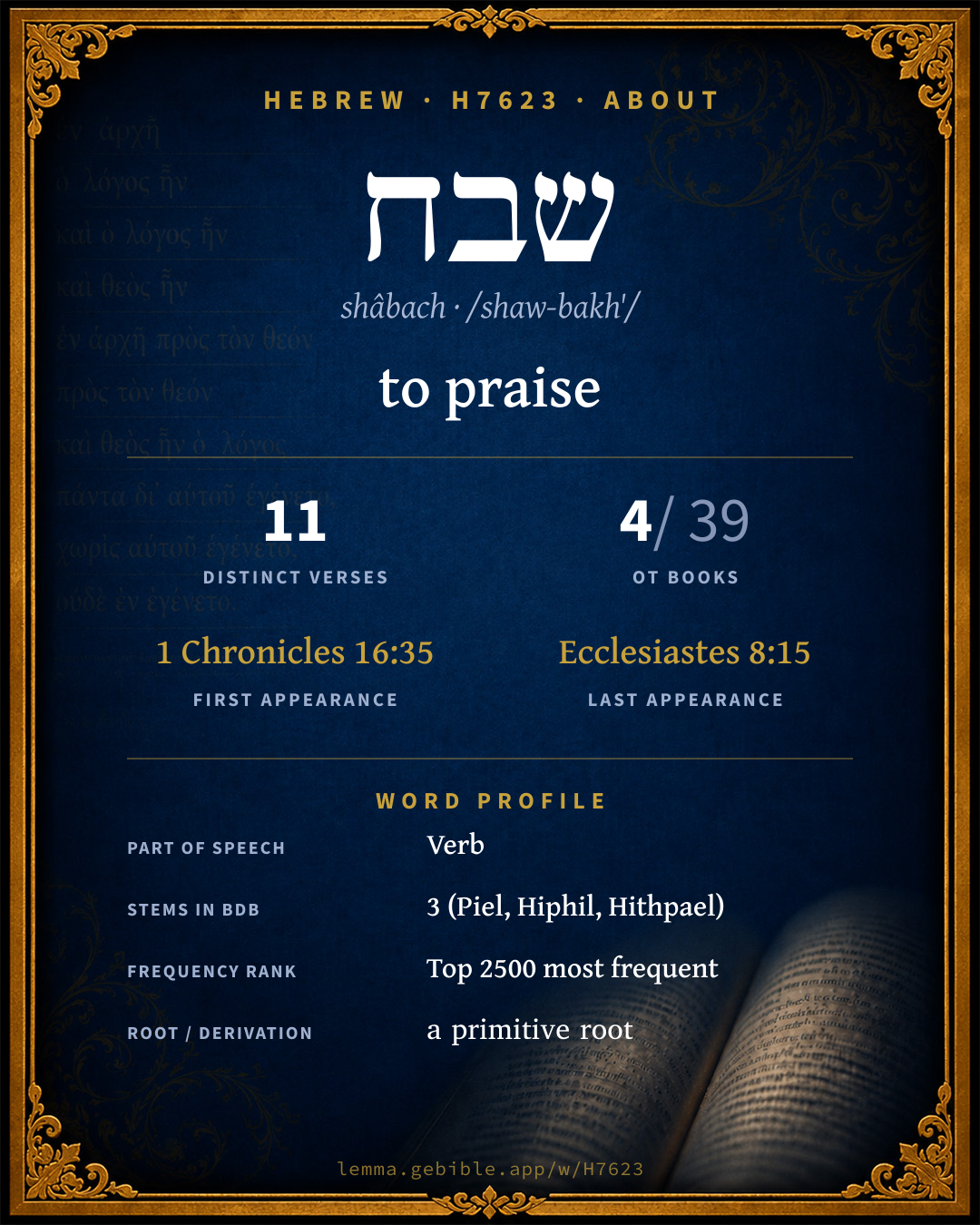
שָׁבַח
to praise
‘to praise’ is one of 2 main senses fuller range ↓
Full lexicon entry — Brown-Driver-Briggs (BDB)
From Brown-Driver-Briggs (BDB)
Where this word appears
See every Piel verb in the Hebrew Bible →
Grammar key — what these labels mean
Part of speech
- Verb
- An action or state-of-being word.
Stem
- Hithpael
- The reflexive or reciprocal stem (the subject acts on itself). Here: ‘boast of’
- Piel
- An intensive or resultative active stem. Here: ‘laud’
- Hiphil
- The causative active stem (“he caused / brought about”). Here: ‘ob. Mass error for Pi.’
Form
- Infinitive Construct
- A bound verbal noun, frequently with prepositions (“to write / in writing”).
- Infinitive Absolute
- An unbound verbal noun, often intensifying or standing in for a finite verb.
- Perfect
- A completed action or state — Hebrew marks aspect (completeness) more than strict tense (“he wrote”).
- Participle Active
- A verbal adjective expressing ongoing or characteristic action (“writing / one who writes”).
- Imperfect
- An incomplete, ongoing, or future action (“he will / would write”).
- Imperative
- A direct command (“write!”).
State
- Absolute
- The independent form of a noun, not bound to a following word.
Person
- 1st Person
- The speaker (“I / we”).
- 2nd Person
- The one addressed (“you”).
- 3rd Person
- The one spoken about (“he / she / it / they”).
Gender
- Common
- Either gender — not distinguished for this form.
- Masculine
- Grammatically masculine.
- Feminine
- Grammatically feminine.
Number
- Singular
- One.
- Plural
- More than one (in Hebrew, generally three or more).
Every verse where H7623 appears in the Book of Psalms — 7 distinct verses. Click any verse to open its interlinear word-by-word view. Verse text shown in the World English Bible for context — . Each verse’s Hebrew form is shown with its reference; the English is not keyword-highlighted, since the data carries no word-level English alignment. Use “Compare translations” on any verse to read it across multiple English versions. This concordance covers the Hebrew Bible; Septuagint (Greek Old Testament) occurrences are not indexed here.
Psalms
- Psalms 63:3 יְשַׁבְּחֽוּ/נְךָ Piel impf 3mp + sfx pers 2ms Because your loving kindness is better than life, My lips shall praise you.
- Psalms 65:7 מַשְׁבִּ֤יחַ Hiphil ptcp.act ms Who stills the roaring of the seas, The roaring of their waves, And the turmoil of the nations.
- Psalms 89:9 תְשַׁבְּחֵֽ/ם Piel impf 2ms + sfx pers 3mp You rule the pride of the sea. When its waves rise up, you calm them.
- Psalms 106:47 לְ֝/הִשְׁתַּבֵּ֗חַ prep + Hithpael inf.cs Save us, Yahweh, our God, Gather us from among the nations, To give thanks to your holy name, To triumph in your praise!
- Psalms 117:1 שַׁ֝בְּח֗וּ/הוּ Piel impv 2mp + sfx pers 3ms Praise Yahweh, all you nations! Extol him, all you peoples!
- Psalms 145:4 יְשַׁבַּ֣ח Piel impf 3ms One generation will commend your works to another, And will declare your mighty acts.
- Psalms 147:12 שַׁבְּחִ֣י Piel impv 2fs Praise Yahweh, Jerusalem! Praise your God, Zion!
About this entry
At a glance — auto-summarized from this page’s data, not written by a person. Every figure links to its source below. This summary describes the numbers; it doesn’t interpret them.
The Hebrew verb שבח centers on the idea of “to praise.” The word gravitates to Psalms (64%), then Ecclesiastes and 1 Chronicles. It turns up in 11 verses across 4 books, an uncommon footprint. Its earliest occurrence is 1 Chronicles 16:35. Read the stem: it spans 3 stems, including Piel and Hiphil. Dig into 11-verse concordance and the renderings breakdown below.
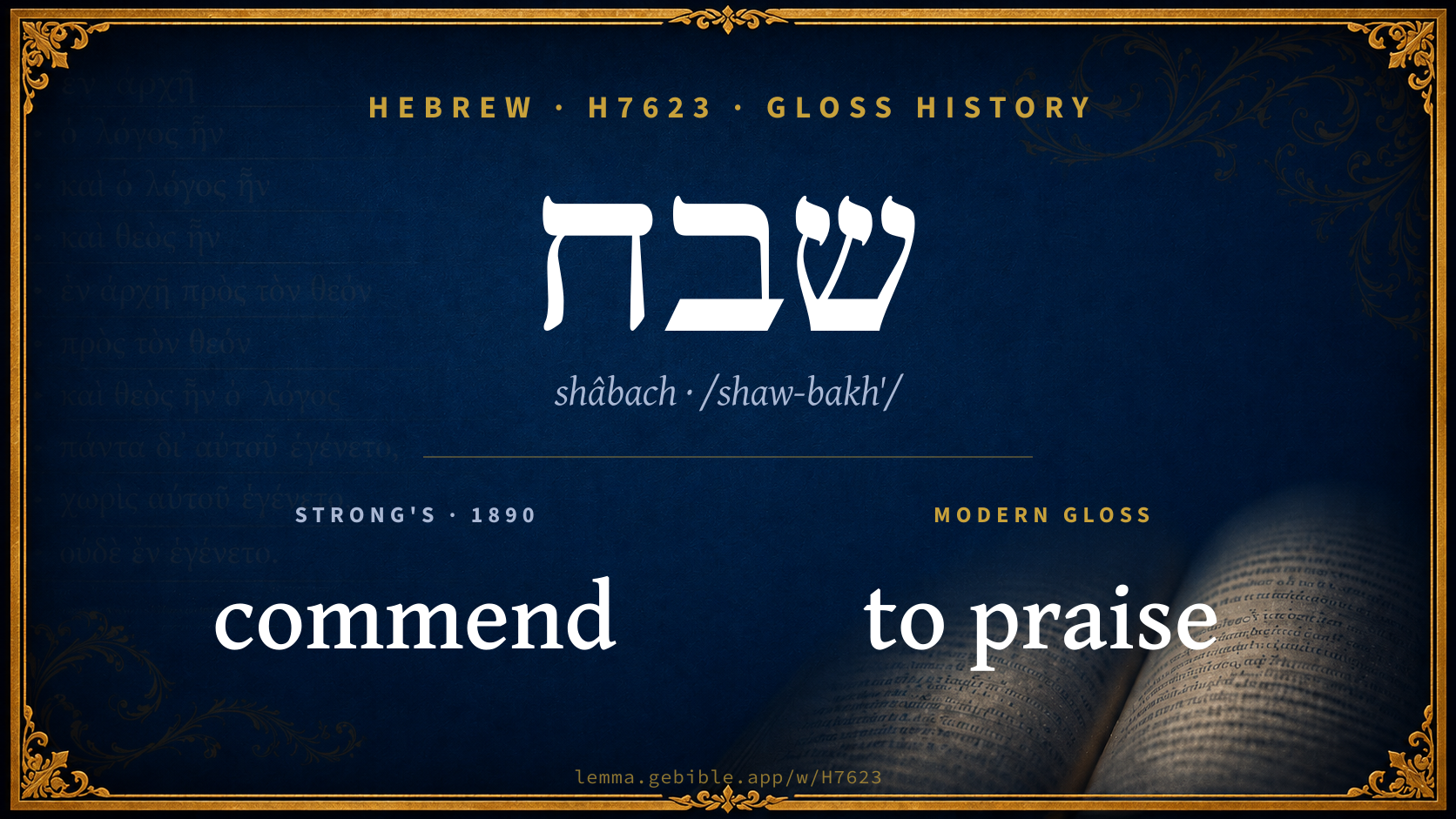
Gloss history
Strong's 1890 vs modern scholarship
About this word
Strong's H7623 catalogs a Hebrew word from the Hebrew Old Testament.
These counts are not copied from any lexicon or concordance. They are computed here, from the morphology-tagged Hebrew Old Testament. What Lemma adds →
- 11
- distinct verses
- The word appears in 11 distinct verses.
- 4 / 39
- OT books
- The word appears in 4 of 39 Old Testament books.
- #2,210
- by frequency
- Top 2500 most frequent Hebrew words (rank 2,210 of 8,640 Hebrew words by occurrence).
View all 11 occurrences in the concordance →
Most concentrated in
- Psalms 7 verses 64%
- Ecclesiastes 2 verses 18%
- 1 Chronicles 1 verse 9%
By section of the Old Testament
By traditional corpus
Conventional, traditional groupings — biblical authorship is debated, so this is a traditional corpus grouping, not an authorship claim. Each share is this word’s portion of its verses in that division of the Hebrew canon. Each figure is a share of the word’s 11 distinct verses.
- Writings (Ketuvim) 11 verses · 100%
How translations render this word
Counts come from each version’s own published word-to-Strong’s tagging or interlinear alignment — an approximate guide to how each version renders this word, not a word-level alignment the data otherwise carries. Because each total is that version’s own tagged count, the per-version totals vary from one another and need not match the appearance or distinct-verse counts above. These counts may also differ from a printed concordance because Lemma counts each distinctly tagged rendering and does not collapse phrase taggings into a single head-word total. This is a fixed set of word-tagged versions (KJV, ASV, BSB, ULT) and does not change with the reading translation you choose elsewhere. Each version’s license is shown beside its name below (and on Sources).
BDB lists this Strong’s number as 2 distinct words (homographs). Each count above pools all of them and is not split by sense — see the Senses section below. A low-frequency rendering may belong to a different one of those words, not the primary meaning.
- King James Version†: Praise 2×, Shall praise 2×
- American Standard Version†: Triumph 2×
- Berean Standard Bible†: We may glory 2×
- unfoldingWord Literal Text†: I praised 2×
King James Version Public Domain
Renders H7623 across 11† tagged occurrences — most commonly:
Plus 7 renderings that appear only once — usually multi-word phrases or single function words the recovered tagging swept in, not distinct renderings.
American Standard Version Public Domain
Renders H7623 across 11† tagged occurrences — most commonly:
Plus 9 renderings that appear only once — usually multi-word phrases or single function words the recovered tagging swept in, not distinct renderings.
Berean Standard Bible Public Domain
Renders H7623 across 11† tagged occurrences — most commonly:
Plus 9 renderings that appear only once — usually multi-word phrases or single function words the recovered tagging swept in, not distinct renderings.
unfoldingWord Literal Text CC BY-SA 4.0
Renders H7623 across 11† tagged occurrences — most commonly:
Plus 9 renderings that appear only once — usually multi-word phrases or single function words the recovered tagging swept in, not distinct renderings.
Senses in the full BDB
Hebrew verbs can shift meaning by stem (binyan): Qal is the basic action, Niphal is often passive or reflexive, Piel often intensifies or makes it factitive, and Hiphil is typically causative. The senses below are grouped under the stem BDB assigns to each. This entry also uses Hithpael (reflexive or reciprocal).
What do BDB’s symbols mean?
BDB uses these scholarly abbreviations:
| Symbol | Meaning |
|---|---|
| 𝔊 | the Septuagint (the ancient Greek translation, LXX) |
| 𝔙 | the Vulgate (the Latin translation) |
| 𝔖 | the Syriac version (the Peshitta) |
| 𝔗 | the Targum (the Aramaic translation) |
| ψ | the Psalms |
| √ | root (the underlying root or stem) |
| ‖ | parallel passage (a synonymous or contrasted parallel) |
| † | the dagger: every passage where the word occurs is cited |
The 6 senses and sub-senses the full Brown-Driver-Briggs lexicon distinguishes for this word, in lexicon order (not ranked by frequency), with BDB’s own verbatim wording and sub-sense lettering. Shown in Hebrew script with BDB’s own scholarly abbreviations. The condensed entry is in the Lexicon Entry tab. See also the Forms in the corpus table below.
שבח I Pi. soothe, still (Arabic سَبَخَ be free from care, etc., JenZA i (1886), 188
Piel
- Impf. 3 ms. sf. יְשַׁבְּחֶ֑נָּה Pr 29:11 he stilleth it, i.e. רוּחוֹ his temper (Bi Toy read חָשַׁךְ אַפּוֹ); 2 ms. sf. תְּשַׁבְּחֵם ψ 89:10 thou stillest them, i.e. waves (‖ גֵּאוּת הַיָּם). e.g. Proverbs 29:11
Hiphil
- Pt. prob. Mass error for Pi. מְשַׁבֵּחַ) מַשְׁבִּיחַ שְׁאוֹן יַמּים ψ 65:8 stilling the roar of the seas. e.g. Psalms 65:8
שבח II
Piel
- laud, praise (late Aramaism, cf. Aramaic (incl. Old Aramaic) שׁבח, ܫܒܚ, Pa. praise; v. SchwallyIdiot. 91 SchulthLex.);—
- 1. laud, praise God (י׳): Impf. 3 mpl. sf. יְשַׁבְּח֑וּנְךָ ψ 63:4 (‖ בֵּרַךְ); Imv. fs. שַׁבְּחִי 147:12, mpl. sf. שַׁבְּח֫וּהוּ 117:1 (both ‖ הִלֵּל); his works, Impf. 3 ms. יְשַׁבַּח 145:4 (‖ הִגִּיד). e.g. Psalms 63:4
- 2. commend, congratulate, the dead, Inf. abs. שַׁבֵּחַ Ec 4:2 (Ges§ 113 gg; c. מִן comp.); mirth, as best thing, Pf. 1 s. שִׁבַּחְתִּי Ec 8:15. e.g. Ecclesiastes 4:2
Hithpael
- boast of (בְּ): Inf. cstr. הִשְׁתַּבֵּחַ ψ 106:47 = 1 Ch 16:35, 𝔊 (ἐλ)καυχᾶσθαι ἐν. e.g. Psalms 106:47
Senses from the full Brown-Driver-Briggs lexicon (Brown, Driver, Briggs; Oxford 1906 — public domain), digitized via Sefaria, supplemented by the OpenScriptures HebrewLexicon (CC BY 4.0). Full attribution on Sources.
Word origin
vb. Pi. soothe, still (Arabic سَبَخَ be free from care, etc., JenZA i (1886), 188; iv (1889), 268, cp. Assyrian pašâḫu, grow calm, so BaES 9 SchulthLex.);—
— Brown-Driver-Briggs (Oxford 1906, public domain), digitized via Sefaria, supplemented by the OpenScriptures HebrewLexicon (CC BY 4.0). See Sources.
Origin: a primitive root
Jastrow Dictionary
A second Hebrew/Aramaic lexicon for comparison, covering Aramaic and post-biblical (Talmudic, Targumic, Midrashic) usage that the biblical-Hebrew BDB does not. Matched by lemma rather than by Strong’s number, so a lemma may carry more than one Jastrow headword (shown separately below), and the entries cover usage well beyond the Bible.
שָׁבַח
- (b. h.) [to grow, spread,] to improve, grow in value. B. Bath. 135ᵇ שֶׁבַח ששָׁבְחוּ וכ׳ an improvement which the estate obtained of itself, i.e. a natural increase in value by growth. Ib. 143ᵇ שבחו נכסים מחמת נכסים the estate improved through outlays made from the estate; שבחו … מחמת עצמן the estate improved owing to their (the heirs’) own expense of labor or money; a. e.
- 1. to improve, ameliorate. B. Mets. 14ᵇ גזל … והִשְׁבִּיחָהּ if one took unlawful possession of a field and sold it to another person who made improvements in it. B. Bath. 124ᵇ שבח שהִשְׁבִּיתוּ יורשין וכ׳ an improvement which the heirs made after their father’s death. Ib. IX, 3 השביחו לאמצע, v. אֶמְצַע. Ib. הִשְׁבִּיחָה לעצמה the increase of value which she produced goes to her own profit; a. fr.
- 2. (neut. verb) to improve, grow in value. Maas. Sh. II, 1; a. e.
- 3. to get bright, v. infra.
- 1. [ [to amplify,] to praise. Erub. 19ᵃ ולא עוד אלא שמְשַׁבֵּחַ and not only (does he submit to God’s judgment in silence), but he even praises. Succ. 27ᵇ, v. עַצְלָן. Sot. VII, 8 ושִׁבְּחוּהוּ חכמים and the scholars praised him for it. Mekh. Bo, s. 12 הודו ושִׁבְּחוּ וכ׳ they offered thanks and praise that the emeny did not see (their dead) &c. Ib. צריך לשַׁבֵּחַ must offer praise; a. fr.—Part. pass. מְשׁוּבָּח; f. מְשׁוּבַּחת; pl. מְשׁוּבָּחִין; מְשׁוּבָּחוֹת a) improved, valuable; b) praiseworthy. Y. Yoma VI, 43ᶜ top מש׳ בגופו a sacrifice superior as to its body (stouter), מש׳ במראיו better looking. Cant. R. to I, 1 המש׳ שבשירים the most precious of songs. Num. R. s. 163 (ref. to Num. XIII, 22) שהפסולת שלה משובחת מן המש׳ (not משובח), v. פְּסוֹלֶת; a. fr.— to quiet, tame.—Part. pass. as ab. Yalk. Num. 729 כחו … ומה מש׳ how great is the strength of this lion, and how tame he is! e.g. Numbers 13:22
- 1. to spread, (of light) get bright. Midr. Till. to Ps. XXII ואחר כך היא מִשְׁתַּבַּחַת והולכת ed. Bub. (oth. ed. מַשְׁבַּחַת Hif.) and at last it grows bright and brighter; Cant. R. to VI, 10 מרטבת (corr. acc.).
- 2. to be improved. Gen. R. s. 34 כל זמן שהוא כותשה היא משתבחת the more he beats it (the flax), the better it grows; ib. s. 32; ib. s. 55 משת׳ והולכת; Midr. Till. to Ps. XI מַשְׁבַּחַת והולכת (Hif.; ed. Bub. משבח והולך, read: מַשְׁבִּיחַ, or משובח); Yalk. Gen. 95 משובחת; Yalk. Ps. 654 משב׳; a. e.
- 3. to praise one’s self. Bekh. 45ᵇ הקב"ה מִשְׁתַּבֵּחַ בבעלי קומה the Lord prides himself on conquering men of high stature. Ex. R. s. 9 אותו רשע משתבח ואומר וכ׳ that wicked man (Pharaoh) prides himself and says, that he is a god; a. e.
- 4. to be praised. Ex. R. s. 41 הקב"ה יִשְׁתַּבַּח שמו ויתעלה זכרו the Holy One, blessed be he, praised be his name, and exalted his memory; a. fr.
שְׁבַח I
- 1. to improve, rise in value; to make profit. B. Bath. 140ᵃ ברשות יורשין שְׁבוּחַ they rose in value while in the possession of the heirs (and the benefit ought to be theirs). B. Kam. 98ᵃ, v. נִסְבָּא II; a. e.
- 2. to praise. Part. pass. שְׁבִיחַ; f. שְׁבִיחָא praiseworthy. Gitt. 80ᵇ ש׳ להו מילתא it is a matter of praise (an honor) to them (to mention the governor’s name in a document), opp. זילא.
- 3. to spread, germinate, v. שְׁוַוח I.
- to praise, sing. Targ. Ex. XV, 1. Targ. Ps. IV, 1 לשַׁבָּחָא (h. text למנצח); a. fr.—[Targ. Y. II, Ex. XXXIV, 29; Targ. Ps. CXLIX, 4, v. שַׁבְהַר.]—Part. pass. מְשַׁבַּח; f. מְשַׁבַּחְתָּא; pl. מְשַׁבְּחַיָּיא; מְשַׁבְּחַן. Ib. CXIII, 3. Targ. Ez. XXVI, 17. Targ. Y. Ex. XV, 10 מיא ממשבחייא, read: במיא מְשַׁבְּ׳ (h. text אדירים).—Lam. R. to III, 9 בכל … סליק ש׳ ונחת וכ׳ every Friday he went up (to Jerusalem), prayed (in the Temple), and went home and lighted the candles; Y. Maas. Sh. V, 57ᵃ top שבת (corr. acc.). Snh. 42ᵃ אַשְׁבּוּחֵי מְשַׁבַּח נפשיה (or מַשְׁבַּח) does he proclaim his own praise? Meg. 25ᵇ האי … שרי לשַׁבּוּחֵיה ומאן דשֵׁבְּחֵיה וכ׳ it is permitted to praise him whose reputation is good, and blessings rest upon the head of him who praises him.
- same. Snh. l. c., v. supra.
- 1. to be praised, sung. Targ. Ps. LXXVIII, 63; a. e.
- 2. to praise one’s self. Targ. Jer. IV, 2. Ib. XLIX, 4; a. fr.—Meg. 11ᵇ (ref. to Ezra I, 2) אִשְׁתַּבּוּחֵי … מִשְׁתַּבַּח בנפשיה it is he (Cyrus) only who thus glorifies himself (as the ruler of all empires). Ber. 6ᵃ, v. שְׁבָחָא; a. e. e.g. Ezra 1:2
- 3. to speak with pride of, commend. Ab. Zar. 4ᵃ משתבח להו … ברב ספרא וכ׳ R. A. recommended RabSafra to the heretics (saying) that he is a great man. Ber. 38ᵃ [read:] מִשְׁתַּבְּחִין ליה רבנן בבר וכ׳ (Ms. M. משבחין, v. Rabb. D. S. a. l. note) the Rabbis recommended the son of Rab Zabid … (saying) that he is a great man &c. Pes. 50ᵇ אישתבוחי משתבח בה קרא the Scripture commends her for it. Nidd. 14ᵇ; a. e.
שֶׁבַח
- (preced.)
- 1. improvement, gain. B. Kam. 95ᵇ שלשה שמין להן הש׳ ומעלין וכ׳ there are three persons for whose benefit the value of an improvement is assessed to be payable in money; they are: the share which the first-born has to pay to the plain heir, if the estate has increased in value before division &c. Ib., a. fr. ש׳ המגיע לכתפים, v. כַּתָּף. Ib. דמי צמרו ושְׁבָחוֹ the original value of his wool and its additional value (through dyeing). Ib. IX, 4; Keth. 80ᵃ, v. הוֹצָאָה. B. Mets. 14ᵃ, v. שִׁעְבּוּד. Pes. 27ᵃ, a. e. יש ש׳ עצים בפת the bread contains the benefit derived from the wood used in baking bread, i.e. bread baked by a fire made of forbidden wood (e.g. an ăsherah) is forbidden; a. fr.
- 2. excellency, superiority, praise. Num. R. s. 1613 לא במקום הש׳ וכ׳ they built the cities not on the best soil &c., opp. פְּסוֹלֶת. Ib. להודיעך שְׁבָחָהּ של וכ׳ to let thee know the superiority of the land of Israel, v. שָׁבַח. Erub. 18ᵇ מקצת שבחו של אדם וכ׳ you may tell part of a man’s praise in his presence, but not all of it. Pes. X, 4 מתחיל בגנות ומסיים בש׳ you begin (the recitation of the Agadah on the Passover eve) with disgrace (telling of the slavery or idolatry of the ancestors), and close with praise. Ib. 117ᵃ בעשרה מאמרות של ש׳ וכ׳ the Book of Psalms uses ten expressions of praise &c.; גדול … שכולל שם וש׳ the highest of all is Halleluiah, because it contains the Name of the Lord and praise. Kidd. 33ᵇ (ref. to Ex. XXXIII, 8) וחד אמר לש׳ and one says, they looked after Moses with the purpose of praising him, v. גְּנַאי; a. fr.—Tosef. Meg. IV (III), 39; Meg. 25ᵇ קורין אותו לש׳ are in reading changed for a more aesthetic expression, v. גְּנַאי.—[Tanḥ. Vaëra 9 ומראה שבחן, read: שַׁחֲצוֹ, v. שַׁחַץ I.] e.g. Exodus 33:8
שְׁבַח
- 1. increase, amelioration, profit. B. Mets. 15ᵃ אמליך וכתוב שופרא ש׳ ופירי (when thou writest a deed of sale of land) ask for the owner’s consent, and write that he guarantees the title with the best of his property, even to indemnity for improvement and for lost usufruct. Ib. לוקח מגזלן לית ליה ש׳ he that buys land from an unlawful possessor (and has to restore it to the legitimate owner) cannot claim indemnity for improved value. Ib.ᵇ; ib. 110ᵇ; B. Kam. 96ᵃ הב לי … שיעור שְׁבָחָאִי give me a g’riva of land (out of my own land) corresponding to the value of the improvement I put in. B. Bath. 124ᵇ ש׳ דאיתיה ברשותיה an increase in value which is in his (the heir’s) possession, opp. to מלוה an outstanding loan; a. fr.—Pl. שְׁבָחִין, שְׁבָחֵי. B. Mets. 15ᵃ ושְׁבָחֵיהוֹן, v. עַמְלָא.
- 2. praise. Targ. Ps. XL, 4 (ed. Wil. שֶׁבַח). Targ. Ps. CXLV, 21 (some ed. שַׁבָּחָא); a. fr.—Sot. 42ᵇ לאודועי שְׁבָחֵיה דדוד to make known David’s praise (valor); a. e.—Pl. as ab. Ber. 6ᵃ ומי משתבח קוב"ה בשְׁבָחַיְיהוּ דישראל does the Lord pride himself on the praises of Israel? Ib. 33ᵇ סיימתינהו לכולהו ש׳ דמרך hast thou finally counted all the excellencies of thy Master?; a. e.
שַׁבָּח
- (preced.) singer.—*Targ. Ps. IV, 1, a. fr. לשַׁ׳ (h. text למנצח), שְׁבַח I.—Pl. שַׁבָּחִין. Cant. R. to I, 1 end (expl. שירות היכל, Am. VIII, 3) שַׁבָּחוֹי דהיכלא (not שבחות) the singers of the Temple; Yalk. ib. 980. e.g. Amos 8:3
A Dictionary of the Targumim, the Talmud Babli and Yerushalmi, and the Midrashic Literature (Marcus Jastrow; London, Luzac, 1903) — Public Domain. Digitized via Sefaria. Digitized via Sefaria. Full attribution on Sources.
Forms in the corpus
The 11 distinct written forms H7623 takes in the Hebrew Bible, most frequent first — each parse links to that stem’s occurrences in the concordance. Hebrew forms include their vowel points and cantillation, so a single lemma takes many written forms.
| Form | Parsing | Example | Uses |
|---|---|---|---|
| וְ/שִׁבַּ֤חְתִּֽי | Verb, Piel, Perfect, 1st Person, Common, Singular | Ecclesiastes 8:15 | 1 |
| וְ/שַׁבֵּ֧חַ | Verb, Piel, Infinitive Absolute | Ecclesiastes 4:2 | 1 |
| יְשַׁבְּחֶֽ/נָּה | Verb, Piel, Imperfect, 3rd Person, Masculine, Singular | Proverbs 29:11 | 1 |
| יְשַׁבְּחֽוּ/נְךָ | Verb, Piel, Imperfect, 3rd Person, Masculine, Plural | Psalms 63:3 | 1 |
| יְשַׁבַּ֣ח | Verb, Piel, Imperfect, 3rd Person, Masculine, Singular | Psalms 145:4 | 1 |
| לְ/הִשְׁתַּבֵּ֖חַ | Verb, Hithpael, Infinitive Construct | 1 Chronicles 16:35 | 1 |
| לְ֝/הִשְׁתַּבֵּ֗חַ | Verb, Hithpael, Infinitive Construct | Psalms 106:47 | 1 |
| מַשְׁבִּ֤יחַ | Verb, Hiphil, Participle Active, Masculine, Singular, Absolute | Psalms 65:7 | 1 |
| שַׁ֝בְּח֗וּ/הוּ | Verb, Piel, Imperative, 2nd Person, Masculine, Plural | Psalms 117:1 | 1 |
| שַׁבְּחִ֣י | Verb, Piel, Imperative, 2nd Person, Feminine, Singular | Psalms 147:12 | 1 |
| תְשַׁבְּחֵֽ/ם | Verb, Piel, Imperfect, 2nd Person, Masculine, Singular | Psalms 89:9 | 1 |
Same root — word family
Other BDB entries built from the same root as H7623, grouped by Strong’s listed origin. These share a root / origin per the lexicon — not necessarily a shared meaning. Each links to that word’s own entry.
Derived from this word
Proper names from this root
People and places named from this root — a name, not an additional meaning of the word.
Compare all same-root words → 1 of the same-root words is a proper name (a person or place). They share a root, not necessarily a meaning.
Septuagint verse parallels
This word appears in 9 verses that also exist in the Greek Old Testament (Septuagint), out of the 11 Hebrew verses it occurs in. You can read those verses in Greek by switching the Old Testament edition to the Septuagint.
Read these verses in the Septuagint
This is a verse-level parallel only — the same verses exist in both the Hebrew and Greek Old Testaments. No word-level Hebrew↔Greek correspondence is claimed: the data carries no such alignment, so no Greek word is shown as this Hebrew word’s translation. Coverage is not total — the Septuagint omits the deuterocanon and renumbers the Psalms, so some Hebrew verses have no direct Greek parallel.