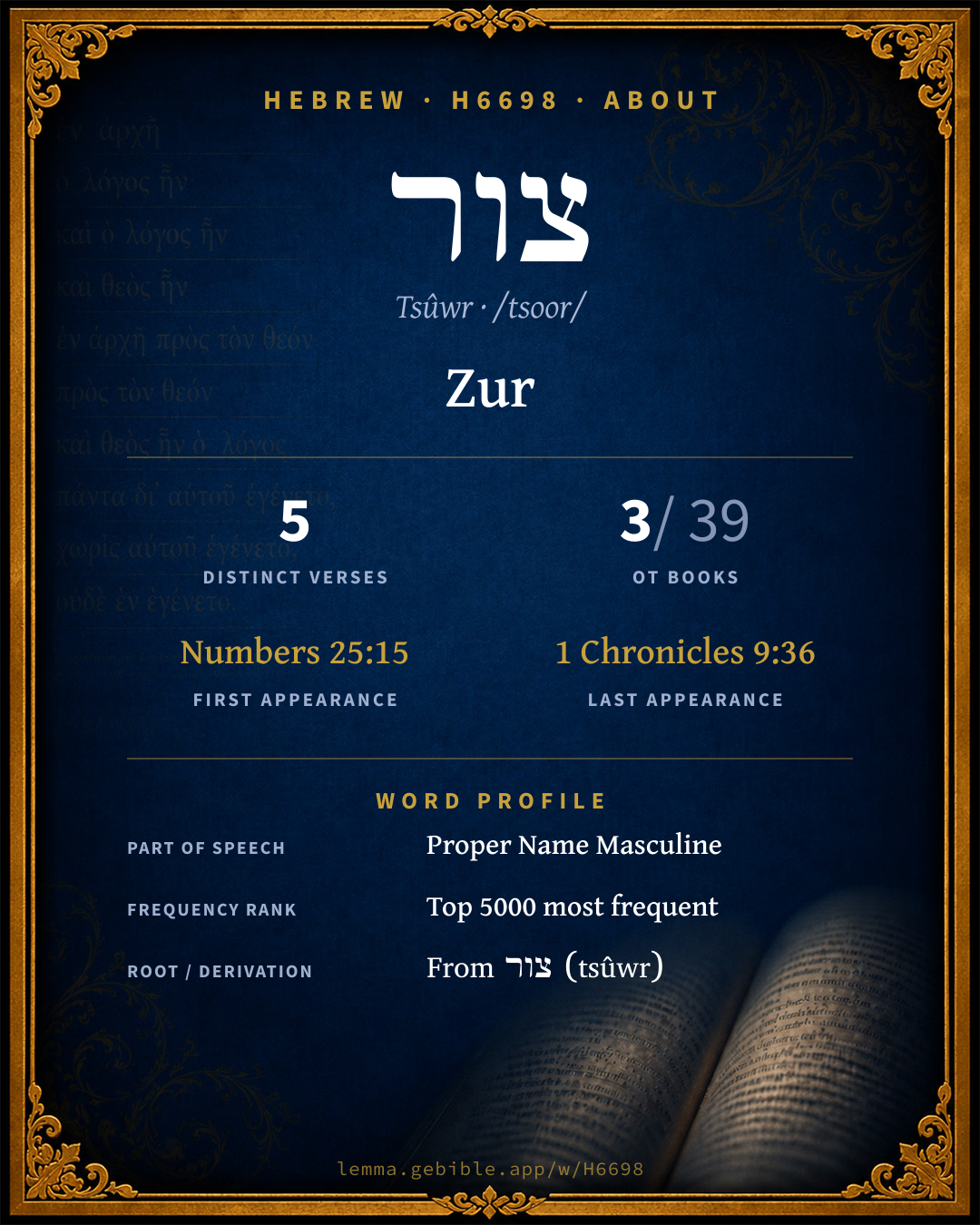
צוּר
Zur
BDB lists 3 entries for ‘Zur’ fuller range ↓
Full lexicon entry — Brown-Driver-Briggs (BDB)
From Brown-Driver-Briggs (BDB)
Where this word appears
Grammar key — what these labels mean
Part of speech
- Noun
- A naming word — a person, place, thing, or idea.
Noun type
- Proper
- A name of a specific person, place, or people (e.g. Abraham, Zion, Israel).
Every verse where H6698 appears in the Book of 1 Chronicles — 2 distinct verses. Click any verse to open its interlinear word-by-word view. Verse text shown in the World English Bible for context — . Each verse’s Hebrew form is shown with its reference; the English is not keyword-highlighted, since the data carries no word-level English alignment. Use “Compare translations” on any verse to read it across multiple English versions. This concordance covers the Hebrew Bible; Septuagint (Greek Old Testament) occurrences are not indexed here.
1 Chronicles
About this entry
At a glance — auto-summarized from this page’s data, not written by a person. Every figure links to its source below. This summary describes the numbers; it doesn’t interpret them.
At its core, צור (Tsûwr) means “Zur.” A scarce word — 5 verses in all of the Hebrew Bible. Its uses concentrate in Numbers (40% of all occurrences). Scripture first uses it in Numbers 25:15. See 5-verse concordance and the renderings breakdown below.
Gloss history
Strong's 1890 vs modern scholarship
About this word
Strong's H6698 catalogs a Hebrew word from the Hebrew Old Testament.
These counts are not copied from any lexicon or concordance. They are computed here, from the morphology-tagged Hebrew Old Testament. What Lemma adds →
- 5
- distinct verses
- The word appears in 5 distinct verses.
- 3 / 39
- OT books
- The word appears in 3 of 39 Old Testament books.
- #3,337
- by frequency
- Top 5000 most frequent Hebrew words (rank 3,337 of 8,640 Hebrew words by occurrence).
View all 5 occurrences in the concordance →
Most concentrated in
- Numbers 2 verses 40%
- 1 Chronicles 2 verses 40%
- Joshua 1 verse 20%
By section of the Old Testament
By traditional corpus
Conventional, traditional groupings — biblical authorship is debated, so this is a traditional corpus grouping, not an authorship claim. Each share is this word’s portion of its verses in that division of the Hebrew canon. Each figure is a share of the word’s 5 distinct verses.
- Torah (Pentateuch) 2 verses · 40%
- Writings (Ketuvim) 2 verses · 40%
- Prophets (Nevi'im) 1 verse · 20%
How translations render this word
Counts come from each version’s own published word-to-Strong’s tagging or interlinear alignment — an approximate guide to how each version renders this word, not a word-level alignment the data otherwise carries. Because each total is that version’s own tagged count, the per-version totals vary from one another and need not match the appearance or distinct-verse counts above. These counts may also differ from a printed concordance because Lemma counts each distinctly tagged rendering and does not collapse phrase taggings into a single head-word total. This is a fixed set of word-tagged versions (KJV, ASV, BSB, ULT) and does not change with the reading translation you choose elsewhere. Each version’s license is shown beside its name below (and on Sources).
BDB lists this Strong’s number as 5 distinct words (homographs). Each count above pools all of them and is not split by sense — see the Senses section below. A low-frequency rendering may belong to a different one of those words, not the primary meaning.
- King James Version†: Zur 5×
- American Standard Version†: Zur 5×
- Berean Standard Bible†: Zur 5×
- unfoldingWord Literal Text†: Zur 5×
King James Version Public Domain
Renders H6698 across 5† tagged occurrences — most commonly:
American Standard Version Public Domain
Renders H6698 across 5† tagged occurrences — most commonly:
Berean Standard Bible Public Domain
Renders H6698 across 5† tagged occurrences — most commonly:
unfoldingWord Literal Text CC BY-SA 4.0
Renders H6698 across 5† tagged occurrences — most commonly:
14 senses and sub-senses in the full BDB
What do BDB’s symbols mean?
BDB uses these scholarly abbreviations:
| Symbol | Meaning |
|---|---|
| 𝔊 | the Septuagint (the ancient Greek translation, LXX) |
| 𝔙 | the Vulgate (the Latin translation) |
| 𝔖 | the Syriac version (the Peshitta) |
| 𝔗 | the Targum (the Aramaic translation) |
| ψ | the Psalms |
| √ | root (the underlying root or stem) |
| ‖ | parallel passage (a synonymous or contrasted parallel) |
| † | the dagger: every passage where the word occurs is cited |
The 14 senses and sub-senses the full Brown-Driver-Briggs lexicon distinguishes for this word, in lexicon order (not ranked by frequency), with BDB’s own verbatim wording and sub-sense lettering. Shown in Hebrew script with BDB’s own scholarly abbreviations. The condensed entry is in the Lexicon Entry tab. See also the Forms in the corpus table below.
צור I confine, bind, besiege (NH id., wrap (rare)
Qal
- Pf. 2 ms. וְצַרְתָּ֫ Dt 14:25, etc.; Impf. 3 ms. וַיָּ֫צַר 1 K 20:1 +, 2 ms. תָּצוּר Dt 20:19, etc.; Imv. fs. צוּרִ֫י Is 21:2 (after עֲלִי Köi. 444, cf. Ges§ 72 s); Inf. cstr. לָצוּר 1 S 23:8; Pt. pl. צָרִים 1 K 15:27 +;— e.g. Deuteronomy 14:25
- 1. confine, secure (‖ I. צרר), acc. rei + ב of receptacle Dt 14:25; 2 K 5:23; Ez 5:3; complem. om. 2 K 12:11. e.g. Deuteronomy 14:25
- 2. shut in, besiege, c. עַל of city 2 S 11:1; 1 K 15:27; 16:17; 20:1; 2 K 6:24, 25; 17:5; 18:9; 24:11; Is 29:3 (+ acc. of siege-works), Je 32:2; 37:5; 39:9; Dt 20:12; Ez 4:3; Dn 1:1; c. עַל pers. (Within city) 2 S 20:15; 2 K 16:5; Je 21:4, 9; c. אֶל of city (for עַל) Dt 20:19; c. אֶל pers. 1 S 23:8; c. אֵת of city only 1 Ch 20:1 (‖ 2 S 11:1 supr.); abs. Is 21:2.—הִנָּם צָרִים אֶת־הָעִיר עָלֶיךָ Ju 9:31 is corrupt; FrankenbRichterbuch 28 Bu GFMHpt Now מְעִרִים inciting against. e.g. 2 Samuel 11:1
- 3. shut up, enclose: נָצוּר עָלֶיהָ לוּחַ אָ֑רֶז Ct 8:9 (על of maid [under fig. of door] + acc. mater., cf. Is 29:3 supr.); c. sf. pers. ψ 139:5 (fig., י׳ subj.). e.g. Song of Solomon 8:9
צור II
Qal
- Pf. 1 s. וְצַרְתִּ֫י אֶת־צֹרֲרֶיךָ Ex 23:22 (subj. י׳; ‖ וְאָיַבְתִּ֫י אֶת־אֹיְבֶיךָ); Impf. 2 ms. אַל־תָּ֫צַר אֶת־מוֹאָב Dt 2:9; 2 mpl. sf. אַל־תְּצֻרֵם v 19; Pt. הַצָּרִים אוֹתָם Est 8:11. e.g. Exodus 23:22
צור III fashion, delineate (NH id.
Qal
- Pf. 2 ms. וְצַרְתָּ֫ Ez 43:11 (for MT צוּרַת) according to 𝔊 We Sm Co Toy Berthol Krae, and thou shalt delineate the house (cf. הַגֵּד v 10, הוֹדַע וּכְתֹב v 11); Impf. 3 ms. וַיָּ֫צַר אֹתוֹ בַּחֶרֶט Ex 32:4 (E) and fashioned it [the gold] with a graving-tool; וַיָּ֫צַר אֶת־שְׁנֵי הָעַמּוּדִים 1 K 7:15 (+ acc. mater.), read וַיִּצֹּק (יצק), so 𝔊 SS Kit Benz cf. Th; 1 s. sf. אצורך Je 1:5 Kt, v. יצר. e.g. Ezekiel 43:11
צור IV
- 1.
- a. rocky wall, cliff, Ex 17:6(×2) (E), Dt 8:15 (צ׳ הַחַלָּמִישׁ), Is 48:21(×2) ψ 78:15, 20; 105:41; 114:8 (‖ חַלָּמִישׁ); בּוֹא בַצּ׳ Is 2:10, בִּמְעָרוֹת צֻרִים v 19, בְּנִקְרוֹת הַצּ׳ v 21, cf. Ex 33:21, 22 (JE); yielding honey (from its clefts) ψ 81:17 (cf. Dt 32:13; Dy PerlesAnal. 34 We read צוּף); as look-out Nu 23:9 (JE), home of goats 1 S 24:3 (Gi v 2), snow-covered Je 18:14; bearing (olives for) oil Dt 32:13 (חַלְמִישׁ צ׳), Jb 29:6; resort of homeless 24:8, pierced by miners 28:10, cf. perhaps שִׁית בְּצ׳ נְחָלִים אוֹפִיר 22:24 deposit (thy) gold in the rock of the wadys (most sub צֹר pebble); as quarry, fig. of Abr. as ancestor of Isr. Is 51:1; place of security 1 Ch 11:15, צ׳ הַמִּישׁוֹר Je 21:13 (of city), fig. ψ 27:5; 61:3; symb. of firmness Na 1:6; Jb 14:18; 18:4; enduring material 19:24. e.g. Exodus 17:6
- b. rock with flat surface 2 S 21:10; Pr 30:19. e.g. 2 Samuel 21:10
- c. block of stone, boulder Ju 6:21; 13:19 (as altar); cf. צוּר מִכְשׁוֹל Is 8:14 (‖ אֶבֶן נֶגֶף). e.g. Judges 6:21
- d. rock with specif. name, צ׳ עוֹרֵב Ju 7:25; Is 10:26. e.g. Judges 7:25
- 2.
- a. fig. of God (33 times) as support and defence of his people (often ‖ אֱלֹהִים, י׳, etc.), צ׳ מָעֻזֵּךְ Is 17:10, צ׳ מָעוֹז ψ 31:3, צ׳ עֻזִּי 62:8, צ׳ מָעוֹן 71:3, צ׳ יְשֻׁעָתוֹ Dt 32:15 cf. 2 S 22:47 b (but del., v. ‖ ψ 18:47), ψ 89:27; 95:1, צ׳ וִישׁוּעָתִי 62:3, 7, צ׳ מַחְסִי 94:22, צ׳ יִשְׂרָאֵל Is 30:29; 2 S 23:3 (personif.), צוּרִי ψ 18:3, 47 = 2 S 22:3, 47a, ψ 19:15; 28:1; 92:16; 144:1, צ׳ לְבָבִי 73:26, צוּרֵנוּ Dt 32:31, צוּרָם v 30 ψ 78:35; c. בְּ essent. בְּיָהּ י׳ צ׳ עוֹלָמִים Is 26:4 (cf. ψ 62:8; v. ב I. 7 c); as n.pr. dei (the) Rock Dt 32:4, 18 (צ׳ יְלָֽדְךָ), v 37 Hb 1:12, + (perhaps) ψ 75:6 (read בַּצּוּר, v. צַוָּאר; v. also פְּדָהצוּר). e.g. Isaiah 17:10
- b. of a heathen god Dt 32:31, 37, cf. Is 44:8, מִי צוּר מִבַּלְעֲדֵי א׳ 2 S 22:32 ‖ ψ 18:32, cf. 1 S 2:2.—Vid. also בֵּית צוּר and חֶלְקַת הַצֻּרִים.—ψ 89:44 v. צֹר sub III. צרר, 49:15 v. צוּרָה sub IV. צור. e.g. Deuteronomy 32:31
צור V m. Σουρ (Rock)
- 1. a prince of Midian Nu 25:15; 31:8; Jos 13:21. e.g. Numbers 25:15
- 2. Gibeonite 1 Ch 8:30; 9:36. צוֹר, צֹר Tyre v. p. 862. e.g. 1 Chronicles 8:30
Senses from the full Brown-Driver-Briggs lexicon (Brown, Driver, Briggs; Oxford 1906 — public domain), digitized via Sefaria, supplemented by the OpenScriptures HebrewLexicon (CC BY 4.0). Full attribution on Sources.
Word origin
I. vb. confine, bind, besiege (NH id., wrap (rare); Aramaic צוּר besiege, beleaguer);—
II. vb. shew hostility to, treat as foe (c. acc. pers.) (akin to II. צרר, to which SS assign the forms, but cf. Arabic ضَارَ (ى) act unjustly, also defraud; Syriac ܥܝܳܪܬܳܐ, rival wife);—
III. vb. fashion, delineate (NH id.; so Aramaic צוּר, ܨܘܪ, ܨܳܪ; ܨܽܘܪܬܳܐ picture, Sab. צור, pl. צורת HomChrest. 125 MordtmHim. Inschr. 14, 15; Arabic صُورَةٌ is loan-word according to Fra272);—
IV. n.m. Jb 29:6 rock, cliff;—צ׳ abs. Ex 17:6 +, cstr. Dt 8:15 +; sf. צוּרִי 2 S 22:3, etc.; pl. צֻרִים Nu 23:9 +, צוּרוֹת Jb 28:10; cstr. צוּרֵי 1 S 24:3 (Gi v 2);—
V. n.pr.m. Σουρ (Rock);—
— Brown-Driver-Briggs (Oxford 1906, public domain), digitized via Sefaria, supplemented by the OpenScriptures HebrewLexicon (CC BY 4.0). See Sources.
Derived from צור (tsûwr) (H6697) — rock.
Jastrow Dictionary
A second Hebrew/Aramaic lexicon for comparison, covering Aramaic and post-biblical (Talmudic, Targumic, Midrashic) usage that the biblical-Hebrew BDB does not. Matched by lemma rather than by Strong’s number, so a lemma may carry more than one Jastrow headword (shown separately below), and the entries cover usage well beyond the Bible.
צוּר I
- rock. Ex. R. s. 15 ומצא שם צ׳ גדול and found there a large rock; a. e.—Pl. צוּרִים. Ib. כאן … על הצ׳ הללו here I will build the fortress, on these rocks.—[Tosef. Pes. VII, 13 שומרי צו׳ ed. Zuck., read: צִירִים, v. צִיר II).—Trnsf. [Protection,] the Lord; (in Agadah derived from יָצַר; v. next w.) the Creator. Ber. 5ᵇ (ref. to Job XVIII, 4) אין צ׳ אלא הקב"ה tsur means the Holy One &c. (with ref. to Deut. XXXII, 18). Lev. R. s. 23 (ref. to Deut. l. c.) התשתם … יוצר you have weakened the power of the Creator. Pirké d’R. El. ch. XLIII מרד בצ׳ עליון rebelled against the Rock on high; a. fr. e.g. Job 18:4
צוּר II
- [to turn,]
- 1. to tie around, wrap. B. Kam. 49ᵇ, a. e. וכי לָצוּר על פי וכ׳ does one want a document to tie around his flask?, i.e. does one care for a paper except for the value it represents? Koh. R. to VIII, 8 (ref. to Zech. XII, 1 ויצר) צָר רוח של אדם בגופו he tied up the spirit of man in his body, v. צָרַר; a. e. e.g. Zechariah 12:1
- 2. to form, shape. Sabb. 75ᵇ הצָר צורה בכלי he who draws a figure on a vessel. Ib. 103ᵇ עד שיָצוּר כולו until he has drawn the entire figure which he intended to draw. Gen. R. s. 7, beg.; Yalk. ib. 11 מדת בו"ד צר צורה … יכול לצור צורה במים (not מלך) a human being draws a design on land, can he draw a design in water?; Mekh. B’shall., Shir., s. 8. Lev. R. s. 14 לשני ציירין זה צר דמותו וכ׳ like two painters, one paints the likeness of one &c.; a. fr.—Zeb. 94ᵃ, v. infra.
- 3. (with על) to surround, besiege. Sifré Deut. 203 אין צָרִים על עיר וכ׳ we must not begin the siege of a town later than three days before the Sabbath; a. e.—[
- 4. (cmp. זוּר) to press, v. צִיר I.]
- to draw, paint; to embroider. Zeb. 94ᵃ בגד עליו לצַיְּירוֹ … Rashi (ed. עליה לצוּרָהּ; v. Rabb. D. S. a. l. note 1) a garment which one intends to embroider.—Part. pass. מְצוּיָּיר, מְצוּיָּר; f. מְצוּיֶּירֶת; pl. מְצוּיָּירִים, מְצוּיָּירִין; מְצוּיָּירוֹת, מְצוּיָּר׳. Num. R. s. 12; Cant. R. to VI, 4 (not צוויינות); Yalk. Num. 713 (not מצויינות), v. צָב I.
צוּר
- 1. to tie around. Snh. 48ᵃ; Ber. 23ᵇ דאזמניה למֵיצַר … צָר וכ׳ which he designated to wrap T’fillin in; if he did so &c. (v. צְרַר).—Part. צָאֵיר צָיֵיר. Y. Ber. IV, 7ᶜ top הוה צ׳ גולתיה וכ׳ tied Rab’s cloak up &c.; Y. Taan. IV, 67ᶜ.—Part. pass. צָיִיר, צָיִר, צָאִיר. Targ. Job XLI, 7.—Ḥull. 105ᵇ כל מילי דצייר וחתים whatever is tied up or sealed. B. Mets. 24ᵇ אשכח … דצָיְירֵי בסדינא found four Zuzin tied up in a sheet. Lev. R. s. 6; a. fr.
- 2. to draw, shape, design. Targ. Am. IV, 13 דצר ed. Lag. (ed. Wil. דִּיצַר, v. יְצַר). Targ. I Kings VII, 15; a. fr.—Part. pass. as ab. Targ. Esth. VIII, 15; a. e.
- 3. (with על) to besiege. Targ. Deut. II, 19. Targ. O. ib. 9 (Y. תעיק; h. text תצר). Targ. O. ib. XX, 12; 19. Targ. I Sam. XXIII, 8 (ed. Lag. לימצר, read למיצר); a. fr.—Gitt. 56ᵃ צר עלה וכ׳ he besieged it (Jerusalem) three years; a. e.
- 1. to form, shape, paint, engrave. Targ. Job X, 8. Targ. Jer. XXII, 14; a. e.—Part. pass. מְצַיַּיר, מְצַיַּר. Targ. O. Ex. XXV, 33, sq. (h. text משקד׳). Targ. Ez. XXIII, 14 (h. text מחקה). Targ. Y. I Lev. XXVI, 1 (h. text משכית).—Gitt. 36ᵃ; 87ᵇ, v. כַּוְורָא, חֲרוּתָא, מָכוּתָא.
- 2. to tie up, fold under. Men. 37ᵇ האי מאן דצַיְּירֵּיה לגלימיה Rashi (ed. דצרייה; Ar. דצארי) he who folds his cloak (and puts the show-fringes on the fold).
- to be embroidered, shaped. Targ. Ps. CXXXIX, 15 (ed. Wil. אצטיד׳, corr. acc.; h. text רקמ׳).—[Ithpe. אִתְצִיר, אִתְצַר, v. יְצַר.]
צוּר III
- (preced. wds.) [twist,] צ׳ דקל band made of palm-bark (cmp. נֵצֶר III).—Pl. constr. צוּרֵי. Sabb. 90ᵇ צ׳ דקל שתים (Ms. M. צַוָּארֵי; Ar. צָרֵי) he who carries palm-bands abroad (on the Sabbath), has transgressed the law by carrying two strips.
צוּר ²
- —Pl. צוּרֵי. Ab. Zar. 75ᵃ bot. חבלי דצ׳ (Ar. צרי) ropes made of palm-bands.
צוֹר
- (b. h.) pr. n. pl. Tyre in Phœnicia. Gen. R. s. 61 end כל צ׳ … מלא בצ׳ מדינה וכ׳ wherever in Scripture Tsor is written plene, the city of Tyre is meant, where it is defective (צר enemy), Rome is meant; Tanḥ. Bo 4; Pesik. R. s. 17. Y. B. Kam. IV, 4ᵇ סולמייא דצ׳; Y. Ab. Zar. I, 40ᵃ bot., v. סוּלָּם, סוּלָּמָא; a. fr.—Denom. צוֹרִי, צוֹרִיִּי. Bekh. VIII, 7, a. e. מנה צ׳, v. מָנֶה. Yalk. Deut. 821 סייף צוריי a Tyrian sword (Tanḥ. Vaëtḥ. 6 הנדיי). Maasr. III, 5, v. חָצֵר; a. fr.—Chald. צוֹרָאָה; pl. צוֹרָאֵי, צוֹרָיֵיא. Y. Sabb. II, 4ᶜ bot.; Y. Meg. II, 73ᵇ bot.
צַוַּר
- , v. צַיַּאר
A Dictionary of the Targumim, the Talmud Babli and Yerushalmi, and the Midrashic Literature (Marcus Jastrow; London, Luzac, 1903) — Public Domain. Digitized via Sefaria. Digitized via Sefaria. Full attribution on Sources.
Forms in the corpus
The 4 distinct written forms H6698 takes in the Hebrew Bible, most frequent first — each parse links to that state’s occurrences in the concordance. Hebrew forms include their vowel points and cantillation, so a single lemma takes many written forms.
| Form | Parsing | Example | Uses |
|---|---|---|---|
| צ֤וּר | Noun, Proper | Joshua 13:21 | 2 |
| וְ/צ֣וּר | Noun, Proper | 1 Chronicles 9:36 | 1 |
| וְ/צ֥וּר | Noun, Proper | 1 Chronicles 8:30 | 1 |
| צ֑וּר | Noun, Proper | Numbers 25:15 | 1 |
Same root — word family
Other BDB entries built from the same root as H6698, grouped by Strong’s listed origin. These share a root / origin per the lexicon — not necessarily a shared meaning. Each links to that word’s own entry.
Derives from
Shares the same root
Proper names from this root
People and places named from this root — a name, not an additional meaning of the word.
Compare all same-root words → Showing 4 of 6 — not the complete family. 2 of the same-root words are proper names (people or places). They share a root, not necessarily a meaning.
Bible dictionary
Public-domain dictionary articles matched to this entry by name (Zur). A biblical name can be shared by more than one person or place, so an article may treat several.
Easton's Bible Dictionary · M. G. Easton, 1897
Rock. (1.) One of the five Midianite kings whom the Israelites defeated and put to death (Num. 31:8).
(2.) A Benjamite (1 Chr. 8:30).
Smith's Bible Dictionary · William Smith, 1863
(a rock).
+ Father of Cozbi, (Numbers 25:15) and one of the five princes of Midian who were slain by the Israelites when Balaam fell. (Numbers 31:8) (B.C. 1451.) + Son of Jehiel, the founder of Gideon. (1 Chronicles 8:30; 9:36), (B.C. after 1445.)
Hitchcock's Bible Names Dictionary · Roswell D. Hitchcock, 1869
stone; rock; that besieges
Classic public-domain reference works; full attribution on Sources.
Septuagint verse parallels
This word appears in 5 verses that also exist in the Greek Old Testament (Septuagint), out of the 5 Hebrew verses it occurs in. You can read those verses in Greek by switching the Old Testament edition to the Septuagint.
Read these verses in the Septuagint
This is a verse-level parallel only — the same verses exist in both the Hebrew and Greek Old Testaments. No word-level Hebrew↔Greek correspondence is claimed: the data carries no such alignment, so no Greek word is shown as this Hebrew word’s translation. Coverage is not total — the Septuagint omits the deuterocanon and renumbers the Psalms, so some Hebrew verses have no direct Greek parallel.