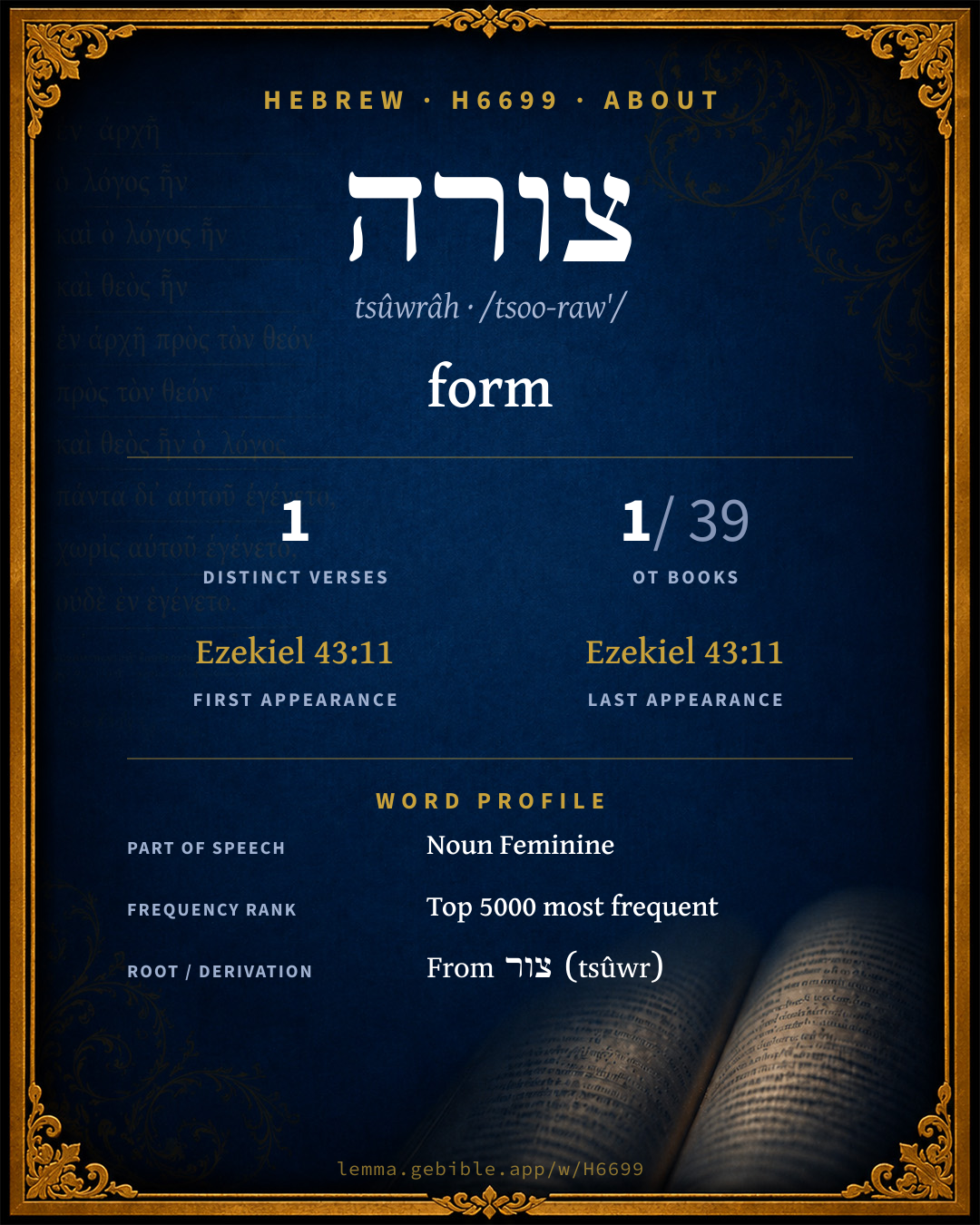
צוּרָה
form
Full lexicon entry — Brown-Driver-Briggs (BDB)
From Brown-Driver-Briggs (BDB)
Where this word appears
Grammar key — what these labels mean
Part of speech
- Noun
- A naming word — a person, place, thing, or idea.
Noun type
- Common
- A common noun — a general class of person, place, or thing (“king,” “city,” “water”), not a specific name.
State
- Construct
- A noun bound to a following noun in a possessive / “of” relationship (the construct chain).
Gender
- Feminine
- Grammatically feminine.
Number
- Plural
- More than one (in Hebrew, generally three or more).
- Singular
- One.
Grammatical forms
- Noun, Common, Feminine, Plural, Construct 3 times (60%)
- Noun, Common, Feminine, Singular, Construct 2 times (40%)
Parsed forms decoded from the imported morphology (morphhb / Westminster Leningrad Codex — WLC text public domain, morphhb tagging CC BY 4.0), counted across 5 parsed occurrences — not distinct verses.
Every verse where H6699 appears — 1 distinct verse across 1 book. Click any verse to open its interlinear word-by-word view. Verse text shown in the World English Bible for context — . Each verse’s Hebrew form is shown with its reference; the English is not keyword-highlighted, since the data carries no word-level English alignment. Use “Compare translations” on any verse to read it across multiple English versions. This concordance covers the Hebrew Bible; Septuagint (Greek Old Testament) occurrences are not indexed here.
Ezekiel 1 verse
About this entry
At a glance — auto-summarized from this page’s data, not written by a person. Every figure links to its source below. This summary describes the numbers; it doesn’t interpret them.
The Hebrew noun צורה centers on the idea of “form.” It occurs a mere 1 verse across Scripture. The word gravitates to Ezekiel (100%). Found nowhere else but Ezekiel 43:11. It shares a root with צור, טור and צור. For the data behind this summary, explore the sense tree and the renderings breakdown below.
Gloss history
Strong's 1890 vs modern scholarship
About this word
Strong's H6699 catalogs a Hebrew word from the Hebrew Old Testament.
These counts are not copied from any lexicon or concordance. They are computed here, from the morphology-tagged Hebrew Old Testament. What Lemma adds →
- 1
- distinct verses
- The word appears in 1 distinct verse.
- 1 / 39
- OT books
- The word appears in 1 of 39 Old Testament books.
- #3,337
- by frequency
- Top 5000 most frequent Hebrew words (rank 3,337 of 8,640 Hebrew words by occurrence).
View all 1 occurrence in the concordance →
Most concentrated in
- Ezekiel 1 verse 100%
By section of the Old Testament
By traditional corpus
Conventional, traditional groupings — biblical authorship is debated, so this is a traditional corpus grouping, not an authorship claim. Each share is this word’s portion of its verses in that division of the Hebrew canon. Each figure is a share of the word’s 1 distinct verse.
- Prophets (Nevi'im) 1 verse · 100%
How translations render this word
Counts come from each version’s own published word-to-Strong’s tagging or interlinear alignment — an approximate guide to how each version renders this word, not a word-level alignment the data otherwise carries. Because each total is that version’s own tagged count, the per-version totals vary from one another and need not match the appearance or distinct-verse counts above. These counts may also differ from a printed concordance because Lemma counts each distinctly tagged rendering and does not collapse phrase taggings into a single head-word total. This is a fixed set of word-tagged versions (KJV, ASV, BSB, ULT) and does not change with the reading translation you choose elsewhere. Each version’s license is shown beside its name below (and on Sources).
- King James Version: Thereof and all the forms 2×
- American Standard Version: All the ordinances thereof 1×, Entrances thereof 1×, Form 1×
- Berean Standard Bible: Design 3×
- unfoldingWord Literal Text: And 1×, Design 1×, Design of the 1×
King James Version Public Domain
Renders H6699 across 4 tagged occurrences — most commonly:
Plus 2 renderings that appear only once — usually multi-word phrases or single function words the recovered tagging swept in, not distinct renderings.
American Standard Version Public Domain
Renders H6699 across 4 tagged occurrences — most commonly:
Berean Standard Bible Public Domain
Renders H6699 across 4 tagged occurrences — most commonly:
Plus 1 rendering that appears only once — usually multi-word phrases or single function words the recovered tagging swept in, not distinct renderings.
unfoldingWord Literal Text CC BY-SA 4.0
Renders H6699 across 6 tagged occurrences — most commonly:
Senses in BDB
The 1 sense BDB distinguishes for this word, in lexicon order (not ranked by frequency or importance). The full entry — with sub-senses — is in the Lexicon Entry tab.
- form, fashion, design
Word origin
[ צוּרָה ] n.f. form, fashion
— Brown-Driver-Briggs (Oxford 1906, public domain), digitized via Sefaria, supplemented by the OpenScriptures HebrewLexicon (CC BY 4.0). See Sources.
Derived from צור (tsûwr) (H6697) — rock.
Jastrow Dictionary
A second Hebrew/Aramaic lexicon for comparison, covering Aramaic and post-biblical (Talmudic, Targumic, Midrashic) usage that the biblical-Hebrew BDB does not. Matched by lemma rather than by Strong’s number, so a lemma may carry more than one Jastrow headword (shown separately below), and the entries cover usage well beyond the Bible.
צוּרָה
- 1. form, shape, figure; painting. Y. Sabb. VII, 10ᵈ כלי צ׳ a vessel with raised figures, v. גָּדַל II. Y. Shebi. VIII, 38ᵃ top [read:] תבשיל שנתלקלה צוּרָתוֹ a dish that has become defaced (looking repulsive). Tosef. Zeb. VII, 6 תעבר צוּרָתָהּ; Pes. VII, 9, a. e. תעובר צוּרָתוֹ let its appearance be gone, i.e. wait until the flesh looks disfigured by beginning decay. Nidd. 25ᵇ צוּרַת פנים the shape of a face. B. Bath. 54ᵃ הצר צ׳ וכ׳ if one draws a figure in the ground (or on the wall) of the estate of a deceased proselyte (as a symbol of possession). Gen. R. s. 73 עד שנשתנה צוּרָתָן until their features had changed (beyond recognition). Num. R. s. 9, beg. צורת הולד the features of the child (born in adultery); צ׳ הנואף the features of the adulterer. Ab. Zar. III, 3 צורת חמה a representation of the sun; צ׳ דרקון of a serpent (idolatrous emblems); a. fr.—Tosef. Meg. IV (III), 41, a. e. המתרגם פסוק כצורתו he who translates a Biblical verse as it is formed, i.e. word for word without regard to idiomatic differences.—Taan. 16ᵃ אדם של צ׳ a stately person. M. Kat. 9ᵃ אנשים של צ׳ worthy men; Yalk. Joh. 31 של צרות (corr. acc.).—Pl. צוּרוֹת. Y. Ab. Zar. III, beg. 42ᵇ; Tosef. Sabb. XVII (XVIII), 1 כתב המהלך תחת הצ׳ וכ׳ an inscription under paintings or busts; Sabb. 149ᵃ הצורה. Num. R. s. 9 צ׳ ביתך שחורות וכ׳ are the paintings in thy house portraits of black or of white persons? (Gen. R. s. 73 מראות); a. e.—[Yalk. Gen. 72 צורות היאור, v. צִנּוֹר.]
- 2. creature. Gen. R. s. 24, beg. (ref. to Is. XXIX, 16) גדול … שמדמין צ׳ ליוצרה great (bold) is the power of the prophets who represent the Creator under the form of the creature (by ref. to Dan. VIII, 16; Ez. I, 26); a. fr. e.g. Isaiah 29:16
צוּרְתָא
- f. = h. צוּרָה. Targ. O. Deut. IV, 16. Targ. Y. Ex. XX, 4 צורה. Targ. O. ib. XXVI, 1. Targ. Ez. XXVIII, 12; a. fr.—B. Mets. 69ᵇ לצור בה צ׳ דצבו וכ׳ to put a painting on (as a sign), which people like, and by which trade is increased. Yoma 54ᵃ, v. כְּרוּב I. B. Bath. 54ᵃ רב לא קני … אלא בצ׳ Rab took symbolical possession of the garden of the school-house merely by drawing a figure. B. Mets. 45ᵇ דעתיה אצ׳ his mind is on the figure (the legend on the coin which determines its value), וצ׳ עבידא דבטלה and the legend is liable to abrogation. Sabb. 63ᵃ צ׳ דשמעתא the form (general outlines) of the subject to be discussed; a. e.
A Dictionary of the Targumim, the Talmud Babli and Yerushalmi, and the Midrashic Literature (Marcus Jastrow; London, Luzac, 1903) — Public Domain. Digitized via Sefaria. Digitized via Sefaria. Full attribution on Sources.
Forms in the corpus
The 5 distinct written forms H6699 takes in the Hebrew Bible, most frequent first — each parse links to that state’s occurrences in the concordance. Hebrew forms include their vowel points and cantillation, so a single lemma takes many written forms.
| Form | Parsing | Example | Uses |
|---|---|---|---|
| צ֨וּרֹתָ֤י/ו | Noun, Common, Feminine, Plural, Construct | Ezekiel 43:11 | 1 |
| צֽוּרֹתָ֡/ו | Noun, Common, Feminine, Plural, Construct | Ezekiel 43:11 | 1 |
| צוּרַ֣ת | Noun, Common, Feminine, Singular, Construct | Ezekiel 43:11 | 1 |
| צוּרָת֛/וֹ | Noun, Common, Feminine, Singular, Construct | Ezekiel 43:11 | 1 |
| צורת/י | Noun, Common, Feminine, Plural, Construct | Ezekiel 43:11 | 1 |
Same root — word family
Other BDB entries built from the same root as H6699, grouped by Strong’s listed origin. These share a root / origin per the lexicon — not necessarily a shared meaning. Each links to that word’s own entry.
Derives from
Shares the same root
Proper names from this root
People and places named from this root — a name, not an additional meaning of the word.
Compare all same-root words → Showing 4 of 6 — not the complete family. 3 of the same-root words are proper names (people or places). They share a root, not necessarily a meaning.
Septuagint verse parallels
This word appears in 1 verse that also exists in the Greek Old Testament (Septuagint), out of the 1 Hebrew verse it occurs in. You can read those verses in Greek by switching the Old Testament edition to the Septuagint.
Read these verses in the Septuagint
This is a verse-level parallel only — the same verses exist in both the Hebrew and Greek Old Testaments. No word-level Hebrew↔Greek correspondence is claimed: the data carries no such alignment, so no Greek word is shown as this Hebrew word’s translation. Coverage is not total — the Septuagint omits the deuterocanon and renumbers the Psalms, so some Hebrew verses have no direct Greek parallel.