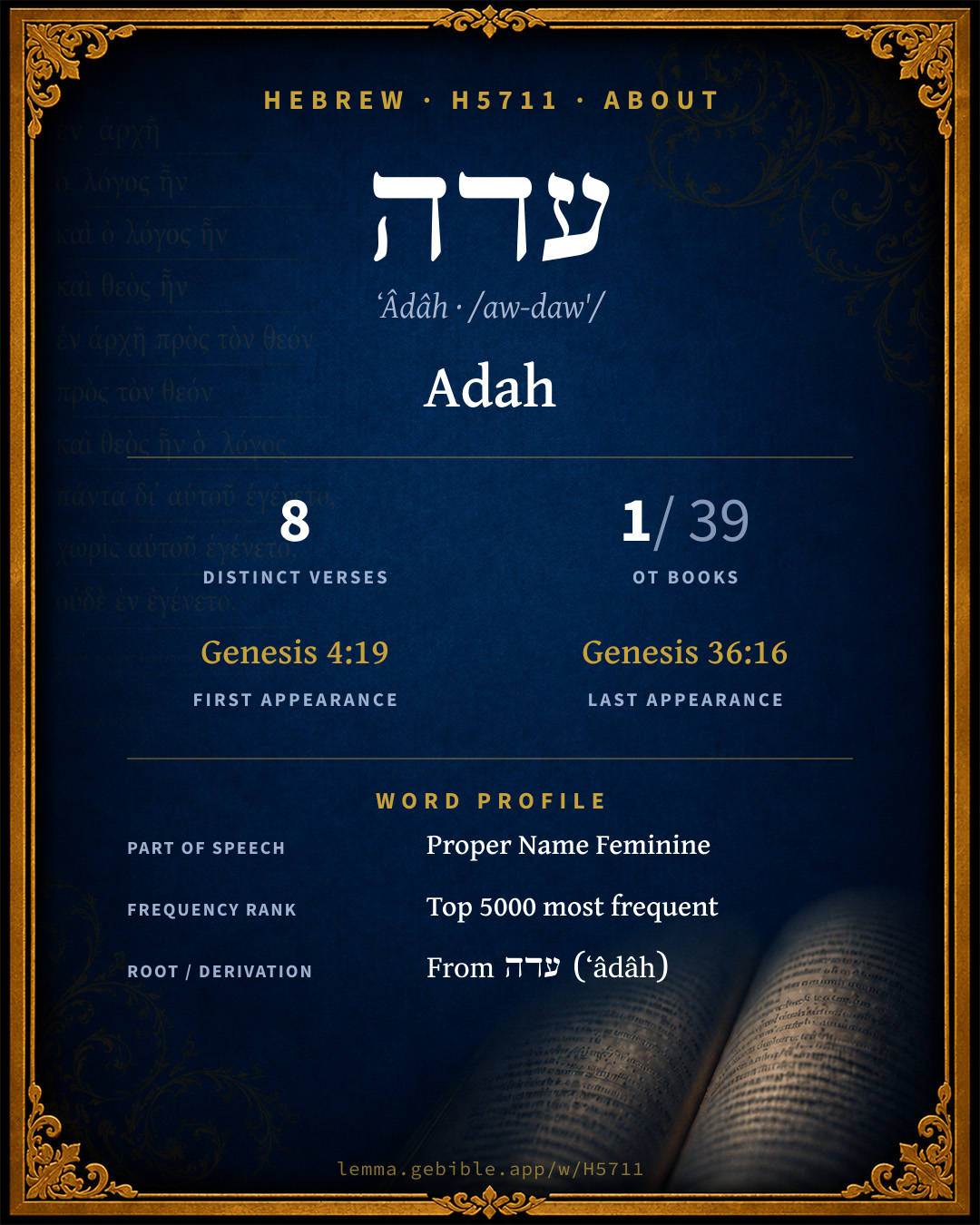
עָדָה
Adah
BDB lists 3 entries for ‘Adah’ fuller range ↓
Full lexicon entry — Brown-Driver-Briggs (BDB)
From Brown-Driver-Briggs (BDB)
Where this word appears
Grammar key — what these labels mean
Part of speech
- Noun
- A naming word — a person, place, thing, or idea.
Noun type
- Proper
- A name of a specific person, place, or people (e.g. Abraham, Zion, Israel).
Every verse where H5711 appears — 8 distinct verses across 1 book. Click any verse to open its interlinear word-by-word view. Verse text shown in the World English Bible for context — . Each verse’s Hebrew form is shown with its reference; the English is not keyword-highlighted, since the data carries no word-level English alignment. Use “Compare translations” on any verse to read it across multiple English versions. This concordance covers the Hebrew Bible; Septuagint (Greek Old Testament) occurrences are not indexed here.
Genesis 8 verses
- Genesis 4:19 עָדָ֔ה n Proper Lamech took two wives: the name of the one was Adah, and the name of the other Zillah.
- Genesis 4:20 עָדָ֖ה n Proper Adah gave birth to Jabal, who was the father of those who dwell in tents and have cattle.
- Genesis 4:23 עָדָ֤ה n Proper Lamech said to his wives, "Adah and Zillah, Hear my voice, You wives of Lamech, listen to my speech, For I have slain a man for wounding me, A young man for bruising me.
- Genesis 36:2 עָדָ֗ה n Proper Esau took his wives from the daughters of Canaan: Adah the daughter of Elon, the Hittite; and Oholibamah the daughter of Anah, the daughter of Zibeon, the Hivite;
- Genesis 36:4 עָדָ֛ה n Proper Adah bore to Esau Eliphaz. Basemath bore Reuel.
- Genesis 36:10 עָדָה֙ n Proper these are the names of Esau's sons: Eliphaz, the son of Adah, the wife of Esau; and Reuel, the son of Basemath, the wife of Esau.
- Genesis 36:12 עָדָ֖ה n Proper Timna was concubine to Eliphaz, Esau's son; and she bore to Eliphaz Amalek. These are the sons of Adah, Esau's wife.
- Genesis 36:16 עָדָֽה n Proper chief Korah, chief Gatam, chief Amalek: these are the chiefs who came of Eliphaz in the land of Edom; these are the sons of Adah.
About this entry
At a glance — auto-summarized from this page’s data, not written by a person. Every figure links to its source below. This summary describes the numbers; it doesn’t interpret them.
עדה (ʻÂdâh) is a Hebrew name most often rendered “Adah.” Genesis dominates its distribution — 8 of 8 verses. The Hebrew Bible uses it across 8 verses — uncommon. Debuting at Genesis 4:19, it then recurs through the corpus. For the data behind this summary, explore 8-verse concordance and the renderings breakdown below.
Gloss history
Strong's 1890 vs modern scholarship
About this word
Strong's H5711 catalogs a Hebrew word from the Hebrew Old Testament.
These counts are not copied from any lexicon or concordance. They are computed here, from the morphology-tagged Hebrew Old Testament. What Lemma adds →
- 8
- distinct verses
- The word appears in 8 distinct verses.
- 1 / 39
- OT books
- The word appears in 1 of 39 Old Testament books.
- #2,625
- by frequency
- Top 5000 most frequent Hebrew words (rank 2,625 of 8,640 Hebrew words by occurrence).
View all 8 occurrences in the concordance →
Most concentrated in
- Genesis 8 verses 100%
By section of the Old Testament
By traditional corpus
Conventional, traditional groupings — biblical authorship is debated, so this is a traditional corpus grouping, not an authorship claim. Each share is this word’s portion of its verses in that division of the Hebrew canon. Each figure is a share of the word’s 8 distinct verses.
- Torah (Pentateuch) 8 verses · 100%
How translations render this word
Counts come from each version’s own published word-to-Strong’s tagging or interlinear alignment — an approximate guide to how each version renders this word, not a word-level alignment the data otherwise carries. Because each total is that version’s own tagged count, the per-version totals vary from one another and need not match the appearance or distinct-verse counts above. These counts may also differ from a printed concordance because Lemma counts each distinctly tagged rendering and does not collapse phrase taggings into a single head-word total. This is a fixed set of word-tagged versions (KJV, ASV, BSB, ULT) and does not change with the reading translation you choose elsewhere. Each version’s license is shown beside its name below (and on Sources).
BDB lists this Strong’s number as 3 distinct words (homographs). Each count above pools all of them and is not split by sense — see the Senses section below. A low-frequency rendering may belong to a different one of those words, not the primary meaning.
- King James Version†: Adah 7×
- American Standard Version†: Adah 7×
- Berean Standard Bible†: Adah 8×
- unfoldingWord Literal Text†: Adah 7×
King James Version Public Domain
Renders H5711 across 8† tagged occurrences — most commonly:
Plus 1 rendering that appears only once — usually multi-word phrases or single function words the recovered tagging swept in, not distinct renderings.
American Standard Version Public Domain
Renders H5711 across 8† tagged occurrences — most commonly:
Plus 1 rendering that appears only once — usually multi-word phrases or single function words the recovered tagging swept in, not distinct renderings.
Berean Standard Bible Public Domain
Renders H5711 across 8† tagged occurrences — most commonly:
unfoldingWord Literal Text CC BY-SA 4.0
Renders H5711 across 8† tagged occurrences — most commonly:
Plus 1 rendering that appears only once — usually multi-word phrases or single function words the recovered tagging swept in, not distinct renderings.
8 senses and sub-senses in the full BDB
Hebrew verbs can shift meaning by stem (binyan): Qal is the basic action, Niphal is often passive or reflexive, Piel often intensifies or makes it factitive, and Hiphil is typically causative. The senses below are grouped under the stem BDB assigns to each.
What do BDB’s symbols mean?
BDB uses these scholarly abbreviations:
| Symbol | Meaning |
|---|---|
| 𝔊 | the Septuagint (the ancient Greek translation, LXX) |
| 𝔙 | the Vulgate (the Latin translation) |
| 𝔖 | the Syriac version (the Peshitta) |
| 𝔗 | the Targum (the Aramaic translation) |
| ψ | the Psalms |
| √ | root (the underlying root or stem) |
| ‖ | parallel passage (a synonymous or contrasted parallel) |
| † | the dagger: every passage where the word occurs is cited |
The 8 senses and sub-senses the full Brown-Driver-Briggs lexicon distinguishes for this word, in lexicon order (not ranked by frequency), with BDB’s own verbatim wording and sub-sense lettering. Shown in Hebrew script with BDB’s own scholarly abbreviations. The condensed entry is in the Lexicon Entry tab. See also the Forms in the corpus table below.
עדה I pass on, advance (Arabic (عدو) عَدَا pass by, also run = Ethiopic ዐደወ
Qal
- Pf. 3 ms. עָדָה Jb 28:8 the fierce lion hath not advanced upon it (sc. the way). e.g. Job 28:8
Hiphil
- Pt. מַעֲדֶה בֶּגֶר Pr 25:20 removing a garment (cf. Gn 38:19 𝔗, Jon 3:6 Heb. and 𝔗). e.g. Proverbs 25:20
עדה II ornament, deck oneself (Aramaic in deriv. עִידּוּת, ornament
Qal
- Pf. 2 fs. וְעָדִית Ez 23:40; Impf. 3 fs. תַּעְדֶּה Is 61:10, וַתַּ֫עַד Ho 2:15; 2 fs. תַּעְדִּי Je 4:30; 31:4, וַתַּעְדִּי Ez 16:13; 1 s. sf. וָאֶעְדֵּךְ v 11; Imv. ms. עֲדֵה־נָא Jb 40:10;—ornament; usually e.g. Ezekiel 23:40
- 1.
- a. reflex., deck oneself with, c. acc. of (woman’s) ornaments, of bride Is 61:10 (sim.; cf. הִלְבִּישׁ v a); fig. of Isr. Ho 2:15; Je 31:4; Jerus. Je 4:30 (c. acc. cogn.; ‖ לָבַשׁ), Ez 16:13 (מַלְבּוּשֵׁךְ in ‖ clause), 23:40 (c. acc. cogn.). e.g. Isaiah 61:10
- b. metaph., עֲדֵה־נָא גָאוֹן וגו׳ Jb 40:10 deck now thyself [Job] with majesty. e.g. Job 40:10
- 2. c. 2 acc., וָאֶעְדֵּךְ עֶ֑דִי Ez 16:11 and I decked thee [Jerus.] with finery (? read Hiph. וָאַ׳). e.g. Ezekiel 16:11
עדה III f. (ornament
- 1. of Lamech Gn 4:19, 20, 23 (J). e.g. Genesis 4:19
- 2. of Esau 36:2, 4, 10, 12, 16 (PR). e.g. Genesis 36:2
Senses from the full Brown-Driver-Briggs lexicon (Brown, Driver, Briggs; Oxford 1906 — public domain), digitized via Sefaria, supplemented by the OpenScriptures HebrewLexicon (CC BY 4.0). Full attribution on Sources.
Word origin
I. vb. pass on, advance (Arabic (عدو) عَدَا pass by, also run = Ethiopic ዐደወ: pass by; Aramaic עדי go along, go by (often for Heb. עָבַר), Aph. remove; Syriac ܥܕܳܐ pass by, come, c. ܥܰܠ fall upon);—
II. vb. ornament, deck oneself (Aramaic in deriv. עִידּוּת, ornament; cf. perhaps עֲדִיתָא, scurf, scab; Arabic عَدْوَى mange, scab, etc. [as sheathing, or excrescence?], also عِدَّى, broad stone for covering grave, etc., Lane1979);—
III. n.pr.f. (ornament; or (Arabic غُدْوَةٌ, غَدْوَةٌ) morning) 𝔊 Αδ(δ)α;—wife,
— Brown-Driver-Briggs (Oxford 1906, public domain), digitized via Sefaria, supplemented by the OpenScriptures HebrewLexicon (CC BY 4.0). See Sources.
Derived from עדה (ʻâdâh) (H5710) — to pass on.
Jastrow Dictionary
A second Hebrew/Aramaic lexicon for comparison, covering Aramaic and post-biblical (Talmudic, Targumic, Midrashic) usage that the biblical-Hebrew BDB does not. Matched by lemma rather than by Strong’s number, so a lemma may carry more than one Jastrow headword (shown separately below), and the entries cover usage well beyond the Bible.
עֵדָה I
- [appointed meeting,] assembly, congregation; court; prayer meeting. Tosef. Snh. XII, 3 (ref. to Ex. XXI, 18) מה אגרוף הידוע לע׳ ילעדים וכ׳ as the fist (of the slayer) is ascertained before court and witnesses, so must the stone (weapon) be &c.; B. Kam. 90ᵇ; ib. 91ᵃ. Snh. I, 6 (ref. to Num. XXXV, 24, sq.) ע׳ שופטת וע׳ מצלת there must be a possibility of an incriminating assembly (of ten persons), and of a saving assembly, which makes twenty persons; ומנין לע׳ שהיא וכ׳ and where do we find an intimation that an ‘edah consists of ten?; Y. Ber. IV, 11ᶜ top; a. fr.—Y. Maas. Sh. II, end, 53ᵈ; Koh. R. to IX, 9; Yalk. ib. 989 ע׳ קדושה the holy brotherhood. e.g. Exodus 21:18
*עֵדָה II
- = עֵדוּת, testimony. Tosef. Bekh. III, 8 שכר עֵדָתוֹ ed. Zuck. (oth. ed. עדותו) pay for his testimony.—Pl. עֵדוֹת. Bekh. IV, 6 (29ᵃ) עֵדוֹתָיו בטילין masc. (Var. in Mish. ed. עדותו בטילה) his testimonies are void; (Kidd. 58ᵇ עדותו בטילה).
עדי
- [to turn, pass; cmp. סוּר and חוּל,] to pass by; to pass away, v. next w.
- to be passed, be caught in passing. Lev. R. s. 26 (ref. to I Sam. XXIV, 11, a. XXVI, 14) בכנף אמרת בסירה ה׳ … בסירה הוּעֲדוּ as to the skirt (of Saul’s cloak) thou saidst, it was caught in a bush: have the spear and the cruise also been caught in the bush?; Num. R. s. 19 הוּעֲדַת (read the second time הועדו); Midr. Till. to Ps. VII; Yalk. Sam. 133, a. e.; (Y. Peah I, 16ᵃ bot.; Y. Sot. I, 17ᵇ הוערת, הוערו, הערת, v. עָרָה). e.g. 1 Samuel 24:11
עדי ²
- to strip.
- same, to take off. Lam. R. introd. (R. Ḥan. 1) יום … ה׳ מהן וכ׳ on the day Nebuchadnezzar came in conflict with Israel, he deprived them of two garments, the garment of priesthood and the garment of royalty.
A Dictionary of the Targumim, the Talmud Babli and Yerushalmi, and the Midrashic Literature (Marcus Jastrow; London, Luzac, 1903) — Public Domain. Digitized via Sefaria. Digitized via Sefaria. Full attribution on Sources.
Forms in the corpus
The 7 distinct written forms H5711 takes in the Hebrew Bible, most frequent first — each parse links to that state’s occurrences in the concordance. Hebrew forms include their vowel points and cantillation, so a single lemma takes many written forms.
| Form | Parsing | Example | Uses |
|---|---|---|---|
| עָדָ֖ה | Noun, Proper | Genesis 4:20 | 2 |
| עָדָ֔ה | Noun, Proper | Genesis 4:19 | 1 |
| עָדָ֗ה | Noun, Proper | Genesis 36:2 | 1 |
| עָדָ֛ה | Noun, Proper | Genesis 36:4 | 1 |
| עָדָ֤ה | Noun, Proper | Genesis 4:23 | 1 |
| עָדָֽה | Noun, Proper | Genesis 36:16 | 1 |
| עָדָה֙ | Noun, Proper | Genesis 36:10 | 1 |
Same root — word family
Other BDB entries built from the same root as H5711, grouped by Strong’s listed origin. These share a root / origin per the lexicon — not necessarily a shared meaning. Each links to that word’s own entry.
Derives from
Shares the same root
- עד ʻad H5703 perpetuity
- עד ʻêd H5708 menstruation
- עדא ʻădâʼ H5709 to pass away
- עדי ʻădîy H5716 ornaments
Proper names from this root
People and places named from this root — a name, not an additional meaning of the word.
- מעדי Maʻăday H4572 Maadai
- מעדיה Maʻădyâh H4573 Maadiah
- עדו ʻIddôw H5714 Iddo
- עדיה ʻĂdâyâh H5718 Adaiah
Compare all same-root words → Showing 4 of 10 — not the complete family. 4 of the same-root words are proper names (people or places). They share a root, not necessarily a meaning.
Bible dictionary
Public-domain dictionary articles matched to this entry by name (Adah). A biblical name can be shared by more than one person or place, so an article may treat several.
Easton's Bible Dictionary · M. G. Easton, 1897
Ornament. (1.) The first of Lamech's two wives, and the mother of Jabal and Jubal (Gen. 4:19, 20, 23).
(2.) The first of Esau's three wives, the daughter of Elon the Hittite (Gen. 36:2, 4), called also Bashemath (26:34).
Smith's Bible Dictionary · William Smith, 1863
(ornament, beauty).
+ The first of the two wives of Lamech, by whom were borne to him Jabal and Jubal. (Genesis 4:19) (B.C. 3600). + A Hittitess, one of the three wives of Esau, mother of Eliphaz. (Genesis 36:2,10,12,16) In (Genesis 26:34) she is called Bashemath. (B.C. 1797.)
Hitchcock's Bible Names Dictionary · Roswell D. Hitchcock, 1869
an assembly
Classic public-domain reference works; full attribution on Sources.
Septuagint verse parallels
This word appears in 8 verses that also exist in the Greek Old Testament (Septuagint), out of the 8 Hebrew verses it occurs in. You can read those verses in Greek by switching the Old Testament edition to the Septuagint.
Read these verses in the Septuagint
This is a verse-level parallel only — the same verses exist in both the Hebrew and Greek Old Testaments. No word-level Hebrew↔Greek correspondence is claimed: the data carries no such alignment, so no Greek word is shown as this Hebrew word’s translation. Coverage is not total — the Septuagint omits the deuterocanon and renumbers the Psalms, so some Hebrew verses have no direct Greek parallel.