Genesis 36:10

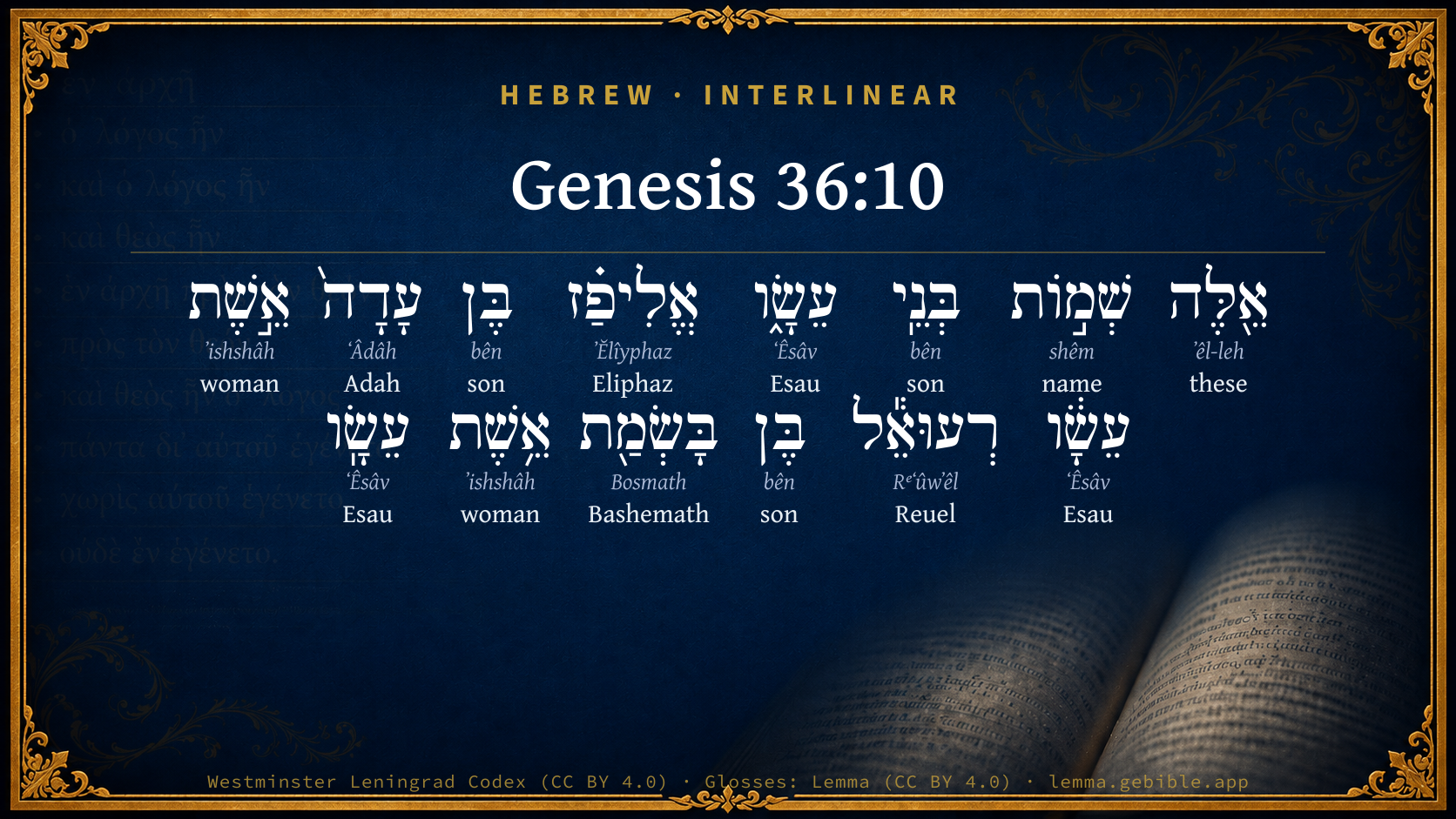
Hebrew (Westminster Leningrad Codex) Genesis 36:10 appears in the Hebrew Old Testament. The text above is from the Westminster Leningrad Codex. Each word links to its Strong’s number, a concise gloss, and parsing drawn from the Open Scriptures Hebrew Bible morphology. Click any word for its full Brown-Driver-Briggs (BDB) entry.
Download image
Cite this verse

Genesis 36:10 (World English Bible). Public Domain. Lemma interlinear Bible study tool, https://lemma.gebible.app/v/genesis/36/10.

Show BibTeX & RIS
BibTeX
RIS
English Translation
these are the names of Esau's sons: Eliphaz, the son of Adah, the wife of Esau; and Reuel, the son of Basemath, the wife of Esau.
World English Bible · Public Domain
Download a study sheet

One document with this verse’s original text, its word-by-word gloss line, the meaning frame, cross-references with their text, attributed commentary, and full source and license credits — printable, and it pastes into notes with its structure intact.

This verse Autodidact and up

Study sheet (.html) Plain text (.txt)

A passage Seminary Student

Up to 50 verses in one chapter. A passage sheet keeps up to 6 commentary sources and 12 cross-references per verse, in the order this page ranks them, and says so on the sheet whenever that leaves anything out. Ask for a single verse and you get the Autodidact verse sheet above.

Everything on this page stays free to read, with no account — the sheet is a download of what is already on screen, not access to it.

Want to remove ads? Support Godless Engineer
Compare translations 3

The same verse in 3 English versions, stacked beneath the original-language interlinear above. Click any original word for its lexicon entry.

Each is an independent rendering of the whole verse — the interlinear is not word-aligned to these translations.

Highlighted words mark where these versions differ — a whole-verse word diff, not a word-by-word alignment.

  • World English Bible Public Domain
    these are the names of Esau's sons: Eliphaz, the son of Adah, the wife of Esau; and Reuel, the son of Basemath, the wife of Esau.
  • King James Version Public Domain
    These are the names of Esau's sons; Eliphaz the son of Adah the wife of Esau, Reuel the son of Bashemath the wife of Esau.
  • unfoldingWord Literal Text CC BY-SA 4.0
    These the names of the sons of Esau: Eliphaz, the son of Esau’s wife Adah, and Reuel, the son of Esau’s wife Basemath.

unfoldingWord Literal Text — © unfoldingWord, licensed CC BY-SA 4.0. Word-aligned USFM3 via Door43 (git.door43.org/unfoldingWord/en_ult).

Versions to compare (up to 4)

3 of 4 selected

Show all 18 translations

Every available English version of this verse, each an independent rendering of the whole verse.

  • World English Bible Public Domain
    these are the names of Esau's sons: Eliphaz, the son of Adah, the wife of Esau; and Reuel, the son of Basemath, the wife of Esau.
  • Berean Standard Bible Public Domain
    These are the names of Esau’s sons: Eliphaz son of Esau’s wife Adah, and Reuel son of Esau’s wife Basemath.
  • Majority Standard Bible Public Domain
    These are the names of Esau’s sons: Eliphaz son of Esau’s wife Adah, and Reuel son of Esau’s wife Basemath.
  • King James Version Public Domain
    These are the names of Esau's sons; Eliphaz the son of Adah the wife of Esau, Reuel the son of Bashemath the wife of Esau.
  • American Standard Version (1901) Public Domain
    these are the names of Esau's sons: Eliphaz the son of Adah the wife of Esau, Reuel the son of Basemath the wife of Esau.
  • Revised Version (1885) Public Domain
    these are the names of Esau’s sons; Eliphaz the son of Adah the wife of Esau, Reuel the son of Basemath the wife of Esau.
  • Geneva Bible (1599) Public Domain
    These are the names of Esaus sonnes: Eliphaz, the sonne of Adah, the wife of Esau, and Reuel the sonne of Bashemath, the wife of Esau.
  • Douay-Rheims (1899) Public Domain
    And these the names of his sons: Eliphaz the son of Ada the wife of Esau: and Rahnel the son of Basemath his wife.
  • Young's Literal Translation Public Domain
    These `are' the names of the sons of Esau: Eliphaz son of Adah, wife of Esau; Reuel son of Bashemath, wife of Esau.
  • Literal Standard Version CC BY-SA 4.0
    These [are] the names of the sons of Esau: Eliphaz son of Adah, wife of Esau; Reuel son of Bashemath, wife of Esau.
  • Unlocked Literal Bible CC BY-SA 4.0
    These were the names of Esau's sons: Eliphaz son of Adah, the wife of Esau; Reuel son of Basemath, the wife of Esau.
  • unfoldingWord Literal Text CC BY-SA 4.0
    These the names of the sons of Esau: Eliphaz, the son of Esau’s wife Adah, and Reuel, the son of Esau’s wife Basemath.
  • Darby Bible Public Domain
    These are the names of Esau's sons: Eliphaz, the son of Adah the wife of Esau; Reuel, the son of Basmath the wife of Esau.
  • World Messianic Bible Public Domain
    these are the names of Esau’s sons: Eliphaz, the son of Adah, the wife of Esau; and Reuel, the son of Basemath, the wife of Esau.
  • Webster's Bible Public Domain
    These are the names of Esau's sons; Eliphaz the son of Adah the wife of Esau, Reuel the son of Bashemath the wife of Esau.
  • Free Bible Version CC BY-SA 4.0
    These were the names of Esau's sons: Eliphaz, son of Esau's wife Adah, and Reuel, son of Esau's wife Basemath.
  • Bible in Basic English Public Domain
    These are the names of Esau's sons: Eliphaz, the son of Esau's wife Adah, and Reuel, the son of Esau's wife Basemath.
  • JPS Tanakh (1917) Public Domain
    These are the names of Esau's sons: Eliphaz the son of Adah the wife of Esau, Reuel the son of Basemath the wife of Esau.

Literal Standard Version (2020), Covenant Press — licensed CC BY-SA 4.0. Text via the HelloAO Bible API (eBible.org). Unlocked Literal Bible (unfoldingWord) — licensed CC BY-SA 4.0. Text via the HelloAO Bible API (eBible.org). unfoldingWord Literal Text — © unfoldingWord, licensed CC BY-SA 4.0. Word-aligned USFM3 via Door43 (git.door43.org/unfoldingWord/en_ult). Free Bible Version, Dr. Jonathan Gallagher — licensed CC BY-SA 4.0. Text via the HelloAO Bible API (eBible.org).

Word by word

More ways to search: Search by grammar → Find every occurrence → Compare this word →

Practice this passage: Drill this verse → Learn its vocabulary →

בָּשְׂמַ֖ת
Bosmath
H1315
“Bashemath”
Noun, Proper
Part of Speech
Noun
Type
Proper
Full BDB Definition

Origin: from H1314 (the second form)

TWOT: fragrance

Bashemath or Basmath = "spice" - Hittite wife of Esau, daughter of Ishmael, sister of Nebaioth - daughter of Solomon, wife of Ahimaaz, one of Solomon's commissariat officers
  1. אֵ֖לֶּה ʼêl-leh H428 “these” Pronoun, Demonstrative, Common, Plural
  2. שְׁמ֣וֹת shêm H8034 “names of” Noun, Common, Masculine, Plural, Construct
  3. בְּנֵֽי bên H1121 “sons of” Noun, Common, Masculine, Plural, Construct
  4. עֵשָׂ֑ו ʻÊsâv H6215 “Esau” Noun, Proper
  5. אֱלִיפַ֗ז ʼĔlîyphaz H464 “Eliphaz” Noun, Proper
  6. בֶּן bên H1121 “son of” Noun, Common, Masculine, Singular, Construct
  7. עָדָה֙ ʻÂdâh H5711 “Adah” Noun, Proper
  8. אֵ֣שֶׁת ʼishshâh H802 “woman of” Noun, Common, Feminine, Singular, Construct
  9. עֵשָׂ֔ו ʻÊsâv H6215 “Esau” Noun, Proper
  10. רְעוּאֵ֕ל Rᵉʻûwʼêl H7467 “Reuel” Noun, Proper
  11. בֶּן bên H1121 “son of” Noun, Common, Masculine, Singular, Construct
  12. אֵ֥שֶׁת ʼishshâh H802 “woman of” Noun, Common, Feminine, Singular, Construct
  13. עֵשָֽׂו ʻÊsâv H6215 “Esau” Noun, Proper

About this verse

These counts appear in no published source. They are computed here, from the morphology-tagged text and Lemma’s own curated glosses. What Lemma adds →

14
words
9
distinct lemmas
Pentateuch
section

Notable vocabulary

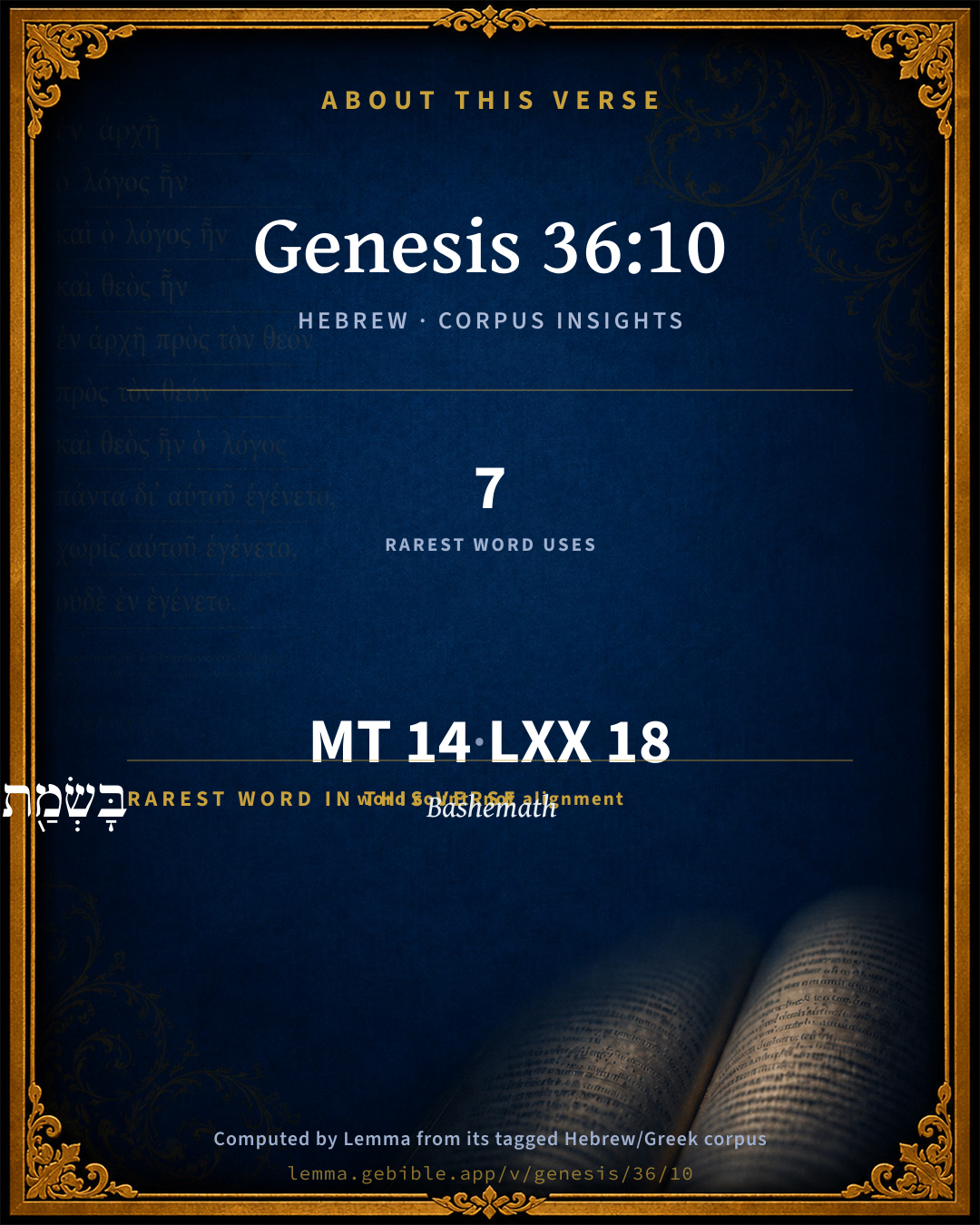
The rarest word here is בָּשְׂמַ֖ת Bashemath H1315 — appearing just 7 times in the whole Hebrew Bible.

Shared distinctive vocabulary

בָּשְׂמַ֖ת Bashemath H1315 occurs in 7 verses of the Hebrew Bible. Also found in:

Grammatical profile

  • 13 nouns
  • 1 pronoun

Repetition

Words recur within this verse — often emphatic in Hebrew:

  • בְּנֵֽי son H1121 ×3
  • עֵשָׂ֑ו Esau H6215 ×3
  • אֵ֣שֶׁת woman H802 ×2

Hebrew & Septuagint length

In English translation the verse runs 26 words from the Hebrew and 28 from the Septuagint (LXX English) — closely comparable.

A rough comparison of the two English renderings, which tokenize alike — not a word-level alignment.

Word counts can differ between the Hebrew and the Greek without any difference in meaning — e.g. the Hebrew direct-object marker אֵת has no separate Greek word, and Greek often adds the article ὁ.

In the original languages it is 14 Hebrew tokens and 18 Greek tokens — but the two are counted differently (Hebrew bundles its prefixes and suffixes into one token; the Greek is in lemma form), so that isn’t a like-for-like length.

Cross-references

2

Topical passages linked to Genesis 36:10 in the Treasury of Scripture Knowledge — connected by theme and wording, ordered by reader-vote popularity; previews shown in the World English Bible.

Cross-references courtesy of OpenBible.info (CC BY 4.0).

Hebrew and Greek witnesses Masoretic Hebrew ↔ Greek Septuagint

The same verse in the two great witnesses to the Old Testament, shown verse-for-verse.

These are two independent witnesses, not word-aligned to each other, and the Septuagint is shown in lemma (dictionary) form.

Hebrew Genesis 36:10 Masoretic · Westminster Leningrad Codex

אֵ֖לֶּה שְׁמ֣וֹת בְּנֵֽי עֵשָׂ֑ו אֱלִיפַ֗ז בֶּן עָדָה֙ אֵ֣שֶׁת עֵשָׂ֔ו רְעוּאֵ֕ל בֶּן בָּשְׂמַ֖ת אֵ֥שֶׁת עֵשָֽׂו

these are the names of Esau's sons: Eliphaz, the son of Adah, the wife of Esau; and Reuel, the son of Basemath, the wife of Esau.

World English Bible · Public Domain

Greek LXX Genesis 36:10 Septuagint · lemma form

καί οὗτος ὁ ὄνομα ὁ υἱός ησαυ ελιφας υἱός αδα γυνή ησαυ καί ραγουηλ υἱός βασεμμαθ γυνή ησαυ

And these are the names of the sons of Esau. Eliphas, the son of Ada, the wife of Esau; and Raguel, the son of Basemath, wife of Esau.

LXX2012 (modern English Septuagint) · Public Domain

Hebrew: Westminster Leningrad Codex (CC BY 4.0). Greek: Septuagint (public domain); English from LXX2012 (modern English Septuagint) (Public Domain). How the Septuagint differs from the Hebrew →

Targum (Aramaic paraphrase)

2

The Targum is the ancient Jewish Aramaic paraphrase of the Hebrew Scriptures — an interpretive translation, not the Hebrew text itself. Onkelos (literal) and Pseudo-Jonathan (expansive) render the Torah, and Jonathan the Prophets. Coverage is partial: where no permissively-licensed English translation exists for a verse, only the Aramaic is shown. This is verse-level text, not a word-by-word alignment to the Hebrew.

  1. Targum Onkelos Torah (Genesis–Deuteronomy)
    אִלֵּין שְׁמָהַת בְּנֵי עֵשָׂו אֱלִיפַז בַּר עָדָה אִתַּת עֵשָׂו רְעוּאֵל בַּר בָּשְׂמַת אִתַּת עֵשָׂו

    (no public-domain English translation for this verse)

    Targum Onkelos — Aramaic: “Onkelos Genesis” (public domain); “Onkelos Exodus” (public domain); “Onkelos Leviticus” (public domain); “Onkelos Numbers” (public domain); “Onkelos Deuteronomy” (public domain). English: “Sefaria Community Translation” (CC0 1.0 (public-domain dedication)); “J.W. Etheridge. The Targums of Onkelos and Jonathan Ben Uzziel on the Pentateuch. London: Longmans, Green, 1862” (public domain). Text via Sefaria.

  2. Targum Pseudo-Jonathan Torah (Genesis–Deuteronomy)
    אִלֵין שְׁמָהַת בְּנֵי עֵשָו אֱלִיפַז בַּר עָדָה אִיתַּת עֵשָו רְעוּאֵל בַּר בָּשְמַת אִיתַּת עֵשָו

    These are the names of the sons of Esau, Eliphaz bar Adah, wife of Esau; Reuel bar Basemath, wife of Esau.

    Targum Pseudo-Jonathan — Aramaic: “Targum Jonathan on Genesis” (public domain); “Targum Jonathan on Exodus” (public domain); “Targum Jonathan on Leviticus” (public domain); “Targum Jonathan on Numbers” (public domain); “Targum Jonathan on Deuteronomy” (public domain). English: “The Targum of Jonathan ben Uzziel, trans. J. W. Etheridge, London, 1862” (public domain). Text via Sefaria.

Commentary

Notes on Genesis 36:10 from classic Christian and Jewish commentators (each source and its license shown beneath its notes). The classic Christian expositions comment on the surrounding passage and are grouped to its opening verse, so a note may address several verses; the Jewish commentaries on the Tanakh (Rashi and others) are per-verse, so they appear only where the commentator wrote on this verse.

Lemma curates 59 commentaries, every one of them public domain or Creative Commons licensed, each selected and text-cleaned for this edition rather than reprinted as found. About our sources →

Joseph Benson's Commentary

Gen 36:10. These are the names — Observe here, 1st, That only the names of Esau’s sons and grandsons are recorded: not their history, for it is the Church that Moses preserves the records of, not of those that were without. The elders only, that lived by faith, obtained a good report. 2d, That the sons and grandsons of Esau are called dukes. Probably they were military commanders, that had soldiers under them; for Esau and his family lived by the sword, Gen 27:40. 3d, We may suppose those dukes had numerous families of children and servants. God promised to multiply Jacob and to enrich him; yet Esau increases and is enriched first. God’s promise to Jacob began to work late, but the effect of it remained longer, and it had its complete accomplishment in the spiritual Israel.

Joseph Benson's Commentary on the Old and New Testaments (1811–1818) — public domain. Text from a community e-Sword module.

The Cambridge Bible for Schools and Colleges

gen. ed. J. J. S. Perowne

10. Eliphaz] See Gen_36:4.

Reuel] See Gen_36:4.

The Cambridge Bible for Schools and Colleges (gen. ed. J. J. S. Perowne; Cambridge University Press, 1878–1918) — public domain. Text from a community e-Sword module.

John Gill's Exposition

And the sons of Eliphaz were Teman,.... This was his firstborn, and from him the city of Teman in Edom or Idumea had its name, see Jer 49:7; and Eliphaz is called the Temanite from hence, Job 2:11; four more sons are mentioned:

Omar, Zepho, and Gatam, and Kenaz; but I do not find that any towns or cities, or any part of the land of Edom, were denominated from any of them; only it may be observed that Zepho is called Zephi in Ch1 1:36; the account seems fabulous and not to be depended on, which Josephus Ben Gorion (w) gives of him, of opposing the burial of Jacob, being taken by Joseph and carried into Egypt, and at his death fleeing to Carthage, and from thence to the Romans, and was king of them (x).

(w) Hist. Heb. l. 1. c. 2. vid. Chizzuk Emunab, par. l. c. 6. p. 66. & Nachman apud Buxtorf. Lex. Talmud. col. 31, 32. (x) Vid. Huls. Theolog. Jud. par. 1. p. 132, &c.

John Gill's Exposition of the Whole Bible (1746–1763) — public domain (CC PDM 1.0). Text via the HelloAO Bible API.

The Pulpit Commentary

Vers. 10-12. These are the names of Esau"s sons; Eliphaz the son of Adah the wife of Esau, Reuel the son of Bashemath the wife of Esau (vide ver. 4). And the sons of Eliphaz were Teman, the name was afterwards given to a district of Idumea, (Jer_49:20) and borne by one of Job"s friends (Job_2:11) Omar, (Gesenius), "Mountain-dweller" (Furst)Zepho, (Gesenius); called Zephi in 1Ch_1:36and Gatam, touch" (Gesenius) "dried up" (Furst)and Kenaz (Gesenius). And Timna (Gesenius, Furst, Murphy)was concubinepilgash, (vide Gen_16:3 Gen_25:6) to Eliphaz Esau"s son; perhaps given to him by Adah, so that her children were reckoned Adah"s (Hughes) and she bare to Eliphaz Amalek of the Valley," or "Warrior" (Furst); "a nation of head-breakers" (Lunge); "Laboring" (Gesenius, Murphy). It is probable that this was the founder of the Amalekite nation who attacked Israel at Horeb (Keil, Kalisch, Murphy), though by others (Gesenius, Michaelis, Furst) these have been regarded as a primitive people, chiefly on the grounds that Amalek is mentioned in Gen_14:7 as having existed in the days of Abraham, and that Balaam calls Amalek the first of nations; (Num_24:20) but the first may simply be a prolepsis (Hengstenberg), while the second alludes not to the antiquity of the nation, but either to its power (Kalisch), or to the circumstance that it was the first heathen tribe to attack Israel (Keil). These (including Eliphaz for the reason,specified above) were the sons of Adah Esau s wife.

The Pulpit Commentary (1880–1919), ed. H.D.M. Spence-Jones & Joseph S. Exell — public domain. Text from a community e-Sword module.

John Wesley's Explanatory Notes

These are the names - Observe here,

1. That only the names of Esau's sons and grand-sons are recorded: not their history, for it is the church that Moses preserves the records of, not of those that were without. The elders only that lived by faith obtained a good report. Nor doth the genealogy go any farther than the third and fourth generation, the very names of all after are buried in oblivion; it is only the pedigree of the Israelites who were to be the heirs of Canaan, and of whom were to come the promised seed, and the holy seed, that is drawn out to any length, as far as there was occasion for it, even of all the tribes till Canaan was divided among them, and of the royal line 'till Christ came.

2. That the sons and grand-sons of Esau are called dukes. Probably they were military commanders, dukes or captains that had soldiers under them; for Esau and his family lived by the sword, chap. xxvii, 40.

3. We may suppose those dukes had numerous families of children and servants. God promised to multiply Jacob and to enrich him, yet Esau increases and is enriched first. God's promise to Jacob began to work late, but the effect of it remained longer, and it had its compleat accomplishment in the spiritual Israel.

John Wesley, Explanatory Notes Upon the Whole Bible (1754–1765) — public domain. Text via the GEBible commentary corpus.

Radak

Rabbi David Kimhi (Radak)

אלה שמות, first the Torah lists the names of his sons, followed by the names of his grandsons. No grandchildren of Oholvamah are mentioned. This need not mean that she did not have grandchildren, but, since the Torah was concerned with listing the Alufim, men of positions of authority, it is likely that none of Oholivamah’s grandchildren rose to such positions whereas her sons did.

Radak on the Tanakh — English translations: “Sefaria Community Translation” (CC0 1.0 (public-domain dedication)); “Eliyahu Munk, HaChut Hameshulash” (CC BY 4.0); “Rabbi Mike Feuer, Jerusalem Anthology” (CC BY 4.0); and “R. David Kimhi on the first book of Psalms, Translated by R.G. Finch, London, 1919” (public domain). Text via Sefaria.

Lesson kit

Teaching starters — assembled from the data on this page, not authored interpretation. Every prompt links to the verse data it draws on. Edit before teaching.

Genesis, in the Pentateuch, opens this verse with 14 words (9 distinct Hebrew lemmas). Its most distinctive word is Bosmath (“Bashemath”). A historical commentator’s framing appears above. Read the whole chapter for the surrounding context.

Discussion questions

  1. The word Bosmath carries the sense “Bashemath.” How does it shape the verse?
  2. Genesis 26:34 shares the word «Bashemath» with this verse. How do the two illuminate each other?
  3. “son” occurs 3× in this one verse. What is the effect of the repetition?
  4. These translations render this verse differently; the difference is in the English rendering, not the original. What questions does that raise?
  5. Reading how Joseph Benson's Commentary and The Cambridge Bible for Schools and Colleges read this verse, where do the two commentators agree and where do they part?

Things to notice

Reading settings

Reading text

Shown beneath each verse's original-language words.

Old Testament
Old Testament edition

Read the OT as the Masoretic Hebrew (MT) or the Greek Septuagint (LXX).

English shown for the Greek Septuagint (in the Hebrew ↔ Greek comparison).

Comparing translations? Open the Compare panel on any verse page to stack up to four side by side.