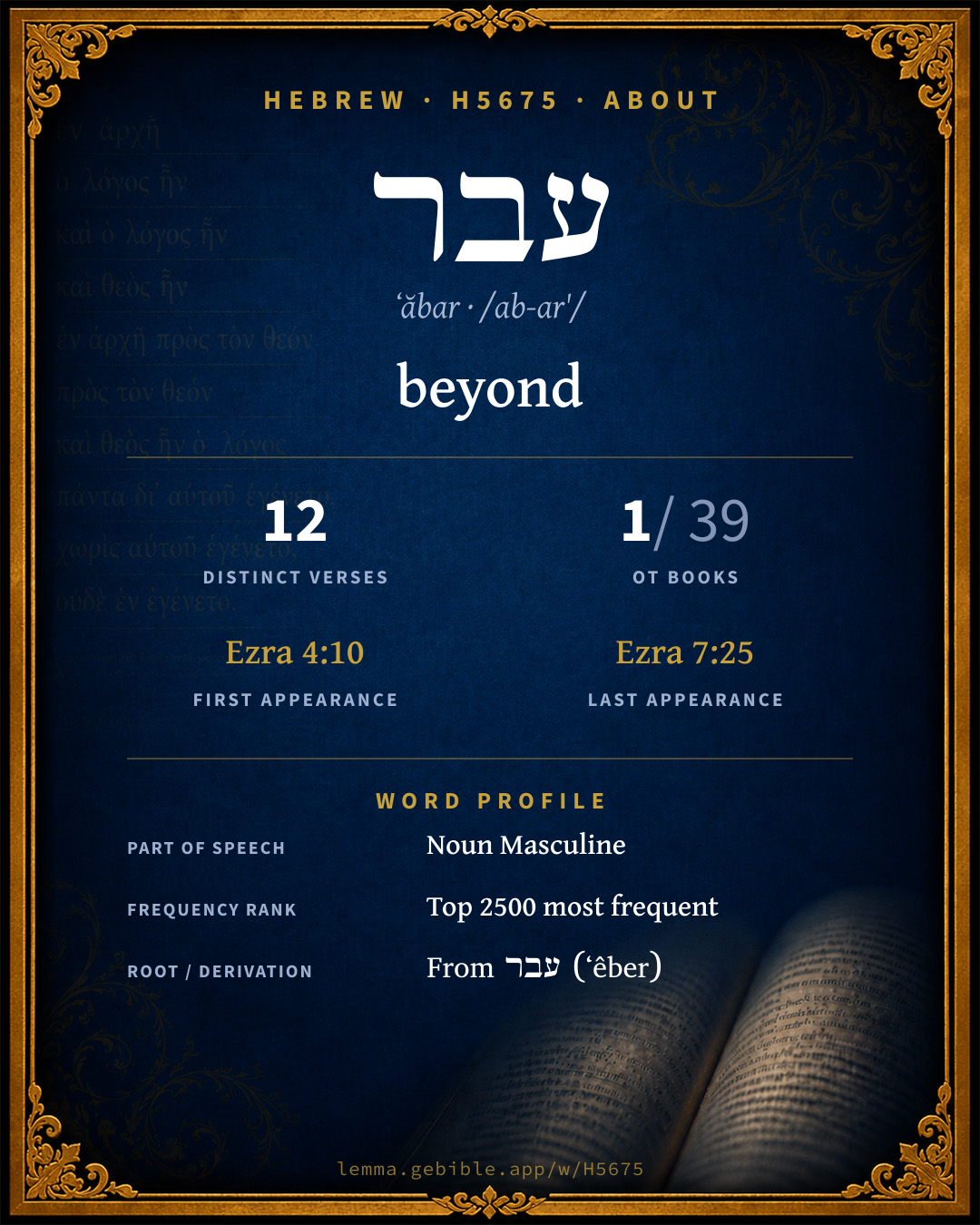
עֲבַר
beyond
Full lexicon entry — Brown-Driver-Briggs (BDB)
From Brown-Driver-Briggs (BDB)
Where this word appears
Grammar key — what these labels mean
Part of speech
- Noun
- A naming word — a person, place, thing, or idea.
Noun type
- Proper
- A name of a specific person, place, or people (e.g. Abraham, Zion, Israel).
Every verse where H5675 appears — 12 distinct verses across 1 book. Click any verse to open its interlinear word-by-word view. Verse text shown in the World English Bible for context — . Each verse’s Hebrew form is shown with its reference; the English is not keyword-highlighted, since the data carries no word-level English alignment. Use “Compare translations” on any verse to read it across multiple English versions. This concordance covers the Hebrew Bible; Septuagint (Greek Old Testament) occurrences are not indexed here.
Ezra 12 verses
- Ezra 4:10 עֲבַֽר n Proper and the rest of the nations whom the great and noble Osnappar brought over, and set in the city of Samaria, and in the rest [of the country] beyond the River, and so forth.
- Ezra 4:11 עֲבַֽר n Proper This is the copy of the letter that they sent to Artaxerxes the king: Your servants the men beyond the River, and so forth.
- Ezra 4:16 בַּ/עֲבַ֣ר prep + n Proper We inform the king that, if this city be built, and the walls finished, by this means you shall have no portion beyond the River.
- Ezra 4:17 עֲבַֽר n Proper [Then] sent the king an answer to Rehum the chancellor, and to Shimshai the scribe, and to the rest of their companions who dwell in Samaria, and in the rest [of the country] beyond the River: Peace, and so forth.
- Ezra 4:20 עֲבַ֣ר n Proper There have been mighty kings also over Jerusalem, who have ruled over all [the country] beyond the River; and tribute, custom, and toll, was paid to them.
- Ezra 5:3 עֲבַֽר n Proper At the same time came to them Tattenai, the governor beyond the River, and Shetharbozenai, and their companions, and said thus to them, Who gave you a decree to build this house, and to finish this wall?
- Ezra 5:6 עֲבַֽר בַּ/עֲבַ֣ר n Proper prep + n Proper The copy of the letter that Tattenai, the governor beyond the River, and Shetharbozenai, and his companions the Apharsachites, who were beyond the River, sent to Darius the king;
- Ezra 6:6 עֲבַֽר בַּ/עֲבַ֣ר n Proper prep + n Proper Now therefore, Tattenai, governor beyond the River, Shetharbozenai, and your companions the Apharsachites, who are beyond the River, be you far from there:
- Ezra 6:8 עֲבַ֣ר n Proper Moreover I make a decree what you shall do to these elders of the Jews for the building of this house of God: that of the king's goods, even of the tribute beyond the River, expenses be given with all diligence to these men, that they be not hindered.
- Ezra 6:13 עֲבַֽר n Proper Then Tattenai, the governor beyond the River, Shetharbozenai, and their companions, because that Darius the king had sent, did accordingly with all diligence.
- Ezra 7:21 בַּ/עֲבַ֣ר prep + n Proper I, even I Artaxerxes the king, do make a decree to all the treasurers who are beyond the River, that whatever Ezra the priest, the scribe of the law of the God of heaven, shall require of you, it be done with all diligence,
- Ezra 7:25 בַּ/עֲבַ֣ר prep + n Proper You, Ezra, after the wisdom of your God who is in your hand, appoint magistrates and judges, who may judge all the people who are beyond the River, all such as know the laws of your God; and teach you him who doesn't know them.
About this entry
At a glance — auto-summarized from this page’s data, not written by a person. Every figure links to its source below. This summary describes the numbers; it doesn’t interpret them.
עבר — transliterated ʻăbar — is a Hebrew noun carrying the sense “beyond.” Its uses cluster heavily in Ezra (100% of all occurrences). With 12 verses in 1 book, it is an uncommon word in the Hebrew Bible. Debuting at Ezra 4:10, it then recurs through the corpus. The King James Version usually renders it “side,” while modern versions prefer “west” (Berean Standard Bible) and “beyond the river” (unfoldingWord Literal Text) — see the renderings breakdown. See the sense tree, 12-verse concordance, and the renderings breakdown below.
Gloss history
Strong's 1890 vs modern scholarship
About this word
Strong's H5675 catalogs a Hebrew word from the Hebrew Old Testament.
These counts are not copied from any lexicon or concordance. They are computed here, from the morphology-tagged Hebrew Old Testament. What Lemma adds →
- 12
- distinct verses
- The word appears in 12 distinct verses.
- 1 / 39
- OT books
- The word appears in 1 of 39 Old Testament books.
- #1,910
- by frequency
- Top 2500 most frequent Hebrew words (rank 1,910 of 8,640 Hebrew words by occurrence).
View all 12 occurrences in the concordance →
Most concentrated in
- Ezra 12 verses 100%
By section of the Old Testament
By traditional corpus
Conventional, traditional groupings — biblical authorship is debated, so this is a traditional corpus grouping, not an authorship claim. Each share is this word’s portion of its verses in that division of the Hebrew canon. Each figure is a share of the word’s 12 distinct verses.
- Writings (Ketuvim) 12 verses · 100%
How translations render this word
Counts come from each version’s own published word-to-Strong’s tagging or interlinear alignment — an approximate guide to how each version renders this word, not a word-level alignment the data otherwise carries. Because each total is that version’s own tagged count, the per-version totals vary from one another and need not match the appearance or distinct-verse counts above. These counts may also differ from a printed concordance because Lemma counts each distinctly tagged rendering and does not collapse phrase taggings into a single head-word total. This is a fixed set of word-tagged versions (KJV, ASV, BSB, ULT) and does not change with the reading translation you choose elsewhere. Each version’s license is shown beside its name below (and on Sources).
- King James Version: Side 5×, Are beyond 3×, Beyond 3×
- American Standard Version: Are beyond 3×, Beyond 3×, Country beyond 3×
- Berean Standard Bible: West 7×, Region west 5×, Region 2×
- unfoldingWord Literal Text: Beyond the river 10×, Are in beyond the river 3×
King James Version Public Domain
Renders H5675 across 14 tagged occurrences — most commonly:
Plus 3 renderings that appear only once — usually multi-word phrases or single function words the recovered tagging swept in, not distinct renderings.
American Standard Version Public Domain
Renders H5675 across 14 tagged occurrences — most commonly:
Plus 2 renderings that appear only once — usually multi-word phrases or single function words the recovered tagging swept in, not distinct renderings.
Berean Standard Bible Public Domain
Renders H5675 across 14 tagged occurrences — most commonly:
unfoldingWord Literal Text CC BY-SA 4.0
Renders H5675 across 14 tagged occurrences — most commonly:
Plus 1 rendering that appears only once — usually multi-word phrases or single function words the recovered tagging swept in, not distinct renderings.
Senses in BDB
The 1 sense BDB distinguishes for this word, in lexicon order (not ranked by frequency or importance). The full entry — with sub-senses — is in the Lexicon Entry tab.
- region beyond or across
Word origin
עֲבַר n.m. region across, beyond
— Brown-Driver-Briggs (Oxford 1906, public domain), digitized via Sefaria, supplemented by the OpenScriptures HebrewLexicon (CC BY 4.0). See Sources.
Derived from עבר (ʻêber) (H5676) — side.
Jastrow Dictionary
A second Hebrew/Aramaic lexicon for comparison, covering Aramaic and post-biblical (Talmudic, Targumic, Midrashic) usage that the biblical-Hebrew BDB does not. Matched by lemma rather than by Strong’s number, so a lemma may carry more than one Jastrow headword (shown separately below), and the entries cover usage well beyond the Bible.
עָבַר
- (b. h.)
- 1. to be thick, swell; to run over. Par. VI, 4 כדי שׁיַעַבְרוּ המים וכ׳ that the water may overflow into a vessel; a. e.—Ex. R. s. 15 שאני עוֹבֵר, v. עֶבְרָה.
- 2. (cmp. סְגֵי I a. II) to pass, to cross. Tosef. Sot. VIII, 1; Sot. 33ᵇ כיצד עָבְרוּ ישראל את וכ׳ in what manner did the Israelites cross the Jordan? Cant. R. to V, 13 עוֹבֵר הוא וחוזר וכ׳ he goes over his studies once and again &c.; a. fr.—ע׳ את הדין to cross the line of justice, to be too severe. Midd. II, 2 כאילו עברו עליו וכ׳ as if they had treated him too severely (arbitrarily). Ex. R. s. 30 כשם שאני יכול לַעֲבוֹר … ואני איני מַעֲבִיר וכ׳ as I (the Lord) have power to treat the nations with rigor, but refrain from doing so, so shall you not go beyond the line of justice. Ib. עִיבְּרָה את הדין (Pi.); a. e.
- 3. (with על) to pass over (a sin); to forgive. Cant. R. to V, 5 (play on מור עובר, ib.) מר עובר ע׳ על מררי the bitterness passes away, he (the Lord) passes over my bitterness (sin). R. Hash. 17ᵃ (ref. to Mic. VII, 18) למי נושא עון למי שעובר על פשע whose iniquity does he pardon? the iniquity of him who forgives (his neighbor’s) transgression; a. e. e.g. Micah 7:18
- 4. to transgress, sin. Yoma 86ᵇ, a. e. כיון שע׳ אדם עבירה ושנה וכ׳ as soon as a man has committed a sin and repeated it, it becomes to him a permitted act. Ib. 86ᵃ, a. e. ע׳ על עשה when one has transgressed a positive law (committed a sin of omission). Ib. ע׳ על כריתות וכ׳ when one has committed sins punishable with extinction or death by a court. Erub. 100ᵃ, a. fr. עובר על בל וכ׳, v. בַּל. Keth. VII, 6 העוֹבֶרֶת על דת וכ׳ if a wife offends against Mosaic or Jewish customs, v. דַּת; Y. ib. VII, 31ᶜ top נשים המְעַבְּרוֹת על הדת (Pi.); a. v. fr.
- 5. to pass, overtake, precede. Pes. 7ᵇ כל המצות מברך עליהן עובר לעשייתן in the performance of all religious ceremonies one must say the benediction over them before doing them; מאי משמע דהאי עובר לישנא דאקדומי היא what evidence is there that this ‘ober has the meaning of precedence? Answ. by ref. to ויעבר (II Sam. XVIII, 23) ‘and he arrived before the Cushite’. e.g. 2 Samuel 18:23
- 6. to pass by, go away, be removed. Pes. III, 1 אלו עוֹבְרִין בפסח the following things must pass away (their use must be suspended) during Passover. Bets. 26ᵃ, a. fr. מום עובר a transitory blemish, opp. קבוע. Ber. 26ᵃ ע׳ יומו בטל קרבנו when its day is passed, the sacrifice of the day is void. Pes. II, 2 חמץ … שע׳ עליו הפסח leavened matter … over which Passover has passed (which had been in the house during Passover). Ber. IX, 3 הצועק לַשֶּׁעָבַר וכ׳ praying for what is passed (decided) is a vain prayer, e.g. if one’s wife is with child, and one prays, may it be the will of God that my wife bear a male child; Y. Taan. II, 65ᶜ bot. נותן הודייה לשעבר וצועק וכ׳ one gives thanks for what is passed, and prays for what is to come. Gitt. VII, 7 כל זמן שאֱעֶבוֹר מכנגד פניך וכ׳ as soon as I shall have been out of thy sight for thirty days; Tosef. ib. VII (V), 10. Keth. 17ᵃ ע׳ מלפני כלה he passed aside to make room for a bridal procession. Yoma 66ᵃ, a. e. חטאת שעָבְרָה שנתה a sin-offering whose year is passed (that is older than one year); Tem. 22ᵃ שעִיבְּרָה שנתה (Pi.) whose year is completed (v. infra). Ib. 21ᵇ בכור שעברה שנתו a first-born animal older than one year; R. Hash. 5ᵇ; Zeb. 29ᵃ bot. שעיברה; Tosef. Snh. III, 6 בכור שעיברה זמנו ed. Zuck. (read with Var.: שעבר). Keth. 87ᵃ על שֶׁעָ׳ as regards the past, v. עָתִיד; a. v. fr.—לַשֶּׁעָ׳ in former days. Gen. R. s. 47, opp. עַכְשָׁיו; a. fr.
- 1. to lead past, stroke gently. Tosef. Sabb. VII (VIII), 23 [read:] מַעֲבִירִין על גבי העין בשבת you are permitted to stroke a sore eye on the Sabbath; Y. ib. XIV, 14ᶜ bot. מעבירין על העין. Ib. הֶעֱבִירוּ עליו כלים they passed garments over it.
- 2. to cause to pass; to remove, displace. Keth. 17ᵃ מַעֲבִירִין את המת מלפני כלה וכ׳ a funeral procession is made to make way for a bridal procession, and both of them for the king, v. supra. Gitt. 57ᵇ שאין אנו מעבירין אותו באל אחר that we shall never displace him for another god; שאין מַעֲבִיר אותנו וכ׳ that he will never displace us for another nation. Ex. R. s. 30 כאילו היא מעביר איקינין וכ׳ as if he removed (defaced) the king’s portrait; a. fr.
- 3. to go beyond. Ib. איני מעביר וכ׳, v. supra. Ib. הבריות מעבירין על הדין וכ׳ men go beyond the line of justice (are treacherous, cruel), and they are punished; a. e.
- 4. to skip over; to forego, postpone.—ה׳ על מדותיו, v. מִדָּה.—Yoma 33ᵃ; 58ᵇ, a. fr. אין מעבירין על המצות you must not forego the occasion for performing a religious act. Erub. 64ᵇ אין מעבירין על האוכלין you must not pass by eatables (and let them lie in the street); B. Mets. 23ᵃ; a. fr.
- 5. to forego, overlook, pardon. R. Hash. 17ᵃ (ref. to Mic. VII, 18) מעביר ראשון ראשין וכך היא המדה (Ms. M. על ראשון וכ׳; v. Rabb. D. S. a. l. note) he pardons one sin after the other (before they are put on the scale), and such is the divine dealing. Ib. מעבירין לו על כל פשעיו all his transgressions are pardoned; a. fr. e.g. Micah 7:18
- 6. to cause to forego or disregard. Erub. 41ᵇ שלשה דברים מעבירין … על וכ׳ three things make a man disregard his own sense (of right) and the sense of his Maker; a. e.
- 1. to be completed, full. Tem. 22ᵃ, a. e., v. supra.
- 2. to transgress repeatedly. Y. Keth. VII, 31ᶜ top, v. supra.
- 3. to go beyond. Ex. R. l. c. עיברה את הדין, v. supra. [Tosef. B. Kam. VI, 22 שעיברה הדליקה עד, read with Y. ib. VII, 5ᶜ. שעברה … את.]
- 4. (v. עוּבָּר) to carry, be with young. Kidd. 31ᵇ כי עִבַּרְתּוֹ אמו וכ׳ while his mother was pregnant with him, his father died. Tosef. B. Kam. X, 1 ועִיבְּרָה אצלו (B. Kam. IX, 1 ונִתְעַבְּרָה) and the cow became pregnant while she was in his possession. Ḥull. 58ᵃ; a. fr.—Part. pass. f. מְעוּבֶּרֶת; pl. מְעוּבָּרוֹת pregnant. Yeb. XVI, 1. Ib. 36ᵇ, a. e. מע׳ חבירו a woman who is with child of another man (divorced or widowed during pregnancy). Gen. R. s. 85 מלכים אני מע׳ גואלים אני מע׳ I am pregnant with kings, with redeemers (kings and redeemers are destined to be of my offspring). Yeb. III, 10; a. fr.—4) (v. עִיבּוּר) to extend the city limits, for the purpose of defining Sabbath distances, in cases of buildings projecting beyond the city lines (outskirts). Erub. V, 1 כיצד מְעַבְּרִין וכ׳ (v. אָבַר), defined ib. 53ᵃ; Y. ib. V, beg. 22ᵇ; Y. Ber. VII, 12ᶜ top כאשה עוברה like a pregnant woman; Tosef. Ber. VI (V), 1; a. e.—6) to complement, add to, esp. to intercalate a month, (second Adar); proclaim a leap year; to complement a month (v. מָלֵא) by assigning to it an additional day (thirty days). Tosef. Snh. II, 1 שנים אומרים צריכה לְעַבֵּר if two judges say, it is necessary to intercalate a month. Ib. 2 על שלשה סימנים מעברין וכ׳ on three indications the intercalation is decided; על שנים מעברין וכ׳ when two of them exist, the intercalation is decreed. Ib. ואם עִיבְּרוּהָ הרי זו מעוברת but if they proclaimed it a leap-year, it remains a leap-year; a. fr.—Part. pass. מְעוּבָּר; f. מְעוּבֶּרֶת. R. Hash. 19ᵇ אלול מע׳ an Elul of thirty days. Snh. 11ᵇ אינה מע׳ the year is not a leap-year (the declared intercalation is invalid); a. fr.
- 1. to swell (with anger), to become wroth. Sifré Num. 135 (expl. ויתעבר, Deut. III, 26) כאדם שאומר נ׳ בי פלוני נתמלא וכ׳ as a man says, that man (became full) got wroth with me, meaning, he was filled with wrath against me; Yalk. Deut. 818; Sifré Deut. 29 כאשה שאינה יכולה לשוח מפני עוברה (swelled,) like a woman that cannot bend down on account of the child she is pregnant with; v. עֶבְרָה. e.g. Deuteronomy 3:26
- 2. to become pregnant. Gen. R. s. 45 מביאה … נִתְעַבְּרָה she conceived on her first intercourse; אין אשה מִתְעַבֶּרֶת וכ׳ no woman conceives on &c.; Yeb. 34ᵃ. Ib. 34ᵇ כדי שלא תִתְעַבֵּר וכ׳ that she may not become with child, and her beauty &c., v. כָּחַשׁ. B. Kam. IX, 1 ונתעברה אצלו, v. supra; a. fr.
- 3. to be extended, to be consolidated into one township. Y. Erub. V, 22ᵇ bot. יכול אני … בית מעון מתעברת וכ׳ I can cause Beth Ma‘on and Tiberias to be considered one township (as regards Sabbath distances).
- 4. to be added to, to be proclaimed a full month (of thirty days), a leap-year (of thirteen months). Y. R. Hash. III, beg. 58ᶜ ניסן לא נ׳ מימיו Nisan was never made a full month (by decree of the court); Y. Shebi. X, beg. 39ᵇ; a. e.—Snh. 12ᵃ ראויה … שתִּתְעַבֵּר that year ought to have been a leap-year. B. Mets. נִתְעַבְּרָה השנה נתע׳ לשוכר if the year was made a leap-year, the tenant (that rented by the year) reaps the benefit of the intercalation. R. Hash. 19ᵇ; a. fr.
- (with עֲבֵרָה) to be committed. Tosef. B. Kam. X, 3 בהמה ונֶעֶבְרָה בה עבירה if one stole a beast, and some sinful act was committed on it (by which it became forbidden for any benefit); (B. Kam. IX, 2, a. fr. נעבדה … עבירה).
עֲבַר
- , to pass, cross, step over, forgive &c. (v. preced.). Impf. יְעִיבַּר; infin. מִיעִיבַּר. Targ. Gen. XXXII, 17. Ib. XII, 6. Targ. O. Deut. XVII, 2 מִיעִיבַּר ed. Berl. (oth. ed. מֶעְבַּר, מֶעֱבַר; Y. מֵעִיבַר). Targ. Ps. CXXIV, 4; a. v. fr.—Sabb. 40ᵃ האי מאן דע׳ אדרבנן he who disregards Rabbinical enactments. Y. ib. VII, 9ᵃ top; Y. Yeb. VIII, 9ᶜ עַבְרַת בידך וכ׳, v. בְּדִי I. Y. Ab. Zar. III, 43ᵇ bot. מהו נִיעֲבוֹר קומוי how about passing it by?; … עבור וסמי עיניה pass it and ignore it, v. סְמֵי; Y. Ber. II, 4ᵇ מהו מִיעֲבוֹר (not מיהו); Y. Shek. II, 47ᵃ top; a. fr.
- as preced. Hif. Targ. O. Lev. XVIII, 21 לאָעַבָרָא ed. Berl. (oth. ed. לאַעְבָּ׳, לאַעֲבָ׳). Targ. Gen. XLVII, 21. Targ. Ex. XXXVI, 6.—Targ. II Sam. XII, 13.—Targ. Mic. VII, 18; a. v. fr.—Esp. (b. h. עִבֵּר) to pass through; to bar. Targ. I Kings VI, 21. Targ. O. Ex. XXXVI, 33.—Part. pass. מַעְבַּר passed through, barring. Ib. XXVI, 28.—Ḥag. 5ᵃ מַעְבִּיר במיליה = h. מַעֲבִיר על מדותיו, v. preced. a. מִדָּה.
- 1. to be with child, to conceive. Targ. Ps. LI, 7 עַבְּרַת (ed. Lag. עברית, Bxt. עֲבָרַת, corr. acc.). Targ. Y. Num. XI, 12 (ed. Vien. עֲבָרִית, corr. acc.); a. fr.—Part. pass. f. מְעַבְּרָא, מְעַבְּרָה, מְעַבַּרְתָּא; pl. מְעַבְּרָתָא. Targ. Y. Gen. XVI, 11. Ib. XXXVIII, 24; a. e.—B. Kam. 47ᵃ פרה מע׳ a pregnant cow. Ḥull. 59ᵇ אַפִּילוּ כל מע׳ all pregnant women miscarried; a. e.
- 2. as preced. Hif., to cause to pass; to remove, displace; to cover up. Ab. Zar. 65ᵇ מְעַבֵּר להו מעברא he passed them over the ford. Yoma 33ᵇ עַבּוּרֵי דרעא וכ׳, v. דְּרָעָא. Erub. 65ᵃ, v. פּוּק. Ḥull. 18ᵃ שמתיה ועַבְּרֵיה he excommunicated him and removed him (from his office). Ib. מְעַבְּרִינָן ליה וכ׳ we remove him and declare his meat ṭ’refah. Ber. 27ᵇ תא ונְעַבְּרֵיה come, let us displace him. Ib. 39ᵃ לעבורי זוהמא to carry off foul matter. Y. Ber. II, 4ᶜ bot. הוה מעבר וכ׳ covered it with a sheet, v. פַּלְיוּם; a. fr.—Yeb. 63ᵇ עבורו, v. infra.
- 3. to declare a full month, a leap year. Targ. I Chr. XII, 32. Targ. Cant. VII, 5; a. e.—Snh. 11ᵇ בתר דעַבְּרוּהָ after they had declared it a leap year. R. Hash. 20ᵃ עַבְּרוּהָ לאלול they have declared Elul a full month; a. e.—Part. pass. מְעַבַּר; f. מְעַבַּרְתָּא. Snh. 12ᵇ שתא מע׳ a leap year; a. e.
- 1. to become pregnant. Targ. Y. Gen. XIX, 36, sq.; a. e.—Yeb. 45ᵃ אִיעַבְּרָא מכותי was with child by a Samaritan.
- 2. to get over it, to be appeased. Yeb. 63ᵇ מתקיף … ועַבּוּרֵי איעברא במילא she is irascible, but is easily appeased with a word.
- 3. to be waded through, be crossed. Targ. Ez. XLVII, 5.
עֵבֶר I
- (b. h.) pr. n. m. Eber, a descendant of Shem, believed to have maintained schools (oracles) in connection with Shem. Gen. R. s. 63 (ref. to Gen. XXV, 22) למדרשו של שם וע׳ to the school of Shem and Eber. Gen. R. s. 37 נביא גדול היה ע׳ וכ׳ E. was a great prophet, for he gave names alluding to coming events. Ib. s. 42 (expl. העברי, Gen. XIV, 13) שהוא מבני בניו של ע׳ because he is a descendant of Eber; a. fr. e.g. Genesis 25:22
עֵבֶר II
- border, bank, side. Gen. R. s. 42 (expl. העברי, v. preced.) כל העולם כולו מֵעֵ׳ אחד וכ׳ the whole world was on one side (idolaters), and he (Abraham) on the other side; שהוא מע׳ הנהר וכ׳ because he came from the banks of the river (Euphrates), and spoke the Hebrew language (v. עִבְרִו).—מע׳ לים beyond the sea. Erub. 55ᵃ (ref. to Deut. XXX, 12) … אם מע׳ לים לעבור אחריה if the Law be beyond the sea, thou must go over to learn it. e.g. Deuteronomy 30:12
עֵבַר
- , v. עֵיבַר II, a. next w.
A Dictionary of the Targumim, the Talmud Babli and Yerushalmi, and the Midrashic Literature (Marcus Jastrow; London, Luzac, 1903) — Public Domain. Digitized via Sefaria. Digitized via Sefaria. Full attribution on Sources.
Forms in the corpus
The 3 distinct written forms H5675 takes in the Hebrew Bible, most frequent first — each parse links to that state’s occurrences in the concordance. Hebrew forms include their vowel points and cantillation, so a single lemma takes many written forms.
| Form | Parsing | Example | Uses |
|---|---|---|---|
| עֲבַֽר | Noun, Proper | Ezra 4:10 | 7 |
| בַּ/עֲבַ֣ר | Noun, Proper | Ezra 4:16 | 5 |
| עֲבַ֣ר | Noun, Proper | Ezra 4:20 | 2 |
Same root — word family
Other BDB entries built from the same root as H5675, grouped by Strong’s listed origin. These share a root / origin per the lexicon — not necessarily a shared meaning. Each links to that word’s own entry.
Derives from
Shares the same root
Proper names from this root
People and places named from this root — a name, not an additional meaning of the word.
Compare all same-root words → Showing 4 of 6 — not the complete family. 3 of the same-root words are proper names (people or places). They share a root, not necessarily a meaning.
Septuagint verse parallels
This word appears in 12 verses that also exist in the Greek Old Testament (Septuagint), out of the 12 Hebrew verses it occurs in. You can read those verses in Greek by switching the Old Testament edition to the Septuagint.
Read these verses in the Septuagint
This is a verse-level parallel only — the same verses exist in both the Hebrew and Greek Old Testaments. No word-level Hebrew↔Greek correspondence is claimed: the data carries no such alignment, so no Greek word is shown as this Hebrew word’s translation. Coverage is not total — the Septuagint omits the deuterocanon and renumbers the Psalms, so some Hebrew verses have no direct Greek parallel.