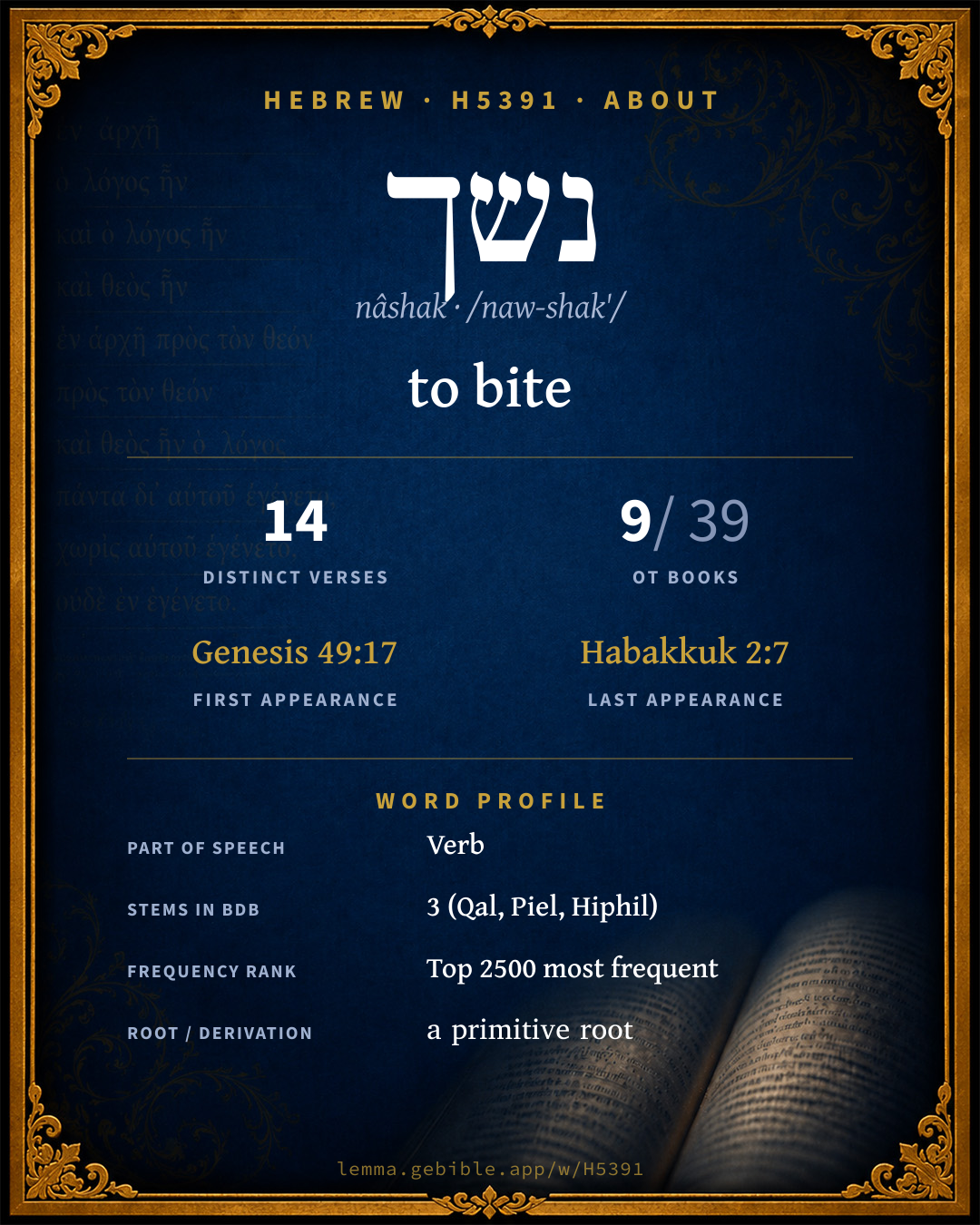
נָשַׁךְ
to bite
‘to bite’ is one of 2 main senses fuller range ↓
Full lexicon entry — Brown-Driver-Briggs (BDB)
From Brown-Driver-Briggs (BDB)
Where this word appears
See every Qal verb in the Hebrew Bible →
Grammar key — what these labels mean
Part of speech
- Verb
- An action or state-of-being word.
Stem
- Hiphil
- The causative active stem (“he caused / brought about”). Here: ‘make one give interest’
- Qal
- The basic, simple active stem — the plain form of the verb (“he wrote”).
- Piel
- An intensive or resultative active stem.
Form
- Imperfect
- An incomplete, ongoing, or future action (“he will / would write”).
- Sequential Perfect
- A perfect with prefixed waw continuing a preceding imperfect or command (waw-consecutive perfect).
- Sequential Imperfect
- An imperfect with prefixed waw — the standard past-narrative form (waw-consecutive imperfect).
- Perfect
- A completed action or state — Hebrew marks aspect (completeness) more than strict tense (“he wrote”).
- Participle Active
- A verbal adjective expressing ongoing or characteristic action (“writing / one who writes”).
- Participle Passive
- A verbal adjective expressing action received (“written”).
State
- Absolute
- The independent form of a noun, not bound to a following word.
- Construct
- A noun bound to a following noun in a possessive / “of” relationship (the construct chain).
Person
- 2nd Person
- The one addressed (“you”).
- 3rd Person
- The one spoken about (“he / she / it / they”).
Gender
- Masculine
- Grammatically masculine.
- Common
- Either gender — not distinguished for this form.
Number
- Singular
- One.
- Plural
- More than one (in Hebrew, generally three or more).
2 verses where H5391 appears in the Qal stem in the Book of Numbers. Filtered view — show all forms. Click any verse to open its interlinear word-by-word view. Verse text shown in the World English Bible for context — . Each verse’s Hebrew form is shown with its reference; the English is not keyword-highlighted, since the data carries no word-level English alignment. Use “Compare translations” on any verse to read it across multiple English versions. This concordance covers the Hebrew Bible; Septuagint (Greek Old Testament) occurrences are not indexed here.
Numbers
- Numbers 21:8 הַ/נָּשׁ֔וּךְ ptcl def.art + Qal ptcp.pass ms Yahweh said to Moses, Make you a fiery serpent, and set it on a standard: and it shall happen, that everyone who is bitten, when he sees it, shall live.
- Numbers 21:9 נָשַׁ֤ךְ Qal pf 3ms Moses made a serpent of brass, and set it on the standard: and it happened, that if a serpent had bitten any man, when he looked to the serpent of brass, he lived.
About this entry
At a glance — auto-summarized from this page’s data, not written by a person. Every figure links to its source below. This summary describes the numbers; it doesn’t interpret them.
At its core, נשך (nâshak) means “to bite.” Scripture first uses it in Genesis 49:17. Spanning 14 verses in 9 books, it ranks among the uncommon words of the Hebrew Bible. As a verb its force shifts by stem, across 3 stems (Qal, Piel, and more). From the same root come נשך. Each statement above links to its evidence; the full detail follows below.
Gloss history
Strong's 1890 vs modern scholarship
About this word
Strong's H5391 catalogs a Hebrew word from the Hebrew Old Testament.
These counts are not copied from any lexicon or concordance. They are computed here, from the morphology-tagged Hebrew Old Testament. What Lemma adds →
- 14
- distinct verses
- The word appears in 14 distinct verses.
- 9 / 39
- OT books
- The word appears in 9 of 39 Old Testament books.
- #1,752
- by frequency
- Top 2500 most frequent Hebrew words (rank 1,752 of 8,640 Hebrew words by occurrence).
View all 14 occurrences in the concordance →
Most concentrated in
- Numbers 3 verses 21%
- Deuteronomy 2 verses 14%
- Ecclesiastes 2 verses 14%
By section of the Old Testament
By traditional corpus
Conventional, traditional groupings — biblical authorship is debated, so this is a traditional corpus grouping, not an authorship claim. Each share is this word’s portion of its verses in that division of the Hebrew canon. Each figure is a share of the word’s 14 distinct verses.
- Torah (Pentateuch) 6 verses · 43%
- Prophets (Nevi'im) 5 verses · 36%
- Writings (Ketuvim) 3 verses · 21%
How translations render this word
Counts come from each version’s own published word-to-Strong’s tagging or interlinear alignment — an approximate guide to how each version renders this word, not a word-level alignment the data otherwise carries. Because each total is that version’s own tagged count, the per-version totals vary from one another and need not match the appearance or distinct-verse counts above. These counts may also differ from a printed concordance because Lemma counts each distinctly tagged rendering and does not collapse phrase taggings into a single head-word total. This is a fixed set of word-tagged versions (KJV, ASV, BSB, ULT) and does not change with the reading translation you choose elsewhere. Each version’s license is shown beside its name below (and on Sources).
BDB lists this Strong’s number as 2 distinct words (homographs). Each count above pools all of them and is not split by sense — see the Senses section below. A low-frequency rendering may belong to a different one of those words, not the primary meaning.
- King James Version†: Biteth 2×, Shall bite 2×, Thou shalt not lend upon usury 2×
- American Standard Version†: Bite 2×, Biteth 2×, Thou shalt not lend upon interest 2×
- Berean Standard Bible†: Bites 3×
- unfoldingWord Literal Text†: Bites 3×, Charge interest 2×, You shall 2×
King James Version Public Domain
Renders H5391 across 16† tagged occurrences — most commonly:
Plus 10 renderings that appear only once — usually multi-word phrases or single function words the recovered tagging swept in, not distinct renderings.
American Standard Version Public Domain
Renders H5391 across 17† tagged occurrences — most commonly:
Plus 11 renderings that appear only once — usually multi-word phrases or single function words the recovered tagging swept in, not distinct renderings.
Berean Standard Bible Public Domain
Renders H5391 across 15† tagged occurrences — most commonly:
Plus 12 renderings that appear only once — usually multi-word phrases or single function words the recovered tagging swept in, not distinct renderings. Not rendered by a distinct English word in 1 further occurrence.
unfoldingWord Literal Text CC BY-SA 4.0
Renders H5391 across 19† tagged occurrences — most commonly:
Plus 12 renderings that appear only once — usually multi-word phrases or single function words the recovered tagging swept in, not distinct renderings.
Senses in the full BDB
Hebrew verbs can shift meaning by stem (binyan): Qal is the basic action, Niphal is often passive or reflexive, Piel often intensifies or makes it factitive, and Hiphil is typically causative. The senses below are grouped under the stem BDB assigns to each.
What do BDB’s symbols mean?
BDB uses these scholarly abbreviations:
| Symbol | Meaning |
|---|---|
| 𝔊 | the Septuagint (the ancient Greek translation, LXX) |
| 𝔙 | the Vulgate (the Latin translation) |
| 𝔖 | the Syriac version (the Peshitta) |
| 𝔗 | the Targum (the Aramaic translation) |
| ψ | the Psalms |
| √ | root (the underlying root or stem) |
| ‖ | parallel passage (a synonymous or contrasted parallel) |
| † | the dagger: every passage where the word occurs is cited |
The 4 senses and sub-senses the full Brown-Driver-Briggs lexicon distinguishes for this word, in lexicon order (not ranked by frequency), with BDB’s own verbatim wording and sub-sense lettering. Shown in Hebrew script with BDB’s own scholarly abbreviations. The condensed entry is in the Lexicon Entry tab. See also the Forms in the corpus table below.
נשך I bite (NH = BH, but also transp. נְכַשׁ Hiph.)
Qal
- Pf. 3 ms. נָשַׁךְ Nu 21:9, sf. וּנְשָׁכוֹ consec. Am 5:19, וּנְשָׁכָם consec. 9:3; Impf. 3 ms. יִשֹּׁךְ Ec 10:11, יִשֹּׁ֑ךְ Pr 23:32, sf. יִשְּׁכֶנּוּ Ec 10:8; Pt. act. נֹשֵׁךְ Gn 49:17; pl. נֹשְׁכִים Mi 3:5, sf. נֹשְׁכֶיךָ Hb 2:7; pass. נָשׁוּךְ Nu 21:8;—bite, chiefly of serpent, c. acc., Am 5:19; 9:3 Gn 49:17 (poem in J), Nu 21:8 (pt. pass., abs.), v 9, Ec 10:8 also v 11 (abs.), Pr 23:32 (sim. of wine); fig. of prophets הַנּ׳ בְּשִׁנֵּיהֶם Mi 3:5 who are biting with their teeth, and crying, Peace! fig. of oppression, etc., נֹשְׁכֶיךָ Hb 2:7 (with play on sense thy debtors, those that give thee interest). e.g. Numbers 21:9
Piel
- Pf. 3 pl. וְנִשְּׁכוּ אֶתְכֶם Je 8:17 and they shall bite you fatally (fig.); Impf. 3 mpl. וַיְנַשְּׁכוּ אֶת־הָעָם Nu 21:6 and they bit the people fatally (both of serpents). e.g. Jeremiah 8:17
נשך II denom. pay, give interest (cf. GerberVerba. denom. 89)
Qal
- Impf. 3 ms. יִשָּׁ֑ךְ Dt 23:20 interest of anything off which one giveth interest (cf. Dr). e.g. Deuteronomy 23:20
Hiphil
- make one give interest; Impf. 2 ms. תָּשִּׁיךְ Dt 23:20 (+ acc. cogn.) v 21(×2), all c. לְ pers. e.g. Deuteronomy 23:20
Senses from the full Brown-Driver-Briggs lexicon (Brown, Driver, Briggs; Oxford 1906 — public domain), digitized via Sefaria, supplemented by the OpenScriptures HebrewLexicon (CC BY 4.0). Full attribution on Sources.
Word origin
I. vb. bite (NH = BH, but also transp. נְכַשׁ Hiph.); Assyrian našâku DlHWB 486; 𝔗 נְכֵית (especially of snakes); Syriac ܢܟܰܬ, ܢܟܶܬ; Ethiopic ነሰከ Di 642; BaZMG xliii (1889), 188 cp. Arabic نَكَثَ, undo threads, untwist rope, disintegrate, dissolve);—
II. vb. denom. pay, give interest (cf. GerberVerba. denom. 89);—
— Brown-Driver-Briggs (Oxford 1906, public domain), digitized via Sefaria, supplemented by the OpenScriptures HebrewLexicon (CC BY 4.0). See Sources.
Origin: a primitive root
Jastrow Dictionary
A second Hebrew/Aramaic lexicon for comparison, covering Aramaic and post-biblical (Talmudic, Targumic, Midrashic) usage that the biblical-Hebrew BDB does not. Matched by lemma rather than by Strong’s number, so a lemma may carry more than one Jastrow headword (shown separately below), and the entries cover usage well beyond the Bible.
נָשַךְ
- 1. to bite. Gen. R. s. 74, beg. שאינן נוֹשְׁכִין ואוכלין וכ׳ they do not bite off and eat, but out &c.; Pesik. Par., p. 34ᵃ; Koh. R. to VII, 23. Pirké d’R. El. ch. XXXVII אל תהי קורא וישקהו אלא וַיִּשָּׁכֵהוּ read not, ‘and he kissed him’ (Gen. XXXIII, 4) but, ‘and he bit him.’ Tosef. B. Kam. I, 5 אינה מועדת … לִישּׁוֹךְ is not considered as forewarned (v. מוּעָד) as regards … biting; a. fr.—Part. pass. נָשׁוּךְ, f. נְשׁוּכָה &c. Num. R. s. 20 רופא … בלשונו נְשׁוּךְ נחש a physician that comes to heal with his tongue (charm) one bitten by a serpent. Ter. VIII, 6 נְשׁוּכַת הנחש וכ׳ any food showing traces of being bitten at by a serpent is forbidden &c.; a. fr.—Trnsf. to adhere to, be affixed. Pes. 48ᵇ ככרות … שנוֹשְׁכוֹת זו מזו Babylonian loaves which stick to one another; T’bul Yom I, 1 נושכות זו בזו; Ḥall. II, 4 עד שיִשּׁוֹכוּ (Nif.) until the pieces of dough have grown together in rising, contrad. to נגע. Sabb. 17ᵃ הנושכות clusters of grapes which stick together (and cannot be separated without squeezing some grapes open); a. fr.—Part. pass. as ab. Y. Ḥall. I, 57ᵇ בנ׳ if refers to pieces of dough sticking together, contrad. to בלול kneaded. Ib. III, 59ᶜ top עיסת הנ׳ dough made one lump by sticking; נ׳ מאליו sticking together of itself (by rising), opp. הִשִּׁיכוֹ בידו he pasted it together with his hand. Ib. 58ᵇ bot., sq. הנָ׳ תורה the liability to T’rumah, Ḥallah &c. of joined lumps of dough is Biblical law. Y. Kil. IX, end, 32ᵈ אין אסור אלא נ׳ בלבד the combination of heterogeneous materials (כִּלְאַיִם) is forbidden only when they are interlaced. Ib. וההן נו נ׳, v. נוּ. e.g. Genesis 33:4
- 2. (denom. of נֶשֶׁךְ) to take interest. B. Mets. V, 1; a. e.
- same, to bite. Gen. R. s. 78 לנַשְּׁכוֹ to bite him. Tanḥ. Vayishl. 4 וינַשְּׁכֶנּוּ and may bite him; a. e.—Part. pass. מְנוּשָּׁךְ. Tosef. B. Kam. III, 6 או מ׳ or he is found to have been bitten.
- 1. to cause to bite. Snh. IX, 1 ה׳ בו וכ׳ he brought the serpent near him to bite him, contrad. to שיסה to set on. Ib. 78ᵃ; B. Kam. 23ᵇ, v. נָכַשׁ. Y. Yeb. VIII, 9ᵇ top [read:] מביא נמלין ומַשִּׁיכָן וקוצץ he gets ants and makes them bite (the open wound) and cuts their bodies off (and so the gap is filled), v. Bab. ib. 76ᵃ.—Trnsf. to paste or press together. Y. Ḥall. III, 59ᶜ top, v. מביא ארבע רובעין ומַשִּׁיךְ he takes four lumps of dough which joined contain four fourths of a Kab and presses them together into one lump; a. e.
- 2. to pay interest. B. Mets. 70ᵇ (ref. to Deut. XXIII, 21) מאי תשיך לאו תִּשּׁוֹךְ לא תַּשִּׁיךְ what is meant by tashshikh? Does it not mean thou mayest (or must) take interest? No, it means, thou mayest (or must) pay him interest. e.g. Deuteronomy 23:21
נֶשֶׁךְ
- preced.) [bite, trnsf., cmp. חִבּוּלְיָא) usury, interest. B. Mets. V, 1 איזהו נ׳ המלוה וכ׳ what is neshekh? If one loans a Sela stipulating the debt at five Denars, contrad. to תַּרְבִּית. Ib. 60ᵇ נ׳ איכא דקא נכית וכ׳ in this case it is neshekh, for he bites (injures the debtor) by receiving what he had not given him; a. fr.
A Dictionary of the Targumim, the Talmud Babli and Yerushalmi, and the Midrashic Literature (Marcus Jastrow; London, Luzac, 1903) — Public Domain. Digitized via Sefaria. Digitized via Sefaria. Full attribution on Sources.
Forms in the corpus
The 16 distinct written forms H5391 takes in the Hebrew Bible, most frequent first — each parse links to that stem’s occurrences in the concordance. Hebrew forms include their vowel points and cantillation, so a single lemma takes many written forms.
Same root — word family
Other BDB entries built from the same root as H5391, grouped by Strong’s listed origin. These share a root / origin per the lexicon — not necessarily a shared meaning. Each links to that word’s own entry.
Derived from this word
Compare all same-root words → They share a root, not necessarily a meaning.
Septuagint verse parallels
This word appears in 14 verses that also exist in the Greek Old Testament (Septuagint), out of the 14 Hebrew verses it occurs in. You can read those verses in Greek by switching the Old Testament edition to the Septuagint.
Read these verses in the Septuagint
- Genesis 49:17
- Numbers 21:6
- Deuteronomy 23:19
- Proverbs 23:32
- Ecclesiastes 10:8
- Jeremiah 8:17
- Amos 5:19
- Micah 3:5
- Habakkuk 2:7
This is a verse-level parallel only — the same verses exist in both the Hebrew and Greek Old Testaments. No word-level Hebrew↔Greek correspondence is claimed: the data carries no such alignment, so no Greek word is shown as this Hebrew word’s translation. Coverage is not total — the Septuagint omits the deuterocanon and renumbers the Psalms, so some Hebrew verses have no direct Greek parallel.