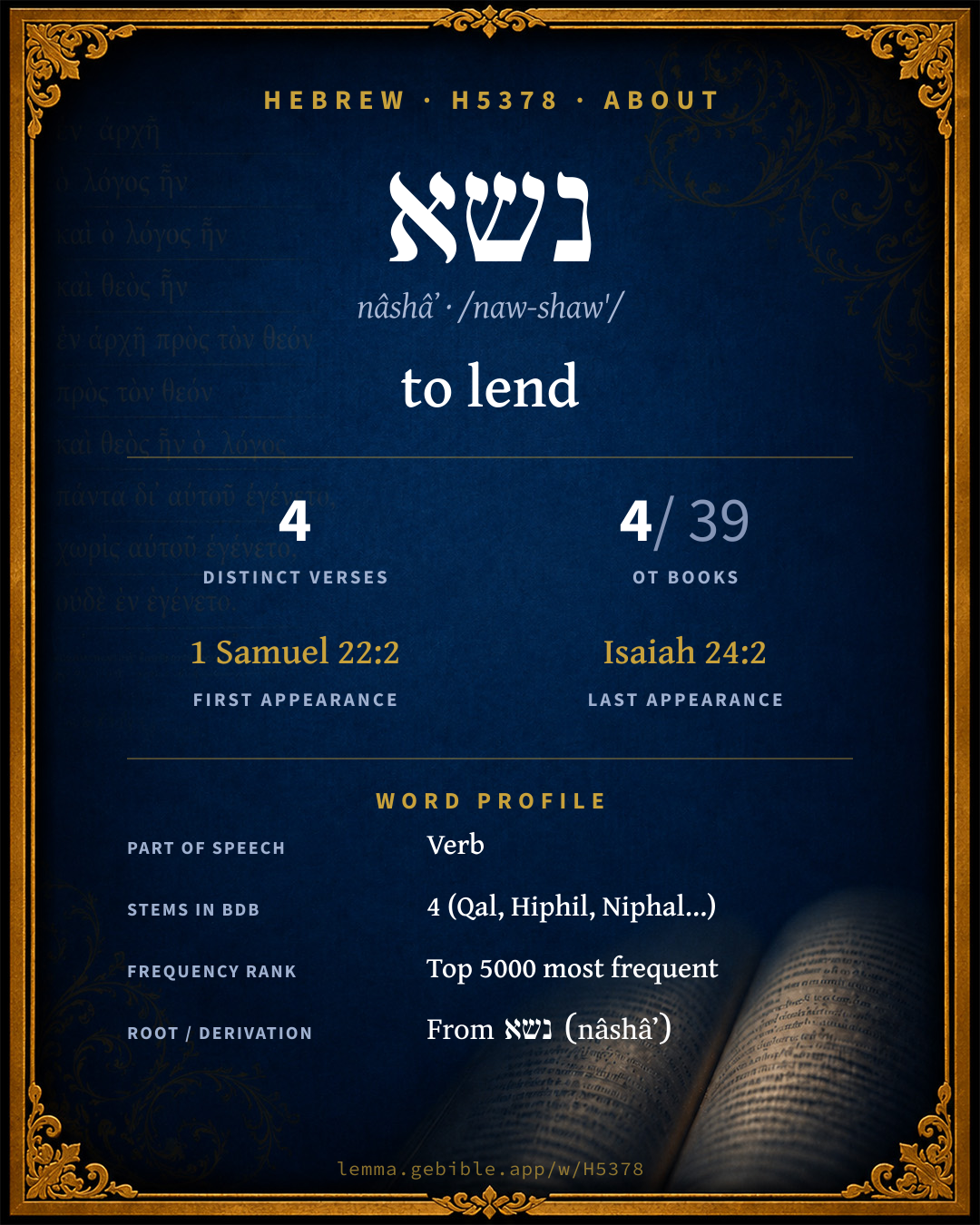
נָשָׁא
to lend
‘to lend’ is one of 3 main senses fuller range ↓
Full lexicon entry — Brown-Driver-Briggs (BDB)
From Brown-Driver-Briggs (BDB)
Where this word appears
Grammar key — what these labels mean
Part of speech
- Verb
- An action or state-of-being word.
Stem
- Qal
- The basic, simple active stem — the plain form of the verb (“he wrote”). Here: ‘act.’
- Hiphil
- The causative active stem (“he caused / brought about”).
Form
- Participle Active
- A verbal adjective expressing ongoing or characteristic action (“writing / one who writes”).
- Sequential Perfect
- A perfect with prefixed waw continuing a preceding imperfect or command (waw-consecutive perfect).
- Imperfect
- An incomplete, ongoing, or future action (“he will / would write”).
State
- Absolute
- The independent form of a noun, not bound to a following word.
Person
- 3rd Person
- The one spoken about (“he / she / it / they”).
Gender
- Masculine
- Grammatically masculine.
Number
- Singular
- One.
Every verse where H5378 appears in the Book of Psalms — 1 distinct verse. Click any verse to open its interlinear word-by-word view. Verse text shown in the World English Bible for context — . Each verse’s Hebrew form is shown with its reference; the English is not keyword-highlighted, since the data carries no word-level English alignment. Use “Compare translations” on any verse to read it across multiple English versions. This concordance covers the Hebrew Bible; Septuagint (Greek Old Testament) occurrences are not indexed here.
Psalms
About this entry
At a glance — auto-summarized from this page’s data, not written by a person. Every figure links to its source below. This summary describes the numbers; it doesn’t interpret them.
נשא (nâshâʼ) is a Hebrew verb most often rendered “to lend.” The Hebrew Bible uses it only 4 verses. It concentrates in 1 Samuel, which alone accounts for 25% of its uses. It first appears in 1 Samuel 22:2. As a verb its force shifts by stem, across 4 stems (Qal, Hiphil, and more). For the data behind this summary, explore the sense tree and the renderings breakdown below.
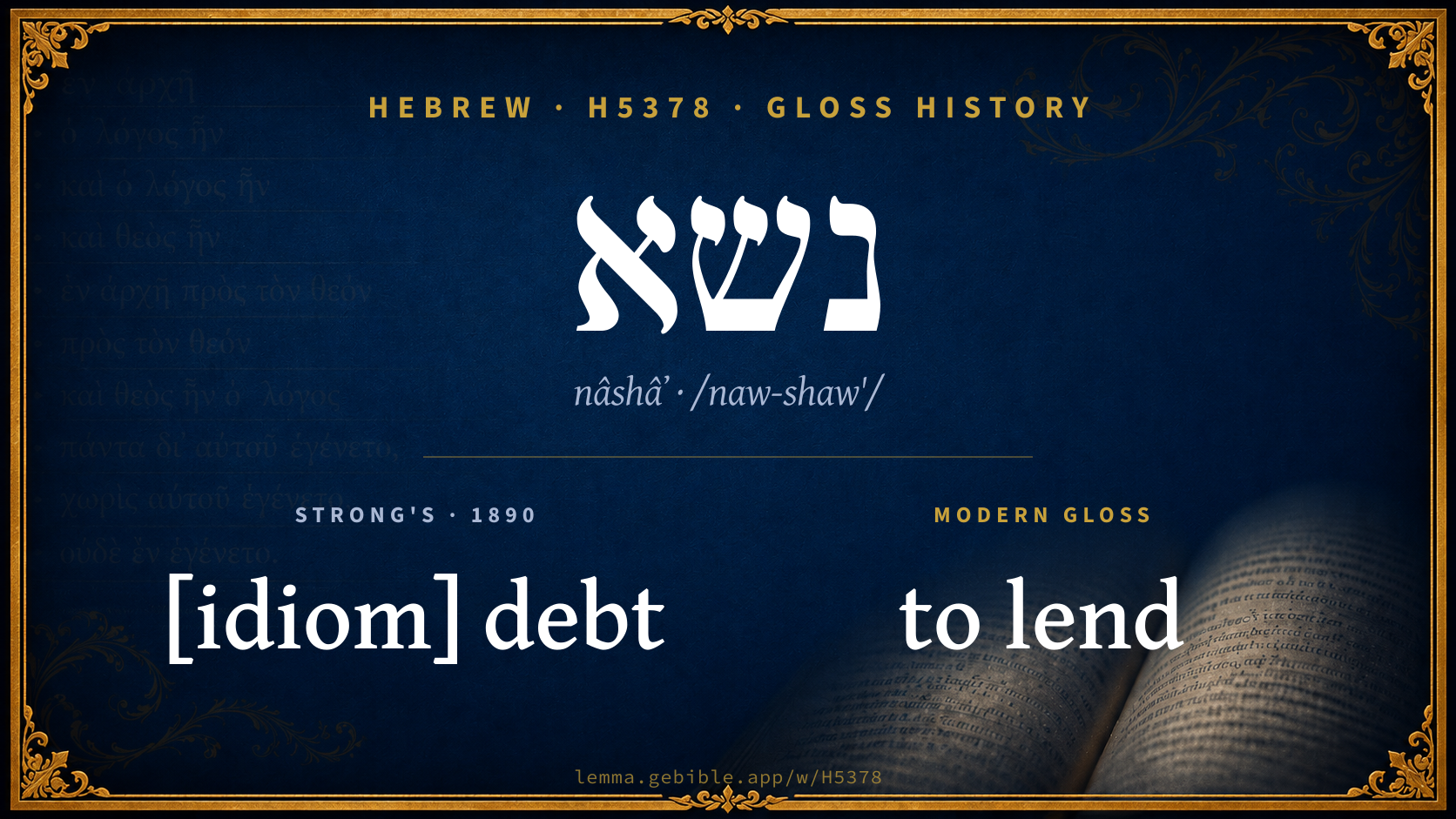
Gloss history
Strong's 1890 vs modern scholarship
About this word
Strong's H5378 catalogs a Hebrew word from the Hebrew Old Testament.
These counts are not copied from any lexicon or concordance. They are computed here, from the morphology-tagged Hebrew Old Testament. What Lemma adds →
- 4
- distinct verses
- The word appears in 4 distinct verses.
- 4 / 39
- OT books
- The word appears in 4 of 39 Old Testament books.
- #3,696
- by frequency
- Top 5000 most frequent Hebrew words (rank 3,696 of 8,640 Hebrew words by occurrence).
View all 4 occurrences in the concordance →
By section of the Old Testament
By traditional corpus
Conventional, traditional groupings — biblical authorship is debated, so this is a traditional corpus grouping, not an authorship claim. Each share is this word’s portion of its verses in that division of the Hebrew canon. Each figure is a share of the word’s 4 distinct verses.
- Prophets (Nevi'im) 3 verses · 75%
- Writings (Ketuvim) 1 verse · 25%
How translations render this word
Counts come from each version’s own published word-to-Strong’s tagging or interlinear alignment — an approximate guide to how each version renders this word, not a word-level alignment the data otherwise carries. Because each total is that version’s own tagged count, the per-version totals vary from one another and need not match the appearance or distinct-verse counts above. These counts may also differ from a printed concordance because Lemma counts each distinctly tagged rendering and does not collapse phrase taggings into a single head-word total. This is a fixed set of word-tagged versions (KJV, ASV, BSB, ULT) and does not change with the reading translation you choose elsewhere. Each version’s license is shown beside its name below (and on Sources).
BDB lists this Strong’s number as 5 distinct words (homographs). Each count above pools all of them and is not split by sense — see the Senses section below. A low-frequency rendering may belong to a different one of those words, not the primary meaning.
- King James Version†: Giver of usury 1×, Shall not exact 1×, Was in debt 1×
- American Standard Version†: Giver of interest to him 1×, Shall not exact 1×, Was in debt 1×
- Berean Standard Bible†: Are exacting 1×, Creditor 1×, Indebted 1×
- unfoldingWord Literal Text†: Exact 1×, He lifts 1×, Is carrying 1×
King James Version Public Domain
Renders H5378 across 4† tagged occurrences — most commonly:
American Standard Version Public Domain
Renders H5378 across 3† tagged occurrences — most commonly:
Berean Standard Bible Public Domain
Renders H5378 across 4† tagged occurrences — most commonly:
unfoldingWord Literal Text CC BY-SA 4.0
Renders H5378 across 5† tagged occurrences — most commonly:
10 senses and sub-senses in the full BDB
Hebrew verbs can shift meaning by stem (binyan): Qal is the basic action, Niphal is often passive or reflexive, Piel often intensifies or makes it factitive, and Hiphil is typically causative. The senses below are grouped under the stem BDB assigns to each.
What do BDB’s symbols mean?
BDB uses these scholarly abbreviations:
| Symbol | Meaning |
|---|---|
| 𝔊 | the Septuagint (the ancient Greek translation, LXX) |
| 𝔙 | the Vulgate (the Latin translation) |
| 𝔖 | the Syriac version (the Peshitta) |
| 𝔗 | the Targum (the Aramaic translation) |
| ψ | the Psalms |
| √ | root (the underlying root or stem) |
| ‖ | parallel passage (a synonymous or contrasted parallel) |
| † | the dagger: every passage where the word occurs is cited |
The 10 senses and sub-senses the full Brown-Driver-Briggs lexicon distinguishes for this word, in lexicon order (not ranked by frequency), with BDB’s own verbatim wording and sub-sense lettering. Shown in Hebrew script with BDB’s own scholarly abbreviations. The condensed entry is in the Lexicon Entry tab. See also the Forms in the corpus table below.
נשא I lend on interest or usury, be a creditor (cf. Arabic نَسَأَ postpone, delay
Qal
- Pt. act. נֹשֶׁא (anal. ל׳ ה) 1 S 22:2 every man that had a creditor; אֲשֶׁר נשֶׁא בוֹ Is 24:2 against whom is a creditor, and pl. נֹשְׁאִים Ne 5:7 Kt (נֹשִׁים Qr, from נָשָׁה), + acc. cogn. מַשָּׁא. e.g. 1 Samuel 22:2
Hiphil
- Impf. 3 ms. לֹא־יַשִּׁיא אוֹיֵב בּוֹ ψ 89:23 an enemy shall not act the creditor against him, make exactions of him (‖ יְעַנֶּנּוּ).—1 K 8:31 2 Ch 6:22 v. נשׂא Qal 1 b (5). e.g. Psalms 89:23
נשא II only Niph.Hiph. beguile, deceive
Niphal
- Pf. 3 pl. נִשְּׁאוּ Is 19:13 the princes have been beguiled (‖ נוֹאֲלוּ, הִתְעוּ). e.g. Isaiah 19:13
Hiphil
- Pf. הִשִּׁיא Je 49:16, sf. הִשִּׁאַ֫נִי Gn 3:13, הִשִּׁיאֶ֑ךָ Ob 3; 2 ms. הִשֵּׁאתָ Je 4:10; 3 pl. sf. הִשִּׁיא֫וּךָ Ob 7; Impf. only juss. יַשִּׁיא 2 Ch 32:15, so ψ 55:16 Qr (v. infr.); יַשִּׁ(י)א 2 K 18:29 Is 36:14, sf. יַשִּׁאֲךָ 2 K 19:10 Is 37:10; 2 mpl. תַּשִּׁאוּ Je 37:9; Inf. abs. הַשֵּׁא Je 4:10;—beguile, usually c. acc. pers. Gn 3:13 (J; not elsewhere Hex); Je 49:16 Ob 3, 7; אַל־יַשִּׁאֲךָ 2 K 19:10 let not thy God beguile thee = Is 37:10, of Hezekiah 2 Ch 32:15 (cf. infr.), אַל־תַּשִּׁאוּ נַפְשֹׁתֵיכֶם Je 37:9 do not deceive yourselves; also sq. ל pers. אַל־יַשִּׁא לָכֶם 2 K 18:29 = Is 36:14 (= 2 Ch 32:15, v. supr.), Je 29:8; הַשֵּׁא הִשֵּׁאתָ לָעָם הַזֶּה 4:10 thou hast utterly beguiled this people; ישׁימות עָלֵימוֹ ψ 55:16 Kt appar. = desolations (be) upon them! (but elsewhere only in n.pr.loc., cf. p. 445 supr.), יַשִּׁיא מָוֶת עלימו Ew Ol Pe De Now Hup, cf. 𝔊, let death (beguile them, i.e.) come deceitfully upon them! Brüll Che, cf. Bae, conj. plausibly יַשִּׁיא מָוֶת יִבְלָעֵמוֹ. e.g. Jeremiah 49:16
נשא III forget, v. II. נָשָׁה.
נשא IV lend, become a creditor (cf. I. נשׁא)
Qal
- Pf. 1 s. נָשִׁ֫יתִי Je 15:10; 3 pl. נָשׁוּ v 10; Pt. נֹשֶׁה Ex 22:24 + 4 times; pl. נֹשִׁים Ne 5:10, 11 + v 7 Qr (Kt נֹשְׁאִים, v. I. נשׁא), sf. נוֹשַׁי Is 50:1;—lend, usually c. ב pers.: לֹא־נָשִׁיתִי וְלֹא־נָשׁוּ־בִי Je 15:10 I have not lent, and they have not lent to me, Dt 24:11 Ne 5:7 (Qr; + acc. cogn.), v 10, 11 (both + acc. rei); pt. as subst. creditor, usurer Ex 22:24 (E), 2 K 4:1 Is 24:2; 50:1 ψ 109:11. e.g. Jeremiah 15:10
Hiphil
- Impf. 3 ms. יַשֶּׁה בְּ Dt 15:2 who lendeth to his neighbour; 2 ms. תַּשֶּׁה בְּ 24:10 when thou lendest to thy neighbour (+ acc. cogn.). e.g. Deuteronomy 15:2
נשא V forget (NH id.
Qal
- Pf. 1 s. וְנָשִׁיתִי אֶתְכֶם נָשֹׁא Je 23:39 I will forget you finally (but 𝔊 𝔙 𝔖 Che Gie וְנָשָׂאתִי, sq. וְנָטַשְׁתִּי as v 33 b, v. iii. מַשָּׂא); נָשִׁיתִי טוֹבָה La 3:17 I have forgotten prosperity; Impf. 1 s. הַאֶשֶּׁה shall I forget? i.e. overlook, read by We Mi 6:10 plausibly for MT הַאִשׁ; Inf. abs. נָשֹׁא (ל׳ א) Je 23:39 (v. supr.). e.g. Jeremiah 23:39
Niphal
- Impf. 2 ms. sf. תִּנָּשֵׁנִי Is 44:21 thou shalt not be forgotten of me, bu dub.; Ges§ 117 x תִּנְשֵׁנִי (Qal); CheHpt. תִּטְּשֵׁנִי (cf. Dt 32:15). e.g. Isaiah 44:21
Piel
- Pf. 3 ms. sf. נַשַּׁ֫נִי Gn 41:51 (E) God hath made me forget + acc. rei (—ַin 1st syllable only here, infl. of מְנַשֶּׁה Ges§ 52 m). e.g. Genesis 41:51
Hiphil
- Pf. 3 ms. sf. הִשָּׁהּ חָכְמָה Jb 39:17 God caused her (the ostrich) to forget wisdom, i.e. did not endow her with it. Impf. יַשֶּׁה לְךָ מִן־ Jb 11:6 Eloah allows a part of thy guilt to be forgotten thee, i.e. does not reckon it to thee in full (𝔊 = יִשְׁוֶה לְךָ מֵאֱלוֹהַּ כַּעֲוֹנֶ֑ךָ [Du] there is equivalent to thee from Eloah, according to thine iniquity, cf. Bi Che Job and Sol.; Bu reads נָשָׁה for יַשֶּׁה; Du rejects ver. as gloss). e.g. Job 39:17
Senses from the full Brown-Driver-Briggs lexicon (Brown, Driver, Briggs; Oxford 1906 — public domain), digitized via Sefaria, supplemented by the OpenScriptures HebrewLexicon (CC BY 4.0). Full attribution on Sources.
Word origin
I. vb. lend on interest or usury, be a creditor (cf. Arabic نَسَأَ postpone, delay; sell on credit; ‖ form of I. נָשָׁה, v. Ges§ 75 oo);—
II. vb. only Niph.Hiph. beguile, deceive;—(kindred with I. שׁוא, from which, however, the forms can hardly be derived (conj. WeComp 2. 351));—
III. forget, v. II. נָשָׁה.
I. vb. lend, become a creditor (cf. I. נשׁא);—
II. vb. forget (NH id.; Assyrian nišîtu perhaps forgottenness DlHWB 486; Aramaic נְשָׁא (especially Ithpe., Aph.), ܢܫܳܐ forget; Arabic نَسِىَ forget, neglect; cf. Ethiopic ናሕሰየ ignoscere, condonare, indulgere Di 633);—
— Brown-Driver-Briggs (Oxford 1906, public domain), digitized via Sefaria, supplemented by the OpenScriptures HebrewLexicon (CC BY 4.0). See Sources.
Derived from נשא (nâshâʼ) (H5377) — to deceive.
Jastrow Dictionary
A second Hebrew/Aramaic lexicon for comparison, covering Aramaic and post-biblical (Talmudic, Targumic, Midrashic) usage that the biblical-Hebrew BDB does not. Matched by lemma rather than by Strong’s number, so a lemma may carry more than one Jastrow headword (shown separately below), and the entries cover usage well beyond the Bible.
נְסֵי
- 1. to lift up. Targ. O. Deut. XXVIII, 56 נְסִיאַת ed. Berl. (oth. ed. נַסִּי׳, Pa.); Y. נַסְיַית (h. text נִסְּתָה). Targ. Ps. IV, 7 נְשָׂא (h. text נְסָה).—[Pesik. B’shall., p. 91ᵃ, v. נְסַח.]
- 2. to take, receive, carry (v. נְסַב). Lam. R. to II, 2 לא נַסְיָין להון they (the areas described) could not receive (would have no room for) them; Y. Taan. IV, 69ᵇ לא נַסְיָיהּ. Y. Maas. Sh. IV, 54ᵈ נַסְתּוֹן בר קפר Bar Ḳ. took them. Lev. R. s. 6 נַסְתֵּיה לקניא וכ׳ he took the cane and knocked it down. Lev. R. s. 34, end נסאתיה וחמאי ליה וכ׳, read: נסא יתיה ואחמי וכ׳ he took him along and showed to him &c.; (Yalk. Is. 355 נסביה ואחמתיה וכ׳).—Pesik. R. s. 22 נשא ואפקדיה וכ׳ he took (his money) and put it in trust with him. Ib. נַסְתָּהּ ויהבה ליה she took it (the deposited money) and gave it to him; a. fr.
- 1. to find out by sign, to divine. Targ. O. Gen. XXX, 27.
- 2. to try, test; to attempt. Targ. O. Deut. XXVIII, 56, v. supra.—Targ. Esth. V, 14 למְנֵסְיָא צליבא to test the (strength of) the gallows. Targ. Ex. XVI, 4; a. fr.—Snh. 107ᵃ מְנַסִּינָא לך I will try thee. Ib. אמר מינסנא לך (corr. acc.). Ab. Zar. 15ᵃ ניסייה ניהלי, read: נִינַסְּיָיהּ let us try the animal for me; a. e.
- same. Targ. Ps. LXXVIII, 56 (Ms. Pa.). Targ. Y. II, Gen. XXII, 1.
- 1. to be lifted up. Targ. Ps. LX, 6.
- 2. to be tried. Targ. II Esth. V, 14.—Snh. l. c. אינהו מִינַּסּוּ לי … מִינַּסְּיַת לי they have been tried (proved true) to me, thou hast not.
נְשָׁא I
- (preced.) woman. Targ. Y. Deut. XXII, 5.—Pl. נְשִׁין, נְשַׁיָּא, נְשֵׁי. Targ. Ruth I, 4. Targ. Gen. VI, 2; a. fr.—Tam. 32ᵃ מחוזא דכוליה נ׳ a place inhabited by women only. Ber. 17ᵃ הני נשי מאי זכיין Ms. M. (ed. נשים) whereby can women acquire merits? M. Kat. 28ᵇ נ׳ דשכנציב the lamenting women of &c.; a. v. fr.—בֵּי נ׳ a) the wife’s family, father-in-law &c.—b) the paternal house after the father’s death. B. Bath. 12ᵇ אמצרא דבי נְשֵׁיה contiguous to the estate of his father-in-law (Rashi: of his deceased father). Sabb. 23ᵇ. Ib. 156ᵃ בי נשיה in the house of his deceased father (Ms. M. נשיאה, v. גַּבָּלָא). Yeb. 35ᵃ בי נְשַׁיְהוּ their (the women’s) paternal home; a. e.
נָשָׁא II
- to forget, v. נשי.
נָשָׁא III
- name of a plant the sap of which is used as a depilatory. B. Kam. 86ᵃ סָכוֹ נ׳ וכ׳ he smeared nasha over it so that the hair will not grow again. Macc. 20ᵇ. Naz. 40ᵃ.—V. נֶשֶׁם.
נָשָׂא
- 1. to lift up, carry. Sot. 35ᵃ נ׳ ארון את נוֹשְׂאָיו the Ark carried its carriers. Ab. ch. VI נוֹשֵׂא בעול וכ׳ helps his brother to bear his yoke. Ber. III, 1 נוֹשְׂאֵי המטה, v. מִטָּה. Meg. 9ᵃ (one of the changes in translating the Bible into Greek) נוֹשֵׂא בני אדם a carrier of men (for חֲמֹר, Ex. IV, 20); a. v. fr.—Pesik. R. s. 6 אני מרומם ונושא את ראשם I will raise and elevate their head; v. infra.—נ׳ כפים, v. כַּף.—נ׳ פנים to lift up the face, to respect, favor, spare, be partial. Ḥag. 14ᵃ (expl. נשוא פנים, Is. III, 3) זה שנוֹשְׂאִין פ׳ לדורו בעבורו he for whose sake his generation is favored in heaven. Sabb. 13ᵇ שלא נ׳ פ׳ לתורה who spared him not for the sake of his scholarship. Yoma 87ᵃ שנָשְׂאוּ לו פ׳ בעה"ז that indulgence was shown him (by the Lord) in this world. Num. R. s. 11 לא אֶשָּׂא פ׳ מפניך shall I not favor thee for thy own sake? Ib. כשם שהם נוֹשְׂאִין לי וכ׳ as they (the Israelites) honor me (by saying grace even after a scanty meal), so do I favor them; a. fr.—נ׳ נפש אל to lift up the soul to, to long for. Midr. Till. to Ps. XXV, 1 למה אתה נושא נפשך אלי why dost thou lift up thy soul to me (why dost thou depend on me)?; Yalk. ib. 701.—נ׳ קרבן to offer up a sacrifice. Ib. 702 אדם חוטא ונושא ק׳ if a man sinned, he offered &c.; Midr. Till. l. c. נושא ומביא ק׳ (corr. acc.)—Part. pass. נָשׂוּא, f. נְשׂוּאָה &c. Ib. עכשו … הרי נפשנו נ׳ לך now that we have no sacrifices, our soul is lifted up to thee. e.g. Exodus 4:20
- 2. to lift, remove. Pesik. R. l. c. (ref. to the double meaning of נ׳, to raise a. to remove) לכו שְׂאוּ את ראשו go and remove (or lift up) his head; a. fr.—נ׳ עון to forgive. Y. Snh. X, beg., 27ᶜ (ref. to Ex. XXXIV, 7) נושא עוונות אין וכ׳ the text does not say, ‘removing iniquities’, but ‘removing iniquity’, the Lord takes away (from the scales) one bond of man’s sins, and the merits prevail &c.; Y. Peah I, 16ᵇ bot. (corr. acc.); Yalk. Ex. 400; v. שְׁטַר. Pesik. R. s. 45; a. e. e.g. Exodus 34:7
- 3. to take, esp. נ׳ ונתן to take and give, to deal; to transact, argue. Sabb. 31ᵃ נָשָׂאתָ ונתת באמונה hast thou (while on earth) been dealing honestly? B. Mets. 48ᵃ הנושא ונותן בדברים he who concludes a bargain verbally. Tanḥ. Sh’moth 18 כשם שנושאין ונותנין בהלכה וכ׳ as well as they debate on the law below, so do they above. Ib. שנושאין ונותנין בדין וכ׳ they argue in court, and the Lord argues with them; a. fr.
- 4. נ׳ אשה, or נ׳ to take a wife into one’s house, to marry. Keth. II, 1 בתולה נְשָׂאתַנִי thou hast married me as a virgin; אלמנה נְשָׂאתִיךְ I married thee as a widow. Yeb. 37ᵇ לא יִשָּׂא אדם וכ׳ one may not marry in one country and go away &c. M. Kat. I, 7 אין נושאין נשים וכ׳ no marriages may take place during the festive week; a. v. fr.—Part. pass. נָשׂוּי (followed by accus.) having married; f. נְשׂוּאָה (followed by ל) being married to; pl. נְשׂוּאִים, … אִין; נְשׂוּאוֹת. Yeb. III, 6 ואחד נ׳ נכרית one of them has married a stranger. Ib. ומתו הנ׳ את האחיות and those brothers who had married two sisters died. Ib. I, 2 (2ᵇ) היתה … נשואה לאחיו Y. ed. (Mish. ed. נשואת, corr. acc.; Bab. ed. נשואות) if his daughter or … was married to &c.; a. fr.—Tosef. ib. VI, 5 נָשׂאוּי.
- 1. to be lifted up, removed &c. Pesik. R. l. c. כבר … שיִנָּשְׂאוּ את ראשם וכ׳ it had been decreed that their head should be lifted (v. supra): turn its meaning and elevate their head.
- 2. f. נִישֵּׂאת, נִשֵּׂ׳, נִישֵּׂת, נִיסֵּת to be married. Keth. I, 1 בתולה נ׳ וכ׳ a virgin’s marriage takes place on the fourth day of the week. Ib. V, 2 הגיע … ולא נִשְּׂאוּ if the time set for marriage expired and they were not taken in marriage. Yeb. II, 10 מותרות לִינָּשֵׂא להם they may marry them. Ib. 88ᵇ הרי זו לא תִנָּשֵׂא ואם ניסת וכ׳ she must not marry again, and if she does &c.; Keth. 22ᵇ; a. v. fr.
- 1. to lift up, to announce by signals (the New Moon). R. Hash. II, 2, a. e. מַשִּׂיאִין, v. מַשּׂוּאָה. Y. ib. II, 58ᵃ top אין משיאין לילי זמנו we do not raise signals in the night of the regular New Moon (from the 29ᵗʰ to the 30ᵗʰ) &c.; a. fr.—Tosef. ib. II (I), 2 מַסִּיעִין את החדש ed. Zuck. (משיא׳ על, מסיא׳) we signalize the New Moon.
- 2. to transfer. Deut. R. s. 11 (ref. to ישא, Ps. IXXV, 5) יַשִּׂיא ברכה לאחרים he will bring blessing upon others.
- 3. to move, remove, pass. Bets. III, 7 מַשִּׂיאָהּ על גבי חברתה he may pass one knife over the other (to whet it). Tosef. Par. X (IX), 3 הִשִּׂיאוֹ לדבר אחר he diverted his mind towards another subject; Ab. Zar. II, 5. Y. ib. II, 41ᶜ bot. היה לו להַשִּׂיאוֹ וכ׳, v. הֶשֵּׂיאָה.
- 4. to transfer, transcribe, translate. Tosef. Sot. VIII, 6 הִשִּׂיאוּ את הכתב וכ׳ they transcribed the inscription on the stones in seventy languages; Sot. 35ᵇ; Y. ib. VII, 21ᵈ bot.
- 5. to give away in marriage; to cause to marry. Keth. 111ᵇ כל המַשִּׂיא בתו וכ׳ he who marries his daughter to a scholar. Ib. 67ᵇ top מַשִּׂיאִין את היתומה וכ׳ we must first help the fatherless maiden to marry, and then the fatherless lad. Kidd. 29ᵃ האב חייב … ולהַשִּׂיאוֹ אשה a father is bound to …, and to provide a wife for him; a. fr.
- to be raised; to exalt one’s self, to boast. Ab. Zar. 44ᵃ, v. הָלַם. Ber. 63ᵇ להִתְנַשֵּׂא, v. נָבַל; a. e.
נְשָׂא
- 1. to lift up, v. נְסֵי.
- 2. to bring, offer. Pesik. B’shall., p. 90ᵇ, sq. אימיה נשא (Ms. O. נַשְׂאָה) his mother was bringing (the bread); v., however, נְסַח.
- 3. (neut. verb) to move, stir. Taan. 24ᵃ; B. Mets. 85ᵇ, v. נְשַׁב.
נשי
- 1. to move, slip. Ḥull. 91ᵃ it is called gid hannasheh (v. גִּיד), שנ׳ ממקזמו וכ׳ because it slipped from its place and went up; Yalk. Gen. 133. Ib. א"ר חנניא … שנשא את מקומו R. Ḥ. said, … because it left its place; Gen. R. s. 78 שנשה ממקומו; a. e.
- 2. to discard, forget. Ned. 50ᵇ אבותינו אמרו נָשִׁינוּ טובה וכ׳ our fathers said (Lam. III, 17), we have forgotten the good times: we have not even seen them &c. Snh. 102ᵇ (play on מנ̇ש̇ה̇) שנ̇ש̇ה יה̇ he forgot Yah. Pesik. R. s. 45 (ref. to נְשׂוּי, Ps. XXXII, 1) אל תהי … ש"ין נְשׁוּי read it not with Samekh (n’suy), but with Shin, n’shuy, whose sin is forgotten; a. e. e.g. Lamentations 3:17
- 3. (with ב, cmp. נְסַק Af.) [to raise, collect,] to have a claim against; to be a creditor of. B. Mets. 75ᵇ נוֹשֶׁה בחבירו מנה he who has a claim &c., to whom his neighbor owes money. Men. 85ᵇ נושה בי וכ׳ I owe him &c.; a. e.
- 1. to carry away; to incite, allure. Gen. R. s. 19 (expl. השיאני, Gen. III, 13) הטעני he led me astray; v. גָּרָה. e.g. Genesis 3:13
- 2. to make a loan to; to collect, distrain; to pledge. Ib. (expl. השיאני) חייבני he made me a debtor (guilty, v. חוּב). Cant. R. to II, 7 (ref. to אֶשָּׂא, Ps. XXV, 1) אַשִּׁיא כתיב it may be read ashshi, I pledge (my soul); שהיו מַשִּׁיאִין נפשם על וכ׳ they (the martyrs) pledged their lives for the sanctification &c. (v. Midr. Till. to Ps. XXV שנתמשכנו וכ); ib. משיאין … מהם they (the torturers) take their lives as pledges; Midr. Till. to Ps. XVI; Yalk. Ps. 667 משיחין (corr. acc.). e.g. Psalms 25:1
- 3. הִנְשִׁי to cause to forget. Snh. l. c. (play on מנ̇ש̇ה) שהנ̇ש̇י את ישראל לאביהם וכ׳ he made Israel forget their Father in heaven; Yalk. Kings 245 שהִנְשִׁיא.
נְשֵׁי
- , to forget. Targ. Deut. VIII, 19 (O. ed. Berl. Ithpe.).
- 1. same. Targ. Ps. CXXXVII, 5; a. e.—Y. Dem. IV, 24ᵃ [read:] דילמא אַנְשִׁיתָה מתקנה perhaps thou didst forget to prepare it (by giving tithes)? Keth. 20ᵃ ומַנְשֵׁי חר וכ׳ and one of the witnesses has forgotten (that he knows of the case). Ḥull. 93ᵇ אַנְשְׁיוּהָ לדר׳ וכ׳ they have forgotten R. Judah’s opinion. Gen. R. s. 77 דילמא אַנְשִׁינָן כלום perhaps we forgot something (left behind). Gen. R. s. 78 אַנְשִׁית מאה I forgot one hundred (of the fables); a. fr.
- 2. to cause to forget. Targ. Lam. II, 6 (ed. Vien. אינשי, corr. acc.); a. e.
- to forget. Targ. O. Deut. VIII, 19 (v. supra); a. e.—Y. Shek. VII, 50ᶜ bot. ואִינְשְׁתָהּ and forgot to take it out; a. e.
A Dictionary of the Targumim, the Talmud Babli and Yerushalmi, and the Midrashic Literature (Marcus Jastrow; London, Luzac, 1903) — Public Domain. Digitized via Sefaria. Digitized via Sefaria. Full attribution on Sources.
Forms in the corpus
The 4 distinct written forms H5378 takes in the Hebrew Bible, most frequent first — each parse links to that stem’s occurrences in the concordance. Hebrew forms include their vowel points and cantillation, so a single lemma takes many written forms.
| Form | Parsing | Example | Uses |
|---|---|---|---|
| וְ/נָֽשָׁא | Verb, Qal, Sequential Perfect, 3rd Person, Masculine, Singular | 1 Kings 8:31 | 1 |
| יַשִּׁ֣א | Verb, Hiphil, Imperfect, 3rd Person, Masculine, Singular | Psalms 89:22 | 1 |
| נֹשֶׁ֥א | Verb, Qal, Participle Active, Masculine, Singular, Absolute | Isaiah 24:2 | 1 |
| נֹשֶׁא֙ | Verb, Qal, Participle Active, Masculine, Singular, Absolute | 1 Samuel 22:2 | 1 |
Same root — word family
Other BDB entries built from the same root as H5378, grouped by Strong’s listed origin. These share a root / origin per the lexicon — not necessarily a shared meaning. Each links to that word’s own entry.
Derives from
Shares the same root
Compare all same-root words → They share a root, not necessarily a meaning.
Septuagint verse parallels
This word appears in 3 verses that also exist in the Greek Old Testament (Septuagint), out of the 4 Hebrew verses it occurs in. You can read those verses in Greek by switching the Old Testament edition to the Septuagint.
Read these verses in the Septuagint
This is a verse-level parallel only — the same verses exist in both the Hebrew and Greek Old Testaments. No word-level Hebrew↔Greek correspondence is claimed: the data carries no such alignment, so no Greek word is shown as this Hebrew word’s translation. Coverage is not total — the Septuagint omits the deuterocanon and renumbers the Psalms, so some Hebrew verses have no direct Greek parallel.