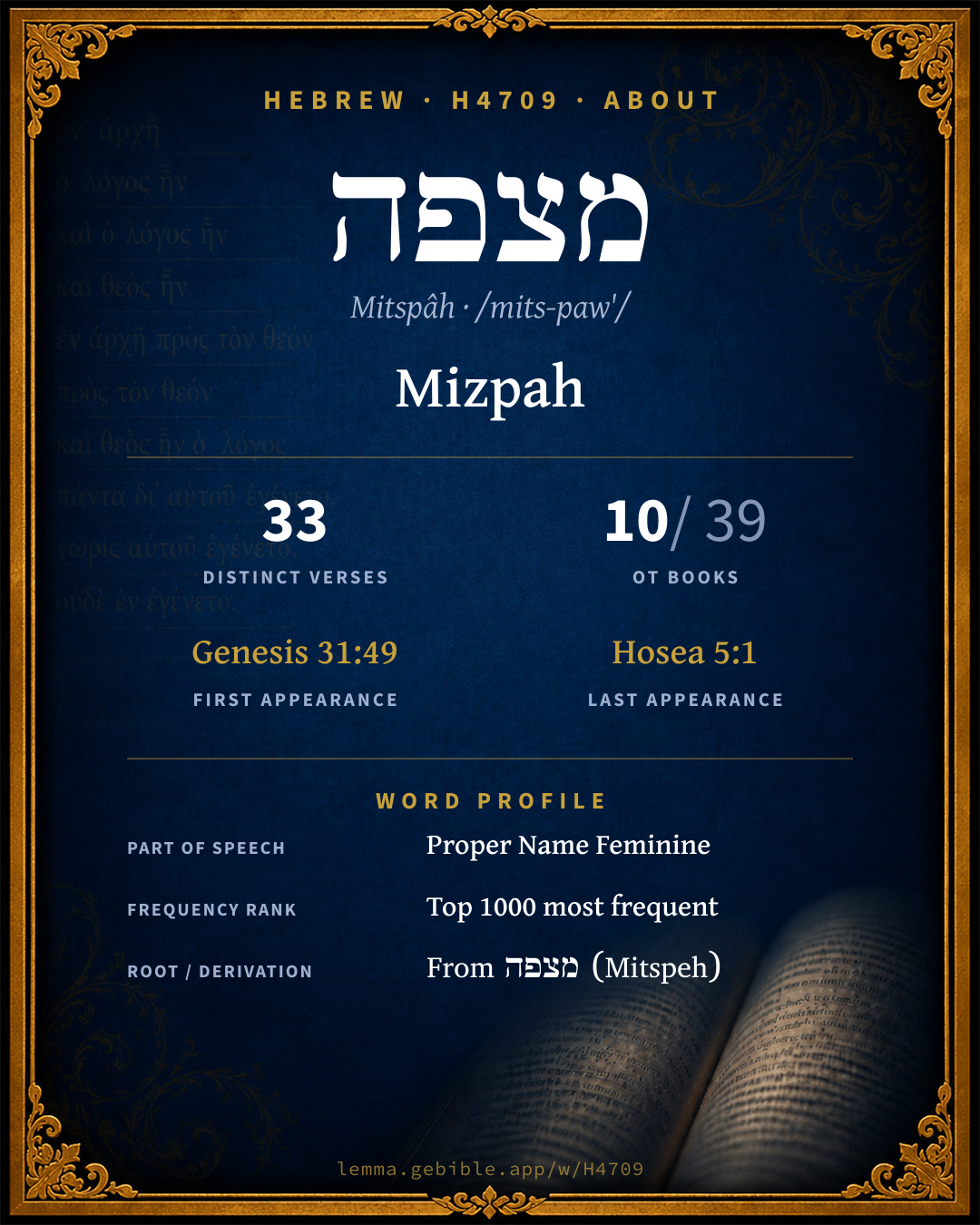
מִצְפָּה
Mizpah
BDB lists 5 entries for ‘Mizpah’ fuller range ↓
Full lexicon entry — Brown-Driver-Briggs (BDB)
From Brown-Driver-Briggs (BDB)
Where this word appears
Grammar key — what these labels mean
Noun type
- Proper
- A name of a specific person, place, or people (e.g. Abraham, Zion, Israel).
Every verse where H4709 appears in the Book of Joshua — 1 distinct verse. Click any verse to open its interlinear word-by-word view. Verse text shown in the World English Bible for context — . Each verse’s Hebrew form is shown with its reference; the English is not keyword-highlighted, since the data carries no word-level English alignment. Use “Compare translations” on any verse to read it across multiple English versions. This concordance covers the Hebrew Bible; Septuagint (Greek Old Testament) occurrences are not indexed here.
Joshua
About this entry
At a glance — auto-summarized from this page’s data, not written by a person. Every figure links to its source below. This summary describes the numbers; it doesn’t interpret them.
The Hebrew name מצפה centers on the idea of “Mizpah.” First canonically at Genesis 31:49, it enters the text early. It turns up in 33 verses across 10 books, a moderately common footprint. Dig into 33-verse concordance and the renderings breakdown below.
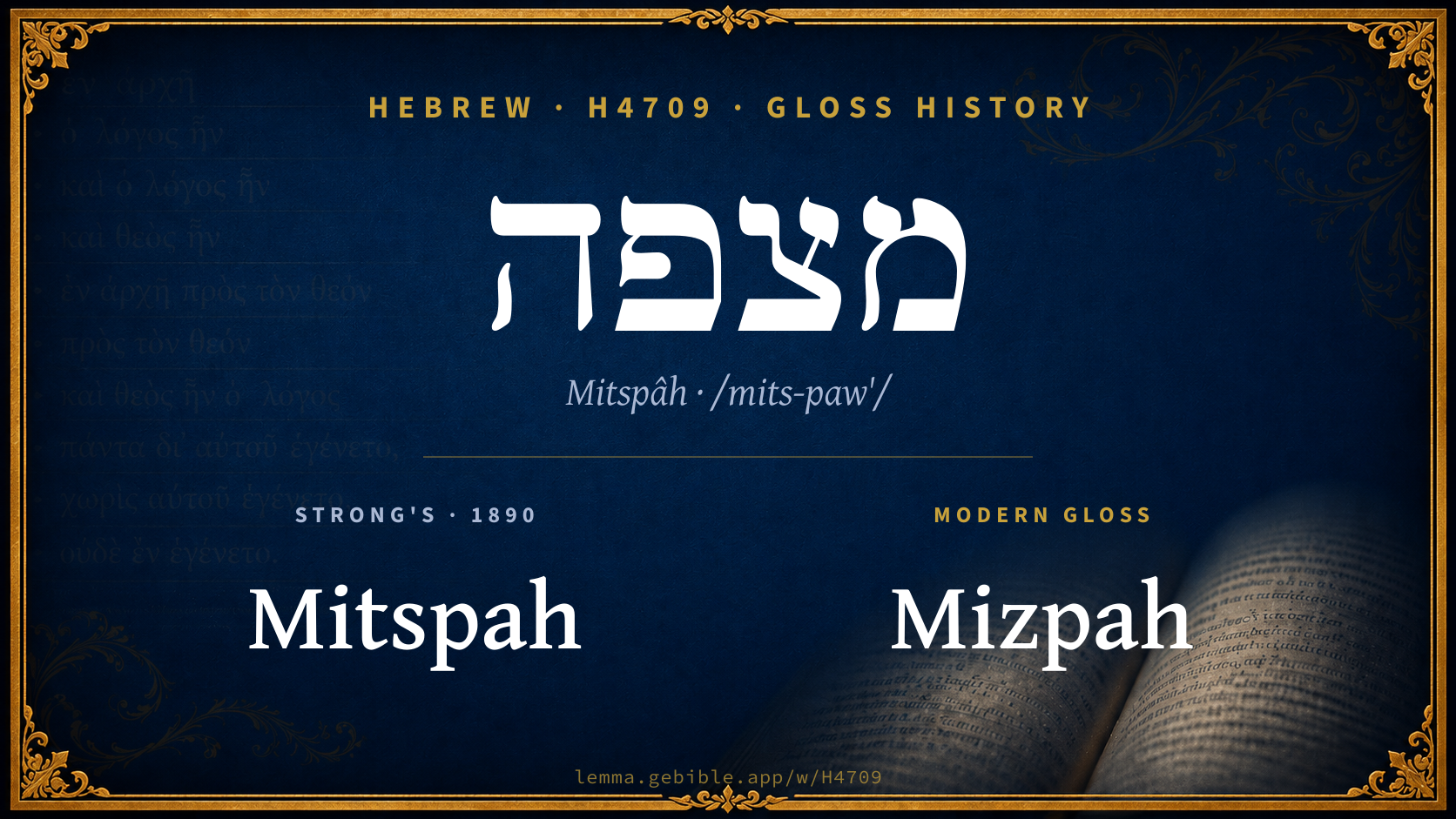
Gloss history
Strong's 1890 vs modern scholarship
About this word
Strong's H4709 catalogs a Hebrew word from the Hebrew Old Testament.
These counts are not copied from any lexicon or concordance. They are computed here, from the morphology-tagged Hebrew Old Testament. What Lemma adds →
- 33
- distinct verses
- The word appears in 33 distinct verses.
- 10 / 39
- OT books
- The word appears in 10 of 39 Old Testament books.
- #990
- by frequency
- Top 1000 most frequent Hebrew words (rank 990 of 8,640 Hebrew words by occurrence).
View all 33 occurrences in the concordance →
By section of the Old Testament
By traditional corpus
Conventional, traditional groupings — biblical authorship is debated, so this is a traditional corpus grouping, not an authorship claim. Each share is this word’s portion of its verses in that division of the Hebrew canon. Each figure is a share of the word’s 33 distinct verses.
- Prophets (Nevi'im) 28 verses · 85%
- Writings (Ketuvim) 4 verses · 12%
- Torah (Pentateuch) 1 verse · 3%
How translations render this word
Counts come from each version’s own published word-to-Strong’s tagging or interlinear alignment — an approximate guide to how each version renders this word, not a word-level alignment the data otherwise carries. Because each total is that version’s own tagged count, the per-version totals vary from one another and need not match the appearance or distinct-verse counts above. These counts may also differ from a printed concordance because Lemma counts each distinctly tagged rendering and does not collapse phrase taggings into a single head-word total. This is a fixed set of word-tagged versions (KJV, ASV, BSB, ULT) and does not change with the reading translation you choose elsewhere. Each version’s license is shown beside its name below (and on Sources).
- King James Version: Mizpah 16×, Mizpeh 13×
- American Standard Version: Mizpah 27×
- Berean Standard Bible: Mizpah 39×
- unfoldingWord Literal Text: Mizpah 25×
King James Version Public Domain
Renders H4709 across 32 tagged occurrences — most commonly:
Plus 3 renderings that appear only once — usually multi-word phrases or single function words the recovered tagging swept in, not distinct renderings.
American Standard Version Public Domain
Renders H4709 across 32 tagged occurrences — most commonly:
Plus 5 renderings that appear only once — usually multi-word phrases or single function words the recovered tagging swept in, not distinct renderings.
Berean Standard Bible Public Domain
Renders H4709 across 39 tagged occurrences — most commonly:
Not rendered by a distinct English word in 1 further occurrence.
unfoldingWord Literal Text CC BY-SA 4.0
Renders H4709 across 26 tagged occurrences — most commonly:
Plus 1 rendering that appears only once — usually multi-word phrases or single function words the recovered tagging swept in, not distinct renderings.
Senses in BDB
The 5 senses BDB distinguishes for this word, in lexicon order (not ranked by frequency or importance). The full entry — with sub-senses — is in the Lexicon Entry tab.
- Mizpah = "watchtower"
- a place in Gilead north of Jabbok and location of Laban's cairn
- a place in Gilead south of Jabbok; site unknown
- a place near Mount Hermon
- an old sacred place in Benjamin
Word origin
Derived from מצפה (Mitspeh) (H4708) — Mizpeh.
Jastrow Dictionary
A second Hebrew/Aramaic lexicon for comparison, covering Aramaic and post-biblical (Talmudic, Targumic, Midrashic) usage that the biblical-Hebrew BDB does not. Matched by lemma rather than by Strong’s number, so a lemma may carry more than one Jastrow headword (shown separately below), and the entries cover usage well beyond the Bible.
מִצְפֶּה
- (b. h.) pr. n. pl. Mizpeh or Mizpah (Watch-Tower). Peah II, 6 איש המ׳ the man of M. (or the governor of the Watch-Tower of the Temple).
A Dictionary of the Targumim, the Talmud Babli and Yerushalmi, and the Midrashic Literature (Marcus Jastrow; London, Luzac, 1903) — Public Domain. Digitized via Sefaria. Digitized via Sefaria. Full attribution on Sources.
Forms in the corpus
The 19 distinct written forms H4709 takes in the Hebrew Bible, most frequent first — each parse links to that state’s occurrences in the concordance. Hebrew forms include their vowel points and cantillation, so a single lemma takes many written forms.
| Form | Parsing | Example | Uses |
|---|---|---|---|
| בַּ/מִּצְפָּֽה | Noun, Proper | 1 Samuel 7:6 | 5 |
| הַ/מִּצְפָּֽה | Noun, Proper | 1 Kings 15:22 | 5 |
| הַ/מִּצְפָּ֑ה | Noun, Proper | 2 Kings 25:23 | 4 |
| בַּ/מִּצְפָּ֔ה | Noun, Proper | Jeremiah 40:10 | 3 |
| הַ/מִּצְפָּ֔ה | Noun, Proper | 1 Samuel 7:11 | 3 |
| הַ/מִּצְפָּ֑תָ/ה | Noun, Proper | 1 Samuel 7:5 | 2 |
| וְ/הַ/מִּצְפָּ֑ה | Noun, Proper | 1 Samuel 7:16 | 2 |
| בַּ/מִּצְפָּ֖ה | Noun, Proper | Judges 21:1 | 1 |
| בַּ/מִּצְפָּ֗ה | Noun, Proper | Jeremiah 41:10 | 1 |
| בַּ/מִּצְפָּ֜ה | Noun, Proper | Jeremiah 40:15 | 1 |
| הַ/מִּצְפָּ֔תָ/ה | Noun, Proper | 1 Samuel 7:7 | 1 |
| הַ/מִּצְפָּ֖ה | Noun, Proper | Nehemiah 3:19 | 1 |
| הַ/מִּצְפָּ֛ה | Noun, Proper | Judges 21:5 | 1 |
| הַ/מִּצְפָּה֒ | Noun, Proper | Nehemiah 3:15 | 1 |
| הַ/מִּצְפָּה֙ | Noun, Proper | 1 Samuel 7:12 | 1 |
| הַ/מִּצְפָּה֮ | Noun, Proper | Judges 11:34 | 1 |
| הַ֠/מִּצְפָּתָ/ה | Noun, Proper | 1 Samuel 7:6 | 1 |
| וְ/הַ/מִּצְפָּה֙ | Noun, Proper | Genesis 31:49 | 1 |
| לְ/מִצְפָּ֔ה | Noun, Proper | Hosea 5:1 | 1 |
Bible dictionary
Public-domain dictionary articles matched to this entry by name (Mizpah). A biblical name can be shared by more than one person or place, so an article may treat several.
Easton's Bible Dictionary · M. G. Easton, 1897
Or Miz'peh, watch-tower; the look-out. (1.) A place in Gilead, so named by Laban, who overtook Jacob at this spot (Gen. 31:49) on his return to Palestine from Padan-aram. Here Jacob and Laban set up their memorial cairn of stones. It is the same as Ramath-mizpeh (Josh. 13:26).
(2.) A town in Gilead, where Jephthah resided, and where he assumed the command of the Israelites in a time of national danger. Here he made his rash vow; and here his daughter submitted to her mysterious fate (Judg. 10:17; 11:11, 34). It may be the same as Ramoth-Gilead (Josh. 20:8), but it is more likely that it is identical with the foregoing, the Mizpeh of Gen. 31:23, 25, 48, 49.
(3.) Another place in Gilead, at the foot of Mount Hermon, inhabited by Hivites (Josh. 11:3, 8). The name in Hebrew here has the article before it, "the Mizpeh," "the watch-tower." The modern village of Metullah, meaning also "the look-out," probably occupies the site so called.
(4.) A town of Moab to which David removed his parents for safety during his persecution by Saul (1 Sam. 22:3). This was probably the citadel known as Kir-Moab, now Kerak. While David resided here he was visited by the prophet Gad, here mentioned for the first time, who was probably sent by Samuel to bid him leave the land of Moab and betake himself to the land of Judah. He accordingly removed to the forest of Hareth (q.v.), on the edge of the mountain chain of Hebron.
(5.) A city of Benjamin, "the watch-tower", where the people were accustomed to meet in great national emergencies (Josh. 18:26; Judg. 20:1, 3; 21:1, 5; 1 Sam. 7:5-16). It has been supposed to be the same as Nob (1 Sam. 21:1; 22:9-19). It was some 4 miles north-west of Jerusalem, and was situated on the loftiest hill in the neighbourhood, some 600 feet above the plain of Gibeon. This village has the modern name of Neby Samwil, i.e., the prophet Samuel, from a tradition that Samuel's tomb is here. (See NOB.)
Samuel inaugurated the reformation that characterized his time by convening a great assembly of all Israel at Mizpeh, now the politico-religious centre of the nation. There, in deep humiliation on account of their sins, they renewed their vows and entered again into covenant with the God of their fathers. It was a period of great religious awakening and of revived national life. The Philistines heard of this assembly, and came up against Israel. The Hebrews charged the Philistine host with great fury, and they were totally routed. Samuel commemorated this signal victory by erecting a memorial-stone, which he called "Ebenezer" (q.v.), saying, "Hitherto hath the Lord helped us" (1 Sam. 7:7-12).
Smith's Bible Dictionary · William Smith, 1863
and Miz'peh (a watch-tower), the name of several places in Palestine.
+ The earliest of all, in order of the narrative, is the heap of stones piled up by Jacob and Laban, (Genesis 31:48) on Mount Gilead, ver. (Genesis 31:25) to serve both as a witness to the covenant then entered into and as a landmark of the boundary between them. ver. (Genesis 31:52) On this natural watch-tower did the children of Israel assemble for the choice of a leader to resist the children of Ammon. (Judges 10:17) There the fatal meeting took place between Jephthah and his daughter on his return from the war. ch. (Judges 11:34) It seems most probable that the "Mizpeh-gilead" which is mentioned here, and here only, is the same as the "ham-Mizpah" of the other parts of the narrative; and both are probably identical with the Ramath-mizpeh and Ramoth-gilead, so famous in the later history. + A second Mizpeh, on the east of Jordan, was the Mizpeh-moab, where the king of that nation was living when David committed his parents to his care. (1 Samuel 22:3) + A third was "the land of Mizpeh," or more accurately "of Mizpah," the residence of the Hivites who joined the northern confederacy against Israel, headed by Jabin king of Hazor. (Joshua 11:3) No other mention is found of this district in the Bible, unless it be identical with-- + The valley of Mizpeh, to which the discomfited hosts of the same confederacy were chased by Joshua, (Joshua 11:8) perhaps identical with the great country of Coele-Syria. + Mizpeh, a city of Judah, (Joshua 15:38) in the district of the Shefelah or maritime lowland. + Mizpeh, in Joshua and Samuel; elsewhere Mizpah, a "city" of Benjamin, not far from Jerusalem. (Joshua 18:26; 1 Kings 15:22; 2 Chronicles 16:6; Nehemiah 3:7) It was one of the places fortified by Asa against the incursions of the kings of northern Israel, (1 Kings 15:22; 2 Chronicles 16:6; Jeremiah 41:10) and after the destruction of Jerusalem it became the residence of the superintendent appointed by the king of Babylon, (Jeremiah 40:7) etc., and the scene of his murder and of the romantic incidents connected with the name of Ishmael the son of Nethaniah. It was one of the three holy cities which Samuel visited in turn as judge of the people, (1 Samuel 7:6,16) the other two being Bethel and Gilgal. With the conquest of Jerusalem and the establishment there of the ark, the sanctity of Mizpah, or at least its reputation, seems to have declined. From Mizpah the city or the temple was visible. These conditions are satisfied by the position of Scopus, the broad ridge which forms the continuation of the Mount of Olives to the north and cast, from which the traveller gains, like Titus, his first view, and takes his last farewell, of the domes, walls and towers of the holy city.
Hitchcock's Bible Names Dictionary · Roswell D. Hitchcock, 1869
Mizpeh, a watch-tower; speculation
Classic public-domain reference works; full attribution on Sources.
Septuagint verse parallels
This word appears in 29 verses that also exist in the Greek Old Testament (Septuagint), out of the 33 Hebrew verses it occurs in. You can read those verses in Greek by switching the Old Testament edition to the Septuagint.
Read these verses in the Septuagint
- Genesis 31:49
- Joshua 11:3
- Judges 10:17
- 1 Samuel 7:5
- 1 Kings 15:22
- 2 Kings 25:23
- 2 Chronicles 16:6
- Jeremiah 40:10
- Hosea 5:1
This is a verse-level parallel only — the same verses exist in both the Hebrew and Greek Old Testaments. No word-level Hebrew↔Greek correspondence is claimed: the data carries no such alignment, so no Greek word is shown as this Hebrew word’s translation. Coverage is not total — the Septuagint omits the deuterocanon and renumbers the Psalms, so some Hebrew verses have no direct Greek parallel.