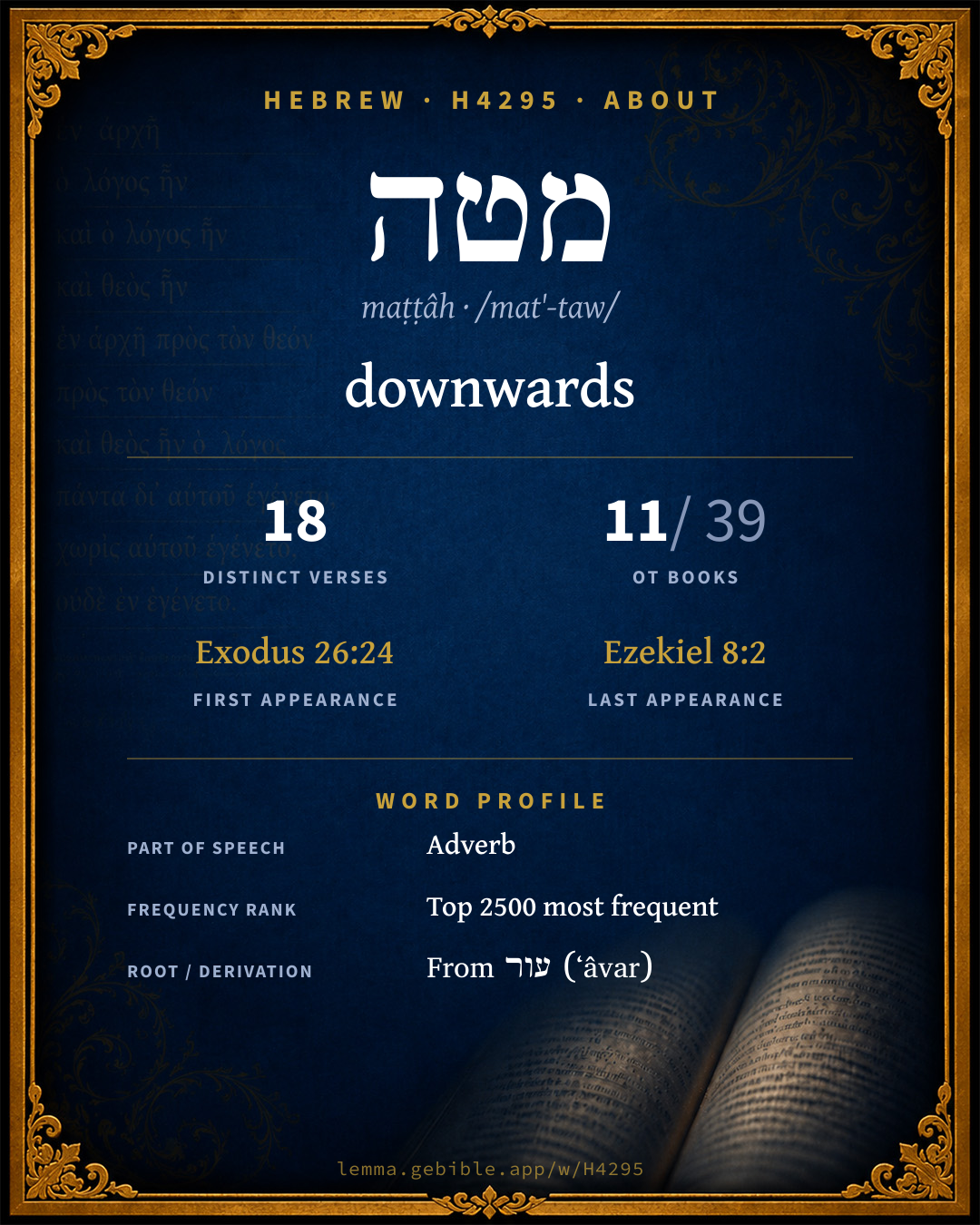
מַ֫טָּה
downwards
‘downwards’ is one of 4 main senses fuller range ↓
Full lexicon entry — Brown-Driver-Briggs (BDB)
From Brown-Driver-Briggs (BDB)
Where this word appears
Grammar key — what these labels mean
Part of speech
- Adverb
- A word that modifies a verb, adjective, or other adverb.
Every verse where H4295 appears in the Book of Exodus — 6 distinct verses. Click any verse to open its interlinear word-by-word view. Verse text shown in the World English Bible for context — . Each verse’s Hebrew form is shown with its reference; the English is not keyword-highlighted, since the data carries no word-level English alignment. Use “Compare translations” on any verse to read it across multiple English versions. This concordance covers the Hebrew Bible; Septuagint (Greek Old Testament) occurrences are not indexed here.
Exodus
- Exodus 26:24 מִ/לְּ/מַטָּה֒ prep + prep + adv They shall be double beneath, and in like manner they shall be entire to the top of it to one ring: thus shall it be for them both; they shall be for the two corners.
- Exodus 27:5 מִ/לְּ/מָ֑טָּה prep + prep + adv You shall put it under the ledge around the altar beneath, that the net may reach halfway up the altar.
- Exodus 28:27 מִ/לְּ/מַ֨טָּה֙ prep + prep + adv You shall make two rings of gold, and shall put them on the two shoulder-pieces of the ephod underneath, in the forepart of it, close by the coupling of it, above the skillfully woven band of the ephod.
- Exodus 36:29 מִ/לְּ/מַטָּה֒ prep + prep + adv They were double beneath, and in like manner they were all the way to the top of it to one ring. He did thus to both of them in the two corners.
- Exodus 38:4 מִ/לְּ/מַ֖טָּה prep + prep + adv He made for the altar a grating of a network of brass, under the ledge around it beneath, reaching halfway up.
- Exodus 39:20 מִ/לְ/מַ֨טָּה֙ prep + prep + adv They made two rings of gold, and put them on the two shoulder-pieces of the ephod underneath, in the front of it, close by its coupling, above the skillfully woven band of the ephod.
About this entry
At a glance — auto-summarized from this page’s data, not written by a person. Every figure links to its source below. This summary describes the numbers; it doesn’t interpret them.
The Hebrew verb מטה centers on the idea of “downwards.” Its meaning spans more than one sense — see its full sense range. The Hebrew Bible uses it across 18 verses — uncommon. Exodus dominates its distribution — 6 of 18 verses. First canonically at Exodus 26:24, it enters the text early. For the data behind this summary, explore the sense tree and the renderings breakdown below.
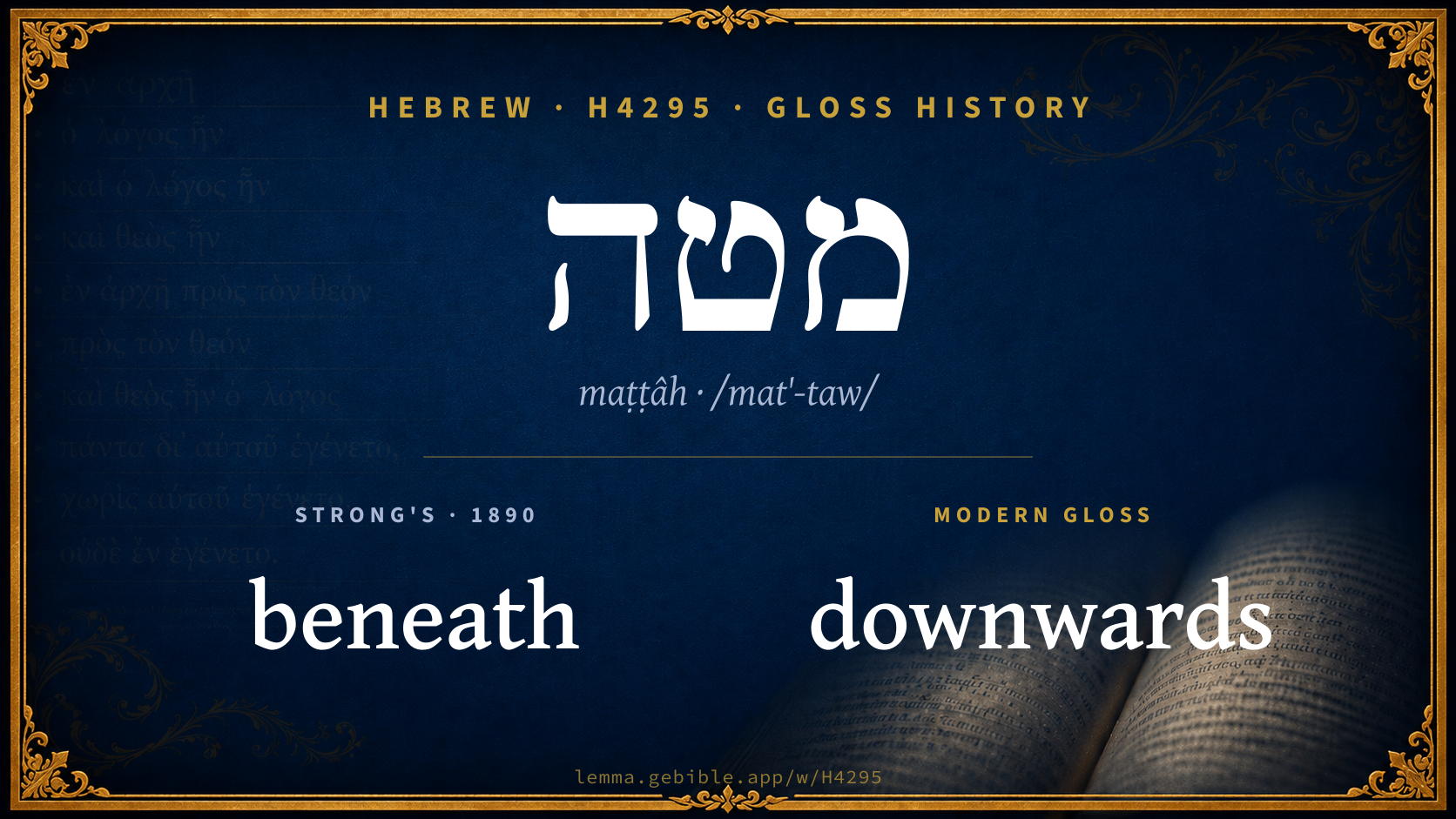
Gloss history
Strong's 1890 vs modern scholarship
About this word
Strong's H4295 catalogs a Hebrew word from the Hebrew Old Testament.
These counts are not copied from any lexicon or concordance. They are computed here, from the morphology-tagged Hebrew Old Testament. What Lemma adds →
- 18
- distinct verses
- The word appears in 18 distinct verses.
- 11 / 39
- OT books
- The word appears in 11 of 39 Old Testament books.
- #1,563
- by frequency
- Top 2500 most frequent Hebrew words (rank 1,563 of 8,640 Hebrew words by occurrence).
View all 18 occurrences in the concordance →
Most concentrated in
- Exodus 6 verses 33%
- Deuteronomy 2 verses 11%
- Ezekiel 2 verses 11%
By section of the Old Testament
By traditional corpus
Conventional, traditional groupings — biblical authorship is debated, so this is a traditional corpus grouping, not an authorship claim. Each share is this word’s portion of its verses in that division of the Hebrew canon. Each figure is a share of the word’s 18 distinct verses.
- Torah (Pentateuch) 8 verses · 44%
- Prophets (Nevi'im) 5 verses · 28%
- Writings (Ketuvim) 5 verses · 28%
How translations render this word
Counts come from each version’s own published word-to-Strong’s tagging or interlinear alignment — an approximate guide to how each version renders this word, not a word-level alignment the data otherwise carries. Because each total is that version’s own tagged count, the per-version totals vary from one another and need not match the appearance or distinct-verse counts above. These counts may also differ from a printed concordance because Lemma counts each distinctly tagged rendering and does not collapse phrase taggings into a single head-word total. This is a fixed set of word-tagged versions (KJV, ASV, BSB, ULT) and does not change with the reading translation you choose elsewhere. Each version’s license is shown beside its name below (and on Sources).
- King James Version: Downward 5×, Beneath 4×, Underneath 2×
- American Standard Version: Beneath 6×, Downward 5×, Lower 2×
- Berean Standard Bible: Bottom 4×, Below 3×, Down 3×
- unfoldingWord Literal Text: Downward 4×, Below 3×, Lower 3×
King James Version Public Domain
Renders H4295 across 19 tagged occurrences — most commonly:
Plus 8 renderings that appear only once — usually multi-word phrases or single function words the recovered tagging swept in, not distinct renderings.
American Standard Version Public Domain
Renders H4295 across 19 tagged occurrences — most commonly:
Plus 4 renderings that appear only once — usually multi-word phrases or single function words the recovered tagging swept in, not distinct renderings.
Berean Standard Bible Public Domain
Renders H4295 across 18 tagged occurrences — most commonly:
Plus 6 renderings that appear only once — usually multi-word phrases or single function words the recovered tagging swept in, not distinct renderings. Not rendered by a distinct English word in 1 further occurrence.
unfoldingWord Literal Text CC BY-SA 4.0
Renders H4295 across 18 tagged occurrences — most commonly:
Plus 4 renderings that appear only once — usually multi-word phrases or single function words the recovered tagging swept in, not distinct renderings.
Senses in the full BDB
What do BDB’s symbols mean?
BDB uses these scholarly abbreviations:
| Symbol | Meaning |
|---|---|
| 𝔊 | the Septuagint (the ancient Greek translation, LXX) |
| 𝔙 | the Vulgate (the Latin translation) |
| 𝔖 | the Syriac version (the Peshitta) |
| 𝔗 | the Targum (the Aramaic translation) |
| ψ | the Psalms |
| √ | root (the underlying root or stem) |
| ‖ | parallel passage (a synonymous or contrasted parallel) |
| † | the dagger: every passage where the word occurs is cited |
The 5 senses and sub-senses the full Brown-Driver-Briggs lexicon distinguishes for this word, in lexicon order (not ranked by frequency), with BDB’s own verbatim wording and sub-sense lettering. Shown in Hebrew script with BDB’s own scholarly abbreviations. The condensed entry is in the Lexicon Entry tab. See also the Forms in the corpus table below.
- 1. alone, Dt 28:43 and thou shalt descend מַ֫טָּה מָ֑֫טָּה downwards, downwards, i.e. lower and lower, Pr 15:24 לְמַעַן סוּר מִשְּׁאוֹל מ׳. e.g. Deuteronomy 28:43
- 2. לְמַ֫טָּה:
- a. downwards Dt 28:13 וְלֹא תִהְיֶה למ׳, Is 37:31 = 2 K 19:30 שֹׁרֶשׁ למ׳ (cf. Ph CISI. i. 2, 11 f. אל יכן לם שׁרשׁ למט ופר למעל let them not have root downwards, or fruit upwards), Je 31:37; Ec 3:21 2 Ch 32:30; Ezr 9:13 כי אתה חָשַׂכְתָּ לְמַ֫טָּה מֵעֲוֹנֵנוּ either (Be) hast kept back, downward, part of our iniquity (prevented it from appearing, and being counted against us), or, held us (Ges), or thy anger (Ke), back, below (cf. לְמַ֫עְלָה מֵעַל above, 2 Ch 34:4) our iniq. (punished us less than our iniq. deserved). e.g. Deuteronomy 28:13
- b. וּלְמַ֫טָּה, (a) of space, and downwards, Ez 1:27 וּמִמַּרְאֵה מָתְנָיו ול׳, 8:2; (b) of age, and under, 1 Ch 27:23 לְמִבֶּן עשׂרים שׁנה ול׳. e.g. Ezekiel 1:27
- 3. מִלְּמַ֫טָּה beneath (v. מִן 9 a: opp. מִלְמַעְלָה above), Ex 26:24 = 36:29, 27:5 = 38:4, 38:27 = 39:20. e.g. Exodus 26:24
Senses from the full Brown-Driver-Briggs lexicon (Brown, Driver, Briggs; Oxford 1906 — public domain), digitized via Sefaria, supplemented by the OpenScriptures HebrewLexicon (CC BY 4.0). Full attribution on Sources.
Word origin
adv. downwards (from [מַט] for [מַטֶּה] a place of declension (cf. נָטֶה, 3 a), with ה—ָ loc., Ol222 b Köii. 260: cf. the opp. מַ֫עְלָה, sub עָלָה):—
— Brown-Driver-Briggs (Oxford 1906, public domain), digitized via Sefaria, supplemented by the OpenScriptures HebrewLexicon (CC BY 4.0). See Sources.
Derived from עור (ʻâvar) (H5786) — to blind.
Jastrow Dictionary
A second Hebrew/Aramaic lexicon for comparison, covering Aramaic and post-biblical (Talmudic, Targumic, Midrashic) usage that the biblical-Hebrew BDB does not. Matched by lemma rather than by Strong’s number, so a lemma may carry more than one Jastrow headword (shown separately below), and the entries cover usage well beyond the Bible.
מְטָה
- , v. מְטֵי
מִטָּה
- couch, bed, frame, bier. Ned. VII, 5, v. דַּרְגֵּשׁ. Ib. 56ᵃ, a. fr. הכופה את מִטָּתוֹ, v. כָּפָה. Ib. 56ᵇ מ׳ המיוחדת לכלים a bed designated for the exhibit of garments (not slept upon); Snh. 20ᵃ. Ber. III, 1 נושאי המ׳ those carrying the bier; a. fr.—מ׳של גילה, מ׳ גלילתא, v. גִּלָּה, גְּלִילְתָּא.—Sabb. 47ᵃ, v. טרְסִי I.—Pl. מִטּוֹת, מִי׳. Ned. 56ᵃ; a. fr.—Trnsf. family, offspring. Lev. R. s. 36 שהיתה מִטָּתוֹ שלימה his bed was perfect, his children were all righteous; Sifra B’ḥuck., Par. 2, ch. VIII. Ber. 60ᵇ. Pes. 56ᵃ שמא … יש במִיטָּתִי פסול perhaps there is a blemish in my family; a. e.
מַטֶּה
- 1. staff. Ab. V, 6 המ׳ the staff of Moses. Ex. R. s. 3 המ׳ שתייסרנו בו the staff with which thou shalt chastise him. Ib. ‘the signs which I placed in thy hands’ (Ex. IV, 21) זה המ׳ that means the staff; a. fr. e.g. Exodus 4:21
- 2. tribe. Tosef. R. Hash. III (II), 3 שלש על כל מ׳ ומ׳ three notes for each tribe; Y. Succ. V, 55ᶜ
מֹטָה
- , v. מוֹטָה
מַטָּה
- adv. (b. h.; downward, (used as a noun) below. Tanḥ. B’shall. 23 מחמת אש של מעלה … של מ׳ through the fire from above were his wheels below ignited; (Yalk. Ex. 235 שלמעלן … שלמַטָּן, v. infra). Ḥag. II, 1 (11ᵇ) מה למעלה ומה למ׳ what is above (in heaven) and what is below (in the nether world, Rashi: above the Ḥayoth, below the Ḥayoth, v. חַיָּה). Tosef. Ber. V, 5 שלישי לו למ׳ הימנו he who is the third in rank reclines below him (v. Sm. Ant. s. v. Triclinium); a. fr.—Euphem. for מעלה in order to avoid a blasphemous expression: B. Kam. 79ᵇ כביכול עשה עין של מ׳ … ואוזן של מ׳ וכ׳ he treated, if one may say so, the divine eye as if did not see, and the divine ear as if did not hear.—Frequ. מַטָּן. Y. Yoma VII, 44ᵇ כשירות של מעלן … של מ׳ as the service in heaven, so is that on earth; Lev. R. s. 21, end (not שורות). Y. R. Hash. II, 58ᵇ ב"ד שלמ׳ the court on earth; a. fr.
מְטֵי
- (= h. מָצָא)
- 1. to stretch, reach; to arrive at; to obtain; to happen to. Targ. Gen. XI, 4 (Y. II מַמְטֵי). Targ. O. ib. X, 19 (h. text באכה). Targ. II Kings XIX, 26. Targ. Koh. VIII, 14; a. fr.—Targ. Esth. V, 2 [read:] ומְטָת לִידָהּ and it (the scepter) reached her hand (v. Meg. 15ᵇ).—Snh. 109ᵃ כי מ׳ להאי וכ׳ when he arrived at a certain inn. Keth. 63ᵃ כי מַטְיָא לגביה when she came near him. Ib. מ׳ מעלי וכ׳ the eve of the Day of Atonement came. R. Hash. 12ᵇ א"ר אסי א"ר יוחנן ומָטוּ בה משמיה וכ׳ said R. A. in the name of R. Joh., and they arrived in the chain of tradition up to ‘in the name of R. J. the Galilean’ (an editorial gloss). Y. Ber. III, 6ᵃ top, a. fr. מַטְתֵיה אונס an accident (mourning) befell him. Y. Peah VIII, end, 21ᵇ ומטתיה כן and so it happened to him (as he had wished). Ib. ולא מ׳ מיכול וכ׳ and he had no chance to dine with him. Y. Snh. VI, 23ᶜ; Y. Ḥag. II, 77ᵈ bot. בעי מַמְטֵי מיא ולא מ׳ wanted to fetch water but could not. Ib. 78ᵃ top כל דמָטֵי וכ׳, v. זוֹגָא. [Ib. כל מטי יעבוד וכ׳, read: כל חד מינן וכ׳ let each of us do &c.] Y. Keth. IV, 28ᵇ top מְטִינְתָּה להאי דאמר וכ׳ thou hast found that which R … said; ib. מְטִינְתָּא.—Ḥag. 5ᵃ כי מ׳ להאי קרא when he came to this verse. Snh. 100ᵃ כי מָטוּ מגלת וכ׳ when (in preparing wrappers for the scrolls) they came to the roll of Esther; a. v. fr.—[Ḥull. 132ᵃ top מָטוּנָךְ we or they (the words of the text) have reached thee, agree with thee, Rashi; v. טוּנָא I.]
- 2. (sub. בישולא or זימנא) to be ripe, ready. Ḥag. l. c. שביק הנך דמָטוּ וֹכ׳ he left those (figs) which were ripe and plucked those which were not. Ḥull. 112ᵃ תיתאה מטא the lower portion was ready (roasted).
- to cause to reach; to fetch, bring, offer. [Targ. Y. II, Gen. XI, 4 מַמְטֵי part. pass., v. supra.] Targ. Y. ib. XXVII, 25. Targ. O. Lev. IX, 12; a. fr.—B. Kam. 117ᵃ דרי ואַמְטֵי בהדן take it up and hand it over (to the King’s treasury) in our presence; דרא וא׳ וכ׳ he did take it up &c. Ib. 119ᵇ, a. e. אַמְטוּיֵי ואתויי חד (not אמטוי) is leading the needle forth and bringing it home one stitch (= h. הוליך והביא)? B. Bath. 21ᵃ לא מַמְטִינָן וכ׳, v. יָנוּקָא I. Keth. 103ᵇ sq. אַמְטְיוּהִי לצ׳ וכ׳ they took him to Sepphoris which lies high. Gen. R. s. 14, beg.; ib. 20 מן דידכון אנא מַמְטֵי לכון from your own language I will offer (proof) to you; a. fr.
- to repair to. Targ. O. Num. XXIII, 15; a. fr.
A Dictionary of the Targumim, the Talmud Babli and Yerushalmi, and the Midrashic Literature (Marcus Jastrow; London, Luzac, 1903) — Public Domain. Digitized via Sefaria. Digitized via Sefaria. Full attribution on Sources.
Forms in the corpus
The 15 distinct written forms H4295 takes in the Hebrew Bible, most frequent first — each parse links to that state’s occurrences in the concordance. Hebrew forms include their vowel points and cantillation, so a single lemma takes many written forms.
| Form | Parsing | Example | Uses |
|---|---|---|---|
| לְ/מָ֑טָּה | Adverb | Deuteronomy 28:13 | 4 |
| מִ/לְּ/מַטָּה֒ | Adverb | Exodus 26:24 | 2 |
| וּ/לְ/מַ֔טָּה | Adverb | Ezekiel 1:27 | 1 |
| וּ/לְ/מַ֖טָּה | Adverb | Ezekiel 8:2 | 1 |
| וּ/לְ/מָ֑טָּה | Adverb | 1 Chronicles 27:23 | 1 |
| לְ/מַ֥טָּה | Adverb | Ecclesiastes 3:21 | 1 |
| לְ/מַ֨טָּה֙ | Adverb | Ezra 9:13 | 1 |
| לְ/מַֽטָּה | Adverb | 2 Chronicles 32:30 | 1 |
| מִ/לְ/מַ֨טָּה֙ | Adverb | Exodus 39:20 | 1 |
| מִ/לְּ/מַ֖טָּה | Adverb | Exodus 38:4 | 1 |
| מִ/לְּ/מַ֨טָּה֙ | Adverb | Exodus 28:27 | 1 |
| מִ/לְּ/מָ֑טָּה | Adverb | Exodus 27:5 | 1 |
| מַ֥טָּה | Adverb | Deuteronomy 28:43 | 1 |
| מָֽטָּה | Adverb | Proverbs 15:24 | 1 |
| מָּֽטָּה | Adverb | Deuteronomy 28:43 | 1 |
Same root — word family
Other BDB entries built from the same root as H4295, grouped by Strong’s listed origin. These share a root / origin per the lexicon — not necessarily a shared meaning. Each links to that word’s own entry.
Derives from
Shares the same root
Compare all same-root words → They share a root, not necessarily a meaning.
Septuagint verse parallels
This word appears in 17 verses that also exist in the Greek Old Testament (Septuagint), out of the 18 Hebrew verses it occurs in. You can read those verses in Greek by switching the Old Testament edition to the Septuagint.
Read these verses in the Septuagint
- Exodus 26:24
- Deuteronomy 28:13
- 2 Kings 19:30
- 1 Chronicles 27:23
- 2 Chronicles 32:30
- Ezra 9:13
- Proverbs 15:24
- Ecclesiastes 3:21
- Isaiah 37:31
- Jeremiah 31:37
- Ezekiel 1:27
This is a verse-level parallel only — the same verses exist in both the Hebrew and Greek Old Testaments. No word-level Hebrew↔Greek correspondence is claimed: the data carries no such alignment, so no Greek word is shown as this Hebrew word’s translation. Coverage is not total — the Septuagint omits the deuterocanon and renumbers the Psalms, so some Hebrew verses have no direct Greek parallel.