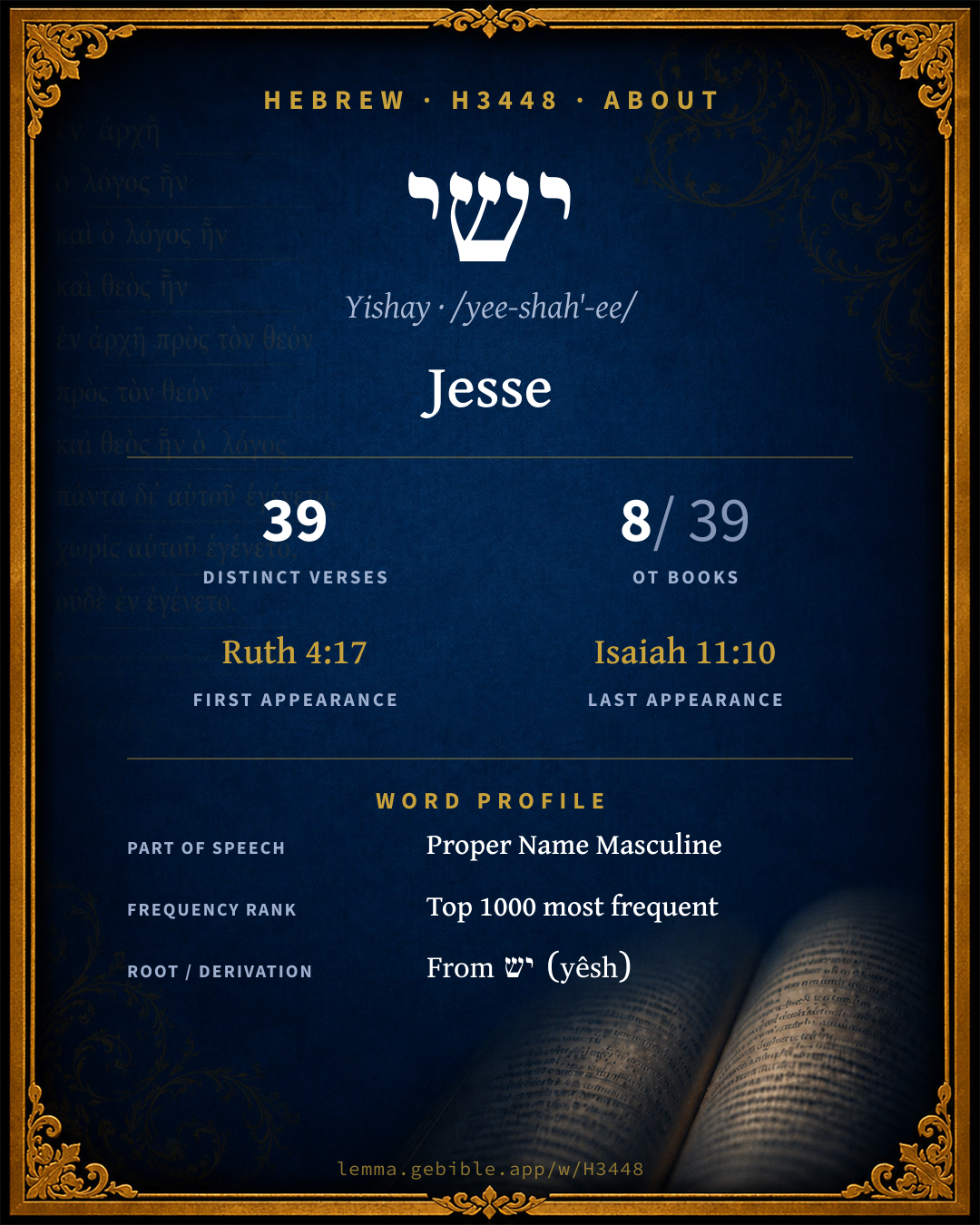
יִשַׁי
Jesse
BDB lists 2 entries for ‘Jesse’ fuller range ↓
Full lexicon entry — Brown-Driver-Briggs (BDB)
From Brown-Driver-Briggs (BDB)
Where this word appears
Grammar key — what these labels mean
Part of speech
- Noun
- A naming word — a person, place, thing, or idea.
Noun type
- Proper
- A name of a specific person, place, or people (e.g. Abraham, Zion, Israel).
Every verse where H3448 appears in the Book of 2 Chronicles — 2 distinct verses. Click any verse to open its interlinear word-by-word view. Verse text shown in the World English Bible for context — . Each verse’s Hebrew form is shown with its reference; the English is not keyword-highlighted, since the data carries no word-level English alignment. Use “Compare translations” on any verse to read it across multiple English versions. This concordance covers the Hebrew Bible; Septuagint (Greek Old Testament) occurrences are not indexed here.
2 Chronicles
- 2 Chronicles 10:16 יִשַׁ֗י n Proper When all Israel saw that the king didn't listen to them, the people answered the king, saying, What portion have we in David? neither have we inheritance in the son of Jesse: every man to your tents, Israel: now see to your own house, David. So all Israel departed to their tents.
- 2 Chronicles 11:18 יִשָֽׁי n Proper Rehoboam took him a wife, Mahalath the daughter of Jerimoth the son of David, [and of] Abihail the daughter of Eliab the son of Jesse;
About this entry
At a glance — auto-summarized from this page’s data, not written by a person. Every figure links to its source below. This summary describes the numbers; it doesn’t interpret them.
ישי — transliterated Yishay — is a Hebrew name carrying the sense “Jesse.” Its uses cluster heavily in 1 Samuel (62% of all occurrences). With 39 verses in 8 books, it is a moderately common word in the Hebrew Bible. It first appears in Ruth 4:17. See 39-verse concordance and the renderings breakdown below.
Gloss history
Strong's 1890 vs modern scholarship
About this word
Strong's H3448 catalogs a Hebrew word from the Hebrew Old Testament.
These counts are not copied from any lexicon or concordance. They are computed here, from the morphology-tagged Hebrew Old Testament. What Lemma adds →
- 39
- distinct verses
- The word appears in 39 distinct verses.
- 8 / 39
- OT books
- The word appears in 8 of 39 Old Testament books.
- #864
- by frequency
- Top 1000 most frequent Hebrew words (rank 864 of 8,640 Hebrew words by occurrence).
View all 39 occurrences in the concordance →
Most concentrated in
- 1 Samuel 24 verses 62%
- 1 Chronicles 5 verses 13%
- Ruth 2 verses 5%
By section of the Old Testament
By traditional corpus
Conventional, traditional groupings — biblical authorship is debated, so this is a traditional corpus grouping, not an authorship claim. Each share is this word’s portion of its verses in that division of the Hebrew canon. Each figure is a share of the word’s 39 distinct verses.
- Prophets (Nevi'im) 29 verses · 74%
- Writings (Ketuvim) 10 verses · 26%
How translations render this word
Counts come from each version’s own published word-to-Strong’s tagging or interlinear alignment — an approximate guide to how each version renders this word, not a word-level alignment the data otherwise carries. Because each total is that version’s own tagged count, the per-version totals vary from one another and need not match the appearance or distinct-verse counts above. These counts may also differ from a printed concordance because Lemma counts each distinctly tagged rendering and does not collapse phrase taggings into a single head-word total. This is a fixed set of word-tagged versions (KJV, ASV, BSB, ULT) and does not change with the reading translation you choose elsewhere. Each version’s license is shown beside its name below (and on Sources).
- King James Version: Jesse 39×
- American Standard Version: Jesse 38×
- Berean Standard Bible: Jesse 35×, Him 2×, Jesse’s 2×
- unfoldingWord Literal Text: Jesse 41×
King James Version Public Domain
Renders H3448 across 42 tagged occurrences — most commonly:
Plus 3 renderings that appear only once — usually multi-word phrases or single function words the recovered tagging swept in, not distinct renderings.
American Standard Version Public Domain
Renders H3448 across 42 tagged occurrences — most commonly:
Plus 4 renderings that appear only once — usually multi-word phrases or single function words the recovered tagging swept in, not distinct renderings.
Berean Standard Bible Public Domain
Renders H3448 across 41 tagged occurrences — most commonly:
Plus 2 renderings that appear only once — usually multi-word phrases or single function words the recovered tagging swept in, not distinct renderings. Not rendered by a distinct English word in 1 further occurrence.
unfoldingWord Literal Text CC BY-SA 4.0
Renders H3448 across 42 tagged occurrences — most commonly:
Plus 1 rendering that appears only once — usually multi-word phrases or single function words the recovered tagging swept in, not distinct renderings.
Senses in BDB
The 2 senses BDB distinguishes for this word, in lexicon order (not ranked by frequency or importance). The full entry — with sub-senses — is in the Lexicon Entry tab.
- Jesse = "I possess"
- son of Boaz and the father of king David
Word origin
n.pr.m. father of David (etym. dub.; Ol§ 277 f. conj. יֵשׁ יָהּ; We 1 S 14:49 ישׁי = אישׁי = אבישׁי (but see this))—יִשַׁי 1 S 16:3 + 29 times; יִשָׁ֑י v 19 + 10 times; 𝔊 Ιεσσαι; (וְ)אִישַׁי 1 Ch 2:13;—+ יִשַׁי בֵּית־הַלַּחְמִי Jesse the Bethlehemite 1 S 16:1, 18 (בֶּן־ישׁי וגו׳, of David), 17:58†; ישׁי also 16:3 + 14 times 1 S 16, 17; †son of עוֹבֵד according to Ru 4:17, 22(×2) = 1 Ch 2:12; דָּוִ(י)ד בֶּן־ישׁי 2 S 23:1; 1 Ch 10:14; 29:26 ψ 72:20; אֱלִיאָב בֶּן־ישׁי 2 Ch 11:18; elsewhere בֶּן־ישׁי alone = David, 1 S 20:27, 30, 31; 22:7, 8, 9, 13; 25:10; 2 S 20:1; 1 K 12:16 = 2 Ch 10:16, 1 Ch 12:18; גֶּזַע יִשָׁ֑י Is 11:1; שֹׁרֶשׁ יִשַׁי v 10 of Jesse as ancestor of future (Messianic) king†.
— Brown-Driver-Briggs (Oxford 1906, public domain), digitized via Sefaria, supplemented by the OpenScriptures HebrewLexicon (CC BY 4.0). See Sources.
Derived from יש (yêsh) (H3426) — there is.
Jastrow Dictionary
A second Hebrew/Aramaic lexicon for comparison, covering Aramaic and post-biblical (Talmudic, Targumic, Midrashic) usage that the biblical-Hebrew BDB does not. Matched by lemma rather than by Strong’s number, so a lemma may carry more than one Jastrow headword (shown separately below), and the entries cover usage well beyond the Bible.
יִשַׁי
- (b. h.) pr. n. m. Jesse, father of king David. Ber. 58ᵃ. Pes. 119ᵃ; a. fr.
A Dictionary of the Targumim, the Talmud Babli and Yerushalmi, and the Midrashic Literature (Marcus Jastrow; London, Luzac, 1903) — Public Domain. Digitized via Sefaria. Digitized via Sefaria. Full attribution on Sources.
Forms in the corpus
The 15 distinct written forms H3448 takes in the Hebrew Bible, most frequent first — each parse links to that state’s occurrences in the concordance. Hebrew forms include their vowel points and cantillation, so a single lemma takes many written forms.
| Form | Parsing | Example | Uses |
|---|---|---|---|
| יִשַׁ֔י | Noun, Proper | 1 Chronicles 12:18 | 7 |
| יִשַׁי֙ | Noun, Proper | 1 Samuel 16:5 | 6 |
| יִשָׁ֑י | Noun, Proper | 1 Samuel 16:19 | 5 |
| יִשַׁ֖י | Noun, Proper | 1 Samuel 16:9 | 4 |
| יִשַׁ֗י | Noun, Proper | 1 Kings 12:16 | 4 |
| יִשָֽׁי | Noun, Proper | 1 Chronicles 2:12 | 4 |
| יִשַׁ֛י | Noun, Proper | 1 Samuel 16:10 | 2 |
| יִשַׁ֜י | Noun, Proper | 1 Samuel 16:20 | 2 |
| יִשָׁ֔י | Noun, Proper | 1 Chronicles 29:26 | 2 |
| וְ/אִישַׁ֛י | Noun, Proper | 1 Chronicles 2:13 | 1 |
| וְ/יִשַׁ֖י | Noun, Proper | Ruth 4:22 | 1 |
| יִשַׁ֣י | Noun, Proper | 1 Samuel 16:1 | 1 |
| יִשַׁי֮ | Noun, Proper | 1 Samuel 16:11 | 1 |
| לְ/יִשַׁ֖י | Noun, Proper | 1 Samuel 16:3 | 1 |
| לְ/יִשַׁי֮ | Noun, Proper | 1 Samuel 16:18 | 1 |
Same root — word family
Other BDB entries built from the same root as H3448, grouped by Strong’s listed origin. These share a root / origin per the lexicon — not necessarily a shared meaning. Each links to that word’s own entry.
Derives from
Shares the same root
Proper names from this root
People and places named from this root — a name, not an additional meaning of the word.
Compare all same-root words → 1 of the same-root words is a proper name (a person or place). They share a root, not necessarily a meaning.
Bible dictionary
Public-domain dictionary articles matched to this entry by name (Jesse). A biblical name can be shared by more than one person or place, so an article may treat several.
Easton's Bible Dictionary · M. G. Easton, 1897
Firm, or a gift, a son of Obed, the son of Boaz and Ruth (Ruth 4:17, 22; Matt. 1:5, 6; Luke 3:32). He was the father of eight sons, the youngest of whom was David (1 Sam. 17:12). The phrase "stem of Jesse" is used for the family of David (Isa. 11:1), and "root of Jesse" for the Messiah (Isa. 11:10; Rev. 5:5). Jesse was a man apparently of wealth and position at Bethlehem (1 Sam. 17:17, 18, 20; Ps. 78:71). The last reference to him is of David's procuring for him an asylum with the king of Moab (1 Sam. 22:3).
Smith's Bible Dictionary · William Smith, 1863
(wealthy), the father of David, was the son of Obed, who again was the fruit of the union of Boaz and the Moabitess Ruth. His great-grandmother was Rahab the Canaanite, of Jericho. (Matthew 1:5) Jesse's genealogy is twice given in full in the Old Testament, viz., (Ruth 4:18-22) and 1Chr 2:5-12 He is commonly designated as "Jesse the Bethlehemite," (1 Samuel 16:1,18; 17:58) but his full title is "the Ephrathite of Bethlehem Judah." ch. (1 Samuel 17:12) He is an "old man" when we first meet with him, (1 Samuel 17:12) with eight sons, ch. (1 Samuel 16:10; 17:12) residing at Bethlehem. ch (1 Samuel 16:4,5) Jesse's wealth seems to have consisted of a flock of sheep and goats, which were under the care of David. ch. (1 Samuel 16:11; 17:34,35) After David's rupture with Saul he took his father and his mother into the country of Moab and deposited them with the king, and there they disappear from our view in the records of Scripture. (B.C. 1068-61.) Who the wife of Jesse was we are not told.
Hitchcock's Bible Names Dictionary · Roswell D. Hitchcock, 1869
gift; oblation; one who is
Classic public-domain reference works; full attribution on Sources.
Septuagint verse parallels
This word appears in 38 verses that also exist in the Greek Old Testament (Septuagint), out of the 39 Hebrew verses it occurs in. You can read those verses in Greek by switching the Old Testament edition to the Septuagint.
Read these verses in the Septuagint
- Ruth 4:17
- 1 Samuel 16:1
- 2 Samuel 20:1
- 1 Kings 12:16
- 1 Chronicles 2:12
- 2 Chronicles 10:16
- Psalms 72:20
- Isaiah 11:1
This is a verse-level parallel only — the same verses exist in both the Hebrew and Greek Old Testaments. No word-level Hebrew↔Greek correspondence is claimed: the data carries no such alignment, so no Greek word is shown as this Hebrew word’s translation. Coverage is not total — the Septuagint omits the deuterocanon and renumbers the Psalms, so some Hebrew verses have no direct Greek parallel.