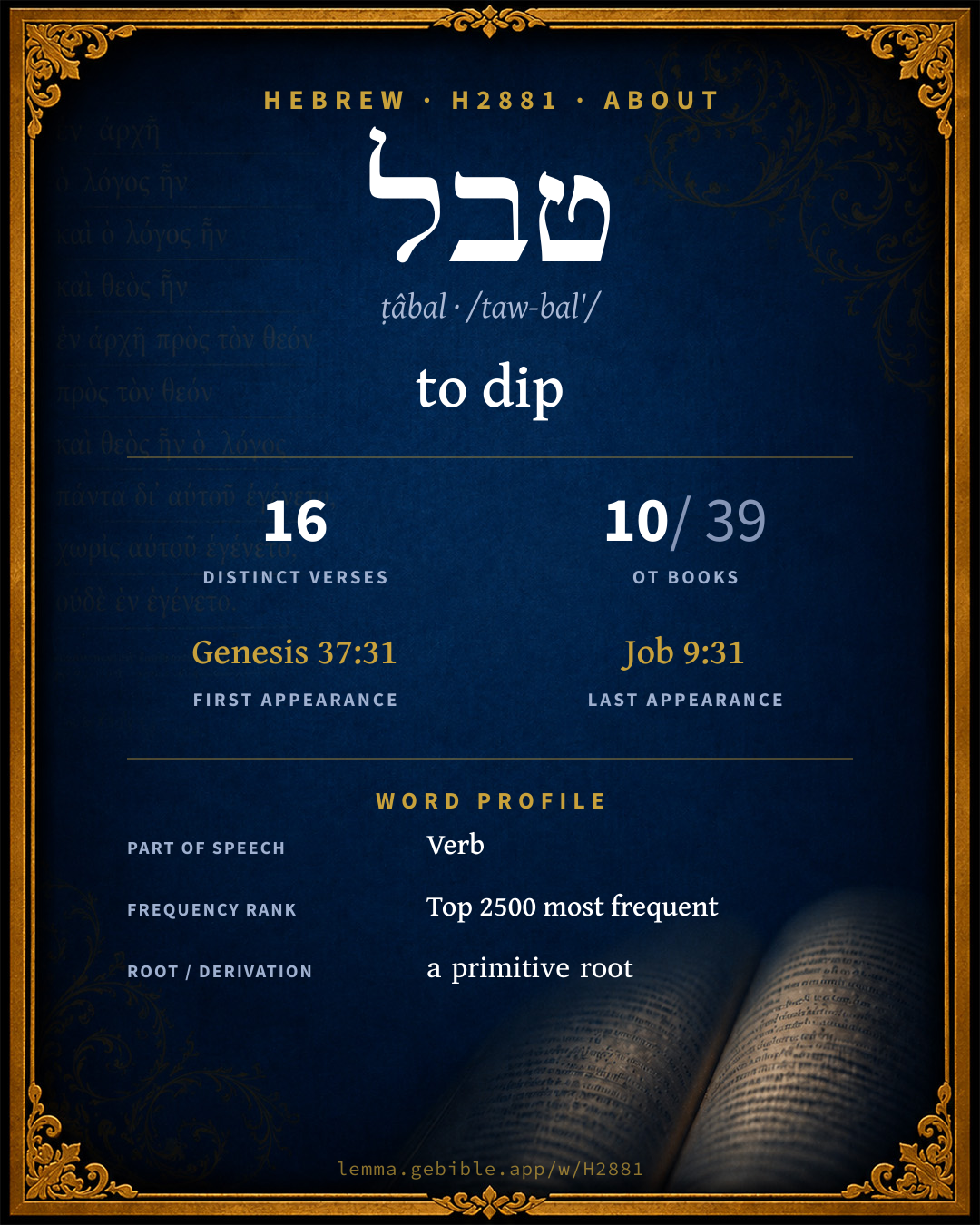
טָבַל
to dip
also: dip into, plunge fuller range ↓
Full lexicon entry — Brown-Driver-Briggs (BDB)
From Brown-Driver-Briggs (BDB)
Where this word appears
Grammar key — what these labels mean
Part of speech
- Verb
- An action or state-of-being word.
Stem
- Qal
- The basic, simple active stem — the plain form of the verb (“he wrote”).
- Niphal
- Usually the simple passive or reflexive of the Qal (“he was written”).
Form
- Sequential Perfect
- A perfect with prefixed waw continuing a preceding imperfect or command (waw-consecutive perfect).
- Sequential Imperfect
- An imperfect with prefixed waw — the standard past-narrative form (waw-consecutive imperfect).
- Participle Active
- A verbal adjective expressing ongoing or characteristic action (“writing / one who writes”).
- Perfect
- A completed action or state — Hebrew marks aspect (completeness) more than strict tense (“he wrote”).
- Imperfect
- An incomplete, ongoing, or future action (“he will / would write”).
State
- Absolute
- The independent form of a noun, not bound to a following word.
Person
- 3rd Person
- The one spoken about (“he / she / it / they”).
- 2nd Person
- The one addressed (“you”).
Gender
- Masculine
- Grammatically masculine.
- Feminine
- Grammatically feminine.
- Common
- Either gender — not distinguished for this form.
Number
- Singular
- One.
- Plural
- More than one (in Hebrew, generally three or more).
Every verse where H2881 appears in the Book of 1 Samuel — 1 distinct verse. Click any verse to open its interlinear word-by-word view. Verse text shown in the World English Bible for context — . Each verse’s Hebrew form is shown with its reference; the English is not keyword-highlighted, since the data carries no word-level English alignment. Use “Compare translations” on any verse to read it across multiple English versions. This concordance covers the Hebrew Bible; Septuagint (Greek Old Testament) occurrences are not indexed here.
1 Samuel
About this entry
At a glance — auto-summarized from this page’s data, not written by a person. Every figure links to its source below. This summary describes the numbers; it doesn’t interpret them.
At its core, טבל (ṭâbal) means “to dip.” First canonically at Genesis 37:31, it enters the text early. With 16 verses in 10 books, it is an uncommon word in the Hebrew Bible. Its uses concentrate in Leviticus (38% of all occurrences). Not a single-sense word, it carries 2 senses, among them “dip into” and “plunge”. Each statement above links to its evidence; the full detail follows below.
Gloss history
Strong's 1890 vs modern scholarship
About this word
Strong's H2881 catalogs a Hebrew word from the Hebrew Old Testament.
These counts are not copied from any lexicon or concordance. They are computed here, from the morphology-tagged Hebrew Old Testament. What Lemma adds →
- 16
- distinct verses
- The word appears in 16 distinct verses.
- 10 / 39
- OT books
- The word appears in 10 of 39 Old Testament books.
- #1,752
- by frequency
- Top 2500 most frequent Hebrew words (rank 1,752 of 8,640 Hebrew words by occurrence).
View all 16 occurrences in the concordance →
By section of the Old Testament
By traditional corpus
Conventional, traditional groupings — biblical authorship is debated, so this is a traditional corpus grouping, not an authorship claim. Each share is this word’s portion of its verses in that division of the Hebrew canon. Each figure is a share of the word’s 16 distinct verses.
- Torah (Pentateuch) 10 verses · 63%
- Prophets (Nevi'im) 4 verses · 25%
- Writings (Ketuvim) 2 verses · 13%
How translations render this word
Counts come from each version’s own published word-to-Strong’s tagging or interlinear alignment — an approximate guide to how each version renders this word, not a word-level alignment the data otherwise carries. Because each total is that version’s own tagged count, the per-version totals vary from one another and need not match the appearance or distinct-verse counts above. These counts may also differ from a printed concordance because Lemma counts each distinctly tagged rendering and does not collapse phrase taggings into a single head-word total. This is a fixed set of word-tagged versions (KJV, ASV, BSB, ULT) and does not change with the reading translation you choose elsewhere. Each version’s license is shown beside its name below (and on Sources).
- King James Version: Dip 4×, Dipped 4×, Shall dip 4×
- American Standard Version: Dip 4×, Dipped 4×, Shall dip 4×
- Berean Standard Bible: Dip 7×, Dipped 3×, Is to dip 2×
- unfoldingWord Literal Text: And 3×, He dipped 3×, Shall dip 3×
King James Version Public Domain
Renders H2881 across 16 tagged occurrences — most commonly:
Plus 4 renderings that appear only once — usually multi-word phrases or single function words the recovered tagging swept in, not distinct renderings.
American Standard Version Public Domain
Renders H2881 across 16 tagged occurrences — most commonly:
Plus 4 renderings that appear only once — usually multi-word phrases or single function words the recovered tagging swept in, not distinct renderings.
Berean Standard Bible Public Domain
Renders H2881 across 16 tagged occurrences — most commonly:
Plus 4 renderings that appear only once — usually multi-word phrases or single function words the recovered tagging swept in, not distinct renderings.
unfoldingWord Literal Text CC BY-SA 4.0
Renders H2881 across 20 tagged occurrences — most commonly:
Plus 5 renderings that appear only once — usually multi-word phrases or single function words the recovered tagging swept in, not distinct renderings.
Senses in BDB
The 2 senses BDB distinguishes for this word, in lexicon order (not ranked by frequency or importance). The full entry — with sub-senses — is in the Lexicon Entry tab.
- to dip, dip into, plunge
(Qal)
- (Niphal) to be dipped
Word origin
Origin: a primitive root
Jastrow Dictionary
A second Hebrew/Aramaic lexicon for comparison, covering Aramaic and post-biblical (Talmudic, Targumic, Midrashic) usage that the biblical-Hebrew BDB does not. Matched by lemma rather than by Strong’s number, so a lemma may carry more than one Jastrow headword (shown separately below), and the entries cover usage well beyond the Bible.
טָבַל I
- 1. to dip. Zeb. 93ᵇ, a. e. וט׳ ולא מספג, v. סָפַג.
- 2. to immerse, to bathe for purification. Yoma VII, 4 ירד וט׳ went down to the bath and took an immersion. Ber. 2ᵇ שהכהנים טוֹבְלִין וכ׳ when the priests (that have been unclean) bathe in order to be permitted to partake of their priestly share; a. v. fr.—Ib. 22ᵃ טוֹבְלֵי שחרין those taking a bath in the morning (after emission of semen virile); Y. ib. III, 6ᶜ top ט׳ שחרית.—Tosef. Yad. II, 20 טובלי שחרין (Var. טוֹבְלָנֵי) morning bathers (Essenes, v. Graetz Gesch. d. Jud. III2, p. 468, a. for correct vers. R. S. to Yad. IV, 8).—Part. pass. טָבוּל.—טְבוּל יום (one who has bathed in day-time,) one who has bathed but must wait for sunset to be perfectly clean (Lev. XXII, 7). T’bul Yom I, 1; a. fr.—Nidd. 30ᵃ טְבוּלַת יום ארוך a woman after bathing whose day is adjourned (having to wait a long time for perfect levitical purity).—טְבוּל יוֹם T’bul Yom, name of a treatise of Mishnah and Tosefta of the order of Tahăroth e.g. Leviticus 22:7
- 1. to dip into vinegar, salt &c., to make tasty; esp. to take a luncheon, to take the first course of a meal consisting of relishes; to take the antepast. Maasr. IV, 1 המְטַבֵּל בשדה he who makes a luncheon (of fruits) in the field. Pes. X, 3 מטבל בחזרת he takes lettuce as antepast. Tosef. ib. X, 9 לא טי׳ וכ׳ if he has eaten as antepast only &c. Pes. 107ᵇ אבל מטבל וכ׳ Ms. M. a. comment. (ed. מטביל) but he may make a luncheon of &c. Ib. השמש מטבל בבני וכ׳ comment. (ed. מטביל; Tosef. ib. X, 5 מכביש, v. כָּבַשׁ); a. fr.
- 2. (cmp. תבל) to season with spices. Part. pass. מְטוּבָּל. Y. Shek. III, 47ᶜ top מבושל כמ׳ boiled (wine) is (in ritual law) like spiced wine; v. infra.
- 1. to immerse vessels for purification, to order immersion. Ter. II, 3 המַטְבִּיל כלים וכ׳ he who immerses vessels on the Sabbath. Bets. II, 2 מַטְבִּילִין את הכל וכ׳ you must immerse whatever needs immersion (both persons and vessels) before &c.—Ib. 3 (17ᵇ), v. גַּב.—Nidd. 29ᵇ, v. טְבִילָה; a. fr.
- 2. to take luncheon, v. supra.
- 3. to season. Erub. 28ᵇ מטבילין בו וכ׳ they used to season the roast with it (in place of pepper).
- to be immersed, to be made clean. Mikv. V, 6 לא הוּטְבָּלוּ are not considered as clean through immersion; Tosef. ib. IV, 10.
טְבַל
- Targ. Lev. IX, 9; a. fr.—Part. pass. טְבִיל, f. טְבִילָא. Targ. Josh. III, 15 (טְבִילָן?).—Snh. 39ᵃ במאי טביל wherewith did he purify himself (after contact with a corpse)?; בנורא טביל he did it by means of fire, v. טְבִילָה. Nidd. 30ᵃ לִיטְבְּלָהּ let her bathe; a. fr.—
- as preced. Hif.
- 1. to immerse, order immersion. Nidd. l. c. אַטְבְּלִינָן לה we make her bathe. Bets. 19ᵃ לאַטְבּוּלֵיה to immerse it; a. fr.
- 2. as preced. Pi. 1, to take an antepast. Pes. 114ᵇ למיהדר לאַטְבּוּלֵי must take the bitter herb a second time; a. e.
טָבַל II
- (denom. of טֶבֶל) to create Tebel, to make obligatory the setting aside of tithes&c. Y. Maasr. IV, beg. 51ᵃ אור טוֹבֵל fire (roasting) makes subject to sacred gifts; מלח טוֹבֶלֶת salting makes subject &c.; a. fr.—Part. part. טָבוּל that which is subject to sacred gifts, forbidden as Tebel. Ber. 47ᵇ טבל ט׳ מדרבנן Tebel declared to be such by rabbinical enactment; a. e.—Pl. טְבוּלִים, טְבוּלִין. Y. Dem. VI, 25ᶜ bot., opp. מתוקנים. Ib. VII, 26ᵇ top פירות ט׳ fruits of which the sacred gifts have not been set aside.
- to become, or to be declared Tebel. Y. Maasr. I, end, 49ᵇ טבל שנ׳ מדבריהן Tebel which is declared to be such by rabbinical law, v. supra. Ib. IV, beg. 51ᵃ נִטְבְּלוּ the roasted ears became subject to tithes; a. fr.
טְבַל ²
- Men. 70ᵃ טַבְלָהּ לה (not טבלא) he made it subject to tithes. Bets. 13ᵃ טַבְלָן ביומיה Ms. M. (ed. טבלא, corr. acc.) he made them Tebel on that day (by designating them for immediate use); a. e.
טֶבֶל
- , v. Pi. a. Hif.) fruits of which you are permitted to make a luncheon or improvised meal in the field without separating the priestly or levitical shares. Ber. 35ᵇ איו הט׳ טתחייב וכ׳ the tebel is not subject to tithes, until it is brought home (for consumption or storage).—Esp. Tebel, produces inthat stage in which the separation of levitical and priestly shares respectively is required, before you may partake of them; eatables forbidden pending the separation of sacred gifts. Ter. X, 6 חבילי תלתן של ט׳ bundles of fenugrec subject to T’rumah; expl. Bets. 13ᵃ ט׳ טבול של תרומה (Rashi: לתרומה) Tebel considered as such, because it is subject to T’rumah (Deut. XVIII, 4; Ms. M. של ת׳ גדולה to the general gifts of T’rumah and tithes); ט׳ טבול של תרומת מעשר Tebel (in the possession of a Levite who received it for tithes, and) considered Tebel, because it is subject to the T’rumah from tithes (Num. XVIII, 26). Ter. IX, 6 הט׳ גדוליו וכ׳ the growth of seeds that had been subject to sacred gifts the separation of which had been omitted &c. Ib. 7 אע"פ שפירותיו ט׳ although its growth is considered Tebel (because the seeds were not tithed) &c. Kidd. 58ᵇ טִיבְלוֹ של וכ׳ his neighbor’s Tebel; a. fr.—[Erub. 86ᵃ יש לו ט׳, read: טַבְלָא I.].—Pl. טְבָלִים. Ib.—Ned. 20ᵃ סיפך להאכילך ט׳ he will finally give thee to eat things from which the tithes have not been given. Ḥull. 132ᵇ; a. e. e.g. Deuteronomy 18:4
A Dictionary of the Targumim, the Talmud Babli and Yerushalmi, and the Midrashic Literature (Marcus Jastrow; London, Luzac, 1903) — Public Domain. Digitized via Sefaria. Digitized via Sefaria. Full attribution on Sources.
Forms in the corpus
The 13 distinct written forms H2881 takes in the Hebrew Bible, most frequent first — each parse links to that stem’s occurrences in the concordance. Hebrew forms include their vowel points and cantillation, so a single lemma takes many written forms.
Same root — word family
Other BDB entries built from the same root as H2881, grouped by Strong’s listed origin. These share a root / origin per the lexicon — not necessarily a shared meaning. Each links to that word’s own entry.
Derived from this word
Proper names from this root
People and places named from this root — a name, not an additional meaning of the word.
Compare all same-root words → 1 of the same-root words is a proper name (a person or place). They share a root, not necessarily a meaning.
Septuagint verse parallels
This word appears in 16 verses that also exist in the Greek Old Testament (Septuagint), out of the 16 Hebrew verses it occurs in. You can read those verses in Greek by switching the Old Testament edition to the Septuagint.
Read these verses in the Septuagint
- Genesis 37:31
- Exodus 12:22
- Leviticus 4:6
- Numbers 19:18
- Deuteronomy 33:24
- Joshua 3:15
- Ruth 2:14
- 1 Samuel 14:27
- 2 Kings 5:14
- Job 9:31
This is a verse-level parallel only — the same verses exist in both the Hebrew and Greek Old Testaments. No word-level Hebrew↔Greek correspondence is claimed: the data carries no such alignment, so no Greek word is shown as this Hebrew word’s translation. Coverage is not total — the Septuagint omits the deuterocanon and renumbers the Psalms, so some Hebrew verses have no direct Greek parallel.