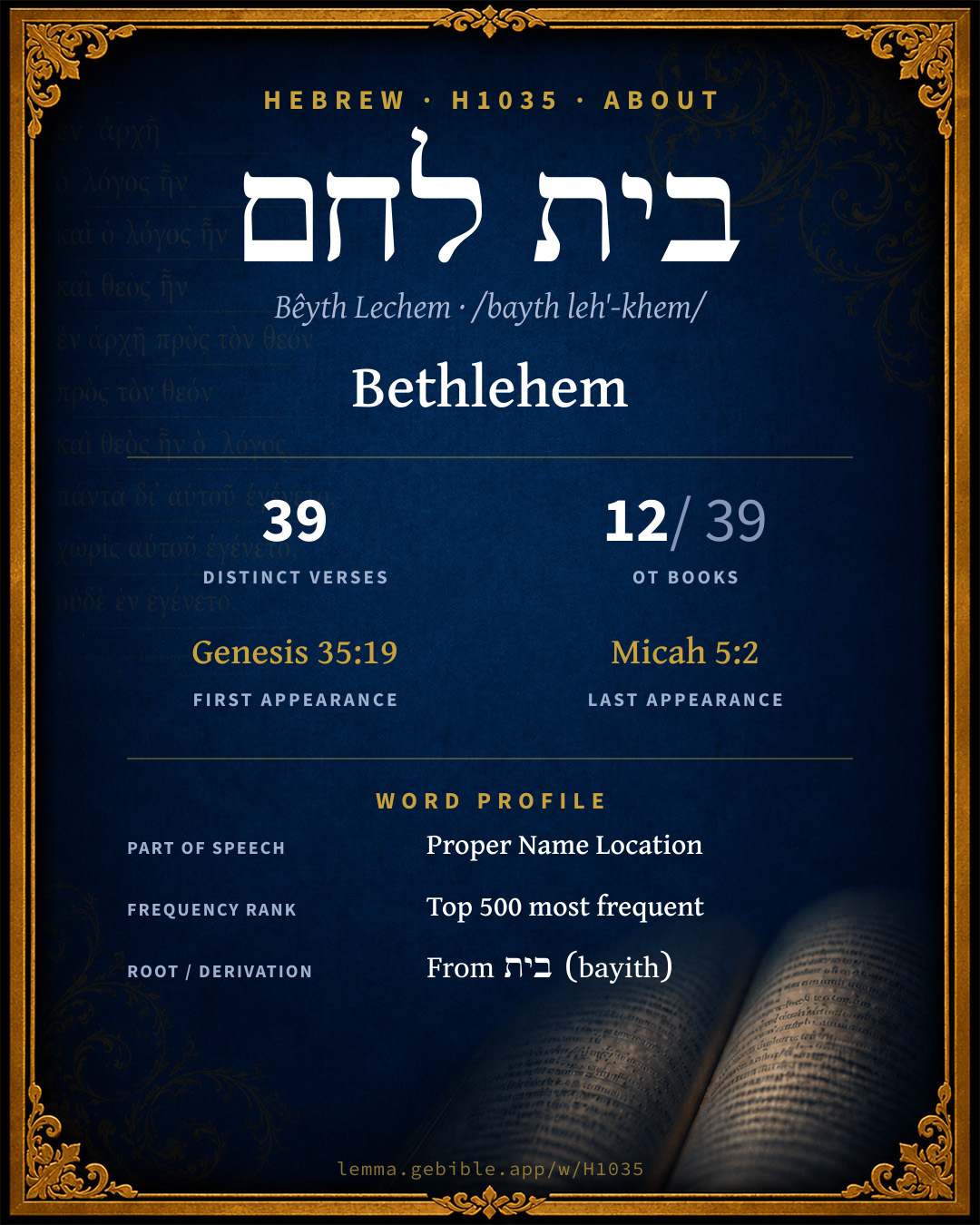
בֵּית לֶ֫חֶם
Bethlehem
BDB lists 3 entries for ‘Bethlehem’ fuller range ↓
Full lexicon entry — Brown-Driver-Briggs (BDB)
From Brown-Driver-Briggs (BDB)
Where this word appears
Grammar key — what these labels mean
Part of speech
- Noun
- A naming word — a person, place, thing, or idea.
Noun type
- Proper
- A name of a specific person, place, or people (e.g. Abraham, Zion, Israel).
Every verse where H1035 appears in the Book of Micah — 1 distinct verse. Click any verse to open its interlinear word-by-word view. Verse text shown in the World English Bible for context — . Each verse’s Hebrew form is shown with its reference; the English is not keyword-highlighted, since the data carries no word-level English alignment. Use “Compare translations” on any verse to read it across multiple English versions. This concordance covers the Hebrew Bible; Septuagint (Greek Old Testament) occurrences are not indexed here.
Micah
About this entry
At a glance — auto-summarized from this page’s data, not written by a person. Every figure links to its source below. This summary describes the numbers; it doesn’t interpret them.
At its core, בית לחם (Bêyth Lechem) means “Bethlehem.” Scripture first uses it in Genesis 35:19. With 39 verses in 12 books, it is a moderately common word in the Hebrew Bible. Each statement above links to its evidence; the full detail follows below.
Gloss history
Strong's 1890 vs modern scholarship
About this word
Strong's H1035 catalogs a Hebrew word from the Hebrew Old Testament.
These counts are not copied from any lexicon or concordance. They are computed here, from the morphology-tagged Hebrew Old Testament. What Lemma adds →
- 39
- distinct verses
- The word appears in 39 distinct verses.
- 12 / 39
- OT books
- The word appears in 12 of 39 Old Testament books.
- #487
- by frequency
- Top 500 most frequent Hebrew words (rank 487 of 8,640 Hebrew words by occurrence).
View all 39 occurrences in the concordance →
Most concentrated in
- Judges 8 verses 21%
- 1 Chronicles 7 verses 18%
- Ruth 6 verses 15%
By section of the Old Testament
By traditional corpus
Conventional, traditional groupings — biblical authorship is debated, so this is a traditional corpus grouping, not an authorship claim. Each share is this word’s portion of its verses in that division of the Hebrew canon. Each figure is a share of the word’s 39 distinct verses.
- Prophets (Nevi'im) 21 verses · 54%
- Writings (Ketuvim) 16 verses · 41%
- Torah (Pentateuch) 2 verses · 5%
How translations render this word
Counts come from each version’s own published word-to-Strong’s tagging or interlinear alignment — an approximate guide to how each version renders this word, not a word-level alignment the data otherwise carries. Because each total is that version’s own tagged count, the per-version totals vary from one another and need not match the appearance or distinct-verse counts above. These counts may also differ from a printed concordance because Lemma counts each distinctly tagged rendering and does not collapse phrase taggings into a single head-word total. This is a fixed set of word-tagged versions (KJV, ASV, BSB, ULT) and does not change with the reading translation you choose elsewhere. Each version’s license is shown beside its name below (and on Sources).
- King James Version: Bethlehem 24×, Bethlehemjudah 10×
- American Standard Version: Beth-lehem 29×, Same is beth-lehem 2×, Was then in beth-lehem 2×
- Berean Standard Bible: Bethlehem 38×, Of 3×, From 2×
- unfoldingWord Literal Text: Bethlehem 74×, Bethlehem of 4×, Was 4×
King James Version Public Domain
Renders H1035 across 41 tagged occurrences — most commonly:
Plus 7 renderings that appear only once — usually multi-word phrases or single function words the recovered tagging swept in, not distinct renderings.
American Standard Version Public Domain
Renders H1035 across 41 tagged occurrences — most commonly:
Plus 8 renderings that appear only once — usually multi-word phrases or single function words the recovered tagging swept in, not distinct renderings.
Berean Standard Bible Public Domain
Renders H1035 across 47 tagged occurrences — most commonly:
Plus 2 renderings that appear only once — usually multi-word phrases or single function words the recovered tagging swept in, not distinct renderings. Not rendered by a distinct English word in 5 further occurrences.
unfoldingWord Literal Text CC BY-SA 4.0
Renders H1035 across 84 tagged occurrences — most commonly:
Senses in the full BDB
What do BDB’s symbols mean?
BDB uses these scholarly abbreviations:
| Symbol | Meaning |
|---|---|
| 𝔊 | the Septuagint (the ancient Greek translation, LXX) |
| 𝔙 | the Vulgate (the Latin translation) |
| 𝔖 | the Syriac version (the Peshitta) |
| 𝔗 | the Targum (the Aramaic translation) |
| ψ | the Psalms |
| √ | root (the underlying root or stem) |
| ‖ | parallel passage (a synonymous or contrasted parallel) |
| † | the dagger: every passage where the word occurs is cited |
The 2 senses and sub-senses the full Brown-Driver-Briggs lexicon distinguishes for this word, in lexicon order (not ranked by frequency), with BDB’s own verbatim wording and sub-sense lettering. Shown in Hebrew script with BDB’s own scholarly abbreviations. The condensed entry is in the Lexicon Entry tab. See also the Forms in the corpus table below.
- 1. in Judah (place of bread (food), mod. Arabic بَيْت لَحْم, place of meat), 2 hours south of Jerusalem; birth-place of David;—בֵּית לֶ֫חֶם Ru 1:19 + 11 times; בּ׳־לֶחֶם 1 S 20:6 + 9 times; בֵּית לָ֑חֶם Ju 12:8 = 11 times + Gn 35:19; 48:7, where הוא בית לחם is a gloss, v. אֶפְרָ֫תָה, p. 68; בּ׳־לָ֑חֶם 1 S 17:15 + 3 times;—as cstr. בּ׳ לֶ֫חֶם יְהוּדָה Ju 17:7, 8, 9; 19:1, 2, 18(×2) Ru 1:1, 2; 1 S 17:12; treated as n.pr.m. 1 Ch 2:51, 54; 4:4; men of Bethlehem אַנְשֵׁי בּ׳ Ne 7:26 = בְּנֵי בּ׳ Ezr 2:21;—on אֶפְרָ֫תָה as name of Bethlehem, & confusion arising from gloss Gn 35:19; 48:7, v. p. 68;—mod. Beit Laḥm, 5 m. S. of Jerus. RobBR i. 471 BdPal. 123 Surveyiii. 28, 83 GuérinJudée i. 120–206. e.g. Ruth 1:19
- 2. בֵּית לָ֑חֶם in Zeb. Jos 19:15; perhaps also Ju 12:8, 10; = Beit Laḥm, 7 m. NW. of Nazareth RobBR iii. 113 Survey i. 301. e.g. Joshua 19:15
Senses from the full Brown-Driver-Briggs lexicon (Brown, Driver, Briggs; Oxford 1906 — public domain), digitized via Sefaria, supplemented by the OpenScriptures HebrewLexicon (CC BY 4.0). Full attribution on Sources.
Word origin
Derived from בית (bayith) (H1004) — house.
Forms in the corpus
The 18 distinct written forms H1035 takes in the Hebrew Bible, most frequent first — each parse links to that state’s occurrences in the concordance. Hebrew forms include their vowel points and cantillation, so a single lemma takes many written forms.
| Form | Parsing | Example | Uses |
|---|---|---|---|
| לָֽחֶם | Noun, Proper | Genesis 35:19 | 12 |
| בֵּ֥ית | Noun, Proper | Genesis 35:19 | 9 |
| בֵּֽית | Noun, Proper | 1 Chronicles 11:17 | 8 |
| לֶ֨חֶם֙ | Noun, Proper | 1 Chronicles 2:54 | 8 |
| מִ/בֵּ֥ית | Noun, Proper | 1 Chronicles 11:26 | 8 |
| בֵּ֣ית | Noun, Proper | 1 Samuel 16:4 | 6 |
| לֶ֖חֶם | Noun, Proper | 1 Chronicles 11:17 | 6 |
| לָ֑חֶם | Noun, Proper | 1 Samuel 16:4 | 5 |
| לֶ֣חֶם | Noun, Proper | 1 Samuel 20:6 | 4 |
| בֵֽית | Noun, Proper | Ezra 2:21 | 3 |
| בְּ/בֵ֥ית | Noun, Proper | 1 Chronicles 11:16 | 3 |
| לֶ֔חֶם | Noun, Proper | Ruth 1:19 | 3 |
| לָ֔חֶם | Noun, Proper | Ezra 2:21 | 2 |
| וּ/בֵ֣ית | Noun, Proper | Joshua 19:15 | 1 |
| לֶ֛חֶם | Noun, Proper | 2 Chronicles 11:6 | 1 |
| מִ/בֵּ֣ית | Noun, Proper | Ruth 2:4 | 1 |
| מִ/בֵּ֧ית | Noun, Proper | Ruth 1:1 | 1 |
| מִ/בֵּֽית | Noun, Proper | Judges 19:18 | 1 |
Same root — word family
Other BDB entries built from the same root as H1035, grouped by Strong’s listed origin. These share a root / origin per the lexicon — not necessarily a shared meaning. Each links to that word’s own entry.
Derives from
Shares the same root
Proper names from this root
People and places named from this root — a name, not an additional meaning of the word.
- Βηθαβαρα Bēthabará G962 Bethabara
- בית Bayith H1006 Bajith
- בית און Bêyth ʼÂven H1007 Beth-aven
- ביתאל Bêyth-ʼÊl H1008 Bethel
- בית ארבאל Bêyth ʼArbêʼl H1009 Beth-Arbel
- בית בעל מעון Bêyth Baʻal Mᵉʻôwn H1010 Beth-baal-meon
- בית בראי Bêyth Birʼîy H1011 Beth-birei
- בית ברה Bêyth Bârâh H1012 Beth-barah
- ביתגדר Bêyth-Gâdêr H1013 Beth-gader
- בית גמול Bêyth Gâmûwl H1014 Beth-gamul
- בית דבלתים Bêyth Diblâthayim H1015 Beth-diblathaim
- ביתדגון Bêyth-Dâgôwn H1016 Beth-dagon
- בית האצל Bêyth hâʼêtsel H1018 Beth-ezel
- בית הגלגל Bêyth hag-Gilgâl H1019 Beth-gilgal
- בית הישימות Bêyth ha-Yshîy-môwth H1020 Beth-jesimoth
- בית הכרם Bêyth hak-Kerem H1021 Beth-haccerem
- בית המרחק Bêyth ham-Merchâq H1023 Beth Ham-merchaq
- בית המרכבות Bêyth ham-Markâbôwth H1024 Beth-marcaboth
- בית העמק Bêyth hâ-ʻÊmeq H1025 Beth-emek
- בית הערבה Bêyth hâ-ʻĂrâbâh H1026 Beth-arabah
- בית הרם Bêyth hâ-Râm H1027 Beth-aram
- בית השטה Bêyth hash-Shiṭṭâh H1029 Beth-shittah
- בית חגלה Bêyth Choglâh H1031 Beth-hoglah
- בית חורון Bêyth Chôwrôwn H1032 Beth-horon
- Βηθλεεμ Bēthleém G965 Bethlehem
- בית הלחמי Bêyth hal-Lachmîy H1022 Bethlehemite
+20 more proper names from this root (not shown).
Compare all same-root words → Showing 4 of 50 — not the complete family. 46 of the same-root words are proper names (people or places). They share a root, not necessarily a meaning.
Bible dictionary
Public-domain dictionary articles matched to this entry by name (Bethlehem). A biblical name can be shared by more than one person or place, so an article may treat several.
Easton's Bible Dictionary · M. G. Easton, 1897
House of bread. (1.) A city in the "hill country" of Judah. It was originally called Ephrath (Gen. 35:16, 19; 48:7; Ruth 4:11). It was also called Beth-lehem Ephratah (Micah 5:2), Beth-lehem-judah (1 Sam. 17:12), and "the city of David" (Luke 2:4). It is first noticed in Scripture as the place where Rachel died and was buried "by the wayside," directly to the north of the city (Gen. 48:7). The valley to the east was the scene of the story of Ruth the Moabitess. There are the fields in which she gleaned, and the path by which she and Naomi returned to the town. Here was David's birth-place, and here also, in after years, he was anointed as king by Samuel (1 Sam. 16:4-13); and it was from the well of Bethlehem that three of his heroes brought water for him at the risk of their lives when he was in the cave of Adullam (2 Sam. 23:13-17). But it was distinguished above every other city as the birth-place of "Him whose goings forth have been of old" (Matt. 2:6; comp. Micah 5:2). Afterwards Herod, "when he saw that he was mocked of the wise men," sent and slew "all the children that were in Bethlehem, and in all the coasts thereof, from two years old and under" (Matt. 2:16, 18; Jer. 31:15).
Bethlehem bears the modern name of Beit-Lahm, i.e., "house of flesh." It is about 5 miles south of Jerusalem, standing at an elevation of about 2,550 feet above the sea, thus 100 feet higher than Jerusalem.
There is a church still existing, built by Constantine the Great (A.D. 330), called the "Church of the Nativity," over a grotto or cave called the "holy crypt," and said to be the "stable" in which Jesus was born. This is perhaps the oldest existing Christian church in the world. Close to it is another grotto, where Jerome the Latin father is said to have spent thirty years of his life in translating the Scriptures into Latin. (See VERSION.)
(2.) A city of Zebulun, mentioned only in Josh. 19:15. Now Beit-Lahm, a ruined village about 6 miles west-north-west of Nazareth.
Smith's Bible Dictionary · William Smith, 1863
(house of bread).
+ One of the oldest towns in Palestine, already in existence at the time of Jacob's return to the country. Its earliest name was Ephratah, Or Ephrath or EPHRATAH. See (Genesis 35:16,19; 48:7) After the conquest Bethlehem appears under its own name, BETHLEHEM-JUDAH. (Judges 17:7; 1 Samuel 17:12; Ruth 1:1,2) The book of Ruth is a page from the domestic history of Bethlehem. It was the home of Ruth, (Ruth 1:19) and of David. (1 Samuel 17:12) It was fortified by Rehoboam. (2 Chronicles 11:6) It was here that our Lord was born, (Matthew 2:1) and here that he was visited by the shepherds, (Luke 2:15-17) and the Magi. Matt 2. The modern town of Beit-lahm lies to the east of the main road from Jerusalem to Hebron, six miles from the former. It covers the east and northeast parts of the ridge of a long gray hill of Jura limestone, which stands nearly due east and west, and is about a mile in length. The hill has a deep valley on the north and another on the south. On the top lies the village in a kind of irregular triangle. The population is about 3000 souls, entirely Christians. The Church of the Nativity, built by the empress Helena A.D. 330, is the oldest Christian church in existence. It is built over the grotto where Christ is supposed to have been born. + A town in the portion of Zebulun, named nowhere but in (Joshua 19:15) Now known as Beit-lahm .
Hitchcock's Bible Names Dictionary · Roswell D. Hitchcock, 1869
house of bread
Classic public-domain reference works; full attribution on Sources.
Septuagint verse parallels
This word appears in 38 verses that also exist in the Greek Old Testament (Septuagint), out of the 39 Hebrew verses it occurs in. You can read those verses in Greek by switching the Old Testament edition to the Septuagint.
Read these verses in the Septuagint
- Genesis 35:19
- Joshua 19:15
- Judges 12:8
- Ruth 1:1
- 1 Samuel 16:4
- 2 Samuel 2:32
- 1 Chronicles 2:51
- 2 Chronicles 11:6
- Ezra 2:21
- Jeremiah 41:17
- Micah 5:2
This is a verse-level parallel only — the same verses exist in both the Hebrew and Greek Old Testaments. No word-level Hebrew↔Greek correspondence is claimed: the data carries no such alignment, so no Greek word is shown as this Hebrew word’s translation. Coverage is not total — the Septuagint omits the deuterocanon and renumbers the Psalms, so some Hebrew verses have no direct Greek parallel.