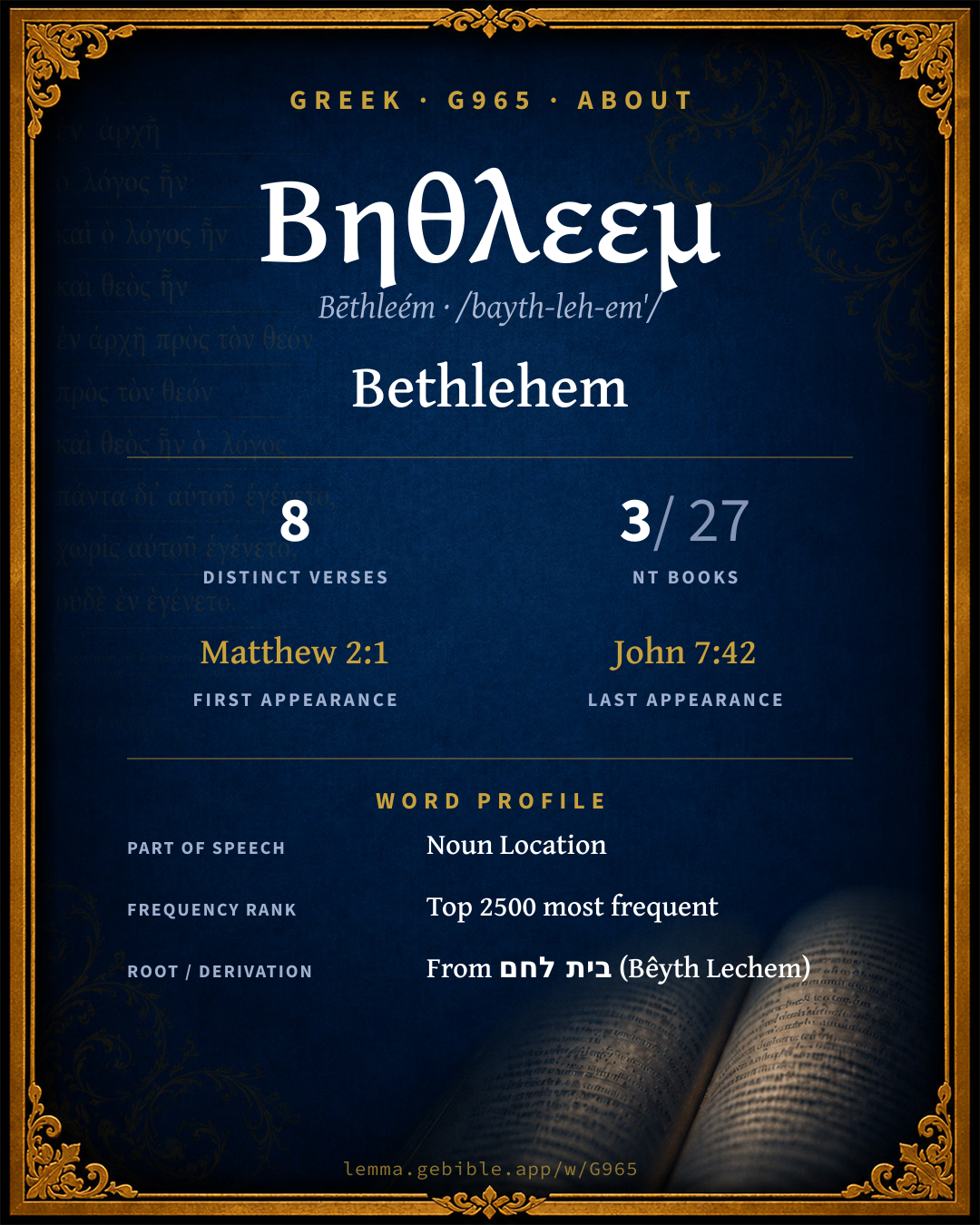
Βηθλεέμ
Bethlehem
Thayer's lists 2 entries for ‘Bethlehem’ fuller range ↓
Full lexicon entry — Thayer's Greek Lexicon
From Thayer's Greek Lexicon
Where this word appears
Every verse where G965 appears — 8 distinct verses across 3 books. Click any verse to open its interlinear word-by-word view. Verse text shown in the World English Bible for context — . Each verse’s Greek form is shown with its reference; the English is not keyword-highlighted, since the data carries no word-level English alignment. Use “Compare translations” on any verse to read it across multiple English versions. This concordance covers the Greek New Testament; Septuagint (Greek Old Testament) occurrences of this word are not indexed here.
Matthew 5 verses
- Matthew 2:1 Βηθλέεμ n proper indecl Now when Jesus was born in Bethlehem of Judea in the days of Herod the king, behold, wise men from the east came to Jerusalem, saying,
- Matthew 2:5 Βηθλέεμ n proper indecl They said to him, "In Bethlehem of Judea, for thus it is written through the prophet,
- Matthew 2:6 Βηθλέεμ n proper indecl 'You Bethlehem, land of Judah, Are in no way least among the princes of Judah: For out of you shall come forth a governor, Who shall shepherd my people, Israel.'"
- Matthew 2:8 Βηθλέεμ n proper indecl He sent them to Bethlehem, and said, "Go and search diligently for the young child. When you have found him, bring me word, so that I also may come and worship him."
- Matthew 2:16 Βηθλεὲμ n proper indecl Then Herod, when he saw that he was mocked by the wise men, was exceedingly angry, and sent out, and killed all the male children who were in Bethlehem and in all the surrounding countryside, from two years old and under, according to the exact time which he had learned from the wise men.
Luke 2 verses
- Luke 2:4 Βηθλέεμ n proper indecl Joseph also went up from Galilee, out of the city of Nazareth, into Judea, to the city of David, which is called Bethlehem, because he was of the house and family of David;
- Luke 2:15 Βηθλεὲμ n proper indecl It happened, when the angels went away from them into the sky, that the shepherds said one to another, "Let's go to Bethlehem, now, and see this thing that has happened, which the Lord has made known to us."
John 1 verse
About this entry
At a glance — auto-summarized from this page’s data, not written by a person. Every figure links to its source below. This summary describes the numbers; it doesn’t interpret them.
“Bethlehem” is the headline sense of the Greek name Βηθλεεμ (Bēthleém). More than half of its appearances fall in Matthew. The Greek New Testament uses it across 8 verses — uncommon. Its earliest occurrence is Matthew 2:1. Each statement above links to its evidence; the full detail follows below.
Gloss history
Strong's 1890 vs modern scholarship
About this word
Strong's G965 catalogs a Greek word from the Greek New Testament.
These counts are not copied from any lexicon or concordance. They are computed here, from the morphology-tagged Greek New Testament. What Lemma adds →
- 8
- distinct verses
- The word appears in 8 distinct verses.
- 3 / 27
- NT books
- The word appears in 3 of 27 New Testament books.
- #1,240
- by frequency
- Top 2500 most frequent Greek words (rank 1,240 of 5,347 Greek words by occurrence).
View all 8 occurrences in the concordance →
By section of the New Testament
By traditional corpus
Conventional, traditional groupings — biblical authorship is debated, so this is a traditional corpus grouping, not an authorship claim. Some books belong to more than one corpus (Luke is in both the Gospels and the Lukan corpus, and so on), so these shares overlap and need not total 100%. Each figure is a share of the word’s 8 distinct verses.
- Gospels 8 verses · 100%
- Lukan (Luke–Acts) 2 verses · 25%
- Johannine 1 verse · 13%
How translations render this word
Counts come from each version’s own published word-to-Strong’s tagging or interlinear alignment — an approximate guide to how each version renders this word, not a word-level alignment the data otherwise carries. Because each total is that version’s own tagged count, the per-version totals vary from one another and need not match the appearance or distinct-verse counts above. These counts may also differ from a printed concordance because Lemma counts each distinctly tagged rendering and does not collapse phrase taggings into a single head-word total. This is a fixed set of word-tagged versions (KJV, ASV, BSB, ULT) and does not change with the reading translation you choose elsewhere. Each version’s license is shown beside its name below (and on Sources).
- King James Version: Bethlehem 8×
- American Standard Version: Bethlehem 8×
- Berean Standard Bible: Bethlehem 8×
- unfoldingWord Literal Text: Bethlehem 8×
King James Version Public Domain
Renders G965 across 8 tagged occurrences — most commonly:
American Standard Version Public Domain
Renders G965 across 8 tagged occurrences — most commonly:
Berean Standard Bible Public Domain
Renders G965 across 8 tagged occurrences — most commonly:
unfoldingWord Literal Text CC BY-SA 4.0
Renders G965 across 8 tagged occurrences — most commonly:
Senses in Thayer's
The 2 senses Thayer's distinguishes for this word, in lexicon order (not ranked by frequency or importance). The full entry — with sub-senses — is in the Lexicon Entry tab.
- Bethlehem = "house of bread"
- a village about six miles (10 km) south of Jerusalem
Word origin
Derived from בית לחם (Bêyth Lechem) (H1035) — Bethlehem.
Of hebrew origin [ H1036 ]; Bethleem (that is Beth-lechem ) a place in Palestine : - Bethlehem.
— Strong’s Exhaustive Concordance (1890), public domain.
Forms in the corpus
The 2 distinct written forms G965 takes in the Greek New Testament, most frequent first — each parse links to that case’s occurrences in the concordance.
| Form | Parsing | Example | Uses |
|---|---|---|---|
| Βηθλέεμ Bēthléem | Noun, Proper, indeclinable | Matthew 2:1 | 5 |
| Βηθλεὲμ Bēthleèm | Noun, Proper, indeclinable | Matthew 2:16 | 3 |
Same root — word family
Other Thayer's entries built from the same root as G965, grouped by Strong’s listed origin. These share a root / origin per the lexicon — not necessarily a shared meaning. Each links to that word’s own entry.
Derives from
Proper names from this root
People and places named from this root — a name, not an additional meaning of the word.
Compare all same-root words → 2 of the same-root words are proper names (people or places). They share a root, not necessarily a meaning.
Bible dictionary
Public-domain dictionary articles matched to this entry by name (Bethlehem). A biblical name can be shared by more than one person or place, so an article may treat several.
Easton's Bible Dictionary · M. G. Easton, 1897
House of bread. (1.) A city in the "hill country" of Judah. It was originally called Ephrath (Gen. 35:16, 19; 48:7; Ruth 4:11). It was also called Beth-lehem Ephratah (Micah 5:2), Beth-lehem-judah (1 Sam. 17:12), and "the city of David" (Luke 2:4). It is first noticed in Scripture as the place where Rachel died and was buried "by the wayside," directly to the north of the city (Gen. 48:7). The valley to the east was the scene of the story of Ruth the Moabitess. There are the fields in which she gleaned, and the path by which she and Naomi returned to the town. Here was David's birth-place, and here also, in after years, he was anointed as king by Samuel (1 Sam. 16:4-13); and it was from the well of Bethlehem that three of his heroes brought water for him at the risk of their lives when he was in the cave of Adullam (2 Sam. 23:13-17). But it was distinguished above every other city as the birth-place of "Him whose goings forth have been of old" (Matt. 2:6; comp. Micah 5:2). Afterwards Herod, "when he saw that he was mocked of the wise men," sent and slew "all the children that were in Bethlehem, and in all the coasts thereof, from two years old and under" (Matt. 2:16, 18; Jer. 31:15).
Bethlehem bears the modern name of Beit-Lahm, i.e., "house of flesh." It is about 5 miles south of Jerusalem, standing at an elevation of about 2,550 feet above the sea, thus 100 feet higher than Jerusalem.
There is a church still existing, built by Constantine the Great (A.D. 330), called the "Church of the Nativity," over a grotto or cave called the "holy crypt," and said to be the "stable" in which Jesus was born. This is perhaps the oldest existing Christian church in the world. Close to it is another grotto, where Jerome the Latin father is said to have spent thirty years of his life in translating the Scriptures into Latin. (See VERSION.)
(2.) A city of Zebulun, mentioned only in Josh. 19:15. Now Beit-Lahm, a ruined village about 6 miles west-north-west of Nazareth.
Smith's Bible Dictionary · William Smith, 1863
(house of bread).
+ One of the oldest towns in Palestine, already in existence at the time of Jacob's return to the country. Its earliest name was Ephratah, Or Ephrath or EPHRATAH. See (Genesis 35:16,19; 48:7) After the conquest Bethlehem appears under its own name, BETHLEHEM-JUDAH. (Judges 17:7; 1 Samuel 17:12; Ruth 1:1,2) The book of Ruth is a page from the domestic history of Bethlehem. It was the home of Ruth, (Ruth 1:19) and of David. (1 Samuel 17:12) It was fortified by Rehoboam. (2 Chronicles 11:6) It was here that our Lord was born, (Matthew 2:1) and here that he was visited by the shepherds, (Luke 2:15-17) and the Magi. Matt 2. The modern town of Beit-lahm lies to the east of the main road from Jerusalem to Hebron, six miles from the former. It covers the east and northeast parts of the ridge of a long gray hill of Jura limestone, which stands nearly due east and west, and is about a mile in length. The hill has a deep valley on the north and another on the south. On the top lies the village in a kind of irregular triangle. The population is about 3000 souls, entirely Christians. The Church of the Nativity, built by the empress Helena A.D. 330, is the oldest Christian church in existence. It is built over the grotto where Christ is supposed to have been born. + A town in the portion of Zebulun, named nowhere but in (Joshua 19:15) Now known as Beit-lahm .
Hitchcock's Bible Names Dictionary · Roswell D. Hitchcock, 1869
house of bread
Classic public-domain reference works; full attribution on Sources.
Septuagint usage
The same Greek word Βηθλεεμ appears 13 times in the Greek Old Testament (Septuagint), across 12 verses in 5 books.
- 13
- LXX occurrences
- Tagged occurrences of this Greek word in the Septuagint.
- 12
- verses
- Distinct Septuagint verses containing this word.
- 5 / 39
- OT books
- The word appears in 5 of the 39 Old Testament books.
Sample Septuagint occurrences
- Genesis 35:19 βηθλεεμ
- Judges 17:7 βηθλεεμ
- 1 Samuel 16:1 βηθλεεμ
- Jeremiah 48:17 βηθλεεμ
- Micah 5:1 βηθλεεμ
Septuagint occurrences (same lexeme)
Every verse where the same Strong’s number (G965) appears in the Greek Septuagint. Verse text shown in the World English Bible for context; the Greek form is the matched word — the English is not keyword-highlighted.
- Genesis 35:19 βηθλεεμ Rachel died, and was buried in the way to Ephrath (the same is Bethlehem).
- Judges 17:7 βηθλεεμ There was a young man out of Bethlehem Judah, of the family of Judah, who was a Levite; and he sojourned there.
- Judges 17:8 βηθλεεμ The man departed out of the city, out of Bethlehem Judah, to sojourn where he could find [a place], and he came to the hill-country of Ephraim to the house of Micah, as he traveled.
- Judges 19:1 βηθλεεμ It happened in those days, when there was no king in Israel, that there was a certain Levite sojourning on the farther side of the hill-country of Ephraim, who took to him a concubine out of Bethlehem Judah.
- Judges 19:2 βηθλεεμ His concubine played the prostitute against him, and went away from him to her father's house to Bethlehem Judah, and was there the space of four months.
- Judges 19:18 βηθλεεμ He said to him, We are passing from Bethlehem Judah to the farther side of the hill-country of Ephraim; from there am I, and I went to Bethlehem Judah: and I am [now] going to the house of Yahweh; and there is no man who takes me into his house.
- 1 Samuel 16:1 βηθλεεμ Yahweh said to Samuel, How long will you mourn for Saul, seeing I have rejected him from being king over Israel? fill your horn with oil, and go: I will send you to Jesse the Bethlehemite; for I have provided me a king among his sons.
- 1 Samuel 16:4 βηθλεεμ Samuel did that which Yahweh spoke, and came to Bethlehem. The elders of the city came to meet him trembling, and said, Come you peaceably?
- 1 Samuel 20:6 βηθλεεμ If your father miss me at all, then say, David earnestly asked leave of me that he might run to Bethlehem his city; for it is the yearly sacrifice there for all the family.
- 1 Samuel 20:28 βηθλεεμ Jonathan answered Saul, David earnestly asked leave of me to go to Bethlehem:
- Jeremiah 48:17 βηθλεεμ All you who are round about him, bemoan him, and all you who know his name; say, How is the strong staff broken, the beautiful rod!
- Micah 5:1 βηθλεεμ Now you shall gather yourself in troops, Daughter of troops. He has laid siege against us; They will strike the judge of Israel with a rod on the cheek.
These are occurrences of the same Greek lexeme (G965) in the Septuagint — not a translation of any one Hebrew word. The store carries no word-level Hebrew↔Greek alignment, so no Hebrew original is asserted here. Counts come from the recovered LXX Strong's tagging — high-frequency vocabulary is well covered, while rare or late forms may be untagged — so they reflect tagged occurrences and may slightly undercount.