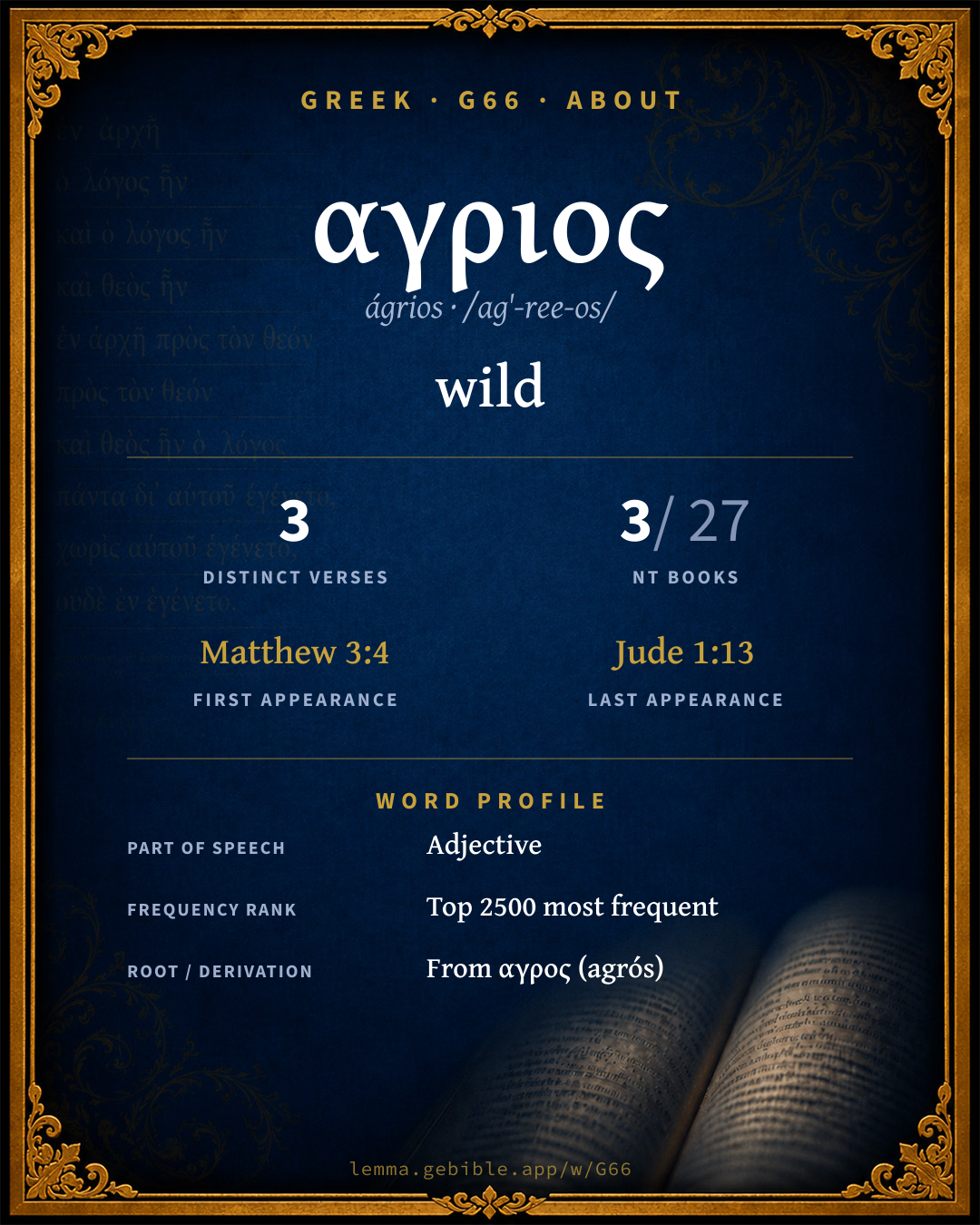
ἄγριος
wild
‘wild’ is one of 2 main senses fuller range ↓
Full lexicon entry — Thayer's Greek Lexicon
From Thayer's Greek Lexicon
Where this word appears
Grammar key — what these labels mean
Part of speech
- Adjective
- A word that describes or qualifies a noun.
Case
- Accusative
- The case of the direct object and of extent.
- Nominative
- The case of the subject (and the predicate nominative).
Gender
- Neuter
- Grammatically neuter.
Number
- Singular
- One.
- Plural
- More than one.
Every verse where G66 appears in the Book of Matthew — 1 distinct verse. Click any verse to open its interlinear word-by-word view. Verse text shown in the World English Bible for context — . Each verse’s Greek form is shown with its reference; the English is not keyword-highlighted, since the data carries no word-level English alignment. Use “Compare translations” on any verse to read it across multiple English versions. This concordance covers the Greek New Testament; Septuagint (Greek Old Testament) occurrences of this word are not indexed here.
Matthew
About this entry
At a glance — auto-summarized from this page’s data, not written by a person. Every figure links to its source below. This summary describes the numbers; it doesn’t interpret them.
αγριος — transliterated ágrios — is a Greek adjective carrying the sense “wild.” It is rare — just 3 verses in the entire Greek New Testament. More than a third of its appearances fall in Matthew. It first appears in Matthew 3:4. Its lexical range runs to 2 senses. See the sense tree, 3-verse concordance, and the renderings breakdown below.
Gloss history
Strong's 1890 vs modern scholarship
About this word
Strong's G66 catalogs a Greek word from the Greek New Testament.
These counts are not copied from any lexicon or concordance. They are computed here, from the morphology-tagged Greek New Testament. What Lemma adds →
- 3
- distinct verses
- The word appears in 3 distinct verses.
- 3 / 27
- NT books
- The word appears in 3 of 27 New Testament books.
- #2,203
- by frequency
- Top 2500 most frequent Greek words (rank 2,203 of 5,347 Greek words by occurrence).
View all 3 occurrences in the concordance →
By section of the New Testament
By traditional corpus
Conventional, traditional groupings — biblical authorship is debated, so this is a traditional corpus grouping, not an authorship claim. Some books belong to more than one corpus (Luke is in both the Gospels and the Lukan corpus, and so on), so these shares overlap and need not total 100%. Each figure is a share of the word’s 3 distinct verses.
- Gospels 2 verses · 67%
- General (Catholic) Epistles 1 verse · 33%
How translations render this word
Counts come from each version’s own published word-to-Strong’s tagging or interlinear alignment — an approximate guide to how each version renders this word, not a word-level alignment the data otherwise carries. Because each total is that version’s own tagged count, the per-version totals vary from one another and need not match the appearance or distinct-verse counts above. These counts may also differ from a printed concordance because Lemma counts each distinctly tagged rendering and does not collapse phrase taggings into a single head-word total. This is a fixed set of word-tagged versions (KJV, ASV, BSB, ULT) and does not change with the reading translation you choose elsewhere. Each version’s license is shown beside its name below (and on Sources).
- King James Version: Wild 2×
- American Standard Version: Wild 3×
- Berean Standard Bible: Wild 3×
- unfoldingWord Literal Text: Wild 3×
King James Version Public Domain
Renders G66 across 3 tagged occurrences — most commonly:
Plus 1 rendering that appears only once — usually multi-word phrases or single function words the recovered tagging swept in, not distinct renderings.
American Standard Version Public Domain
Renders G66 across 3 tagged occurrences — most commonly:
Berean Standard Bible Public Domain
Renders G66 across 3 tagged occurrences — most commonly:
unfoldingWord Literal Text CC BY-SA 4.0
Renders G66 across 3 tagged occurrences — most commonly:
Senses in Thayer's
The 2 senses Thayer's distinguishes for this word, in lexicon order (not ranked by frequency or importance). The full entry — with sub-senses — is in the Lexicon Entry tab.
- living or growing in the fields or woods
- of men and animals in a moral sense, wild savage, fierce
Word origin
Derived from αγρος (agrós) (G68) — land.
From G68 ; wild (as pertaining to the country ) literally ( natural ) or figuratively ( fierce ): - wild raging.
— Strong’s Exhaustive Concordance (1890), public domain.
Forms in the corpus
The 2 distinct written forms G66 takes in the Greek New Testament, most frequent first — each parse links to that case’s occurrences in the concordance.
| Form | Parsing | Example | Uses |
|---|---|---|---|
| ἄγριον ágrion | Adjective, Accusative, Singular, Neuter | Mark 1:6 | 2 |
| ἄγρια ágria | Adjective, Nominative, Plural, Neuter | Jude 1:13 | 1 |
Same root — word family
Other Thayer's entries built from the same root as G66, grouped by Strong’s listed origin. These share a root / origin per the lexicon — not necessarily a shared meaning. Each links to that word’s own entry.
Derives from
Shares the same root
Derived from this word
Proper names from this root
People and places named from this root — a name, not an additional meaning of the word.
Compare all same-root words → Showing 4 of 5 — not the complete family. 1 of the same-root words is a proper name (a person or place). They share a root, not necessarily a meaning.
Septuagint usage
The same Greek word αγριος appears 18 times in the Greek Old Testament (Septuagint), across 18 verses in 10 books.
- 18
- LXX occurrences
- Tagged occurrences of this Greek word in the Septuagint.
- 18
- verses
- Distinct Septuagint verses containing this word.
- 10 / 39
- OT books
- The word appears in 10 of the 39 Old Testament books.
Sample Septuagint occurrences
- Exodus 23:11 ἄγριος
- Leviticus 21:20 ἄγριος
- Deuteronomy 7:22 ἄγριος
- Joshua 23:5 ἄγριος
- 2 Kings 4:39 ἄγριος
- Job 5:22 ἄγριος
- Psalms 79:14 ἄγριος
- Isaiah 32:14 ἄγριος
- Jeremiah 14:6 ἄγριος
- Daniel 2:38 ἄγριος
Septuagint occurrences (same lexeme)
Every verse where the same Strong’s number (G66) appears in the Greek Septuagint. Verse text shown in the World English Bible for context; the Greek form is the matched word — the English is not keyword-highlighted.
- Exodus 23:11 ἄγριος but the seventh year you shall let it rest and lie fallow, that the poor of your people may eat; and what they leave the animal of the field shall eat. In like manner you shall deal with your vineyard and with your olive grove.
- Leviticus 21:20 ἄγριος or hunchbacked, or a dwarf, or one who has a defect in his eye, or an itching disease, or scabs, or who has damaged testicles;
- Leviticus 26:22 ἄγριος I will send the wild animals among you, which will rob you of your children, destroy your cattle, and make you few in number; and your roads will become desolate.
- Deuteronomy 7:22 ἄγριος Yahweh your God will cast out those nations before you by little and little: you may not consume them at once, lest the animals of the field increase on you.
- Deuteronomy 28:27 ἄγριος Yahweh will strike you with the boil of Egypt, and with the tumors, and with the scurvy, and with the itch, of which you can not be healed.
- Joshua 23:5 ἄγριος Yahweh your God, he will thrust them out from before you, and drive them from out of your sight; and you shall possess their land, as Yahweh your God spoke to you.
- 2 Kings 4:39 ἄγριος One went out into the field to gather herbs, and found a wild vine, and gathered of it wild gourds his lap full, and came and shred them into the pot of stew; for they didn't recognize them.
- Job 5:22 ἄγριος At destruction and famine you shall laugh, Neither shall you be afraid of the animals of the earth.
- Job 5:23 ἄγριος For you shall be in league with the stones of the field. The animals of the field shall be at peace with you.
- Job 6:5 ἄγριος Does the wild donkey bray when he has grass? Or does the ox low over his fodder?
- Job 30:7 ἄγριος Among the bushes they bray; And under the nettles they are gathered together.
- Job 39:5 ἄγριος "Who has set the wild donkey free? Or who has loosened the bonds of the swift donkey,
- Psalms 79:14 ἄγριος
- Isaiah 32:14 ἄγριος For the palace shall be forsaken; the populous city shall be deserted; the hill and the watch-tower shall be for dens forever, a joy of wild donkeys, a pasture of flocks;
- Isaiah 56:9 ἄγριος All you animals of the field, come to devour, [yes], all you animals in the forest.
- Jeremiah 14:6 ἄγριος The wild donkeys stand on the bare heights, they pant for air like jackals; their eyes fail, because there is no herbage.
- Jeremiah 31:6 ἄγριος For there shall be a day, that the watchmen on the hills of Ephraim shall cry, Arise you, and let us go up to Zion to Yahweh our God.
- Daniel 2:38 ἄγριος and wherever the children of men dwell, the animals of the field and the birds of the sky has he given into your hand, and has made you to rule over them all: you are the head of gold.
These are occurrences of the same Greek lexeme (G66) in the Septuagint — not a translation of any one Hebrew word. The store carries no word-level Hebrew↔Greek alignment, so no Hebrew original is asserted here. Counts come from the recovered LXX Strong's tagging — high-frequency vocabulary is well covered, while rare or late forms may be untagged — so they reflect tagged occurrences and may slightly undercount.