Leviticus 21:20

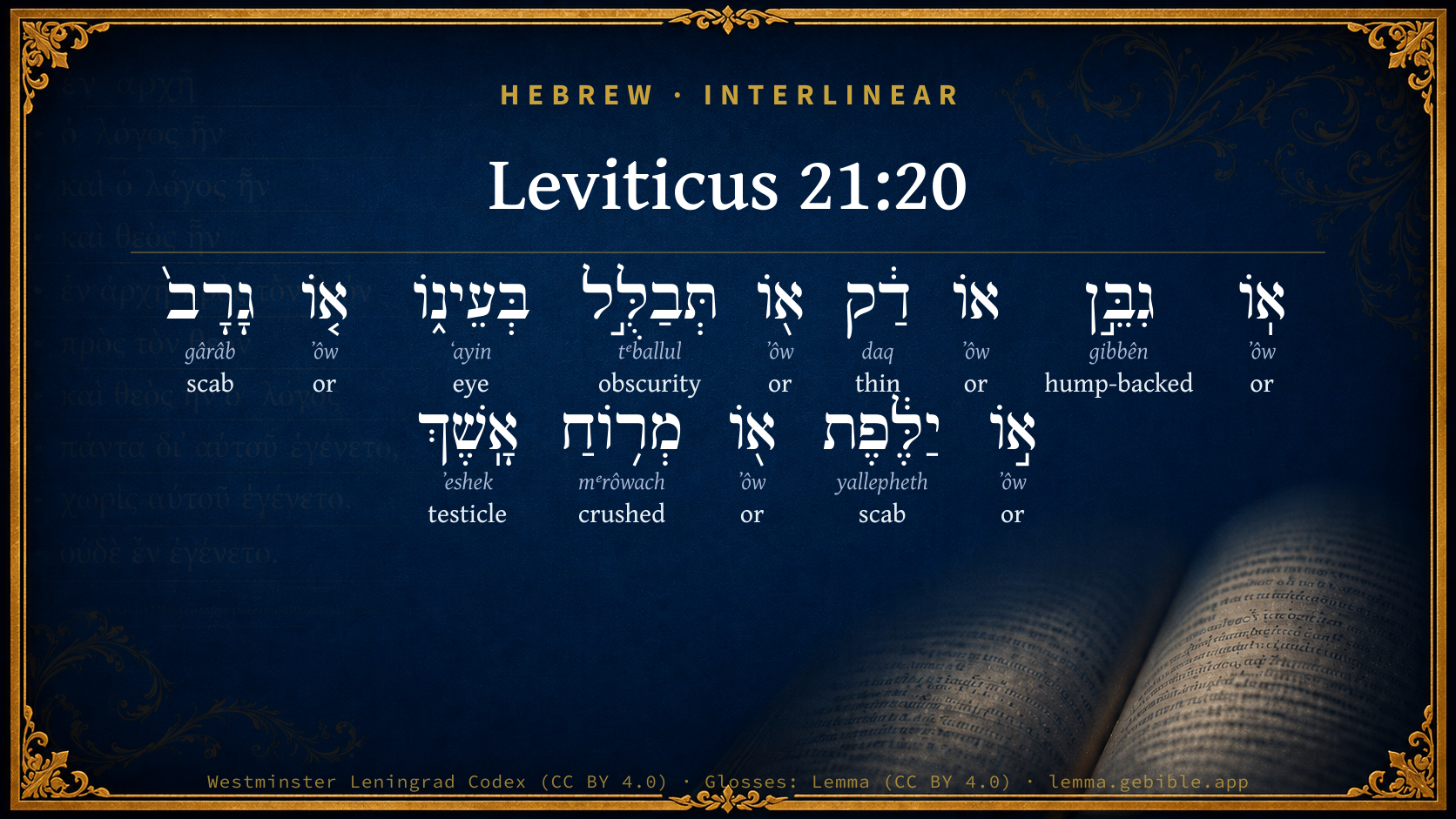
Hebrew (Westminster Leningrad Codex) Leviticus 21:20 appears in the Hebrew Old Testament. The text above is from the Westminster Leningrad Codex. Each word links to its Strong’s number, a concise gloss, and parsing drawn from the Open Scriptures Hebrew Bible morphology. Click any word for its full Brown-Driver-Briggs (BDB) entry.
Download image
Cite this verse

Leviticus 21:20 (World English Bible). Public Domain. Lemma interlinear Bible study tool, https://lemma.gebible.app/v/leviticus/21/20.

Show BibTeX & RIS
BibTeX
RIS
English Translation
or hunchbacked, or a dwarf, or one who has a defect in his eye, or an itching disease, or scabs, or who has damaged testicles;
World English Bible · Public Domain
Highlights
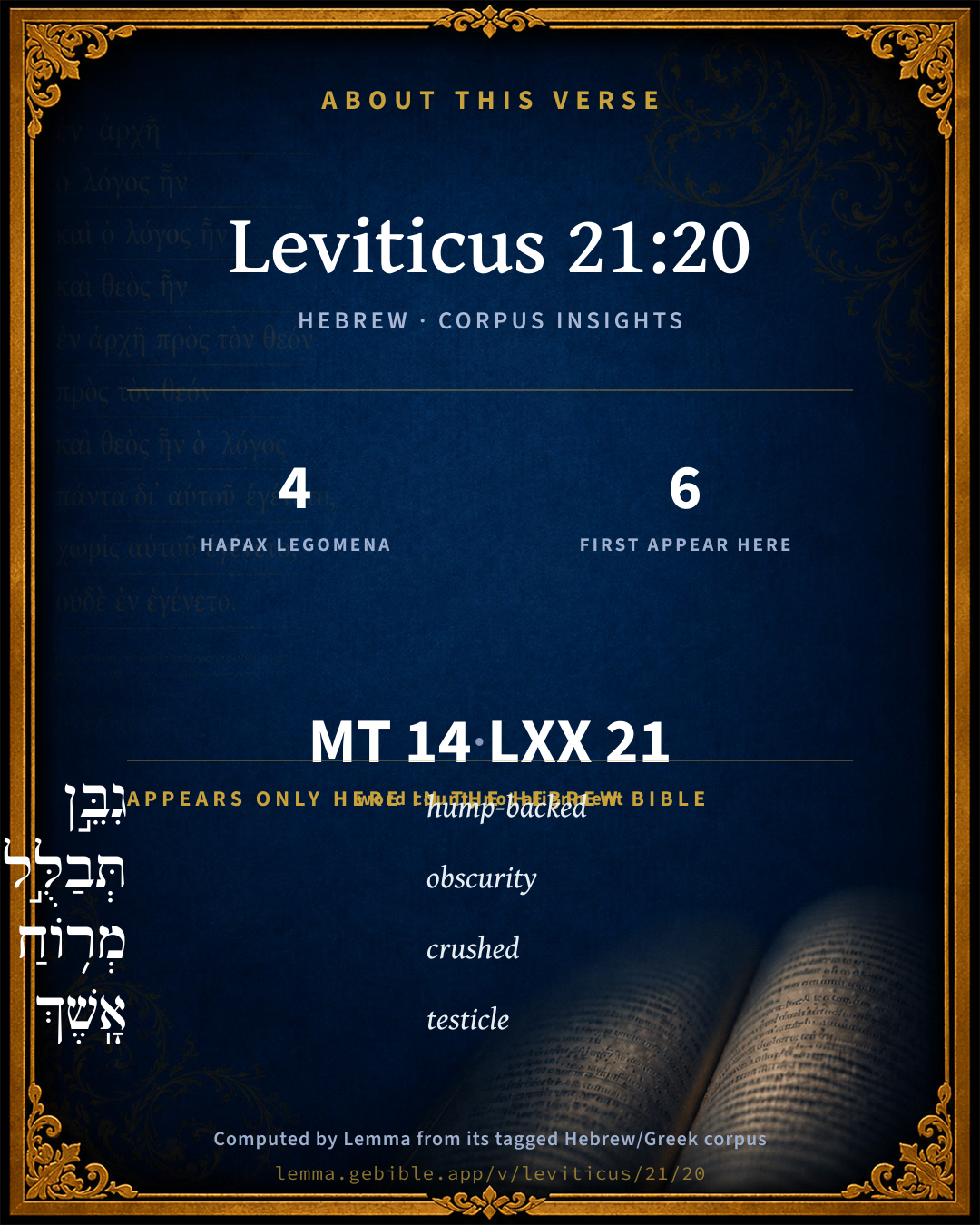
  • 4 hapax legomena — only here in the Hebrew Bible
  • 6 first appearances in the Hebrew Bible
Full analysis ↓
Download a study sheet

One document with this verse’s original text, its word-by-word gloss line, the meaning frame, cross-references with their text, attributed commentary, and full source and license credits — printable, and it pastes into notes with its structure intact.

This verse Autodidact and up

Study sheet (.html) Plain text (.txt)

A passage Seminary Student

Up to 50 verses in one chapter. A passage sheet keeps up to 6 commentary sources and 12 cross-references per verse, in the order this page ranks them, and says so on the sheet whenever that leaves anything out. Ask for a single verse and you get the Autodidact verse sheet above.

Everything on this page stays free to read, with no account — the sheet is a download of what is already on screen, not access to it.

Want to remove ads? Support Godless Engineer
Compare translations 3

The same verse in 3 English versions, stacked beneath the original-language interlinear above. Click any original word for its lexicon entry.

Each is an independent rendering of the whole verse — the interlinear is not word-aligned to these translations.

Highlighted words mark where these versions differ — a whole-verse word diff, not a word-by-word alignment.

  • World English Bible Public Domain
    or hunchbacked, or a dwarf, or one who has a defect in his eye, or an itching disease, or scabs, or who has damaged testicles;
  • King James Version Public Domain
    Or crookbacked, or a dwarf, or that hath a blemish in his eye, or be scurvy, or scabbed, or hath his stones broken;
  • unfoldingWord Literal Text CC BY-SA 4.0
    or a hunchback or a dwarf or one with a defect in his eye or a scab or a rash or a crushed testicle.

unfoldingWord Literal Text — © unfoldingWord, licensed CC BY-SA 4.0. Word-aligned USFM3 via Door43 (git.door43.org/unfoldingWord/en_ult).

Versions to compare (up to 4)

3 of 4 selected

Show all 18 translations

Every available English version of this verse, each an independent rendering of the whole verse.

  • World English Bible Public Domain
    or hunchbacked, or a dwarf, or one who has a defect in his eye, or an itching disease, or scabs, or who has damaged testicles;
  • Berean Standard Bible Public Domain
    or who is a hunchback or dwarf, or who has an eye defect, a festering rash, scabs, or a crushed testicle.
  • Majority Standard Bible Public Domain
    or who is a hunchback or dwarf, or who has an eye defect, a festering rash, scabs, or a crushed testicle.
  • King James Version Public Domain
    Or crookbacked, or a dwarf, or that hath a blemish in his eye, or be scurvy, or scabbed, or hath his stones broken;
  • American Standard Version (1901) Public Domain
    or crook-backed, or a dwarf, or that hath a blemish in his eye, or is scurvy, or scabbed, or hath his stones broken;
  • Revised Version (1885) Public Domain
    or crookbackt, or a dwarf, or that hath a blemish in his eye, or is scurvy, or scabbed, or hath his stones broken;
  • Geneva Bible (1599) Public Domain
    Or is crooke backt, or bleare eyed, or hath a blemish in his eye, or be skiruie, or skabbed, or haue his stones broken.
  • Douay-Rheims (1899) Public Domain
    If he be crookbacked, or blear eyed, or have a pearl in his eye, or a continual scab, or a dry scurf in his body, or a rupture:
  • Young's Literal Translation Public Domain
    or hump-backed, or a dwarf, or with a mixture in his eye, or a scurvy person, or scabbed, or broken-testicled.
  • Literal Standard Version CC BY-SA 4.0
    or hunchbacked, or a dwarf, or [with] a defect in his eye, or [with] an itch, or [with] a scab, or [with] a broken testicle.
  • Unlocked Literal Bible CC BY-SA 4.0
    a man who has a hump in his back or is abnormally thin or short, or a man with a defect in his eyes, or with a disease, sore, scabs, or whose testicles have been crushed.
  • unfoldingWord Literal Text CC BY-SA 4.0
    or a hunchback or a dwarf or one with a defect in his eye or a scab or a rash or a crushed testicle.
  • Darby Bible Public Domain
    or hump-backed, or withered, or that hath a spot in his eye, or hath the itch, or scabs, or his testicles broken.
  • World Messianic Bible Public Domain
    or hunchbacked, or a dwarf, or one who has a defect in his eye, or an itching disease, or scabs, or who has damaged testicles.
  • Webster's Bible Public Domain
    Or crooked-backed, or a dwarf, or that hath a blemish in his eye, or be scurvy, or scabbed, or hath his peculiar members broken:
  • Free Bible Version CC BY-SA 4.0
    anyone who is a hunchback or dwarf, or who has cataracts, skin sores or scabs, or a damaged testicle.
  • Bible in Basic English Public Domain
    Or one whose back is bent, or one who is unnaturally small, or one who has a damaged eye, or whose skin is diseased, or whose sex parts are damaged;
  • JPS Tanakh (1917) Public Domain
    or crook-backed, or a dwarf, or that hath his eye overspread, or is scabbed, or scurvy, or hath his stones crushed;

Literal Standard Version (2020), Covenant Press — licensed CC BY-SA 4.0. Text via the HelloAO Bible API (eBible.org). Unlocked Literal Bible (unfoldingWord) — licensed CC BY-SA 4.0. Text via the HelloAO Bible API (eBible.org). unfoldingWord Literal Text — © unfoldingWord, licensed CC BY-SA 4.0. Word-aligned USFM3 via Door43 (git.door43.org/unfoldingWord/en_ult). Free Bible Version, Dr. Jonathan Gallagher — licensed CC BY-SA 4.0. Text via the HelloAO Bible API (eBible.org).

Word by word

More ways to search: Search by grammar → Find every occurrence → Compare this word →

Practice this passage: Drill this verse → Learn its vocabulary →

גִבֵּ֣ן
gibbên
H1384
“hump-backed”
Adjective, Adjective, Masculine, Singular, Absolute
Part of Speech
Adjective
Type
Adjective
Gender
Masculine
Number
Singular
State
Absolute
Full BDB Definition

Origin: from an unused root meaning to be arched or contracted

TWOT: 308a

hump-backed, crook-backed
  1. אֽוֹ ʼôw H176 “or” Conjunction
  2. אוֹ ʼôw H176 “or” Conjunction
  3. דַ֔ק daq H1851 “thin” Adjective, Adjective, Masculine, Singular, Absolute
  4. א֖וֹ ʼôw H176 “or” Conjunction
  5. תְּבַלֻּ֣ל tᵉballul H8400 “obscurity” Noun, Common, Masculine, Singular, Absolute
  6. בְּעֵינ֑וֹ ʻayin H5869 “in/at · eye · his” Preposition + Noun, Common, Both, Singular, Construct + Suffix, Personal, 3rd Person, Masculine, Singular
  7. א֤וֹ ʼôw H176 “or” Conjunction
  8. גָרָב֙ gârâb H1618 “scab” Noun, Common, Masculine, Singular, Absolute
  9. א֣וֹ ʼôw H176 “or” Conjunction
  10. יַלֶּ֔פֶת yallepheth H3217 “scab” Noun, Common, Feminine, Singular, Absolute
  11. א֖וֹ ʼôw H176 “or” Conjunction
  12. מְר֥וֹחַ mᵉrôwach H4790 “crushed of” Adjective, Adjective, Masculine, Singular, Construct
  13. אָֽשֶׁךְ ʼeshek H810 “testicle” Noun, Common, Masculine, Singular, Absolute

About this verse

These counts appear in no published source. They are computed here, from the morphology-tagged text and Lemma’s own curated glosses. What Lemma adds →

14
words
9
distinct lemmas
Pentateuch
section

Notable vocabulary

4 hapax legomena — words that appear only here in the entire Hebrew Bible:

  • גִבֵּ֣ן hump-backed H1384
  • תְּבַלֻּ֣ל obscurity H8400
  • מְר֥וֹחַ crushed H4790
  • אָֽשֶׁךְ testicle H810

First appearance in Scripture

These words make their first canonical appearance in the Hebrew Bible here:

  • גִבֵּ֣ן hump-backed H1384
  • תְּבַלֻּ֣ל obscurity H8400
  • גָרָב֙ scab H1618
  • יַלֶּ֔פֶת scab H3217
  • מְר֥וֹחַ crushed H4790
  • אָֽשֶׁךְ testicle H810

Shared distinctive vocabulary

יַלֶּ֔פֶת scab H3217 occurs in 2 verses of the Hebrew Bible. Also found in:

Grammatical profile

  • 5 nouns
  • 3 adjectives
  • 6 conjunctions

Repetition

A word recurs within this verse — often emphatic in Hebrew:

  • אֽוֹ or H176 ×6

Hebrew & Septuagint length

In English translation the verse runs 25 words from the Hebrew and 27 from the Septuagint (LXX English) — closely comparable.

A rough comparison of the two English renderings, which tokenize alike — not a word-level alignment.

Word counts can differ between the Hebrew and the Greek without any difference in meaning — e.g. the Hebrew direct-object marker אֵת has no separate Greek word, and Greek often adds the article ὁ.

In the original languages it is 14 Hebrew tokens and 21 Greek tokens — but the two are counted differently (Hebrew bundles its prefixes and suffixes into one token; the Greek is in lemma form), so that isn’t a like-for-like length.

Cross-references

2

Topical passages linked to Leviticus 21:20 in the Treasury of Scripture Knowledge — connected by theme and wording, ordered by reader-vote popularity; previews shown in the World English Bible.

  • Deuteronomy 23:1 He who is wounded in the stones, or has his privy member cut off, shall not enter into the assembly of Yahweh.
  • Isaiah 56:3 Neither let the foreigner, who has joined himself to Yahweh, speak, saying, Yahweh will surely separate me from his people; neither let the eunuch say, Behold, I am a dry tree.

Cross-references courtesy of OpenBible.info (CC BY 4.0).

Hebrew and Greek witnesses Masoretic Hebrew ↔ Greek Septuagint

The same verse in the two great witnesses to the Old Testament, shown verse-for-verse.

These are two independent witnesses, not word-aligned to each other, and the Septuagint is shown in lemma (dictionary) form.

Hebrew Leviticus 21:20 Masoretic · Westminster Leningrad Codex

אֽוֹ גִבֵּ֣ן אוֹ דַ֔ק א֖וֹ תְּבַלֻּ֣ל בְּעֵינ֑וֹ א֤וֹ גָרָב֙ א֣וֹ יַלֶּ֔פֶת א֖וֹ מְר֥וֹחַ אָֽשֶׁךְ

or hunchbacked, or a dwarf, or one who has a defect in his eye, or an itching disease, or scabs, or who has damaged testicles;

World English Bible · Public Domain

Greek LXX Leviticus 21:20 Septuagint · lemma form

ἤ κυρτός ἤ ἔφηλος ἤ πτίλος ὁ ὀφθαλμός ἤ ἄνθρωπος ὅς ἄν εἰμί ἐν αὐτός ψώρα ἄγριος ἤ λειχήν ἤ μόνορχις

or humpbacked, or blear-eyed, or that has lost his eye-lashes, or a man who has a malignant ulcer, or tetter, or one that has lost a testicle.

LXX2012 (modern English Septuagint) · Public Domain

On this verse, Haydock's Catholic Bible Commentary discusses the Septuagint’s reading. Read the note in Commentary ↓

Hebrew: Westminster Leningrad Codex (CC BY 4.0). Greek: Septuagint (public domain); English from LXX2012 (modern English Septuagint) (Public Domain). How the Septuagint differs from the Hebrew →

Targum (Aramaic paraphrase)

2

The Targum is the ancient Jewish Aramaic paraphrase of the Hebrew Scriptures — an interpretive translation, not the Hebrew text itself. Onkelos (literal) and Pseudo-Jonathan (expansive) render the Torah, and Jonathan the Prophets. Coverage is partial: where no permissively-licensed English translation exists for a verse, only the Aramaic is shown. This is verse-level text, not a word-by-word alignment to the Hebrew.

  1. Targum Onkelos Torah (Genesis–Deuteronomy)
    אוֹ גְבִין אוֹ דֻקָא אוֹ חִלִיז בְּעֵינֵהּ אוֹ גַרְבָן אוֹ חֲזָזָן אוֹ מְרִיס פַּחֲדִין

    (no public-domain English translation for this verse)

    Targum Onkelos — Aramaic: “Onkelos Genesis” (public domain); “Onkelos Exodus” (public domain); “Onkelos Leviticus” (public domain); “Onkelos Numbers” (public domain); “Onkelos Deuteronomy” (public domain). English: “Sefaria Community Translation” (CC0 1.0 (public-domain dedication)); “J.W. Etheridge. The Targums of Onkelos and Jonathan Ben Uzziel on the Pentateuch. London: Longmans, Green, 1862” (public domain). Text via Sefaria.

  2. Targum Pseudo-Jonathan Torah (Genesis–Deuteronomy)
    אוֹ דְגָבִינוֹי שִׁכְבַן חַפְיַין עֵינוֹי אוֹ לֵית שְעַר בְּגָבִינוֹי אוֹ דְחִילָזוֹן בְּעֵינוֹי דִמְעַרֵב חִיוְורָא בְּאוֹכְמָא אוֹ דְמָלֵי חַרְסִין יְבֵישִׁין אוֹ דְמָלֵי חֲזָזִיתָא מִצְרֵיתָא אוֹ דְפַחְדוֹי נְפִיחִין וּקְלִיטִין

    or whose eyelids droop so as to cover his eyes, who hath no hair on his eyelids; or who hath a suffusion of whiteness with darkness in his eyes; or who hath the dry scurvy, or who is full of the blotches of Egypt, or whose testicles are swollen or shrunk,

    Targum Pseudo-Jonathan — Aramaic: “Targum Jonathan on Genesis” (public domain); “Targum Jonathan on Exodus” (public domain); “Targum Jonathan on Leviticus” (public domain); “Targum Jonathan on Numbers” (public domain); “Targum Jonathan on Deuteronomy” (public domain). English: “The Targum of Jonathan ben Uzziel, trans. J. W. Etheridge, London, 1862” (public domain). Text via Sefaria.

Commentary

Notes on Leviticus 21:20 from classic Christian and Jewish commentators (each source and its license shown beneath its notes). The classic Christian expositions comment on the surrounding passage and are grouped to its opening verse, so a note may address several verses; the Jewish commentaries on the Tanakh (Rashi and others) are per-verse, so they appear only where the commentator wrote on this verse.

Lemma curates 59 commentaries, every one of them public domain or Creative Commons licensed, each selected and text-cleaned for this edition rather than reprinted as found. About our sources →

Trapp's Complete Commentary

John Trapp

Lev 21:20 Or crookbackt, or a dwarf, or that hath a blemish in his eye, or be scurvy, or scabbed, or hath his stones broken;

Ver. 20. A blemish in his eye.] By a mixture of the humours there, or otherwise; when that little man {a} in the eye, as the Hebrews call the apple thereof, acteth not his part aright.

{a} Ishon

John Trapp, A Commentary or Exposition upon All the Books of the Old and New Testament (1647–1656) — public domain. Text from a community e-Sword module.

Geneva Bible (1599)

Geneva Bible translators

Or that hath a web or pearl.

Geneva Bible (1599) marginal notes — public domain. Text via Bolls.life.

Adam Clarke's Commentary

Verse 20. Crooked-backed] Hunch-backed or gibbous. A dwarf, דק dak, a person too short or too thin, so as to be either particularly observable, or ridiculous in his appearance.

A blemish in his eye] A protuberance on the eye, observable spots or suffusions.

Scurvy, or scabbed] A bad habit of body, evidenced by scorbutic or scrofulous affections.

Stones broken] Is ruptured; an infirmity which would render him incapable of fulfilling the duties of his office, which might be often very fatiguing.

In the above list of blemishes we meet with some that might render the priest contemptible in the eyes of men, and be the means of leading them, not only to despise the man, but to despise the ministry itself; and we meet with others that would be a very great impediment in the discharge of his ministerial duties, and therefore any person thus blemished is by this law precluded from the ministry.

The blemishes here enumerated have been considered by some in an allegorical point of view, as if only referring to the necessity of moral purity; but although holiness of heart and righteousness of life be essentially necessary in a minister of God, yet an absence of the defects mentioned above is, I fully believe, what God intends here, and for the reasons too which have been already advanced. It must however be granted, that there have been some eminent divines who have been deformed; and some with certain blemishes have been employed in the Christian ministry, and have been useful. The Mosaic rule, however, will admit of but few exceptions, when even examined according to the more extended interpretation of the Christian system.

"The Hebrews say there are in all 120 blemishes which disable the priest-eight in the head, two in the neck, nine in the ears, five in the brows, seven in the eyelids, nineteen in the eyes, nine in the nose, nine in the mouth, three in the belly, three in the back, seven in the hands, sixteen in the secrets, eight in any part of the body, eight in the skin, and seven in the strength and in the breath." - Ainsworth. In ancient times, even among heathens, persons of the most respectable appearance were appointed to the priesthood; and the emperor, both among the ancient Greeks and Romans, was both king and priest. It is reported of Metellus, that, having lost an eye in endeavouring to save the Palladium from the flames, when the temple of Vesta was on fire, he was denied the priesthood, though he had rendered such an excellent piece of service to the public; yet the public opinion was that a priest who was defective in any member was to be avoided as ominous. - See Dodd. "At Elis, in Greece, the judges chose the finest looking man to carry the sacred vessels of the deity; he that was next to him in beauty and elegance led the ox; and the third in personal beauty, c., carried the garlands, ribbons, wine, and the other matters used for the sacrifice." - Athen. Deipnisoph., l. xiii., c. 2.

Formerly the Church of England was very cautious in admitting to her ministry those who had gross personal defects but now we find the hump-backed, the jolt-headed, bandy-legged, club-footed, one-eyed, &c., priests even of her high places. Why do our prelates ordain such?

Adam Clarke's Commentary on the Bible (1810–1826) — public domain. Text from a community e-Sword/MySword module.

Ellicott's Commentary for English Readers

(20) Or crookbackt.—Rather, or whose eyebrows cover his eyes. This is the sense given to this clause during the second Temple. Hence the ancient Chaldee version of Jonathan translates it, “whose eyebrows lying cover his eyes.” That is, the hair, of the eyebrows are so thick, heavy, and long, that they join together and cover his eyes, thus interfering with his eyesight, and rendering him unsightly in appearance.

Or a dwarf, or that hath a blemish in his eye.—Better, or hath a cataract or a fusion of the white and black in his eye, as the administrators of the Law during the second Temple interpret the two defects here spoken of.

Or be scurvy, or scabbed.—According to the authorities in the time of Christ, both these are kinds of ulcers or scurvy; the former is a scab which is dry both within and without, whilst the second is a scab which is moist within and dry without, and which clings to a man till he dies.

Or hath his stones broken.—That is, one whose testicles are injured. This included several kinds of defectiveness, which are exhibited in the different renderings of the ancient versions, but all refer to the same seat of the blemish.

A Bible Commentary for English Readers, edited by Charles John Ellicott (1878–1897) — public domain. Text from a community e-Sword module.

The Cambridge Bible for Schools and Colleges

gen. ed. J. J. S. Perowne

20. a dwarf] lit. thin, hence shrunk, withered.

a blemish] lit. a confusion, obscurity.

The Cambridge Bible for Schools and Colleges (gen. ed. J. J. S. Perowne; Cambridge University Press, 1878–1918) — public domain. Text from a community e-Sword module.

John Gill's Exposition

No man that hath a blemish, of the seed of Aaron the priest,.... Whether an high priest or a common priest that lies on him anyone of the above blemishes; and which the Jewish writers (f) make to amount to the number of one hundred and forty, and which they reckon, so many in one part of the booty and so many in another, till they make up the said number; and whoever had any might not

come nigh to offer up the sacrifices of the Lord made by fire; the burnt offerings on the altar, to which he might not approach, and the meat offerings, and the fat, and the incense:

he hath a blemish; in one part of him or another; and though but one:

he shall not come nigh to offer the bread of his God: this is repeated for the confirmation of it, and to show how determined the Lord was in this matter; and how much he should resent it in any that should be found guilty of the breach of those rules, and so it is designed to deter from attempting: it.

(f) Maimon. Biath Hamikdash, c. 8. sect. 17.

John Gill's Exposition of the Whole Bible (1746–1763) — public domain (CC PDM 1.0). Text via the HelloAO Bible API.

Haydock's Catholic Bible Commentary

Eyed. Hebrew dak, may denote "a dwarf." Syriac, or something very thin, Exodus xvi. 14. --- Pearl, (albuginem) whiteness. --- Rupture, (herniosus). One perhaps troubled with the stone, (Menochius) whose testicles have been bruised, (Onkelos) or who has only one (Septuagint and Syriac).

George Leo Haydock (1774–1849), Haydock's Catholic Family Bible and Commentary, 1859 edition — public domain. Excludes Psalms (Douay-Rheims chapter numbering differs from Protestant) and Deuterocanonical books (Catholic canon only).

Whedon's Commentary on the Bible

Daniel D. Whedon

20. A dwarf — This signifies one who is lean or consumptive, or having a withered limb. Onkelos and several versions render it sore-eyed.

Blemish in his eye — Either a suppuration, dropping of the eye, or having white spots or stripes.

Scurvy, or scabbed — These words in Hebrew are found only here and in Lev_22:22, and the former in Deu_28:27; they may denote almost any skin disease, from leprosy to the common itch.

Stones broken — A sort of castration, by bruising the cords of the testicles, hence “ruptured testicles.” (Targ. Onk.)

Daniel D. Whedon (gen. ed.), Commentary on the Old and New Testaments (1874–1909) — public domain. Text from a community e-Sword module.

Keil & Delitzsch

C. F. Keil & F. Delitzsch

גּבּן a hump-backed man. דּק, lit., crushed to powder, fine: as distinguished from the former, it signified one how had an unnaturally thin or withered body or member, not merely consumptive or wasted away. בּעינו תּבלּל mixed, i.e., spotted in his eye, one who had a white speck in his eye (Onk., Vulg., Saad.), not blear-eyed (lxx). גּרב, which occurs nowhere else except in Lev 22:22 and Deu 28:27, signifies, according to the ancient versions, the itch; and ילּפת, which only occurs here and in Lev 22:22, the ring-worm (lxx, Targ., etc.). אשׁך מרוח, crushed in the stones, one who had crushed or softened stones; for in Isa 38:21, the only other place where מרח occurs, it signifies, not to rub to pieces, but to squeeze out, to lay in a squeezed or liquid form upon the wound: the Sept. rendering is μόνορχις, having only one stone. Others understand the word as signifying ruptured (Vulg., Saad.), or with swollen testicles (Juda ben Karish). All that is certain is, that we are not to think of castration of any kind (cf. Deu 23:2), and that there is not sufficient ground for altering the text into מרוח extension.

Keil & Delitzsch — Biblical Commentary on the Old Testament (1861–1891) — public domain (CC PDM 1.0). Text via the HelloAO Bible API. (Old Testament only.)

Rashi

Rabbi Shlomo Yitzchaki (Rashi)

או גבן — sourcils in O. F. — is one whose eye-brows have their hair long so that they lie over his eyes (Bekhorot 43b)

או דק — one who has in his eye a membrane which is called “toile” (web) in old French The word is similar in meaning to (Isaiah 40:22) “It is He that stretcheth out the heavens like a web (כַּדֹּק) (Bekhorot 48a).

או תבלל — (from בלל "to mingle") denotes anything that causes a mingling in the eye, e. g., a white line which extends from the white of the eye and intersects the סירא (the iris), which is the ring that encloses the black of the eye which is called prunelle in old French This white line intersects the circle and runs into the black (so that the white and the black of the eye mingle). The Targum rendering of תבלל is חילוז, connected in meaning with חלזון (a kind of worm); he translates it thus because that line resembles a worm. Thus, too, the Sages of Israel name it (the while line) among the blemishes of first-born animals: חלזון נחש עינב (worm, snake, wart) (cf. Bekhorot 38a,b).

גרב וילפת — These are kinds of boil; גרב is identical with חרס (mentioned in Deuteronomy 28:27) — a boil which is dry both inside and on the surface. ילפת is identical with the Egyptian lichen, (חזזית) (Sifra, Emor, Section 3 15). Why is it called ילפת (root לפת “to embrace")? Because it continues to cling to the body until the day of death. It is wet on the surface and dry inside. In another passage, however, Scripture gives the name גרב to a boil which is wet on the surface and dry inside, as it is said (Deuteronomy 28:27) "[The Lord will smite thee…] ובגרב ובחרס”, where גרב necessarily denotes a wet boil since חרס (identical with חרש, potsherd) denotes the dry species. But the explanation is as follows: חרס always denotes the dry skin disease, ילפח always the wet one; as to גרב it depends: When Scripture mentions גרב together with חרס it is calling a ילפת by the term,גרב and when it mentions it (גרב) together with ילפת (as is the case here) it is calling a חרס by the term גרב. Thus is it explained in Bekhorot 41a.

מרוח אשך, according to the Targum, מרס פחדין, which signifies one whose פחדין are מרוססין, i. e., one whose testicles are crushed. פחדין has the same meaning as (Job 40:17) “and the sinews of his stones (פחדיו) are wrapped together”.

Rashi on the Tanakh — English translations: “The Judaica Press complete Tanach with Rashi, translated by A. J. Rosenberg” (CC BY 4.0); “Pentateuch with Rashi's commentary by M. Rosenbaum and A.M. Silbermann, 1929-1934” (public domain); “The Metsudah Tanach series, Lakewood, N.J” (CC BY 4.0); and “The Book of Joshua, Metsudah Publications, 1997” (CC BY 4.0). Text via Sefaria.

Lesson kit

Teaching starters — assembled from the data on this page, not authored interpretation. Every prompt links to the verse data it draws on. Edit before teaching.

Leviticus, in the Pentateuch, opens this verse with 14 words (9 distinct Hebrew lemmas). Its most distinctive word is gibbên (“hump-backed”). A historical commentator’s framing appears above. Read the whole chapter for the surrounding context.

Discussion questions

  1. The word gibbên carries the sense “hump-backed.” How does it shape the verse?
  2. 4 words here appear nowhere else in the Hebrew Bible. Why might the author reach for such rare wording?
  3. 6 words make their first appearance in Scripture here. What does this debut establish?
  4. How does Leviticus 22:22, which shares the word «scab», read alongside this verse?
  5. What does the repetition of “or” (6× in this one verse) do in this verse?
  6. The translations on this page render this verse differently — a whole-verse word diff, not a word-by-word alignment. What might account for the different wordings?
  7. Compare how Trapp's Complete Commentary and Geneva Bible (1599) read this verse. Where do they agree or differ?

Things to notice

  • 4 words in this verse appear nowhere else in the Hebrew Bible.
  • 6 words make their first canonical appearance in Scripture here.
  • This verse counts 14 Hebrew ↔ 21 Greek words.
  • These translations choose different wording for 21 words in this verse.
  • “or” occurs 6× in this single verse.

Reading settings

Reading text

Shown beneath each verse's original-language words.

Old Testament
Old Testament edition

Read the OT as the Masoretic Hebrew (MT) or the Greek Septuagint (LXX).

English shown for the Greek Septuagint (in the Hebrew ↔ Greek comparison).

Comparing translations? Open the Compare panel on any verse page to stack up to four side by side.