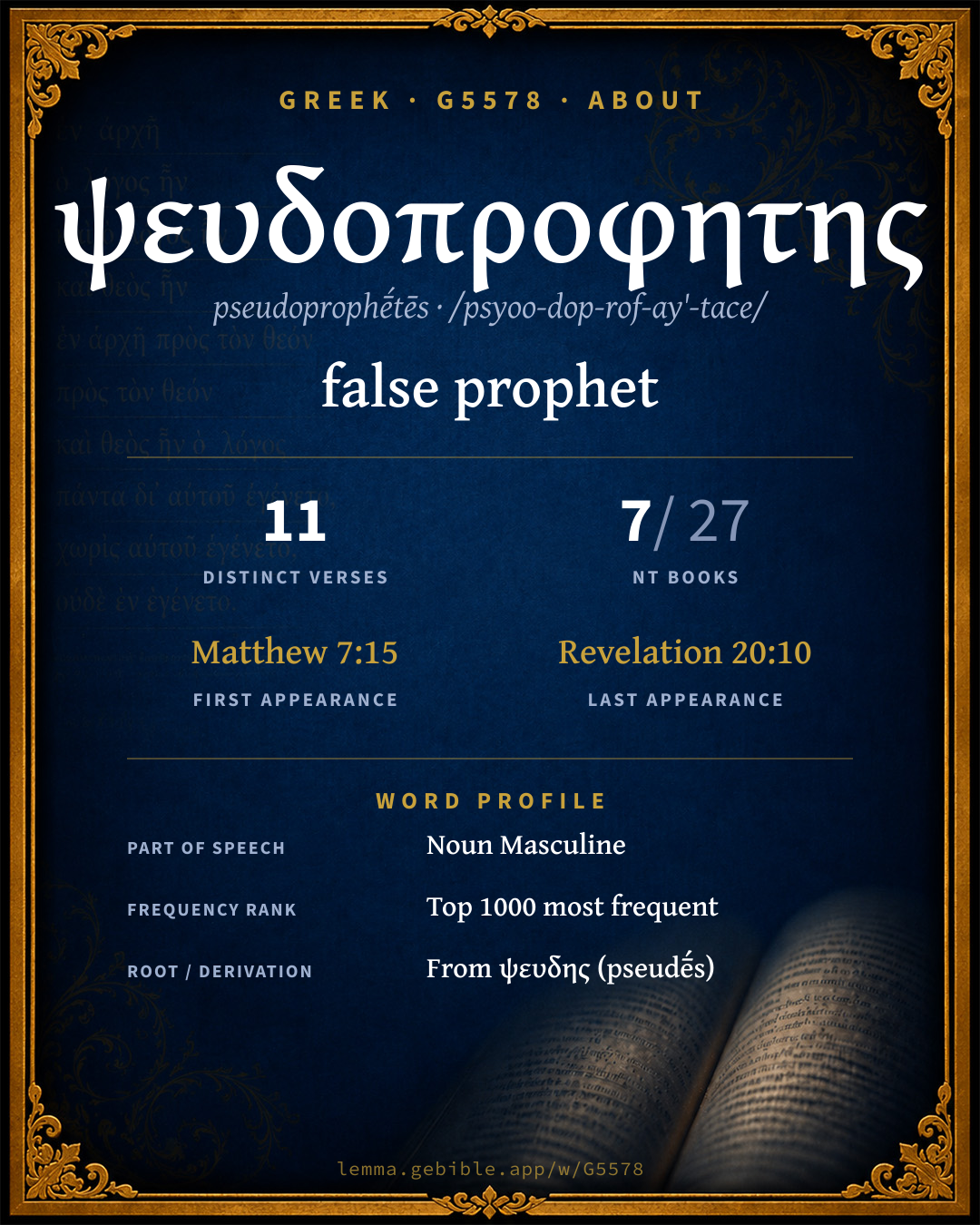
ψευδοπροφήτης
false prophet
‘false prophet’ is one of 2 main senses fuller range ↓
Full lexicon entry — Thayer's Greek Lexicon
From Thayer's Greek Lexicon
Where this word appears
See every Nominative-case word in the Greek New Testament →
Grammar key — what these labels mean
Part of speech
- Noun
- A naming word — a person, place, thing, or idea.
Case
- Nominative
- The case of the subject (and the predicate nominative).
- Accusative
- The case of the direct object and of extent.
- Dative
- The case of the indirect object, means, or location — “to / for / with / in.”
- Genitive
- The case of source, possession, or “of” — answers “whose / from what.”
Gender
- Masculine
- Grammatically masculine.
Number
- Plural
- More than one.
- Singular
- One.
Grammatical forms
- Noun, Nominative, Plural, Masculine 5 times (45%)
- Noun, Nominative, Singular, Masculine 2 times (18%)
- Noun, Accusative, Singular, Masculine 1 time (9%)
- Noun, Dative, Plural, Masculine 1 time (9%)
- Noun, Genitive, Plural, Masculine 1 time (9%)
- Noun, Genitive, Singular, Masculine 1 time (9%)
Parsed forms decoded from the imported morphology (Robinson–Tischendorf, public domain), counted across 11 parsed occurrences — not distinct verses.
Every verse where G5578 appears — 11 distinct verses across 7 books. Click any verse to open its interlinear word-by-word view. Verse text shown in the World English Bible for context — . Each verse’s Greek form is shown with its reference; the English is not keyword-highlighted, since the data carries no word-level English alignment. Use “Compare translations” on any verse to read it across multiple English versions. This concordance covers the Greek New Testament; Septuagint (Greek Old Testament) occurrences of this word are not indexed here.
Matthew 3 verses
- Matthew 7:15 ψευδοπροφητῶν n gen pl masc "Beware of false prophets, who come to you in sheep's clothing, but inwardly are ravening wolves.
- Matthew 24:11 ψευδοπροφῆται n nom pl masc Many false prophets will arise, and will lead many astray.
- Matthew 24:24 ψευδοπροφῆται n nom pl masc For there will arise false christs, and false prophets, and they will show great signs and wonders, so as to lead astray, if possible, even the chosen ones.
Mark 1 verse
Luke 1 verse
Acts 1 verse
2 Peter 1 verse
1 John 1 verse
Revelation 3 verses
- Revelation 16:13 ψευδοπροφήτου n gen sg masc I saw coming out of the mouth of the dragon, and out of the mouth of the beast, and out of the mouth of the false prophet, three unclean spirits, something like frogs;
- Revelation 19:20 ψευδοπροφήτης n nom sg masc The beast was taken, and with him the false prophet who worked the signs in his sight, with which he deceived those who had received the mark of the beast and those who worshiped his image. These two were thrown alive into the lake of fire that burns with sulfur.
- Revelation 20:10 ψευδοπροφήτης n nom sg masc The devil who deceived them was thrown into the lake of fire and sulfur, where the beast and the false prophet are also. They will be tormented day and night forever and ever.
About this entry
At a glance — auto-summarized from this page’s data, not written by a person. Every figure links to its source below. This summary describes the numbers; it doesn’t interpret them.
The Greek noun ψευδοπροφητης centers on the idea of “false prophet.” Its earliest occurrence is Matthew 7:15. The Greek New Testament uses it across 11 verses — uncommon. Matthew dominates its distribution — 3 of 11 verses. Thayer's distinguishes 2 senses for it. Dig into 11-verse concordance and the renderings breakdown below.
Gloss history
Strong's 1890 vs modern scholarship
About this word
Strong's G5578 catalogs a Greek word from the Greek New Testament.
These counts are not copied from any lexicon or concordance. They are computed here, from the morphology-tagged Greek New Testament. What Lemma adds →
- 11
- distinct verses
- The word appears in 11 distinct verses.
- 7 / 27
- NT books
- The word appears in 7 of 27 New Testament books.
- #978
- by frequency
- Top 1000 most frequent Greek words (rank 978 of 5,347 Greek words by occurrence).
View all 11 occurrences in the concordance →
Most concentrated in
- Matthew 3 verses 27%
- Revelation 3 verses 27%
- Mark 1 verse 9%
By section of the New Testament
By traditional corpus
Conventional, traditional groupings — biblical authorship is debated, so this is a traditional corpus grouping, not an authorship claim. Some books belong to more than one corpus (Luke is in both the Gospels and the Lukan corpus, and so on), so these shares overlap and need not total 100%. Each figure is a share of the word’s 11 distinct verses.
- Gospels 5 verses · 45%
- Johannine 4 verses · 36%
- Revelation 3 verses · 27%
- Lukan (Luke–Acts) 2 verses · 18%
- General (Catholic) Epistles 2 verses · 18%
How translations render this word
Counts come from each version’s own published word-to-Strong’s tagging or interlinear alignment — an approximate guide to how each version renders this word, not a word-level alignment the data otherwise carries. Because each total is that version’s own tagged count, the per-version totals vary from one another and need not match the appearance or distinct-verse counts above. These counts may also differ from a printed concordance because Lemma counts each distinctly tagged rendering and does not collapse phrase taggings into a single head-word total. This is a fixed set of word-tagged versions (KJV, ASV, BSB, ULT) and does not change with the reading translation you choose elsewhere. Each version’s license is shown beside its name below (and on Sources).
- King James Version: False prophets 7×, False prophet 4×
- American Standard Version: False prophets 7×, False prophet 4×
- Berean Standard Bible: False prophets 7×, False prophet 4×
- unfoldingWord Literal Text: False prophets 7×, False prophet 4×
King James Version Public Domain
Renders G5578 across 11 tagged occurrences — most commonly:
American Standard Version Public Domain
Renders G5578 across 11 tagged occurrences — most commonly:
Berean Standard Bible Public Domain
Renders G5578 across 11 tagged occurrences — most commonly:
unfoldingWord Literal Text CC BY-SA 4.0
Renders G5578 across 14 tagged occurrences — most commonly:
Plus 3 renderings that appear only once — usually multi-word phrases or single function words the recovered tagging swept in, not distinct renderings.
Senses in Thayer's
The 2 senses Thayer's distinguishes for this word, in lexicon order (not ranked by frequency or importance). The full entry — with sub-senses — is in the Lexicon Entry tab.
- one who, acting the part of a divinely inspired prophet, utters falsehoods under the name of divine prophecies
- a false prophet
Word origin
Derived from ψευδης (pseudḗs) (G5571) — false.
Forms in the corpus
The 6 distinct written forms G5578 takes in the Greek New Testament, most frequent first — each parse links to that case’s occurrences in the concordance.
| Form | Parsing | Example | Uses |
|---|---|---|---|
| ψευδοπροφῆται pseudoprophē̂tai | Noun, Nominative, Plural, Masculine | Matthew 24:11 | 5 |
| ψευδοπροφήτης pseudoprophḗtēs | Noun, Nominative, Singular, Masculine | Revelation 19:20 | 2 |
| ψευδοπροφήταις pseudoprophḗtais | Noun, Dative, Plural, Masculine | Luke 6:26 | 1 |
| ψευδοπροφήτην pseudoprophḗtēn | Noun, Accusative, Singular, Masculine | Acts 13:6 | 1 |
| ψευδοπροφήτου pseudoprophḗtou | Noun, Genitive, Singular, Masculine | Revelation 16:13 | 1 |
| ψευδοπροφητῶν pseudoprophētō̂n | Noun, Genitive, Plural, Masculine | Matthew 7:15 | 1 |
Same root — word family
Other Thayer's entries built from the same root as G5578, grouped by Strong’s listed origin. These share a root / origin per the lexicon — not necessarily a shared meaning. Each links to that word’s own entry.
Derives from
Shares the same root
- ψευδαδελφος pseudádelphos G5569 false brother
- ψευδαποστολος pseudapóstolos G5570 false apostle
- ψευδοδιδασκαλος pseudodidáskalos G5572 false teacher
- ψευδολογος pseudológos G5573 to teach falsely
- ψευδομαρτυρ pseudomártyr G5575 false witness
- ψευδοχριστος pseudóchristos G5580 false Messiah
- ψευδωνυμος pseudṓnymos G5581 falsely named
Compare all same-root words → Showing 4 of 9 — not the complete family. They share a root, not necessarily a meaning.
Septuagint usage
The same Greek word ψευδοπροφητης appears 10 times in the Greek Old Testament (Septuagint), across 10 verses in 2 books.
- 10
- LXX occurrences
- Tagged occurrences of this Greek word in the Septuagint.
- 10
- verses
- Distinct Septuagint verses containing this word.
- 2 / 39
- OT books
- The word appears in 2 of the 39 Old Testament books.
Sample Septuagint occurrences
- Jeremiah 6:13 ψευδοπροφήτης
- Zechariah 13:2 ψευδοπροφήτης
Septuagint occurrences (same lexeme)
Every verse where the same Strong’s number (G5578) appears in the Greek Septuagint. Verse text shown in the World English Bible for context; the Greek form is the matched word — the English is not keyword-highlighted.
- Jeremiah 6:13 ψευδοπροφήτης For from the least of them even to the greatest of them everyone is given to covetousness; and from the prophet even to the priest everyone deals falsely.
- Jeremiah 33:7 ψευδοπροφήτης I will cause the captivity of Judah and the captivity of Israel to return, and will build them, as at the first.
- Jeremiah 33:8 ψευδοπροφήτης I will cleanse them from all their iniquity, by which they have sinned against me; and I will pardon all their iniquities, by which they have sinned against me, and by which they have transgressed against me.
- Jeremiah 33:11 ψευδοπροφήτης the voice of joy and the voice of gladness, the voice of the bridegroom and the voice of the bride, the voice of those who say, Give thanks to Yahweh of Hosts, for Yahweh is good, for his loving kindness endures forever; [and of them] who bring [sacrifices of] thanksgiving into the house of Yahweh. For I will cause the captivity of the land to return as at the first, says Yahweh.
- Jeremiah 33:16 ψευδοπροφήτης In those days shall Judah be saved, and Jerusalem shall dwell safely; and this is [the name] by which she shall be called: Yahweh our righteousness.
- Jeremiah 34:9 ψευδοπροφητής that every man should let his man-servant, and every man his maid-servant, who is a Hebrew or a Hebrewess, go free; that none should make bondservants of them, [to wit], of a Jew his brother.
- Jeremiah 35:1 ψευδοπροφήτης The word which came to Jeremiah from Yahweh in the days of Jehoiakim the son of Josiah, king of Judah, saying,
- Jeremiah 36:1 ψευδοπροφήτης It happened in the fourth year of Jehoiakim the son of Josiah, king of Judah, that this word came to Jeremiah from Yahweh, saying,
- Jeremiah 36:8 ψευδοπροφήτης Baruch the son of Neriah did according to all that Jeremiah the prophet commanded him, reading in the book the words of Yahweh in Yahweh's house.
- Zechariah 13:2 ψευδοπροφήτης It will come to pass in that day, says Yahweh of Hosts, that I will cut off the names of the idols out of the land, and they will no more be remembered; and also I will cause the prophets and the spirit of impurity to pass out of the land.
These are occurrences of the same Greek lexeme (G5578) in the Septuagint — not a translation of any one Hebrew word. The store carries no word-level Hebrew↔Greek alignment, so no Hebrew original is asserted here. Counts come from the recovered LXX Strong's tagging — high-frequency vocabulary is well covered, while rare or late forms may be untagged — so they reflect tagged occurrences and may slightly undercount.