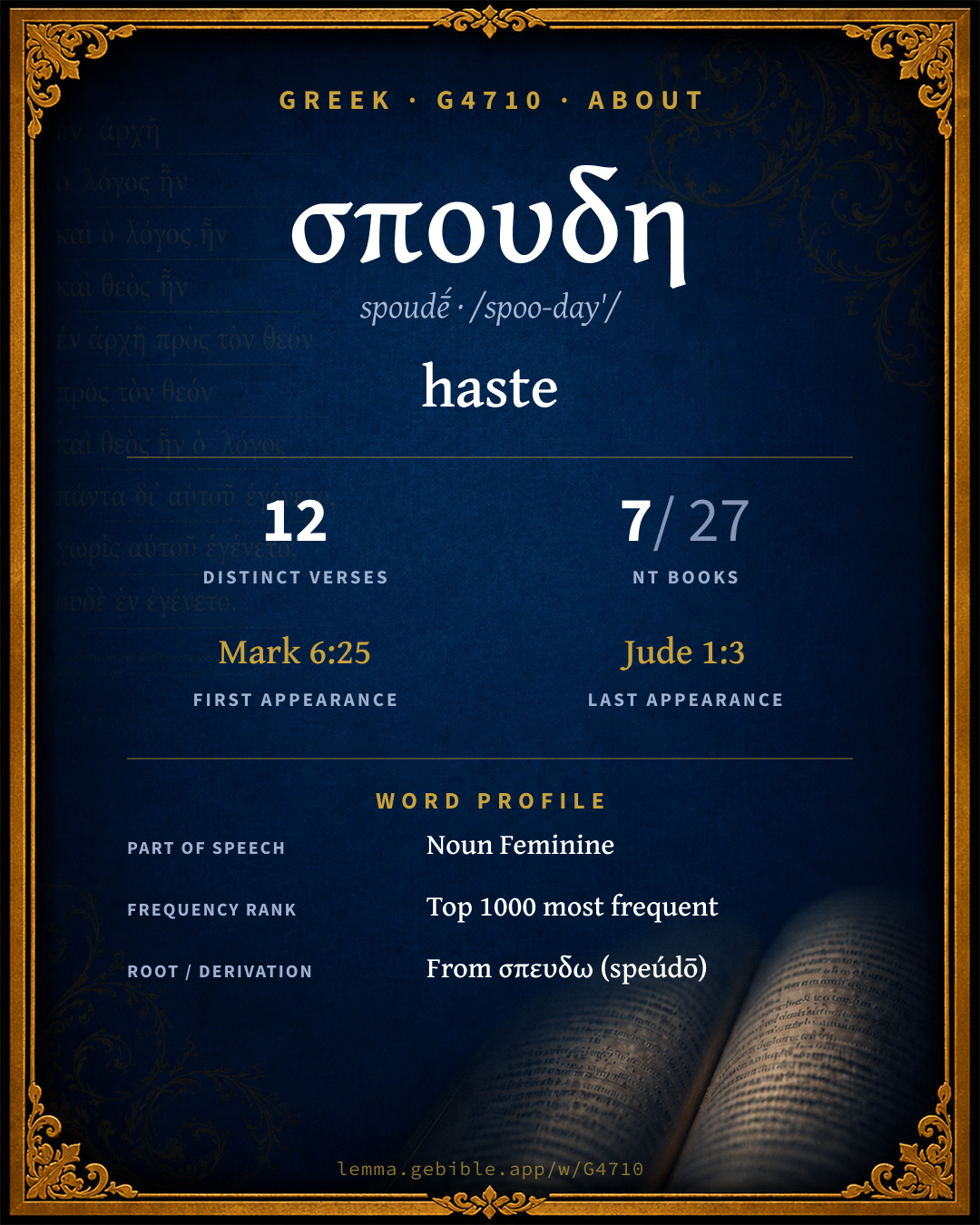
σπουδή
haste
‘haste’ is one of 2 main senses fuller range ↓
Full lexicon entry — Thayer's Greek Lexicon
From Thayer's Greek Lexicon
Where this word appears
See every Accusative-case word in the Greek New Testament →
Grammar key — what these labels mean
Part of speech
- Noun
- A naming word — a person, place, thing, or idea.
Case
- Accusative
- The case of the direct object and of extent.
- Dative
- The case of the indirect object, means, or location — “to / for / with / in.”
- Genitive
- The case of source, possession, or “of” — answers “whose / from what.”
Gender
- Feminine
- Grammatically feminine.
Number
- Singular
- One.
1 verse where G4710 appears in the Dative case in the Book of 2 Corinthians. Filtered view — show all forms. Click any verse to open its interlinear word-by-word view. Verse text shown in the World English Bible for context — . Each verse’s Greek form is shown with its reference; the English is not keyword-highlighted, since the data carries no word-level English alignment. Use “Compare translations” on any verse to read it across multiple English versions. This concordance covers the Greek New Testament; Septuagint (Greek Old Testament) occurrences of this word are not indexed here.
2 Corinthians
About this entry
At a glance — auto-summarized from this page’s data, not written by a person. Every figure links to its source below. This summary describes the numbers; it doesn’t interpret them.
The Greek noun σπουδη centers on the idea of “haste.” Where the King James Version says “diligence,” newer translations reach for “earnestness” (unfoldingWord Literal Text); the renderings breakdown has the detail. It appears 12 verses across 7 books of the Greek New Testament, among its uncommon vocabulary. The word gravitates to 2 Corinthians (42%), then Romans and Mark. Thayer's distinguishes 2 senses for it. Dig into 12-verse concordance and the renderings breakdown below.
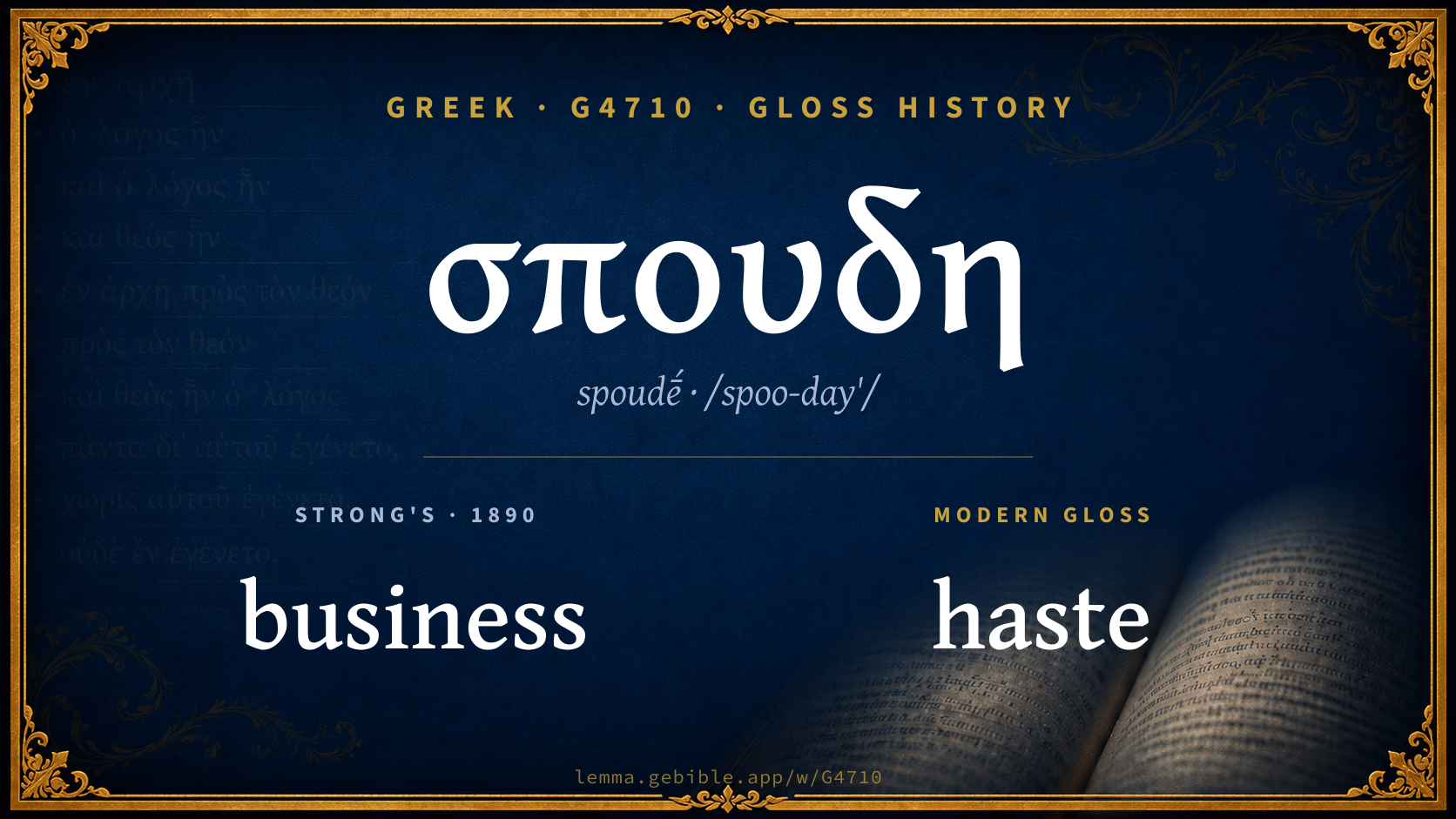
Gloss history
Strong's 1890 vs modern scholarship
About this word
Strong's G4710 catalogs a Greek word from the Greek New Testament.
These counts are not copied from any lexicon or concordance. They are computed here, from the morphology-tagged Greek New Testament. What Lemma adds →
- 12
- distinct verses
- The word appears in 12 distinct verses.
- 7 / 27
- NT books
- The word appears in 7 of 27 New Testament books.
- #904
- by frequency
- Top 1000 most frequent Greek words (rank 904 of 5,347 Greek words by occurrence).
View all 12 occurrences in the concordance →
Most concentrated in
- 2 Corinthians 5 verses 42%
- Romans 2 verses 17%
- Mark 1 verse 8%
By section of the New Testament
By traditional corpus
Conventional, traditional groupings — biblical authorship is debated, so this is a traditional corpus grouping, not an authorship claim. Some books belong to more than one corpus (Luke is in both the Gospels and the Lukan corpus, and so on), so these shares overlap and need not total 100%. Each figure is a share of the word’s 12 distinct verses.
- Pauline corpus 7 verses · 58%
- Gospels 2 verses · 17%
- General (Catholic) Epistles 2 verses · 17%
- Lukan (Luke–Acts) 1 verse · 8%
- Hebrews 1 verse · 8%
How translations render this word
Counts come from each version’s own published word-to-Strong’s tagging or interlinear alignment — an approximate guide to how each version renders this word, not a word-level alignment the data otherwise carries. Because each total is that version’s own tagged count, the per-version totals vary from one another and need not match the appearance or distinct-verse counts above. These counts may also differ from a printed concordance because Lemma counts each distinctly tagged rendering and does not collapse phrase taggings into a single head-word total. This is a fixed set of word-tagged versions (KJV, ASV, BSB, ULT) and does not change with the reading translation you choose elsewhere. Each version’s license is shown beside its name below (and on Sources).
- King James Version: Diligence 5×, Haste 2×
- American Standard Version: Diligence 5×, Earnest care 3×, Haste 2×
- Berean Standard Bible: Earnestness 4×, Diligence 2×, Effort 2×
- unfoldingWord Literal Text: Earnestness 5×, Diligence 4×, Haste 2×
King James Version Public Domain
Renders G4710 across 12 tagged occurrences — most commonly:
Plus 5 renderings that appear only once — usually multi-word phrases or single function words the recovered tagging swept in, not distinct renderings.
American Standard Version Public Domain
Renders G4710 across 13 tagged occurrences — most commonly:
Plus 3 renderings that appear only once — usually multi-word phrases or single function words the recovered tagging swept in, not distinct renderings.
Berean Standard Bible Public Domain
Renders G4710 across 10 tagged occurrences — most commonly:
Plus 2 renderings that appear only once — usually multi-word phrases or single function words the recovered tagging swept in, not distinct renderings. Not rendered by a distinct English word in 2 further occurrences.
unfoldingWord Literal Text CC BY-SA 4.0
Renders G4710 across 13 tagged occurrences — most commonly:
Plus 2 renderings that appear only once — usually multi-word phrases or single function words the recovered tagging swept in, not distinct renderings.
Senses in Thayer's
The 2 senses Thayer's distinguishes for this word, in lexicon order (not ranked by frequency or importance). The full entry — with sub-senses — is in the Lexicon Entry tab.
- haste, with haste
- earnestness, diligence
Word origin
Derived from σπευδω (speúdō) (G4692) — to hasten.
From G4692 ; speed that is (by implication) despatch eagerness earnestness : - business (earnest) care (-fulness) diligence forwardness haste.
— Strong’s Exhaustive Concordance (1890), public domain.
Forms in the corpus
The 4 distinct written forms G4710 takes in the Greek New Testament, most frequent first — each parse links to that case’s occurrences in the concordance.
| Form | Parsing | Example | Uses |
|---|---|---|---|
| σπουδὴν spoudḕn | Noun, Accusative, Singular, Feminine | 2 Corinthians 7:12 | 5 |
| σπουδῆς spoudē̂s | Noun, Genitive, Singular, Feminine | Mark 6:25 | 3 |
| σπουδῇ spoudē̂ | Noun, Dative, Singular, Feminine | Romans 12:8 | 3 |
| σπουδήν spoudḗn | Noun, Accusative, Singular, Feminine | 2 Corinthians 7:11 | 1 |
Same root — word family
Other Thayer's entries built from the same root as G4710, grouped by Strong’s listed origin. These share a root / origin per the lexicon — not necessarily a shared meaning. Each links to that word’s own entry.
Derives from
Derived from this word
Compare all same-root words → They share a root, not necessarily a meaning.
Septuagint usage
The same Greek word σπουδη appears 14 times in the Greek Old Testament (Septuagint), across 14 verses in 11 books.
- 14
- LXX occurrences
- Tagged occurrences of this Greek word in the Septuagint.
- 14
- verses
- Distinct Septuagint verses containing this word.
- 11 / 39
- OT books
- The word appears in 11 of the 39 Old Testament books.
Sample Septuagint occurrences
- Exodus 12:11 σπουδή
- Deuteronomy 16:3 σπουδή
- Judges 5:22 σπουδή
- 1 Samuel 21:9 σπουδή
- Ezra 4:23 σπουδή
- Psalms 77:33 σπουδή
- Jeremiah 8:15 σπουδή
- Lamentations 4:6 σπουδή
- Ezekiel 7:11 σπουδή
- Daniel 2:25 σπουδή
- Zephaniah 1:18 σπουδή
Septuagint occurrences (same lexeme)
Every verse where the same Strong’s number (G4710) appears in the Greek Septuagint. Verse text shown in the World English Bible for context; the Greek form is the matched word — the English is not keyword-highlighted.
- Exodus 12:11 σπουδή This is how you shall eat it: with your loins girded, your shoes on your feet, and your staff in your hand; and you shall eat it in haste: it is Yahweh's Passover.
- Exodus 12:33 σπουδή The Egyptians were urgent with the people, to send them out of the land in haste, for they said, "We are all dead men."
- Deuteronomy 16:3 σπουδή You shall eat no leavened bread with it; seven days shall you eat unleavened bread therewith, even the bread of affliction; for you came forth out of the land of Egypt in haste: that you may remember the day when you came forth out of the land of Egypt all the days of your life.
- Judges 5:22 σπουδή Then did the horse hoofs stamp By reason of the prancings, the prancings of their strong ones.
- 1 Samuel 21:9 σπουδή The priest said, The sword of Goliath the Philistine, whom you killed in the valley of Elah, behold, it is here wrapped in a cloth behind the ephod: if you will take that, take it; for there is no other except that here. David said, There is none like that; give it me.
- Ezra 4:23 σπουδή Then when the copy of king Artaxerxes' letter was read before Rehum, and Shimshai the scribe, and their companions, they went in haste to Jerusalem to the Jews, and made them to cease by force and power.
- Psalms 77:33 σπουδή
- Jeremiah 8:15 σπουδή We looked for peace, but no good came; [and] for a time of healing, and, behold, dismay!
- Jeremiah 15:8 σπουδή Their widows are increased to me above the sand of the seas; I have brought on them against the mother of the young men a destroyer at noonday: I have caused anguish and terrors to fall on her suddenly.
- Lamentations 4:6 σπουδή For the iniquity of the daughter of my people is greater than the sin of Sodom, That was overthrown as in a moment, and no hands were laid on her.
- Ezekiel 7:11 σπουδή Violence is risen up into a rod of wickedness; none of them [shall remain], nor of their multitude, nor of their wealth: neither shall there be eminency among them.
- Daniel 2:25 σπουδή Then Arioch brought in Daniel before the king in haste, and said thus to him, I have found a man of the children of the captivity of Judah, who will make known to the king the interpretation.
- Daniel 10:7 σπουδή I, Daniel, alone saw the vision; for the men who were with me didn't see the vision; but a great quaking fell on them, and they fled to hide themselves.
- Zephaniah 1:18 σπουδή Neither their silver nor their gold will be able to deliver them in the day of Yahweh's wrath, but the whole land will be devoured by the fire of his jealousy; for he will make an end, yes, a terrible end, of all those who dwell in the land.
These are occurrences of the same Greek lexeme (G4710) in the Septuagint — not a translation of any one Hebrew word. The store carries no word-level Hebrew↔Greek alignment, so no Hebrew original is asserted here. Counts come from the recovered LXX Strong's tagging — high-frequency vocabulary is well covered, while rare or late forms may be untagged — so they reflect tagged occurrences and may slightly undercount.