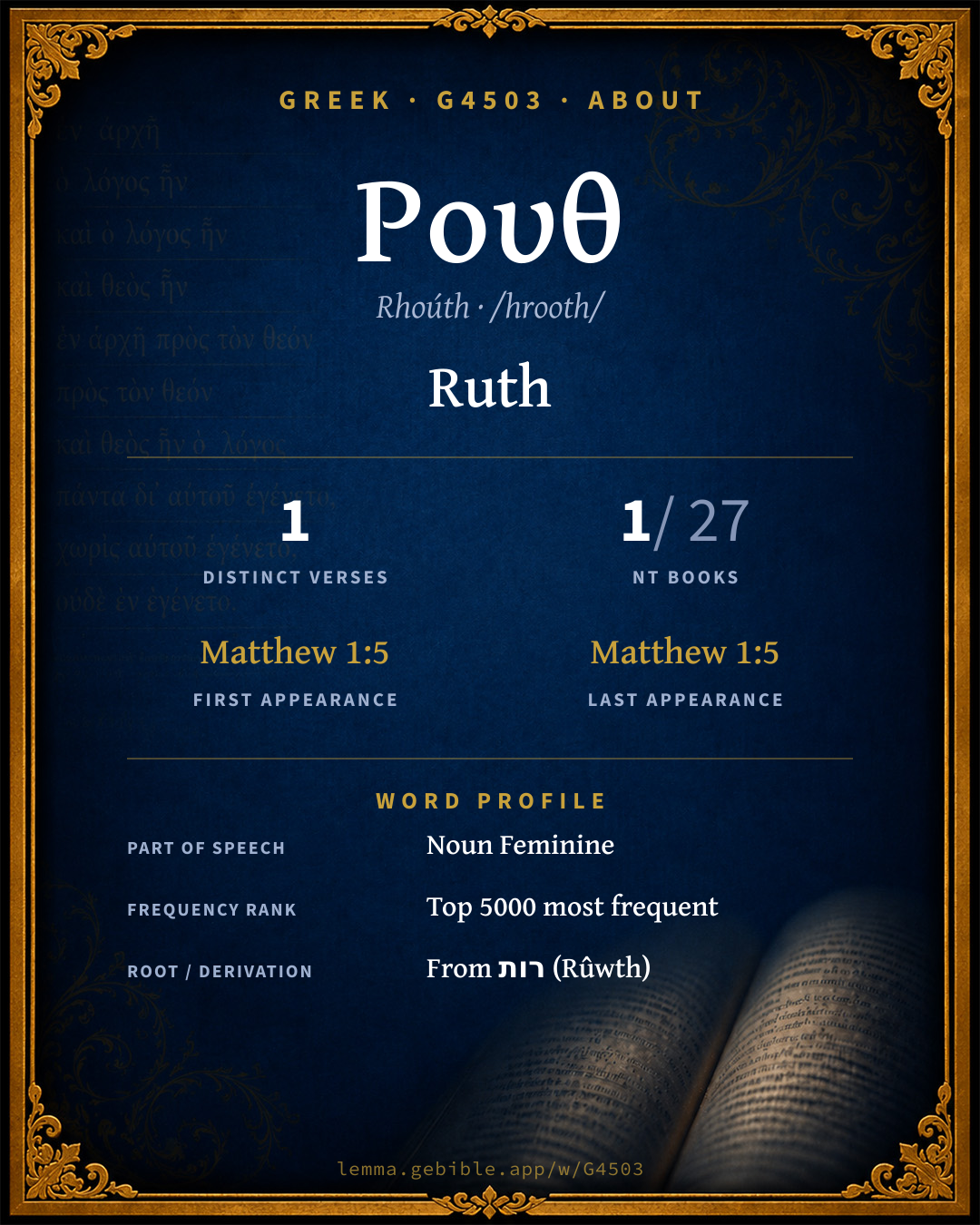
Ῥούθ
Ruth
Thayer's lists 2 entries for ‘Ruth’ fuller range ↓
Full lexicon entry — Thayer's Greek Lexicon
From Thayer's Greek Lexicon
Where this word appears
Every verse where G4503 appears — 1 distinct verse across 1 book. Click any verse to open its interlinear word-by-word view. Verse text shown in the World English Bible for context — . Each verse’s Greek form is shown with its reference; the English is not keyword-highlighted, since the data carries no word-level English alignment. Use “Compare translations” on any verse to read it across multiple English versions. This concordance covers the Greek New Testament; Septuagint (Greek Old Testament) occurrences of this word are not indexed here.
Matthew 1 verse
About this entry
At a glance — auto-summarized from this page’s data, not written by a person. Every figure links to its source below. This summary describes the numbers; it doesn’t interpret them.
The Greek name Ρουθ centers on the idea of “Ruth.” A scarce word — 1 verse in all of the Greek New Testament. Matthew dominates its distribution — 1 of 1 verses. A true hapax — its single appearance is Matthew 1:5. For the data behind this summary, explore 1-verse concordance and the renderings breakdown below.
Gloss history
Strong's 1890 vs modern scholarship
About this word
Strong's G4503 catalogs a Greek word from the Greek New Testament.
These counts are not copied from any lexicon or concordance. They are computed here, from the morphology-tagged Greek New Testament. What Lemma adds →
- 1
- distinct verses
- The word appears in 1 distinct verse.
- 1 / 27
- NT books
- The word appears in 1 of 27 New Testament books.
- #3,503
- by frequency
- Top 5000 most frequent Greek words (rank 3,503 of 5,347 Greek words by occurrence).
View all 1 occurrence in the concordance →
Most concentrated in
- Matthew 1 verse 100%
By section of the New Testament
By traditional corpus
Conventional, traditional groupings — biblical authorship is debated, so this is a traditional corpus grouping, not an authorship claim. Some books belong to more than one corpus (Luke is in both the Gospels and the Lukan corpus, and so on), so these shares overlap and need not total 100%. Each figure is a share of the word’s 1 distinct verse.
- Gospels 1 verse · 100%
How translations render this word
Counts come from each version’s own published word-to-Strong’s tagging or interlinear alignment — an approximate guide to how each version renders this word, not a word-level alignment the data otherwise carries. Because each total is that version’s own tagged count, the per-version totals vary from one another and need not match the appearance or distinct-verse counts above. These counts may also differ from a printed concordance because Lemma counts each distinctly tagged rendering and does not collapse phrase taggings into a single head-word total. This is a fixed set of word-tagged versions (KJV, ASV, BSB, ULT) and does not change with the reading translation you choose elsewhere. Each version’s license is shown beside its name below (and on Sources).
- King James Version: Ruth 1×
- American Standard Version: Ruth 1×
- Berean Standard Bible: Ruth 1×
- unfoldingWord Literal Text: Ruth 1×
King James Version Public Domain
Renders G4503 across 1 tagged occurrence — most commonly:
American Standard Version Public Domain
Renders G4503 across 1 tagged occurrence — most commonly:
Berean Standard Bible Public Domain
Renders G4503 across 1 tagged occurrence — most commonly:
unfoldingWord Literal Text CC BY-SA 4.0
Renders G4503 across 1 tagged occurrence — most commonly:
Senses in Thayer's
The 2 senses Thayer's distinguishes for this word, in lexicon order (not ranked by frequency or importance). The full entry — with sub-senses — is in the Lexicon Entry tab.
- Ruth = "a female friend"
- the ancestor of David and of Christ
Word origin
Derived from רות (Rûwth) (H7327) — Ruth.
Of hebrew origin [ H7327 ]; Ruth a Moabitess : - Ruth.
— Strong’s Exhaustive Concordance (1890), public domain.
Bible dictionary
Public-domain dictionary articles matched to this entry by name (Ruth). A biblical name can be shared by more than one person or place, so an article may treat several.
Easton's Bible Dictionary · M. G. Easton, 1897
A friend, a Moabitess, the wife of Mahlon, whose father, Elimelech, had settled in the land of Moab. On the death of Elimelech and Mahlon, Naomi came with Ruth, her daughter-in-law, who refused to leave her, to Bethlehem, the old home from which Elimelech had migrated. There she had a rich relative, Boaz, to whom Ruth was eventually married. She became the mother of Obed, the grandfather of David. Thus Ruth, a Gentile, is among the maternal progenitors of our Lord (Matt. 1:5). The story of "the gleaner Ruth illustrates the friendly relations between the good Boaz and his reapers, the Jewish land system, the method of transferring property from one person to another, the working of the Mosaic law for the relief of distressed and ruined families; but, above all, handing down the unselfishness, the brave love, the unshaken trustfulness of her who, though not of the chosen race, was, like the Canaanitess Tamar (Gen. 38:29; Matt. 1:3) and the Canaanitess Rahab (Matt. 1:5), privileged to become the ancestress of David, and so of great David's greater Son'" (Ruth 4:18-22).
Smith's Bible Dictionary · William Smith, 1863
(a female friend) a Moabitish woman, the wife, first of Mahlon, second of Boaz, the ancestress of David and Christ, and one of the four women who are named by St. Matthew in the genealogy of Christ. A severe famine in the land of Judah induced Elimelech, a native of Bethlehem--ephratah, to emigrate into the land of Moab, with his wife Naomi, and his two sons, Mahlon and Chilion. This was probably about the time of Gideon, B.C. 1250. At the end of ten years Naomi now left a widow and childless, having heard that there was plenty again in Judah, resolved to return to Bethlehem, and her daughter-in-law Ruth returned with her. They arrived at Bethlehem just at the beginning of barley harvest, and Ruth, going out to glean, chanced to go into the field of wheat, a wealthy man and a near kinsman of her father-in-law, Elimelech. Upon learning who the stranger was, Boaz treated her with the utmost kindness and respect, and sent her home laden with corn which she had gleaned. Encouraged by this incident, Naomi instructed Ruth to claim at the hand of Boaz that he should perform the part of her husband's near kinsman, by purchasing the inheritance of Elimelech and taking her to be his wife. With all due solemnity, Boaz took Ruth to be his wife, amidst the blessings and congratulations of their neighbors. Their son, Obed, was 'the father of Jesse, who was the father of David.
Hitchcock's Bible Names Dictionary · Roswell D. Hitchcock, 1869
drunk; satisfied
Classic public-domain reference works; full attribution on Sources.
Septuagint usage
The same Greek word Ρουθ appears 19 times in the Greek Old Testament (Septuagint), across 19 verses in 1 book.
- 19
- LXX occurrences
- Tagged occurrences of this Greek word in the Septuagint.
- 19
- verses
- Distinct Septuagint verses containing this word.
- 1 / 39
- OT books
- The word appears in 1 of the 39 Old Testament books.
Sample Septuagint occurrences
- Ruth 1:4 ρουθ
Septuagint occurrences (same lexeme)
Every verse where the same Strong’s number (G4503) appears in the Greek Septuagint. Verse text shown in the World English Bible for context; the Greek form is the matched word — the English is not keyword-highlighted.
- Ruth 1:4 ρουθ They took them wives of the women of Moab; the name of the one was Orpah, and the name of the other Ruth: and they lived there about ten years.
- Ruth 1:14 ρουθ They lifted up their voice, and wept again: and Orpah kissed her mother-in-law, but Ruth joined with her.
- Ruth 1:15 ρουθ She said, Behold, your sister-in-law is gone back to her people, and to her god: return you after your sister-in-law.
- Ruth 1:16 ρουθ Ruth said, "Don't entreat me to leave you, and to return from following after you, for where you go, I will go; and where you lodge, I will lodge; your people shall be my people, and your God my God;
- Ruth 1:22 ρουθ So Naomi returned, and Ruth the Moabitess, her daughter-in-law, with her, who returned out of the country of Moab: and they came to Bethlehem in the beginning of barley harvest.
- Ruth 2:2 ρουθ Ruth the Moabitess said to Naomi, Let me now go to the field, and glean among the ears of grain after him in whose sight I shall find favor. She said to her, Go, my daughter.
- Ruth 2:8 ρουθ Then said Boaz to Ruth, Don't you hear, my daughter? Don't go to glean in another field, neither pass from hence, but abide here fast by my maidens.
- Ruth 2:14 ρουθ At meal-time Boaz said to her, Come here, and eat of the bread, and dip your morsel in the vinegar. She sat beside the reapers, and they reached her parched grain, and she ate, and was sufficed, and left of it.
- Ruth 2:18 ρουθ She took it up, and went into the city; and her mother-in-law saw what she had gleaned: and she brought forth and gave to her that which she had left after she was sufficed.
- Ruth 2:19 ρουθ Her mother-in-law said to her, Where have you gleaned today? and where have you worked? blessed be he who did take knowledge of you. She shown her mother-in-law with whom she had worked, and said, The man's name with whom I worked today is Boaz.
- Ruth 2:21 ρουθ Ruth the Moabitess said, Yes, he said to me, You shall keep fast by my young men, until they have ended all my harvest.
- Ruth 2:22 ρουθ Naomi said to Ruth her daughter-in-law, It is good, my daughter, that you go out with his maidens, and that they not meet you in any other field.
- Ruth 2:23 ρουθ So she kept fast by the maidens of Boaz, to glean to the end of barley harvest and of wheat harvest; and she lived with her mother-in-law.
- Ruth 3:5 ρουθ She said to her, All that you say I will do.
- Ruth 3:9 ρουθ He said, Who are you? She answered, I am Ruth your handmaid: spread therefore your skirt over your handmaid; for you are a near kinsman.
- Ruth 3:16 ρουθ When she came to her mother-in-law, she said, Who are you, my daughter? She told her all that the man had done to her.
- Ruth 4:5 ρουθ Then said Boaz, What day you buy the field of the hand of Naomi, you must buy it also of Ruth the Moabitess, the wife of the dead, to raise up the name of the dead on his inheritance.
- Ruth 4:10 ρουθ Moreover Ruth the Moabitess, the wife of Mahlon, have I purchased to be my wife, to raise up the name of the dead on his inheritance, that the name of the dead not be cut off from among his brothers, and from the gate of his place: you are witnesses this day.
- Ruth 4:13 ρουθ So Boaz took Ruth, and she became his wife; and he went in to her, and Yahweh gave her conception, and she bore a son.
These are occurrences of the same Greek lexeme (G4503) in the Septuagint — not a translation of any one Hebrew word. The store carries no word-level Hebrew↔Greek alignment, so no Hebrew original is asserted here. Counts come from the recovered LXX Strong's tagging — high-frequency vocabulary is well covered, while rare or late forms may be untagged — so they reflect tagged occurrences and may slightly undercount.