
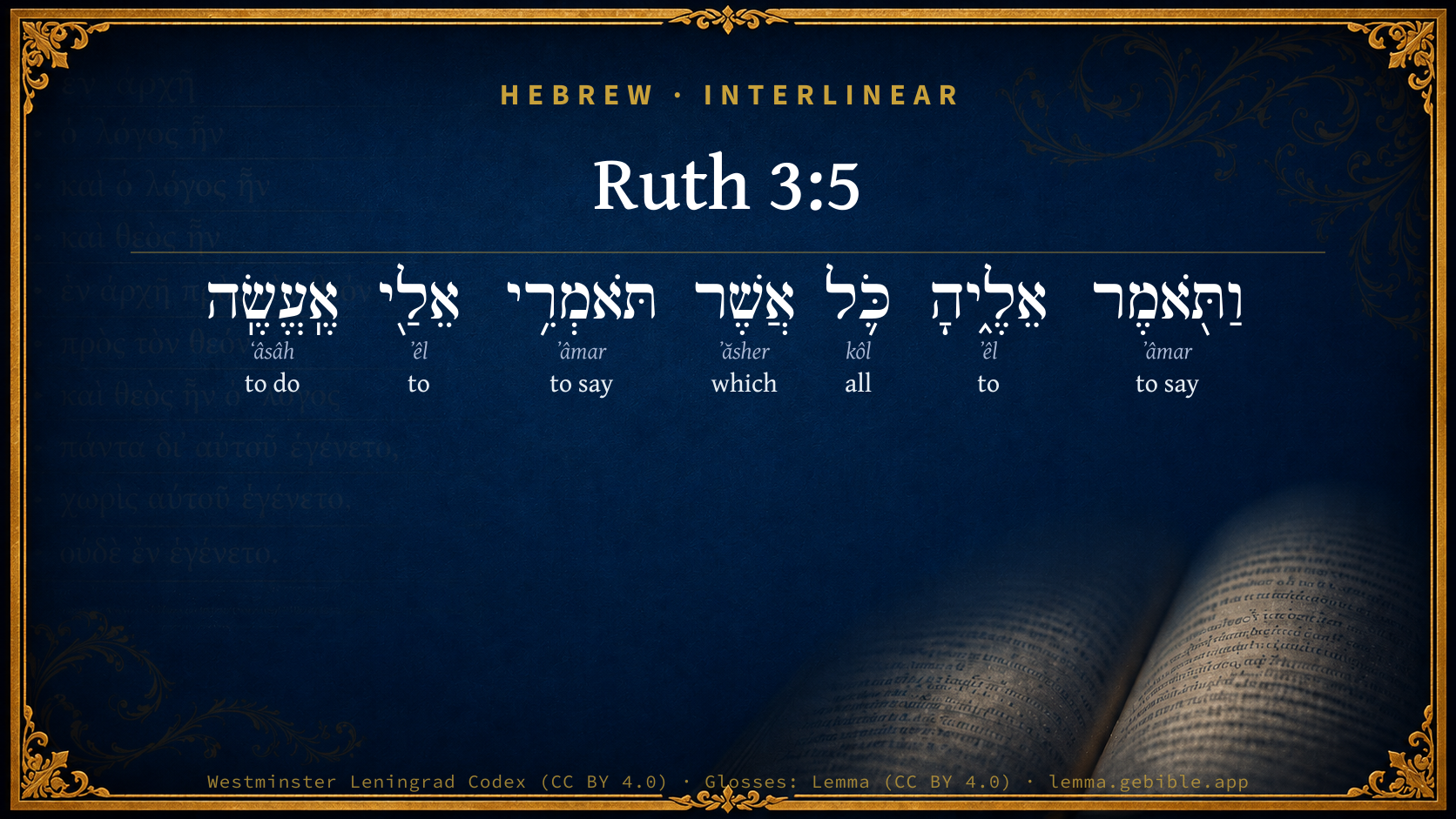
Ruth 3:5

Hebrew (Westminster Leningrad Codex) Ruth 3:5 appears in the Hebrew Old Testament. The text above is from the Westminster Leningrad Codex. Each word links to its Strong’s number, a concise gloss, and parsing drawn from the Open Scriptures Hebrew Bible morphology. Click any word for its full Brown-Driver-Briggs (BDB) entry.
Download image
Cite this verse

Ruth 3:5 (World English Bible). Public Domain. Lemma interlinear Bible study tool, https://lemma.gebible.app/v/ruth/3/5.

Show BibTeX & RIS
BibTeX
RIS
English Translation
She said to her, All that you say I will do.
World English Bible · Public Domain
Download a study sheet

One document with this verse’s original text, its word-by-word gloss line, the meaning frame, cross-references with their text, attributed commentary, and full source and license credits — printable, and it pastes into notes with its structure intact.

This verse Autodidact and up

Study sheet (.html) Plain text (.txt)

A passage Seminary Student

Up to 50 verses in one chapter. A passage sheet keeps up to 6 commentary sources and 12 cross-references per verse, in the order this page ranks them, and says so on the sheet whenever that leaves anything out. Ask for a single verse and you get the Autodidact verse sheet above.

Everything on this page stays free to read, with no account — the sheet is a download of what is already on screen, not access to it.

Want to remove ads? Support Godless Engineer
Compare translations 3

The same verse in 3 English versions, stacked beneath the original-language interlinear above. Click any original word for its lexicon entry.

Each is an independent rendering of the whole verse — the interlinear is not word-aligned to these translations.

Highlighted words mark where these versions differ — a whole-verse word diff, not a word-by-word alignment.

  • World English Bible Public Domain
    She said to her, All that you say I will do.
  • King James Version Public Domain
    And she said unto her, All that thou sayest unto me I will do.
  • unfoldingWord Literal Text CC BY-SA 4.0
    And she said to her, “Everything that you say, I will do.”

unfoldingWord Literal Text — © unfoldingWord, licensed CC BY-SA 4.0. Word-aligned USFM3 via Door43 (git.door43.org/unfoldingWord/en_ult).

Versions to compare (up to 4)

3 of 4 selected

Show all 18 translations

Every available English version of this verse, each an independent rendering of the whole verse.

  • World English Bible Public Domain
    She said to her, All that you say I will do.
  • Berean Standard Bible Public Domain
    “I will do everything you say,” Ruth answered.
  • Majority Standard Bible Public Domain
    “I will do everything you say,” Ruth answered.
  • King James Version Public Domain
    And she said unto her, All that thou sayest unto me I will do.
  • American Standard Version (1901) Public Domain
    And she said unto her, All that thou sayest I will do.
  • Revised Version (1885) Public Domain
    And she said unto her, All that thou sayest I will do.
  • Geneva Bible (1599) Public Domain
    And she answered her, All that thou biddest me, I will doe.
  • Douay-Rheims (1899) Public Domain
    She answered: Whatsoever thou shalt command, I will do.
  • Young's Literal Translation Public Domain
    And she saith unto her, `All that thou sayest -- I do.'
  • Literal Standard Version CC BY-SA 4.0
    And she says to her, “All that you say—I do.”
  • Unlocked Literal Bible CC BY-SA 4.0
    Ruth said to Naomi, “I will do everything you say.”
  • unfoldingWord Literal Text CC BY-SA 4.0
    And she said to her, “Everything that you say, I will do.”
  • Darby Bible Public Domain
    And she said to her, All that thou sayest will I do.
  • World Messianic Bible Public Domain
    She said to her, “All that you say, I will do.”
  • Webster's Bible Public Domain
    And she said to her, All that thou sayest to me I will do.
  • Free Bible Version CC BY-SA 4.0
    “I'll do everything you told me,” said Ruth.
  • Bible in Basic English Public Domain
    And she said, I will do all you say.
  • JPS Tanakh (1917) Public Domain
    And she said unto her: 'All that thou sayest unto me I will do.'

Literal Standard Version (2020), Covenant Press — licensed CC BY-SA 4.0. Text via the HelloAO Bible API (eBible.org). Unlocked Literal Bible (unfoldingWord) — licensed CC BY-SA 4.0. Text via the HelloAO Bible API (eBible.org). unfoldingWord Literal Text — © unfoldingWord, licensed CC BY-SA 4.0. Word-aligned USFM3 via Door43 (git.door43.org/unfoldingWord/en_ult). Free Bible Version, Dr. Jonathan Gallagher — licensed CC BY-SA 4.0. Text via the HelloAO Bible API (eBible.org).

Word by word

More ways to search: Search by grammar → Find every occurrence → Compare this word →

Practice this passage: Drill this verse → Learn its vocabulary →

אֶֽעֱשֶֽׂה
ʻâsâh
H6213
“to do”
Verb, Qal, Imperfect, 1st Person, Common, Singular
Part of Speech
Verb
Stem
Qal
Form
Imperfect
Person
1st Person
Gender
Common
Number
Singular
Full BDB Definition

Origin: a primitive root

TWOT: 1708 , 1709

to do, fashion, accomplish, make - (Qal) - to do, work, make, produce - to do - to work - to deal (with) - to act, act with effect, effect - to make - to make - to produce - to prepare - to make (an offering) - to attend to, put in order - to observe, celebrate - to acquire (property) - to appoint, ordain, institute - to bring about - to use - to spend, pass - (Niphal) - to be done - to be made - to be produced - to be offered - to be observed - to be used - (Pual) to be made - (Piel) to press, squeeze
  1. וַתֹּ֖אמֶר ʼâmar H559 “and · to say” Conjunction + Verb, Qal, Sequential Imperfect, 3rd Person, Feminine, Singular
  2. אֵלֶ֑יהָ ʼêl H413 “to · her” Preposition + Suffix, Personal, 3rd Person, Feminine, Singular
  3. כֹּ֛ל kôl H3605 “all” Noun, Common, Masculine, Singular, Absolute
  4. אֲשֶׁר ʼăsher H834 “which” Particle, Relative
  5. תֹּאמְרִ֥י ʼâmar H559 “to say” Verb, Qal, Imperfect, 2nd Person, Feminine, Singular
  6. אֵלַ֖י ʼêl H413 “to · me” Preposition + Suffix, Personal, 1st Person, Common, Singular

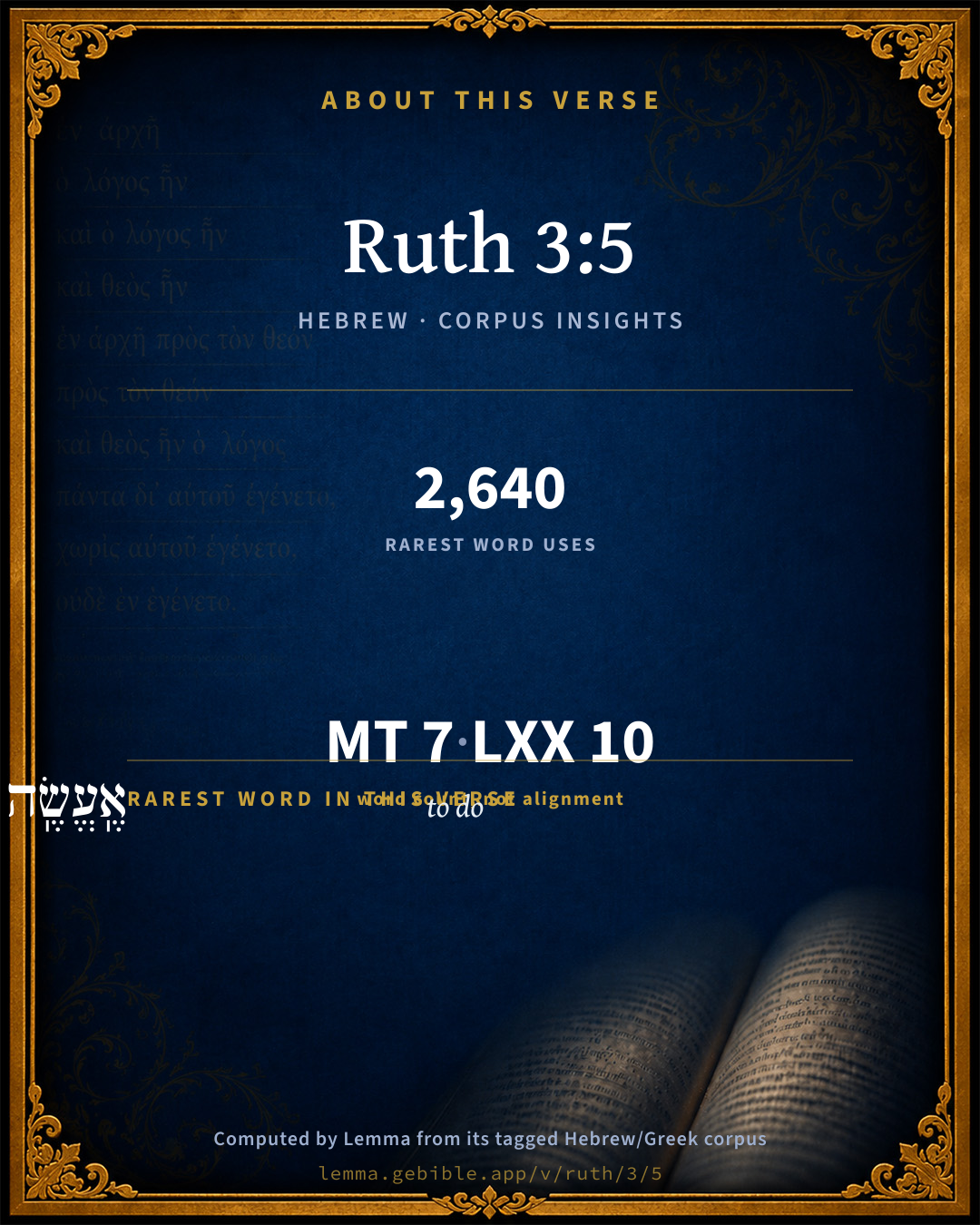
About this verse

These counts appear in no published source. They are computed here, from the morphology-tagged text and Lemma’s own curated glosses. What Lemma adds →

7
words
5
distinct lemmas
Historical
section

Grammatical profile

  • 3 verbs
  • 1 noun
  • 2 prepositions
  • 1 particle

Verb forms

  • וַתֹּ֖אמֶר Qal · Sequential Imperfect
  • תֹּאמְרִ֥י Qal · Imperfect
  • אֶֽעֱשֶֽׂה Qal · Imperfect

Repetition

Words recur within this verse — often emphatic in Hebrew:

  • וַתֹּ֖אמֶר to say H559 ×2
  • אֵלֶ֑יהָ to H413 ×2

Hebrew & Septuagint length

In English translation the verse runs 11 words from the Hebrew and 13 from the Septuagint (LXX English) — closely comparable.

A rough comparison of the two English renderings, which tokenize alike — not a word-level alignment.

Word counts can differ between the Hebrew and the Greek without any difference in meaning — e.g. the Hebrew direct-object marker אֵת has no separate Greek word, and Greek often adds the article ὁ.

In the original languages it is 7 Hebrew tokens and 10 Greek tokens — but the two are counted differently (Hebrew bundles its prefixes and suffixes into one token; the Greek is in lemma form), so that isn’t a like-for-like length.

Cross-references

2

Topical passages linked to Ruth 3:5 in the Treasury of Scripture Knowledge — connected by theme and wording, ordered by reader-vote popularity; previews shown in the World English Bible.

  • Colossians 3:20 Children, obey your parents in all things, for this pleases the Lord.
  • Ephesians 6:1 Children, obey your parents in the Lord, for this is right.

Cross-references courtesy of OpenBible.info (CC BY 4.0).

Hebrew and Greek witnesses Masoretic Hebrew ↔ Greek Septuagint

The same verse in the two great witnesses to the Old Testament, shown verse-for-verse.

These are two independent witnesses, not word-aligned to each other, and the Septuagint is shown in lemma (dictionary) form.

Hebrew Ruth 3:5 Masoretic · Westminster Leningrad Codex

וַתֹּ֖אמֶר אֵלֶ֑יהָ כֹּ֛ל אֲשֶׁר תֹּאמְרִ֥י אֵלַ֖י אֶֽעֱשֶֽׂה

She said to her, All that you say I will do.

World English Bible · Public Domain

Greek LXX Ruth 3:5 Septuagint · lemma form

εἶπον δέ ρουθ πρός αὐτός πᾶς ὅσος ἐάν εἶπον ποιέω

And Ruth said to her, All that you shall say, I will do.

LXX2012 (modern English Septuagint) · Public Domain

On this verse, The Pulpit Commentary discusses the Septuagint’s reading. Read the note in Commentary ↓

Hebrew: Westminster Leningrad Codex (CC BY 4.0). Greek: Septuagint (public domain); English from LXX2012 (modern English Septuagint) (Public Domain). How the Septuagint differs from the Hebrew →

Commentary

Notes on Ruth 3:5 from classic Christian and Jewish commentators (each source and its license shown beneath its notes). The classic Christian expositions comment on the surrounding passage and are grouped to its opening verse, so a note may address several verses; the Jewish commentaries on the Tanakh (Rashi and others) are per-verse, so they appear only where the commentator wrote on this verse.

Lemma curates 59 commentaries, every one of them public domain or Creative Commons licensed, each selected and text-cleaned for this edition rather than reprinted as found. About our sources →

Trapp's Complete Commentary

John Trapp

Rth 3:5 And she said unto her, All that thou sayest unto me I will do.

Ver. 5. All that thou sayest unto me I will do.] The respect Ruth bare to her mother-in-law, and the hope of a good husband, made her thus submissive. Lyra and Carthusian seem to blame the counsel of Naomi, though they excuse the fact of Ruth, because a stranger, and a new convert.

John Trapp, A Commentary or Exposition upon All the Books of the Old and New Testament (1647–1656) — public domain. Text from a community e-Sword module.

Ellicott's Commentary for English Readers

(5) I will do.—Ruth’s obedience here is an intelligent obedience. She knew in what relation Boaz stood for her family, and the duties attaching to the relationship (Rth_2:20; Rth_3:9). Thus with obedient trust, implicitly but not blindly, she follows her mother-in-law’s orders; strong in conscious innocence she risks the obloquy that may attend her duty.

A Bible Commentary for English Readers, edited by Charles John Ellicott (1878–1897) — public domain. Text from a community e-Sword module.

John Gill's Exposition

And she said unto her,.... Having the highest opinion of her piety and prudence, and being confident she would never advise her to what was contrary to true religion and virtue:

all that thou sayest unto me I will do; observe every instruction and direction she gave her, and attend strictly to every circumstance pointed out to her, as she did; the word for "unto me" is one of those instances, the Masora observes, is not written but read; the letters of the word are not in the text, only the vowel points, the reason of which cannot well be said; what the Midrash (q) gives can never satisfy.

(q) Midrash Ruth, ut supra. (fol. 33. 3.)

John Gill's Exposition of the Whole Bible (1746–1763) — public domain (CC PDM 1.0). Text via the HelloAO Bible API.

Matthew Poole's English Annotations

The confidence she had in Naomi’s wisdom and piety, and true love to her, made her ready to follow her advice, wherein she was the more excusable, because she did not understand the laws and customs of the country, as Naomi did.

Matthew Poole's English Annotations on the Holy Bible (1683–1685) — public domain. Text from a community e-Sword/MySword module.

The Pulpit Commentary

And she said, All that thou sayest I will do. There is no need for adopting into the text the K"ri to me," after the expression, All that thou sayest." It is a mere "tittle," indeed, whether we omit or insert the pronoun; yet it was not found in the manuscripts that lay before the Septuagint and Vulgate translators.

Ruth"s confidence in Naomi"s kindness and wisdom is noteworthy. It was no upstart prepossession and blindfold feeling. Naomi had earned it by a long-continued course of prudence and sympathy. Boaz too had earned a corresponding confidence, and hence she did not hesitate to entrust herself to his honor. She felt that she was safe.

Vers. 5, 6. Filial obedience.

Ruth was not Naomi"s daughter, yet she acted, and with good reason and great propriety, as though she had been such. What holds good, therefore, of the relationship described in this book holds good, a fortiori, of the relation between parents and children. In modern society the bonds of parental discipline are, especially among the working class, lamentably relaxed. Christian people should, in the interests alike of patriotism and religion, do all they can to strengthen these bonds. The text affords us a beautiful example of filial obedience.

I MOTIVES to filial obedience. Gratitude should lead the child to obey the parent, to whom he owes so very much. The constraint should be the sweet constraint of love. Reason should lead to the reflection The parent has experience of human life, in which I am necessarily lacking; is not a parent"s judgment far more likely to be sound than is a child"s, or even a youth"s? Divine legislation commands children to obey their parents.

E.g. the fifth commandment, under the old covenant; apostolical admonitions, under the new. The example of the Holy Child, Jesus!

II The ADVANTAGES of filial obedience. Usually, obvious temporal advantages ensue upon such a course. This is proverbial and unquestionable. The satisfaction of a good conscience is a compensation not to be despised for any sacrifice of personal feeling in this matter. The approval of God is most emphatically pronounced upon those who honor and obey their parents. And this is usually followed by the confidence and admiration of fellow-men.

Lessons:

1. Expostulate with the disobedient.

2. Encourage the obedient. T.

The Pulpit Commentary (1880–1919), ed. H.D.M. Spence-Jones & Joseph S. Exell — public domain. Text from a community e-Sword module.

Lesson kit

Teaching starters — assembled from the data on this page, not authored interpretation. Every prompt links to the verse data it draws on. Edit before teaching.

Ruth, in the Historical, opens this verse with 7 words (5 distinct Hebrew lemmas). Its most distinctive word is ʻâsâh (“to do”). A historical commentator’s framing appears above. Read the whole chapter for the surrounding context.

Discussion questions

  1. What does “to do” (ʻâsâh) contribute to the verse as a whole?
  2. How does Colossians 3:20, which shares this passage’s theme, read alongside this verse?
  3. What does the repetition of “to say” (2× in this one verse) do in this verse?
  4. These translations render this verse differently. What is at stake in choosing one wording over another?
  5. «וַתֹּ֖אמֶר» is a Qal Sequential Imperfect verb. How does that grammatical form shape the action described?
  6. Compare how Trapp's Complete Commentary and Ellicott's Commentary for English Readers read this verse. Where do they agree or differ?

Things to notice

Reading settings

Reading text

Shown beneath each verse's original-language words.

Old Testament
Old Testament edition

Read the OT as the Masoretic Hebrew (MT) or the Greek Septuagint (LXX).

English shown for the Greek Septuagint (in the Hebrew ↔ Greek comparison).

Comparing translations? Open the Compare panel on any verse page to stack up to four side by side.