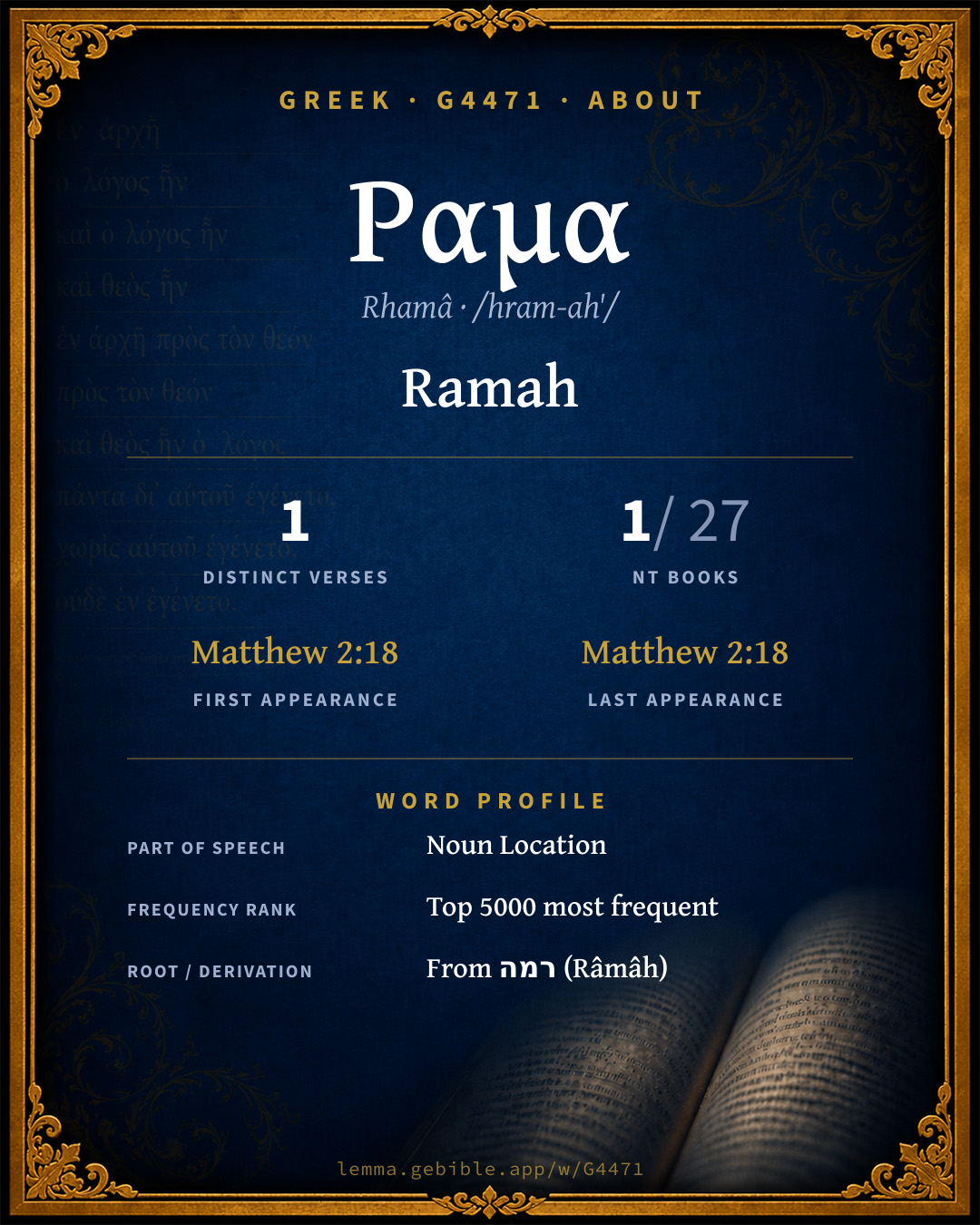
Ῥαμᾶ
Ramah
Thayer's lists 2 entries for ‘Ramah’ fuller range ↓
Full lexicon entry — Thayer's Greek Lexicon
From Thayer's Greek Lexicon
Where this word appears
Every verse where G4471 appears — 1 distinct verse across 1 book. Click any verse to open its interlinear word-by-word view. Verse text shown in the World English Bible for context — . Each verse’s Greek form is shown with its reference; the English is not keyword-highlighted, since the data carries no word-level English alignment. Use “Compare translations” on any verse to read it across multiple English versions. This concordance covers the Greek New Testament; Septuagint (Greek Old Testament) occurrences of this word are not indexed here.
Matthew 1 verse
About this entry
At a glance — auto-summarized from this page’s data, not written by a person. Every figure links to its source below. This summary describes the numbers; it doesn’t interpret them.
The Greek name Ραμα centers on the idea of “Ramah.” It is rare — just 1 verse in the entire Greek New Testament. The word gravitates to Matthew (100%). It occurs only once, in Matthew 2:18. For the data behind this summary, explore 1-verse concordance and the renderings breakdown below.
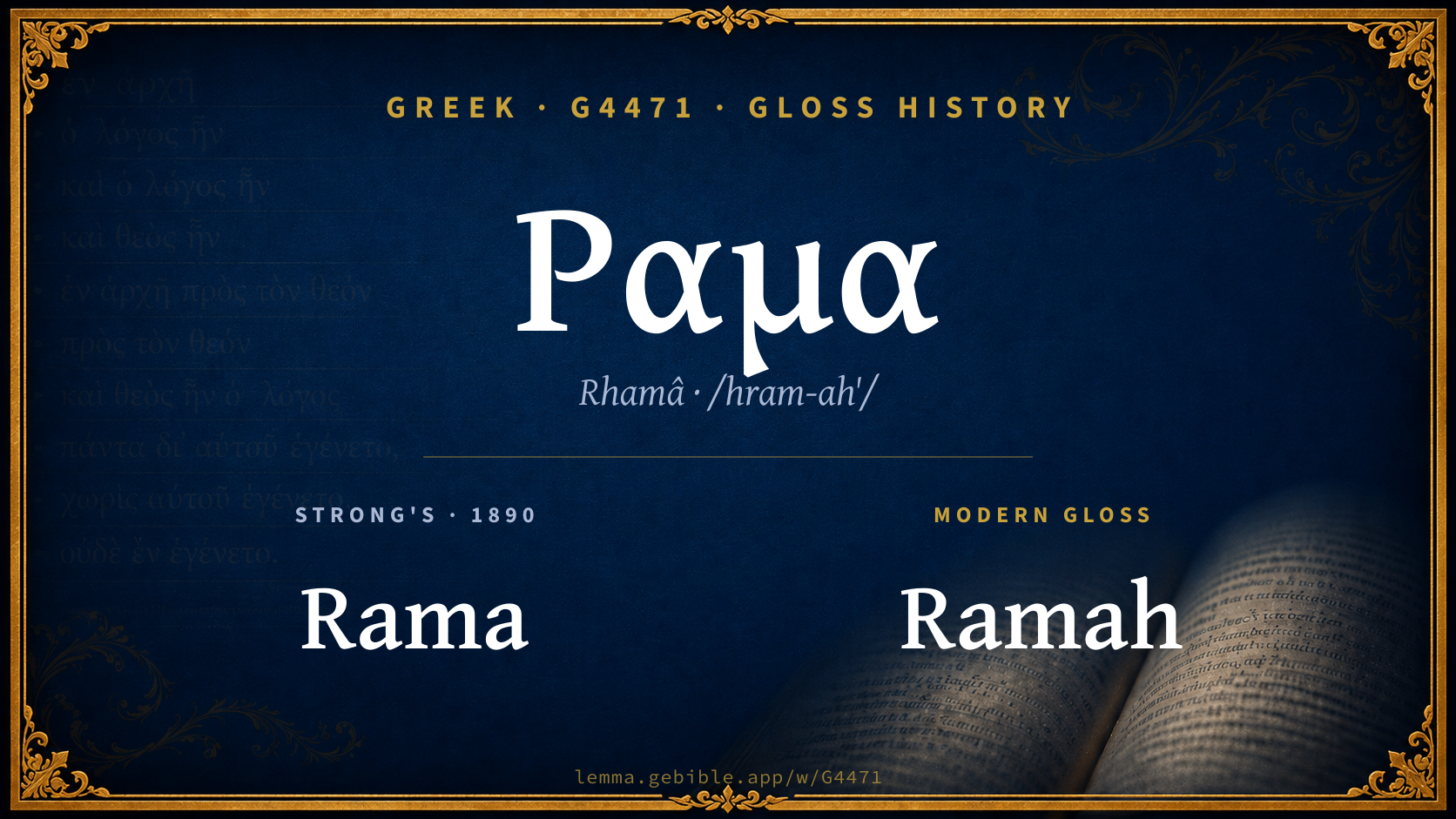
Gloss history
Strong's 1890 vs modern scholarship
About this word
Strong's G4471 catalogs a Greek word from the Greek New Testament.
These counts are not copied from any lexicon or concordance. They are computed here, from the morphology-tagged Greek New Testament. What Lemma adds →
- 1
- distinct verses
- The word appears in 1 distinct verse.
- 1 / 27
- NT books
- The word appears in 1 of 27 New Testament books.
- #3,503
- by frequency
- Top 5000 most frequent Greek words (rank 3,503 of 5,347 Greek words by occurrence).
View all 1 occurrence in the concordance →
Most concentrated in
- Matthew 1 verse 100%
By section of the New Testament
By traditional corpus
Conventional, traditional groupings — biblical authorship is debated, so this is a traditional corpus grouping, not an authorship claim. Some books belong to more than one corpus (Luke is in both the Gospels and the Lukan corpus, and so on), so these shares overlap and need not total 100%. Each figure is a share of the word’s 1 distinct verse.
- Gospels 1 verse · 100%
How translations render this word
Counts come from each version’s own published word-to-Strong’s tagging or interlinear alignment — an approximate guide to how each version renders this word, not a word-level alignment the data otherwise carries. Because each total is that version’s own tagged count, the per-version totals vary from one another and need not match the appearance or distinct-verse counts above. These counts may also differ from a printed concordance because Lemma counts each distinctly tagged rendering and does not collapse phrase taggings into a single head-word total. This is a fixed set of word-tagged versions (KJV, ASV, BSB, ULT) and does not change with the reading translation you choose elsewhere. Each version’s license is shown beside its name below (and on Sources).
- King James Version: Rama 1×
- American Standard Version: Ramah 1×
- Berean Standard Bible: Ramah 1×
- unfoldingWord Literal Text: Ramah 1×
King James Version Public Domain
Renders G4471 across 1 tagged occurrence — most commonly:
American Standard Version Public Domain
Renders G4471 across 1 tagged occurrence — most commonly:
Berean Standard Bible Public Domain
Renders G4471 across 1 tagged occurrence — most commonly:
unfoldingWord Literal Text CC BY-SA 4.0
Renders G4471 across 1 tagged occurrence — most commonly:
Senses in Thayer's
The 2 senses Thayer's distinguishes for this word, in lexicon order (not ranked by frequency or importance). The full entry — with sub-senses — is in the Lexicon Entry tab.
- Ramah = "a hill"
- a town of the tribe of Benjamin, situated about 5 miles (8 km) north of Jerusalem on the road to Bethel
Word origin
Derived from רמה (Râmâh) (H7414) — Ramah.
Of hebrew origin [ H7414 ]; Rama (that is Ramah ) a place in Palestine : - Rama.
— Strong’s Exhaustive Concordance (1890), public domain.
Same root — word family
Other Thayer's entries built from the same root as G4471, grouped by Strong’s listed origin. These share a root / origin per the lexicon — not necessarily a shared meaning. Each links to that word’s own entry.
Derives from
Proper names from this root
People and places named from this root — a name, not an additional meaning of the word.
Compare all same-root words → 3 of the same-root words are proper names (people or places). They share a root, not necessarily a meaning.
Bible dictionary
Public-domain dictionary articles matched to this entry by name (Ramah). A biblical name can be shared by more than one person or place, so an article may treat several.
Smith's Bible Dictionary · William Smith, 1863
(a hill). This is the name of several places in the holy land.
+ One of the cities of the allotment of Benjamin. (Joshua 18:25) Its site is at er-Ram, about five miles from Jerusalem, and near to Gibeah. (Judges 4:5; 19:13; 1 Samuel 22:6) Its people returned after the captivity. (Ezra 2:26; Nehemiah 7:30) + The home of Elkanah, Samuel's father, (1 Samuel 1:19; 2:11) the birthplace of Samuel himself, his home and official residence, the site of his altar ch. (1 Samuel 7:17; 8:4; 15:34; 16:13; 19:18) and finally his burial-place, ch. (1 Samuel 25:1; 28:3) It is a contracted form of Ramathaim-zophim. All that is directly said as to its situation is that it was in Mount Ephraim, (1 Samuel 1:1) a district without defined boundaries, The position of Ramah is a much-disputed question. Tradition, however places the residence of Samuel on the lofty and remarkable eminence of Neby Samwil which rises four miles to the northwest of Jerusalem. Since the days of Arcult the tradition appears to have been continuous. Here, then, we are inclined in the present state of the evidence, to place the Ramah of Samuel. + One of the nineteen fortified places of Naphtali. (Joshua 19:36) Dr. Robinson has discovered a Rameh northwest of the Sea of Galilee, about 8 miles east-south-east of Safed. + One of the landmarks on the boundary of Asher, (Joshua 19:29) apparently between Tyre and Zidon. Some place it 3 miles east of Tyre, others 10 miles off and east-southeast of the same city. + By this name in (2 Kings 8:29) and 2Chr 22:6 only, is designated Ramoth-gilead. + A place mentioned in the catalogue of those reinhabited by the Benjamites after their return from the captivity. (Nehemiah 11:33)
Hitchcock's Bible Names Dictionary · Roswell D. Hitchcock, 1869
same as Ram
Classic public-domain reference works; full attribution on Sources.
Septuagint usage
The same Greek word Ραμα appears 25 times in the Greek Old Testament (Septuagint), across 24 verses in 9 books.
- 25
- LXX occurrences
- Tagged occurrences of this Greek word in the Septuagint.
- 24
- verses
- Distinct Septuagint verses containing this word.
- 9 / 39
- OT books
- The word appears in 9 of the 39 Old Testament books.
Sample Septuagint occurrences
- Joshua 18:25 ραμα
- Judges 4:5 ραμα
- 1 Samuel 19:18 ραμα
- 1 Kings 15:17 ραμα
- 1 Chronicles 27:27 ραμα
- 2 Chronicles 16:1 ραμα
- Isaiah 10:29 ραμα
- Jeremiah 38:15 ραμα
- Zechariah 14:10 ραμα
Septuagint occurrences (same lexeme)
Every verse where the same Strong’s number (G4471) appears in the Greek Septuagint. Verse text shown in the World English Bible for context; the Greek form is the matched word — the English is not keyword-highlighted.
- Joshua 18:25 ραμα Gibeon, and Ramah, and Beeroth,
- Joshua 19:29 ραμα and the border turned to Ramah, and to the fortified city of Tyre; and the border turned to Hosah; and the goings out of it were at the sea by the region of Achzib;
- Judges 4:5 ραμα She lived under the palm tree of Deborah between Ramah and Bethel in the hill-country of Ephraim: and the children of Israel came up to her for judgment.
- Judges 19:13 ραμα He said to his servant, Come and let us draw near to one of these places; and we will lodge in Gibeah, or in Ramah.
- 1 Samuel 19:18 ραμα Now David fled, and escaped, and came to Samuel to Ramah, and told him all that Saul had done to him. He and Samuel went and lived in Naioth.
- 1 Samuel 19:19 ραμα It was told Saul, saying, Behold, David is at Naioth in Ramah.
- 1 Samuel 19:22 ραμα Then went he also to Ramah, and came to the great well that is in Secu: and he asked and said, Where are Samuel and David? One said, Behold, they are at Naioth in Ramah.
- 1 Samuel 19:23 ραμα He went there to Naioth in Ramah: and the Spirit of God came on him also, and he went on, and prophesied, until he came to Naioth in Ramah.
- 1 Samuel 20:1 ραμα David fled from Naioth in Ramah, and came and said before Jonathan, "What have I done? What is my iniquity?" and "What is my sin before your father, that he seeks my life?"
- 1 Samuel 22:6 ραμα Saul heard that David was discovered, and the men who were with him: now Saul was sitting in Gibeah, under the tamarisk tree in Ramah, with his spear in his hand, and all his servants were standing about him.
- 1 Samuel 30:27 ραμα To those who were in Bethel, and to those who were in Ramoth of the South, and to those who were in Jattir,
- 1 Kings 15:17 ραμα Baasha king of Israel went up against Judah, and built Ramah, that he might not allow anyone to go out or come in to Asa king of Judah.
- 1 Kings 15:21 ραμα It happened, when Baasha heard of it, that he left off building Ramah, and lived in Tirzah.
- 1 Kings 15:22 ραμα Then king Asa made a proclamation to all Judah; none was exempted: and they carried away the stones of Ramah, and the timber of it, with which Baasha had built; and king Asa built therewith Geba of Benjamin, and Mizpah.
- 1 Chronicles 27:27 ραμα and over the vineyards was Shimei the Ramathite: and over the increase of the vineyards for the wine-cellars was Zabdi the Shiphmite:
- 2 Chronicles 16:1 ραμα In the six and thirtieth year of the reign of Asa, Baasha king of Israel went up against Judah, and built Ramah, that he might not allow anyone to go out or come in to Asa king of Judah.
- 2 Chronicles 16:5 ραμα It happened, when Baasha heard of it, that he left off building Ramah, and let his work cease.
- 2 Chronicles 16:6 ραμα Then Asa the king took all Judah; and they carried away the stones of Ramah, and the timber of it, with which Baasha had built; and he built therewith Geba and Mizpah.
- 2 Chronicles 22:5 ραμα He walked also after their counsel, and went with Jehoram the son of Ahab king of Israel to war against Hazael king of Syria at Ramoth-gilead: and the Syrians wounded Joram.
- 2 Chronicles 22:6 ραμα He returned to be healed in Jezreel of the wounds which they had given him at Ramah, when he fought against Hazael king of Syria. Azariah the son of Jehoram king of Judah went down to see Jehoram the son of Ahab in Jezreel, because he was sick.
- 2 Chronicles 36:5 ραμα Jehoiakim was Twenty-five years old when he began to reign; and he reigned eleven years in Jerusalem: and he did that which was evil in the sight of Yahweh his God.
- Isaiah 10:29 ραμα they are gone over the pass; they have taken up their lodging at Geba; Ramah trembles; Gibeah of Saul is fled.
- Jeremiah 38:15 ραμα Then Jeremiah said to Zedekiah, If I declare it to you, will you not surely put me to death? and if I give you counsel, you will not listen to me.
- Zechariah 14:10 ραμα All the land will be made like the Arabah, from Geba to Rimmon south of Jerusalem; and she will be lifted up, and will dwell in her place, from Benjamin's gate to the place of the first gate, to the corner gate, and from the tower of Hananel to the king's wine-presses.
These are occurrences of the same Greek lexeme (G4471) in the Septuagint — not a translation of any one Hebrew word. The store carries no word-level Hebrew↔Greek alignment, so no Hebrew original is asserted here. Counts come from the recovered LXX Strong's tagging — high-frequency vocabulary is well covered, while rare or late forms may be untagged — so they reflect tagged occurrences and may slightly undercount.