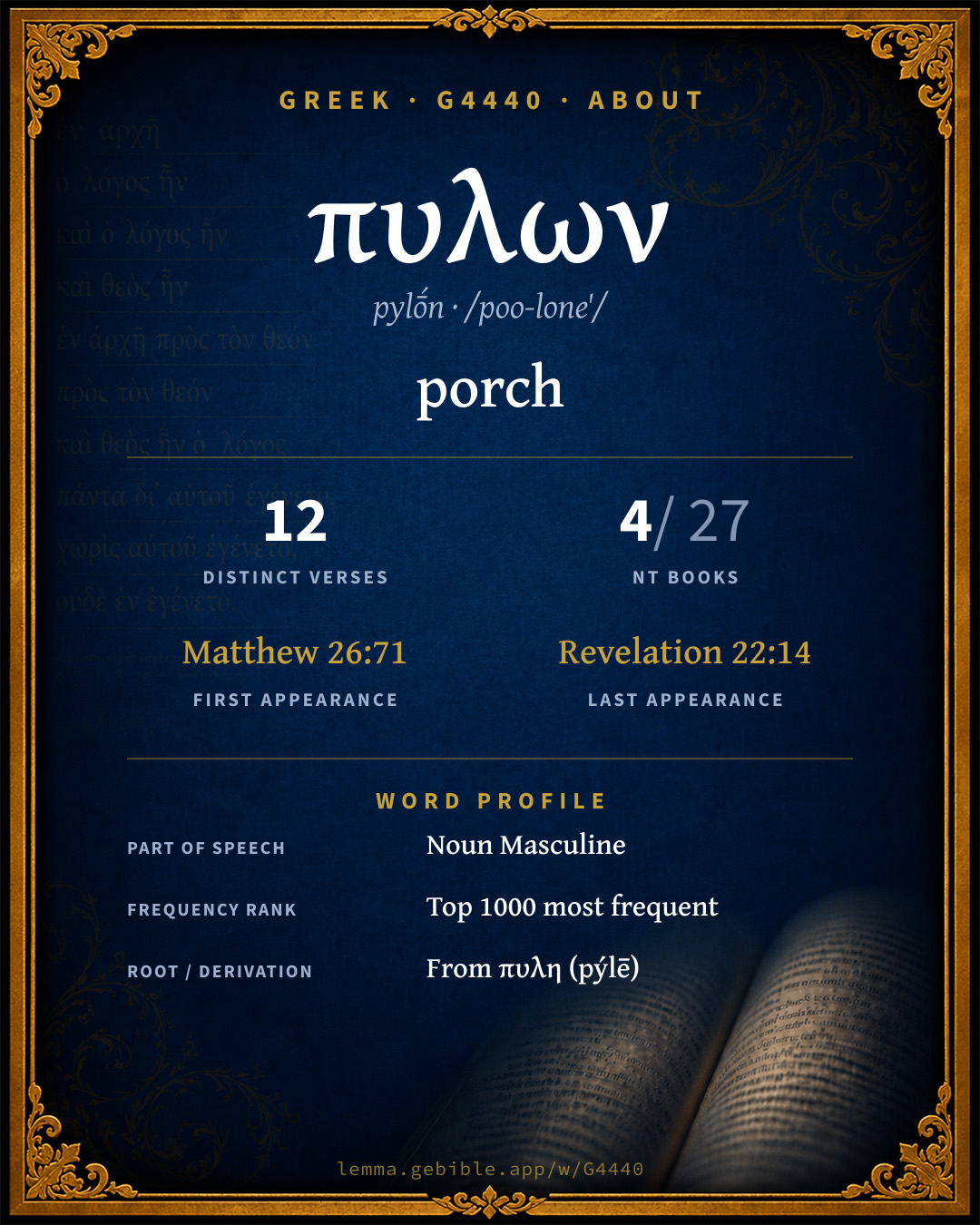
πυλών
porch
‘porch’ is one of 2 main senses fuller range ↓
Full lexicon entry — Thayer's Greek Lexicon
From Thayer's Greek Lexicon
Where this word appears
See every Accusative-case word in the Greek New Testament →
Grammar key — what these labels mean
Part of speech
- Noun
- A naming word — a person, place, thing, or idea.
Case
- Nominative
- The case of the subject (and the predicate nominative).
- Accusative
- The case of the direct object and of extent.
- Dative
- The case of the indirect object, means, or location — “to / for / with / in.”
- Genitive
- The case of source, possession, or “of” — answers “whose / from what.”
Gender
- Masculine
- Grammatically masculine.
Number
- Plural
- More than one.
- Singular
- One.
3 distinct verses where G4440 appears in the Genitive case, across 2 books. Filtered view — show all forms. Click any verse to open its interlinear word-by-word view. Verse text shown in the World English Bible for context — . Each verse’s Greek form is shown with its reference; the English is not keyword-highlighted, since the data carries no word-level English alignment. Use “Compare translations” on any verse to read it across multiple English versions. This concordance covers the Greek New Testament; Septuagint (Greek Old Testament) occurrences of this word are not indexed here.
Acts 2 verses
- Acts 12:13 πυλῶνος n gen sg masc When Peter knocked at the door of the gate, a maid named Rhoda came to answer.
- Acts 12:14 πυλῶνα πυλῶνος n acc sg masc n gen sg masc When she recognized Peter's voice, she didn't open the gate for joy, but ran in, and reported that Peter was standing in front of the gate.
Revelation 1 verse
About this entry
At a glance — auto-summarized from this page’s data, not written by a person. Every figure links to its source below. This summary describes the numbers; it doesn’t interpret them.
“porch” is the headline sense of the Greek noun πυλων (pylṓn). It clusters heavily in Revelation, which alone accounts for 50% of its uses. It turns up in 12 verses across 4 books, an uncommon footprint. Its earliest occurrence is Matthew 26:71. Lexicons map it across 2 senses. The sections below give every sense, occurrence, and version rendering.
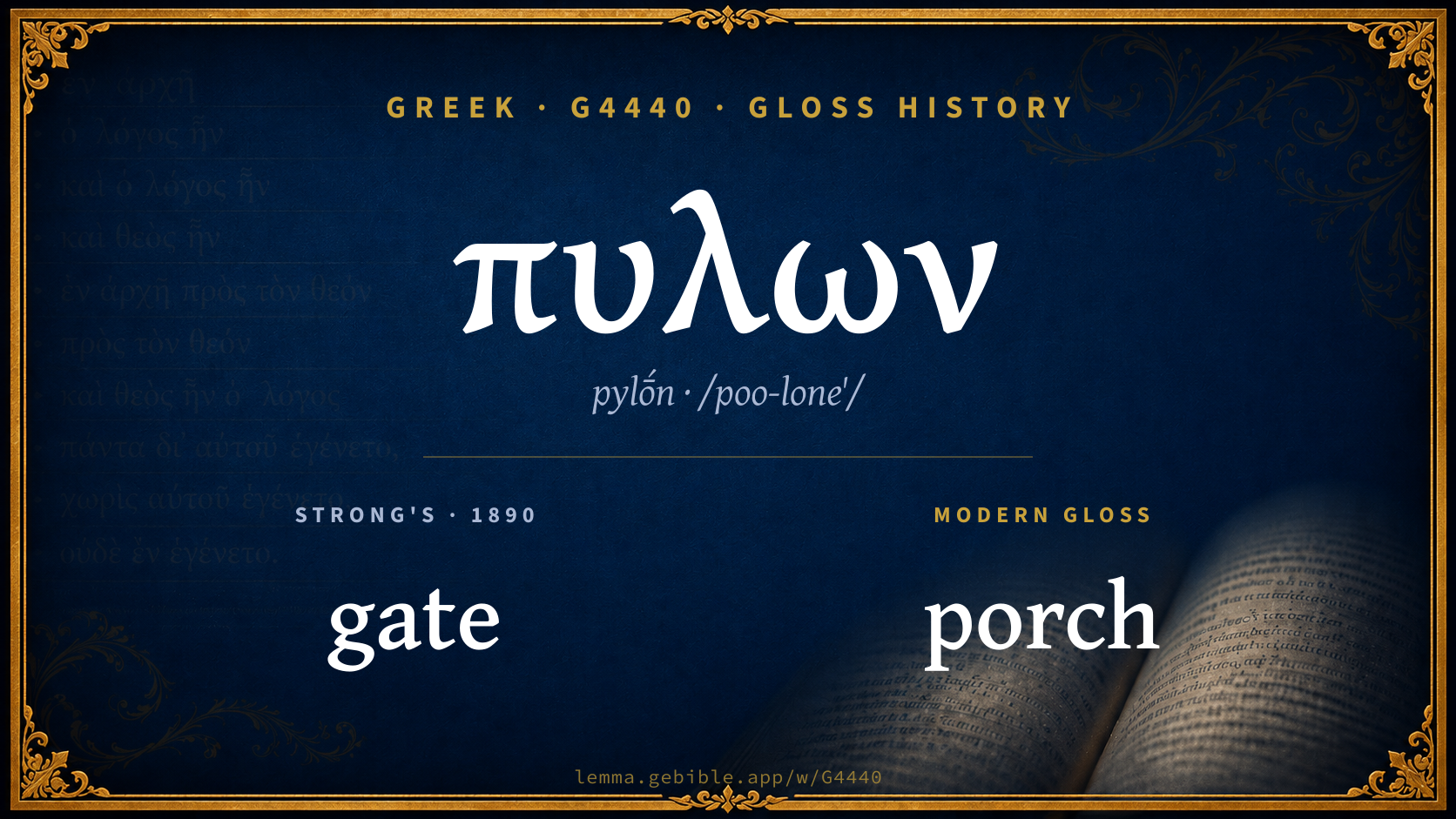
Gloss history
Strong's 1890 vs modern scholarship
About this word
Strong's G4440 catalogs a Greek word from the Greek New Testament.
These counts are not copied from any lexicon or concordance. They are computed here, from the morphology-tagged Greek New Testament. What Lemma adds →
- 12
- distinct verses
- The word appears in 12 distinct verses.
- 4 / 27
- NT books
- The word appears in 4 of 27 New Testament books.
- #664
- by frequency
- Top 1000 most frequent Greek words (rank 664 of 5,347 Greek words by occurrence).
View all 12 occurrences in the concordance →
Most concentrated in
- Revelation 6 verses 50%
- Acts 4 verses 33%
- Matthew 1 verse 8%
By section of the New Testament
By traditional corpus
Conventional, traditional groupings — biblical authorship is debated, so this is a traditional corpus grouping, not an authorship claim. Some books belong to more than one corpus (Luke is in both the Gospels and the Lukan corpus, and so on), so these shares overlap and need not total 100%. Each figure is a share of the word’s 12 distinct verses.
- Johannine 6 verses · 50%
- Revelation 6 verses · 50%
- Lukan (Luke–Acts) 5 verses · 42%
- Gospels 2 verses · 17%
How translations render this word
Counts come from each version’s own published word-to-Strong’s tagging or interlinear alignment — an approximate guide to how each version renders this word, not a word-level alignment the data otherwise carries. Because each total is that version’s own tagged count, the per-version totals vary from one another and need not match the appearance or distinct-verse counts above. These counts may also differ from a printed concordance because Lemma counts each distinctly tagged rendering and does not collapse phrase taggings into a single head-word total. This is a fixed set of word-tagged versions (KJV, ASV, BSB, ULT) and does not change with the reading translation you choose elsewhere. Each version’s license is shown beside its name below (and on Sources).
- King James Version: Gates 10×, Gate 6×
- American Standard Version: Gates 12×, Gate 5×
- Berean Standard Bible: Gates 8×, Gate 5×
- unfoldingWord Literal Text: Gates 12×, Gate 5×, Were 4×
King James Version Public Domain
Renders G4440 across 18 tagged occurrences — most commonly:
Plus 2 renderings that appear only once — usually multi-word phrases or single function words the recovered tagging swept in, not distinct renderings.
American Standard Version Public Domain
Renders G4440 across 18 tagged occurrences — most commonly:
Plus 1 rendering that appears only once — usually multi-word phrases or single function words the recovered tagging swept in, not distinct renderings.
Berean Standard Bible Public Domain
Renders G4440 across 15 tagged occurrences — most commonly:
Plus 2 renderings that appear only once — usually multi-word phrases or single function words the recovered tagging swept in, not distinct renderings. Not rendered by a distinct English word in 3 further occurrences.
unfoldingWord Literal Text CC BY-SA 4.0
Renders G4440 across 22 tagged occurrences — most commonly:
Plus 1 rendering that appears only once — usually multi-word phrases or single function words the recovered tagging swept in, not distinct renderings.
Senses in Thayer's
The 2 senses Thayer's distinguishes for this word, in lexicon order (not ranked by frequency or importance). The full entry — with sub-senses — is in the Lexicon Entry tab.
- a large gate: of a palace
- the front part of a house, into which one enters through the gate, porch
Word origin
Derived from πυλη (pýlē) (G4439) — gate.
From G4439 ; a gateway door way or a building or city; by implication a portal or vestibule : - gate porch.
— Strong’s Exhaustive Concordance (1890), public domain.
Forms in the corpus
The 6 distinct written forms G4440 takes in the Greek New Testament, most frequent first — each parse links to that case’s occurrences in the concordance.
| Form | Parsing | Example | Uses |
|---|---|---|---|
| πυλῶνες pylō̂nes | Noun, Nominative, Plural, Masculine | Revelation 21:13 | 6 |
| πυλῶνα pylō̂na | Noun, Accusative, Singular, Masculine | Matthew 26:71 | 4 |
| πυλῶνας pylō̂nas | Noun, Accusative, Plural, Masculine | Acts 14:13 | 3 |
| πυλῶνος pylō̂nos | Noun, Genitive, Singular, Masculine | Acts 12:13 | 2 |
| πυλῶσιν pylō̂sin | Noun, Dative, Plural, Masculine | Revelation 21:12 | 2 |
| πυλώνων pylṓnōn | Noun, Genitive, Plural, Masculine | Revelation 21:21 | 1 |
Septuagint usage
The same Greek word πυλων appears 19 times in the Greek Old Testament (Septuagint), across 16 verses in 7 books.
- 19
- LXX occurrences
- Tagged occurrences of this Greek word in the Septuagint.
- 16
- verses
- Distinct Septuagint verses containing this word.
- 7 / 39
- OT books
- The word appears in 7 of the 39 Old Testament books.
Sample Septuagint occurrences
- Genesis 43:19 πυλών
- 1 Kings 6:8 πυλών
- 2 Kings 10:9 πυλών
- 1 Chronicles 19:9 πυλών
- 2 Chronicles 3:7 πυλών
- Ezekiel 33:30 πυλών
- Zephaniah 2:14 πυλών
Septuagint occurrences (same lexeme)
Every verse where the same Strong’s number (G4440) appears in the Greek Septuagint. Verse text shown in the World English Bible for context; the Greek form is the matched word — the English is not keyword-highlighted.
- Genesis 43:19 πυλών They came near to the steward of Joseph's house, and they spoke to him at the door of the house,
- 1 Kings 6:8 πυλών The door for the middle side-chambers was in the right side of the house: and they went up by winding stairs into the middle [story], and out of the middle into the third.
- 1 Kings 6:33 πυλών So also made he for the entrance of the temple door-posts of olive-wood, out of a fourth part [of the wall];
- 1 Kings 14:7 πυλών Go, tell Jeroboam, Thus says Yahweh, the God of Israel: Because I exalted you from among the people, and made you prince over my people Israel,
- 1 Kings 17:10 πυλών So he arose and went to Zarephath; and when he came to the gate of the city, behold, a widow was there gathering sticks: and he called to her, and said, Please get me a little water in a vessel, that I may drink.
- 2 Kings 10:9 πυλών It happened in the morning, that he went out, and stood, and said to all the people, You are righteous: behold, I conspired against my master, and killed him; but who struck all these?
- 2 Kings 11:5 πυλών He commanded them, saying, This is the thing that you shall do: a third part of you, who come in on the Sabbath, shall be keepers of the watch of the king's house;
- 1 Chronicles 19:9 πυλών The children of Ammon came out, and put the battle in array at the gate of the city: and the kings who had come were by themselves in the field.
- 1 Chronicles 26:13 πυλών They cast lots, the small as well as the great, according to their fathers' houses, for every gate.
- 2 Chronicles 3:7 πυλών He overlaid also the house, the beams, the thresholds, and the walls of it, and the doors of it, with gold; and engraved cherubim on the walls.
- 2 Chronicles 12:10 πυλών King Rehoboam made in their place shields of brass, and committed them to the hands of the captains of the guard, who kept the door of the king's house.
- Ezekiel 33:30 πυλών As for you, son of man, the children of your people talk of you by the walls and in the doors of the houses, and speak one to another, everyone to his brother, saying, Please come and hear what is the word that comes forth from Yahweh.
- Ezekiel 40:9 πυλών Then measured he the porch of the gate, eight cubits; and the posts of it, two cubits; and the porch of the gate was toward the house.
- Ezekiel 40:11 πυλών He measured the breadth of the opening of the gate, ten cubits; and the length of the gate, thirteen cubits;
- Ezekiel 41:2 πυλών The breadth of the entrance was ten cubits; and the sides of the entrance were five cubits on the one side, and five cubits on the other side: and he measured the length of it, forty cubits, and the breadth, twenty cubits.
- Zephaniah 2:14 πυλών Herds will lie down in the midst of her, all the animals of the nations. Both the pelican and the porcupine will lodge in its capitals. Their calls will echo through the windows. Desolation will be in the thresholds, for he has laid bare the cedar beams.
These are occurrences of the same Greek lexeme (G4440) in the Septuagint — not a translation of any one Hebrew word. The store carries no word-level Hebrew↔Greek alignment, so no Hebrew original is asserted here. Counts come from the recovered LXX Strong's tagging — high-frequency vocabulary is well covered, while rare or late forms may be untagged — so they reflect tagged occurrences and may slightly undercount.