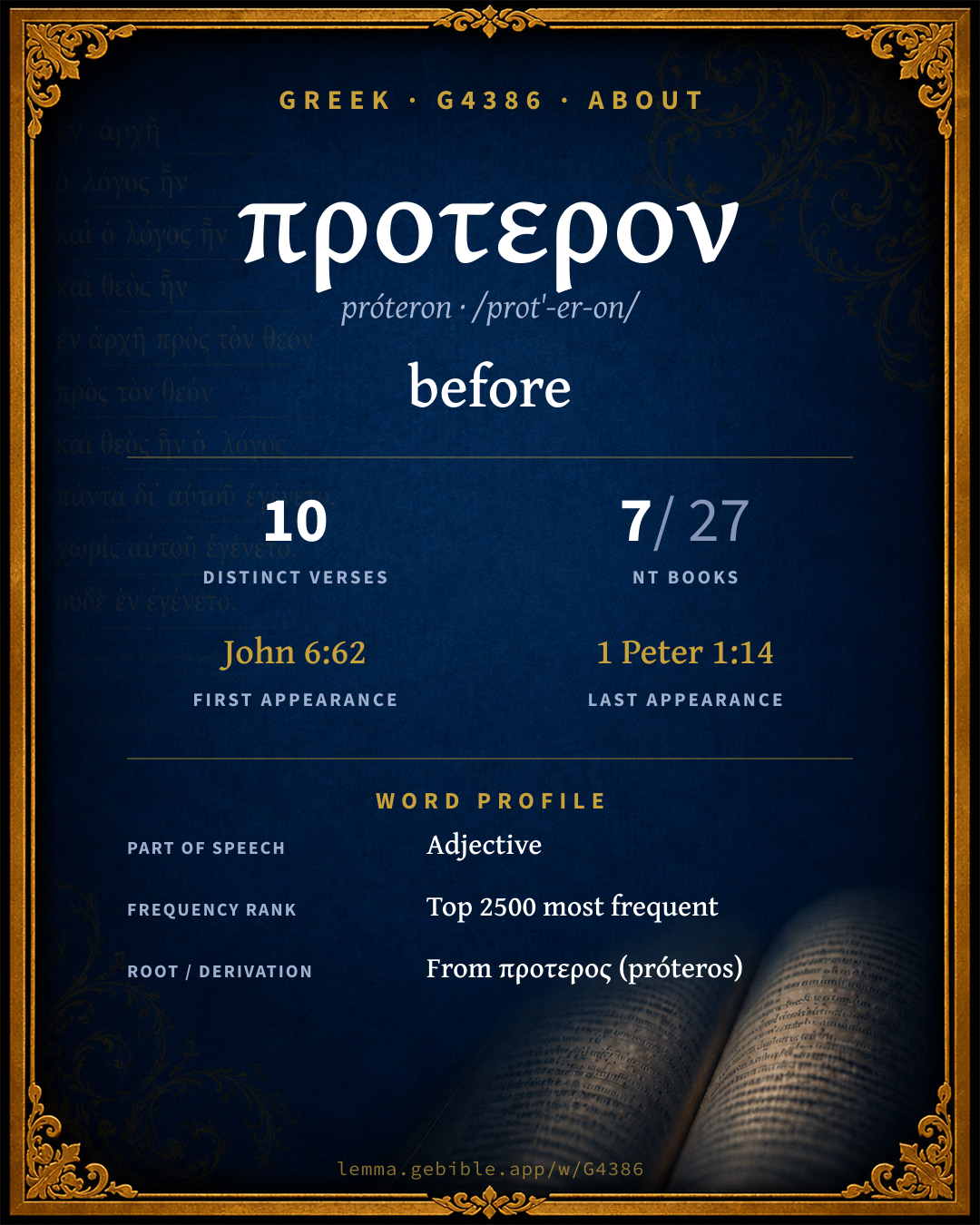
πρότερον
before
Full lexicon entry — Thayer's Greek Lexicon
From Thayer's Greek Lexicon
Where this word appears
Grammar key — what these labels mean
Part of speech
- Adverb
- A word that modifies a verb, adjective, or other adverb.
- Adjective
- A word that describes or qualifies a noun.
Case
- Accusative
- The case of the direct object and of extent.
Gender
- Feminine
- Grammatically feminine.
Number
- Singular
- One.
Degree
- Comparative
- Expresses a greater degree (“greater,” “more”).
Grammatical forms
- Adverb, Comparative 9 times (90%)
- Adjective, Accusative, Singular, Feminine, Comparative 1 time (10%)
Parsed forms decoded from the imported morphology (Robinson–Tischendorf, public domain), counted across 10 parsed occurrences — not distinct verses.
Every verse where G4386 appears — 10 distinct verses across 7 books. Click any verse to open its interlinear word-by-word view. Verse text shown in the World English Bible for context — . Each verse’s Greek form is shown with its reference; the English is not keyword-highlighted, since the data carries no word-level English alignment. Use “Compare translations” on any verse to read it across multiple English versions. This concordance covers the Greek New Testament; Septuagint (Greek Old Testament) occurrences of this word are not indexed here.
John 2 verses
2 Corinthians 1 verse
Galatians 1 verse
Ephesians 1 verse
1 Timothy 1 verse
Hebrews 3 verses
- Hebrews 4:6 πρότερον adv comp Seeing therefore it remains that some should enter therein, and they to whom the good news was before preached failed to enter in because of disobedience,
- Hebrews 7:27 πρότερον adv comp who doesn't need, like those high priests, to daily offer up sacrifices, first for his own sins, and then for the sins of the people. For this he did once for all, when he offered up himself.
- Hebrews 10:32 πρότερον adv comp But remember the former days, in which, after you were enlightened, you endured a great struggle with sufferings;
1 Peter 1 verse
About this entry
At a glance — auto-summarized from this page’s data, not written by a person. Every figure links to its source below. This summary describes the numbers; it doesn’t interpret them.
The Greek adjective προτερον centers on the idea of “before.” Its earliest occurrence is John 6:62. It turns up in 10 verses across 7 books, an uncommon footprint. The word gravitates to Hebrews (30%), then John and 2 Corinthians. Dig into 10-verse concordance and the renderings breakdown below.
Gloss history
Strong's 1890 vs modern scholarship
About this word
Strong's G4386 catalogs a Greek word from the Greek New Testament.
These counts are not copied from any lexicon or concordance. They are computed here, from the morphology-tagged Greek New Testament. What Lemma adds →
- 10
- distinct verses
- The word appears in 10 distinct verses.
- 7 / 27
- NT books
- The word appears in 7 of 27 New Testament books.
- #1,056
- by frequency
- Top 2500 most frequent Greek words (rank 1,056 of 5,347 Greek words by occurrence).
View all 10 occurrences in the concordance →
Most concentrated in
- Hebrews 3 verses 30%
- John 2 verses 20%
- 2 Corinthians 1 verse 10%
By section of the New Testament
By traditional corpus
Conventional, traditional groupings — biblical authorship is debated, so this is a traditional corpus grouping, not an authorship claim. Some books belong to more than one corpus (Luke is in both the Gospels and the Lukan corpus, and so on), so these shares overlap and need not total 100%. Each figure is a share of the word’s 10 distinct verses.
- Pauline corpus 4 verses · 40%
- Hebrews 3 verses · 30%
- Gospels 2 verses · 20%
- Johannine 2 verses · 20%
- General (Catholic) Epistles 1 verse · 10%
How translations render this word
Counts come from each version’s own published word-to-Strong’s tagging or interlinear alignment — an approximate guide to how each version renders this word, not a word-level alignment the data otherwise carries. Because each total is that version’s own tagged count, the per-version totals vary from one another and need not match the appearance or distinct-verse counts above. These counts may also differ from a printed concordance because Lemma counts each distinctly tagged rendering and does not collapse phrase taggings into a single head-word total. This is a fixed set of word-tagged versions (KJV, ASV, BSB, ULT) and does not change with the reading translation you choose elsewhere. Each version’s license is shown beside its name below (and on Sources).
- King James Version: Before 4×, First 2×, Former 2×
- American Standard Version: Before 3×, First 2×, Former 2×
- Berean Standard Bible: First 2×, Former 2×, Formerly 2×
- unfoldingWord Literal Text: Before 1×, First 1×, Previously 1×
King James Version Public Domain
Renders G4386 across 10 tagged occurrences — most commonly:
Plus 2 renderings that appear only once — usually multi-word phrases or single function words the recovered tagging swept in, not distinct renderings.
American Standard Version Public Domain
Renders G4386 across 10 tagged occurrences — most commonly:
Plus 3 renderings that appear only once — usually multi-word phrases or single function words the recovered tagging swept in, not distinct renderings.
Berean Standard Bible Public Domain
Renders G4386 across 9 tagged occurrences — most commonly:
Plus 3 renderings that appear only once — usually multi-word phrases or single function words the recovered tagging swept in, not distinct renderings. Not rendered by a distinct English word in 2 further occurrences.
unfoldingWord Literal Text CC BY-SA 4.0
Renders G4386 across 3 tagged occurrences — most commonly:
Senses in Thayer's
The 1 sense Thayer's distinguishes for this word, in lexicon order (not ranked by frequency or importance). The full entry — with sub-senses — is in the Lexicon Entry tab.
- before, prior
Word origin
Derived from προτερος (próteros) (G4387) — before.
Neuter of G4387 as adverb (with or without the article); previously : - before (at the) first former.
— Strong’s Exhaustive Concordance (1890), public domain.
Forms in the corpus
The 2 distinct written forms G4386 takes in the Greek New Testament, most frequent first — each parse links to that case’s occurrences in the concordance.
| Form | Parsing | Example | Uses |
|---|---|---|---|
| πρότερον próteron | Adverb, Comparative | John 6:62 | 9 |
| προτέραν protéran | Adjective, Accusative, Singular, Feminine, Comparative | Ephesians 4:22 | 1 |
Septuagint usage
The same Greek word προτερον appears 13 times in the Greek Old Testament (Septuagint), across 13 verses in 9 books.
- 13
- LXX occurrences
- Tagged occurrences of this Greek word in the Septuagint.
- 13
- verses
- Distinct Septuagint verses containing this word.
- 9 / 39
- OT books
- The word appears in 9 of the 39 Old Testament books.
Sample Septuagint occurrences
- Genesis 26:1 πρότερον
- Leviticus 5:8 πρότερον
- Deuteronomy 2:12 πρότερον
- 1 Kings 13:6 πρότερον
- 1 Chronicles 9:2 πρότερον
- Ezra 23:5 πρότερον
- Job 42:5 πρότερον
- Isaiah 46:10 πρότερον
- Jeremiah 11:10 πρότερον
Septuagint occurrences (same lexeme)
Every verse where the same Strong’s number (G4386) appears in the Greek Septuagint. Verse text shown in the World English Bible for context; the Greek form is the matched word — the English is not keyword-highlighted.
- Genesis 26:1 πρότερον There was a famine in the land, besides the first famine that was in the days of Abraham. Isaac went to Abimelech king of the Philistines, to Gerar.
- Leviticus 5:8 πρότερον He shall bring them to the priest, who shall first offer the one which is for the sin offering, and wring off its head from its neck, but shall not sever it completely.
- Deuteronomy 2:12 πρότερον The Horites also lived in Seir before, but the children of Esau succeeded them; and they destroyed them from before them, and lived in their place; as Israel did to the land of his possession, which Yahweh gave to them.)
- 1 Kings 13:6 πρότερον The king answered the man of God, Entreat now the favor of Yahweh your God, and pray for me, that my hand may be restored me again. The man of God entreated Yahweh, and the king's hand was restored him again, and became as it was before.
- 1 Chronicles 9:2 πρότερον Now the first inhabitants who lived in their possessions in their cities were Israel, the priests, the Levites, and the Nethinim.
- 1 Chronicles 15:13 πρότερον For because you didn't carry it at the first, Yahweh our God made a breach on us, because we didn't seek him according to the ordinance.
- Ezra 23:5 πρότερον
- Job 42:5 πρότερον I had heard of you by the hearing of the ear, But now my eye sees you.
- Isaiah 46:10 πρότερον declaring the end from the beginning, and from ancient times things that are not [yet] done; saying, My counsel shall stand, and I will do all my pleasure;
- Isaiah 61:4 πρότερον They shall build the old wastes, they shall raise up the former desolations, and they shall repair the waste cities, the desolations of many generations.
- Jeremiah 11:10 πρότερον They are turned back to the iniquities of their forefathers, who refused to hear my words; and they are gone after other gods to serve them: the house of Israel and the house of Judah have broken my covenant which I made with their fathers.
- Jeremiah 40:11 πρότερον Likewise when all the Jews who were in Moab, and among the children of Ammon, and in Edom, and who were in all the countries, heard that the king of Babylon had left a remnant of Judah, and that he had set over them Gedaliah the son of Ahikam, the son of Shaphan;
- Jeremiah 41:5 πρότερον that there came men from Shechem, from Shiloh, and from Samaria, even eighty men, having their beards shaved and their clothes torn, and having cut themselves, with meal-offerings and frankincense in their hand, to bring them to the house of Yahweh.
These are occurrences of the same Greek lexeme (G4386) in the Septuagint — not a translation of any one Hebrew word. The store carries no word-level Hebrew↔Greek alignment, so no Hebrew original is asserted here. Counts come from the recovered LXX Strong's tagging — high-frequency vocabulary is well covered, while rare or late forms may be untagged — so they reflect tagged occurrences and may slightly undercount.