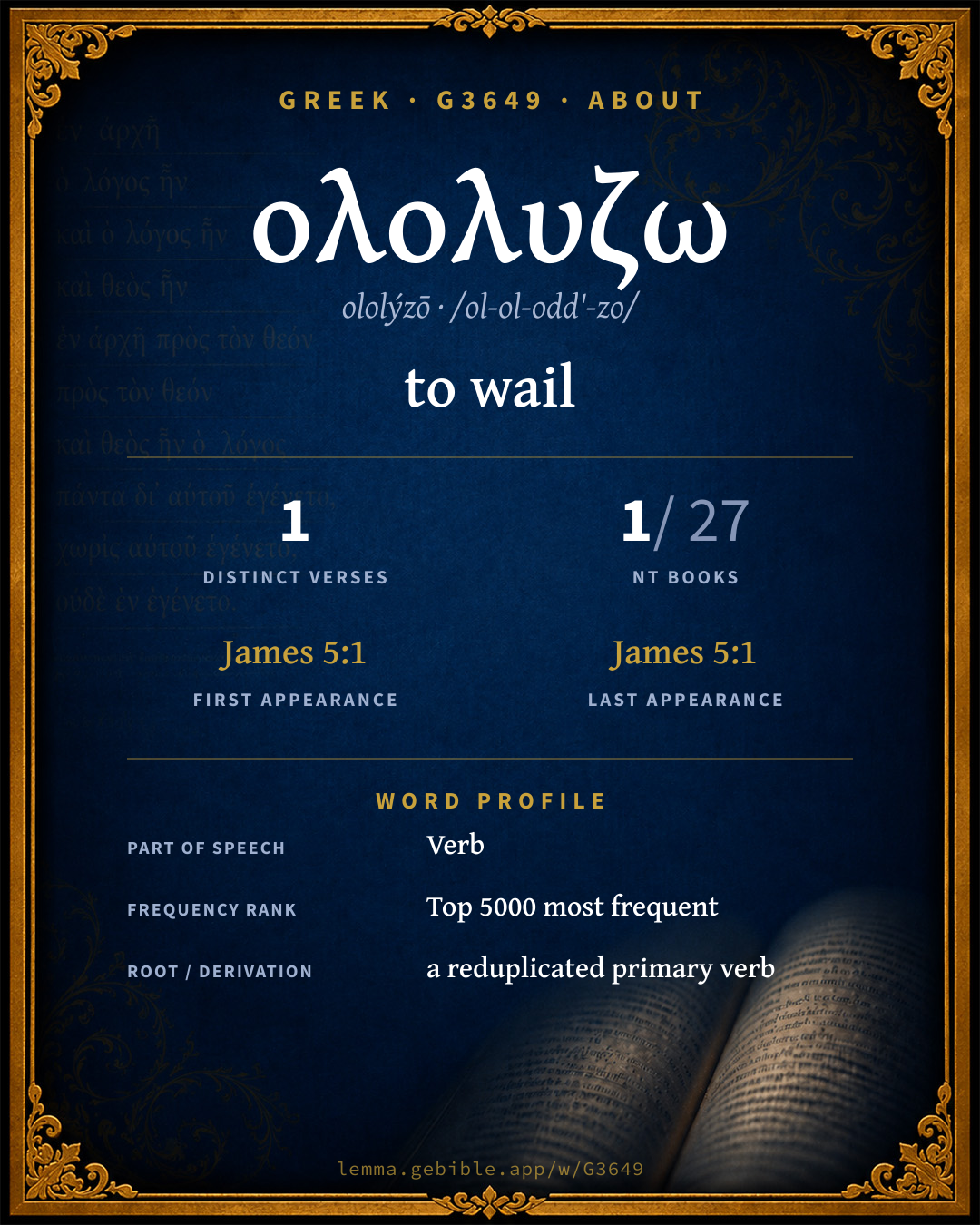
ὀλολύζω
to wail
Full lexicon entry — Thayer's Greek Lexicon
From Thayer's Greek Lexicon
Where this word appears
Grammar key — what these labels mean
Part of speech
- Verb
- An action or state-of-being word.
Tense
- Present
- Ongoing or general action in present time (imperfective aspect).
Voice
- Active
- The subject performs the action.
Mood
- Participle
- A verbal adjective (“writing,” “having written”).
Case
- Nominative
- The case of the subject (and the predicate nominative).
Gender
- Masculine
- Grammatically masculine.
Number
- Plural
- More than one.
Every verse where G3649 appears — 1 distinct verse across 1 book. Click any verse to open its interlinear word-by-word view. Verse text shown in the World English Bible for context — . Each verse’s Greek form is shown with its reference; the English is not keyword-highlighted, since the data carries no word-level English alignment. Use “Compare translations” on any verse to read it across multiple English versions. This concordance covers the Greek New Testament; Septuagint (Greek Old Testament) occurrences of this word are not indexed here.
James 1 verse
About this entry
At a glance — auto-summarized from this page’s data, not written by a person. Every figure links to its source below. This summary describes the numbers; it doesn’t interpret them.
The Greek verb ολολυζω centers on the idea of “to wail.” With only 1 verse it sits in the long tail of Greek New Testament vocabulary. James dominates its distribution — 1 of 1 verses. Its lone occurrence is James 5:1. For the data behind this summary, explore the sense tree and the renderings breakdown below.
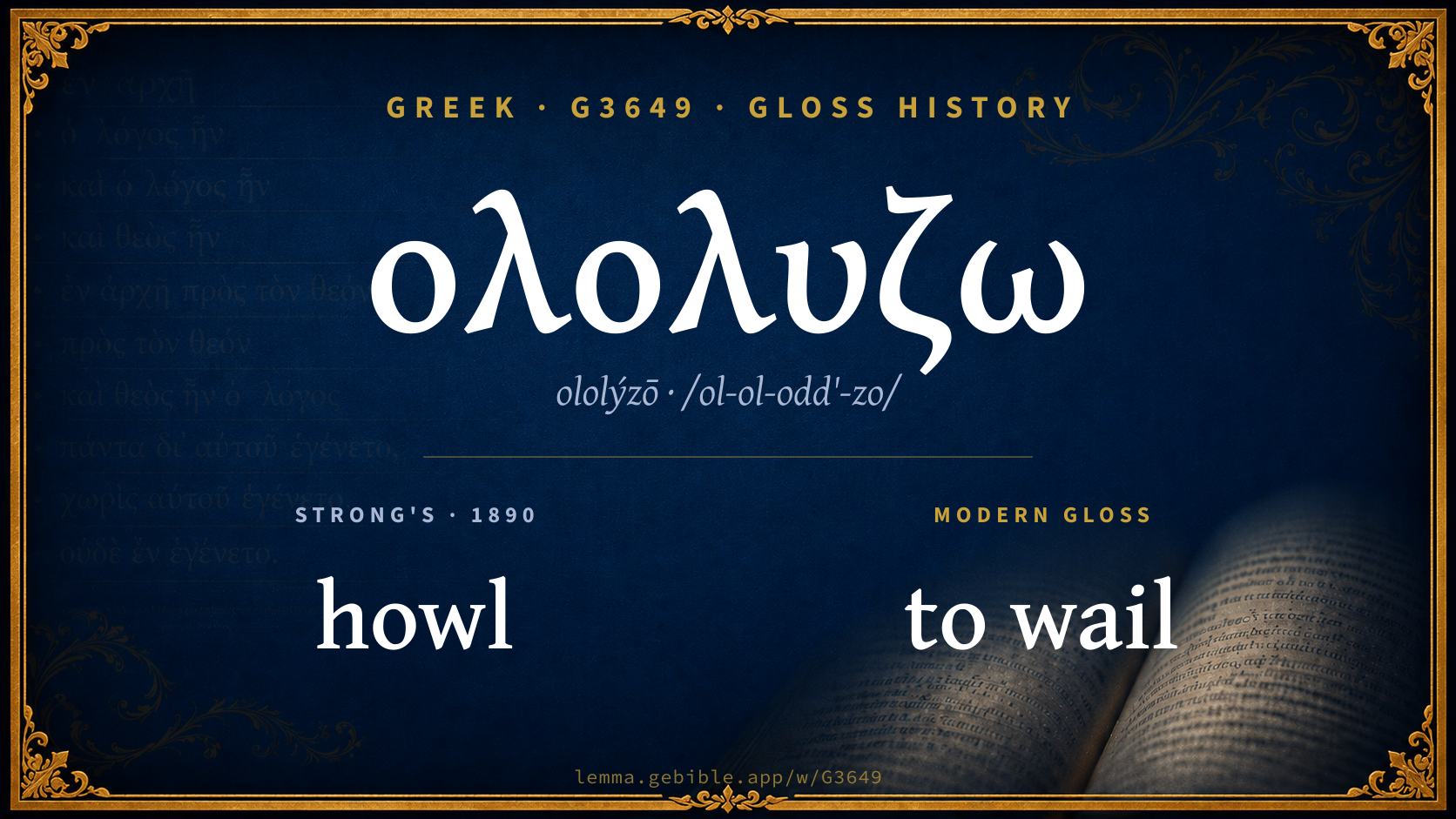
Gloss history
Strong's 1890 vs modern scholarship
About this word
Strong's G3649 catalogs a Greek word from the Greek New Testament.
These counts are not copied from any lexicon or concordance. They are computed here, from the morphology-tagged Greek New Testament. What Lemma adds →
- 1
- distinct verses
- The word appears in 1 distinct verse.
- 1 / 27
- NT books
- The word appears in 1 of 27 New Testament books.
- #3,503
- by frequency
- Top 5000 most frequent Greek words (rank 3,503 of 5,347 Greek words by occurrence).
View all 1 occurrence in the concordance →
Most concentrated in
- James 1 verse 100%
By section of the New Testament
By traditional corpus
Conventional, traditional groupings — biblical authorship is debated, so this is a traditional corpus grouping, not an authorship claim. Some books belong to more than one corpus (Luke is in both the Gospels and the Lukan corpus, and so on), so these shares overlap and need not total 100%. Each figure is a share of the word’s 1 distinct verse.
- General (Catholic) Epistles 1 verse · 100%
How translations render this word
Counts come from each version’s own published word-to-Strong’s tagging or interlinear alignment — an approximate guide to how each version renders this word, not a word-level alignment the data otherwise carries. Because each total is that version’s own tagged count, the per-version totals vary from one another and need not match the appearance or distinct-verse counts above. These counts may also differ from a printed concordance because Lemma counts each distinctly tagged rendering and does not collapse phrase taggings into a single head-word total. This is a fixed set of word-tagged versions (KJV, ASV, BSB, ULT) and does not change with the reading translation you choose elsewhere. Each version’s license is shown beside its name below (and on Sources).
- King James Version: Howl 1×
- American Standard Version: Howl 1×
- Berean Standard Bible: Wail 1×
- unfoldingWord Literal Text: Wailing 1×
King James Version Public Domain
Renders G3649 across 1 tagged occurrence — most commonly:
American Standard Version Public Domain
Renders G3649 across 1 tagged occurrence — most commonly:
Berean Standard Bible Public Domain
Renders G3649 across 1 tagged occurrence — most commonly:
unfoldingWord Literal Text CC BY-SA 4.0
Renders G3649 across 1 tagged occurrence — most commonly:
Senses in Thayer's
The 1 sense Thayer's distinguishes for this word, in lexicon order (not ranked by frequency or importance). The full entry — with sub-senses — is in the Lexicon Entry tab.
- of a loud cry whether for joy or of grief
Word origin
Origin: a reduplicated primary verb
A reduplicated primary verb; to howl or halloo that is shriek : - howl.
— Strong’s Exhaustive Concordance (1890), public domain.
Septuagint usage
The same Greek word ολολυζω appears 21 times in the Greek Old Testament (Septuagint), across 19 verses in 6 books.
- 21
- LXX occurrences
- Tagged occurrences of this Greek word in the Septuagint.
- 19
- verses
- Distinct Septuagint verses containing this word.
- 6 / 39
- OT books
- The word appears in 6 of the 39 Old Testament books.
Sample Septuagint occurrences
- Isaiah 10:10 ὀλολύζω
- Jeremiah 2:23 ὀλολύζω
- Ezekiel 21:17 ὀλολύζω
- Hosea 7:14 ὀλολύζω
- Amos 8:3 ὀλολύζω
- Zechariah 11:2 ὀλολύζω
Septuagint occurrences (same lexeme)
Every verse where the same Strong’s number (G3649) appears in the Greek Septuagint. Verse text shown in the World English Bible for context; the Greek form is the matched word — the English is not keyword-highlighted.
- Isaiah 10:10 ὀλολύζω As my hand has found the kingdoms of the idols, whose engraved images did excel them of Jerusalem and of Samaria;
- Isaiah 13:6 ὀλολύζω Wail; for the day of Yahweh is at hand; as destruction from the Almighty shall it come.
- Isaiah 14:31 ὀλολύζω Howl, gate; cry, city; you are melted away, Philistia, all of you; for there comes a smoke out of the north, and there is no straggler in his ranks.
- Isaiah 15:2 ὀλολύζω They are gone up to Bayith, and to Dibon, to the high places, to weep: Moab wails over Nebo, and over Medeba; on all their heads is baldness, every beard is cut off.
- Isaiah 15:3 ὀλολύζω In their streets they gird themselves with sackcloth; on their housetops, and in their broad places, everyone wails, weeping abundantly.
- Isaiah 16:7 ὀλολύζω Therefore shall Moab wail for Moab, everyone shall wail: for the raisin-cakes of Kir Hareseth shall you mourn, utterly stricken.
- Isaiah 23:1 ὀλολύζω The burden of Tyre. Howl, you ships of Tarshish; for it is laid waste, so that there is no house, no entering in: from the land of Kittim it is revealed to them.
- Isaiah 23:6 ὀλολύζω Pass over to Tarshish; wail, you inhabitants of the coast.
- Isaiah 23:14 ὀλολύζω Howl, you ships of Tarshish; for your stronghold is laid waste.
- Isaiah 24:11 ὀλολύζω There is a crying in the streets because of the wine; all joy is darkened, the mirth of the land is gone.
- Isaiah 52:5 ὀλολύζω Now therefore, what do I here, says Yahweh, seeing that my people is taken away for nothing? those who rule over them do howl, says Yahweh, and my name continually all the day is blasphemed.
- Isaiah 65:14 ὀλολύζω behold, my servants shall sing for joy of heart, but you shall cry for sorrow of heart, and shall wail for vexation of spirit.
- Jeremiah 2:23 ὀλολύζω How can you say, I am not defiled, I have not gone after the Baals? see your way in the valley, know what you have done: [you are] a swift dromedary traversing her ways;
- Jeremiah 31:20 ὀλολύζω Is Ephraim my dear son? is he a darling child? for as often as I speak against him, I do earnestly remember him still: therefore my heart yearns for him; I will surely have mercy on him, says Yahweh.
- Jeremiah 31:31 ὀλολύζω Behold, the days come, says Yahweh, that I will make a new covenant with the house of Israel, and with the house of Judah:
- Ezekiel 21:17 ὀλολύζω I will also strike my hands together, and I will cause my wrath to rest: I, Yahweh, have spoken it.
- Hosea 7:14 ὀλολύζω They haven't cried to me with their heart, But they howl on their beds. They assemble themselves for grain and new wine. They turn away from me.
- Amos 8:3 ὀλολύζω The songs of the temple will be wailings in that day," says the Lord Yahweh. "The dead bodies will be many. In every place they will throw them out with silence.
- Zechariah 11:2 ὀλολύζω Wail, fir tree, for the cedar has fallen, Because the stately ones are destroyed. Wail, you oaks of Bashan, For the strong forest has come down.
These are occurrences of the same Greek lexeme (G3649) in the Septuagint — not a translation of any one Hebrew word. The store carries no word-level Hebrew↔Greek alignment, so no Hebrew original is asserted here. Counts come from the recovered LXX Strong's tagging — high-frequency vocabulary is well covered, while rare or late forms may be untagged — so they reflect tagged occurrences and may slightly undercount.