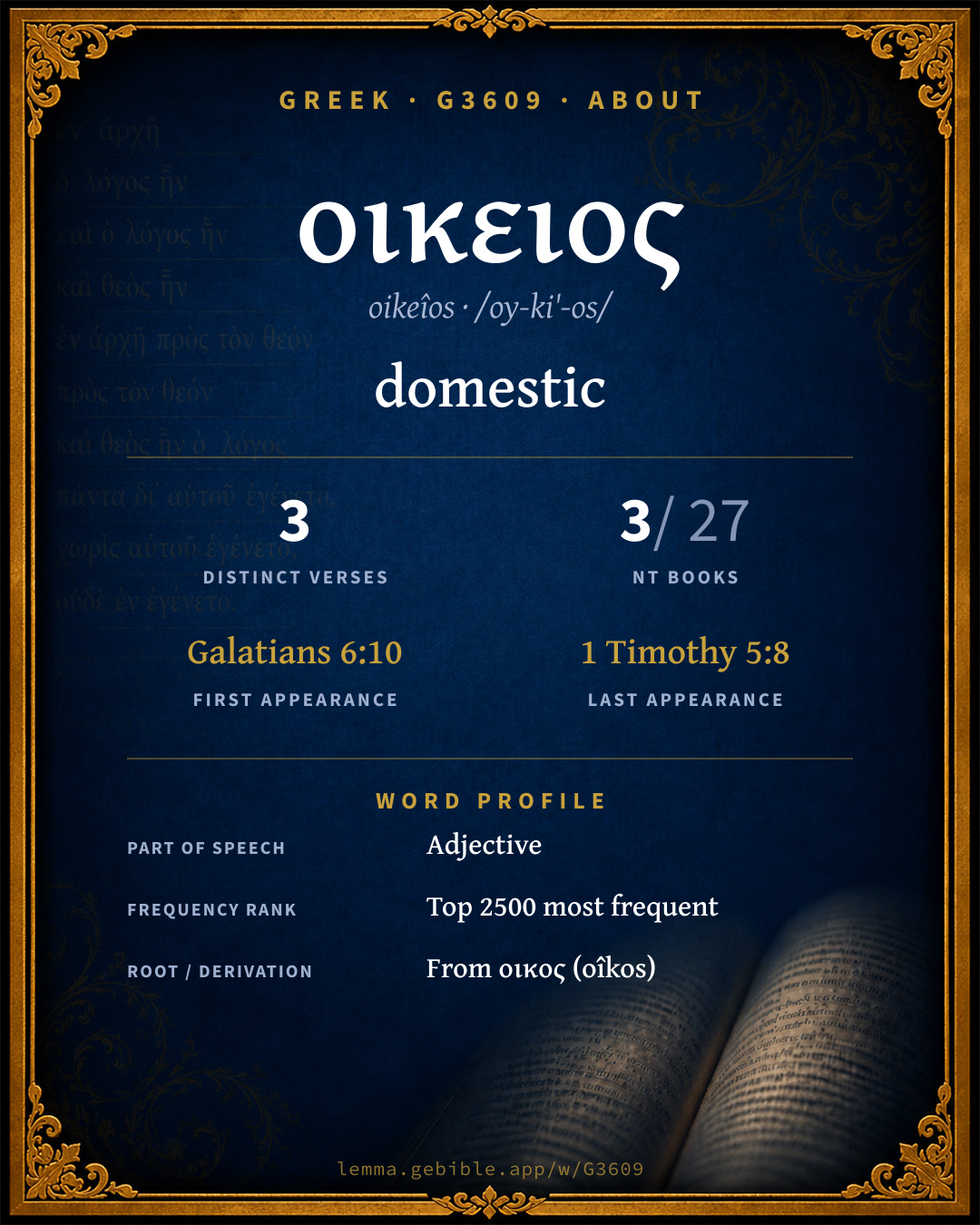
οἰκεῖος
domestic
Full lexicon entry — Thayer's Greek Lexicon
From Thayer's Greek Lexicon
Where this word appears
See every Accusative-case word in the Greek New Testament →
Grammar key — what these labels mean
Part of speech
- Adjective
- A word that describes or qualifies a noun.
Case
- Accusative
- The case of the direct object and of extent.
- Genitive
- The case of source, possession, or “of” — answers “whose / from what.”
- Nominative
- The case of the subject (and the predicate nominative).
Gender
- Masculine
- Grammatically masculine.
Number
- Plural
- More than one.
1 distinct verse where G3609 appears in the Genitive case, across 1 book. Filtered view — show all forms. Click any verse to open its interlinear word-by-word view. Verse text shown in the World English Bible for context — . Each verse’s Greek form is shown with its reference; the English is not keyword-highlighted, since the data carries no word-level English alignment. Use “Compare translations” on any verse to read it across multiple English versions. This concordance covers the Greek New Testament; Septuagint (Greek Old Testament) occurrences of this word are not indexed here.
1 Timothy 1 verse
About this entry
At a glance — auto-summarized from this page’s data, not written by a person. Every figure links to its source below. This summary describes the numbers; it doesn’t interpret them.
“domestic” is the headline sense of the Greek adjective οικειος (oikeîos). A scarce word — 3 verses in all of the Greek New Testament. More than a third of its appearances fall in Galatians. First canonically at Galatians 6:10, it enters the text early. It shares a root with οικος, οικεω and οικια. See the sense tree, 3-verse concordance, and the renderings breakdown below.
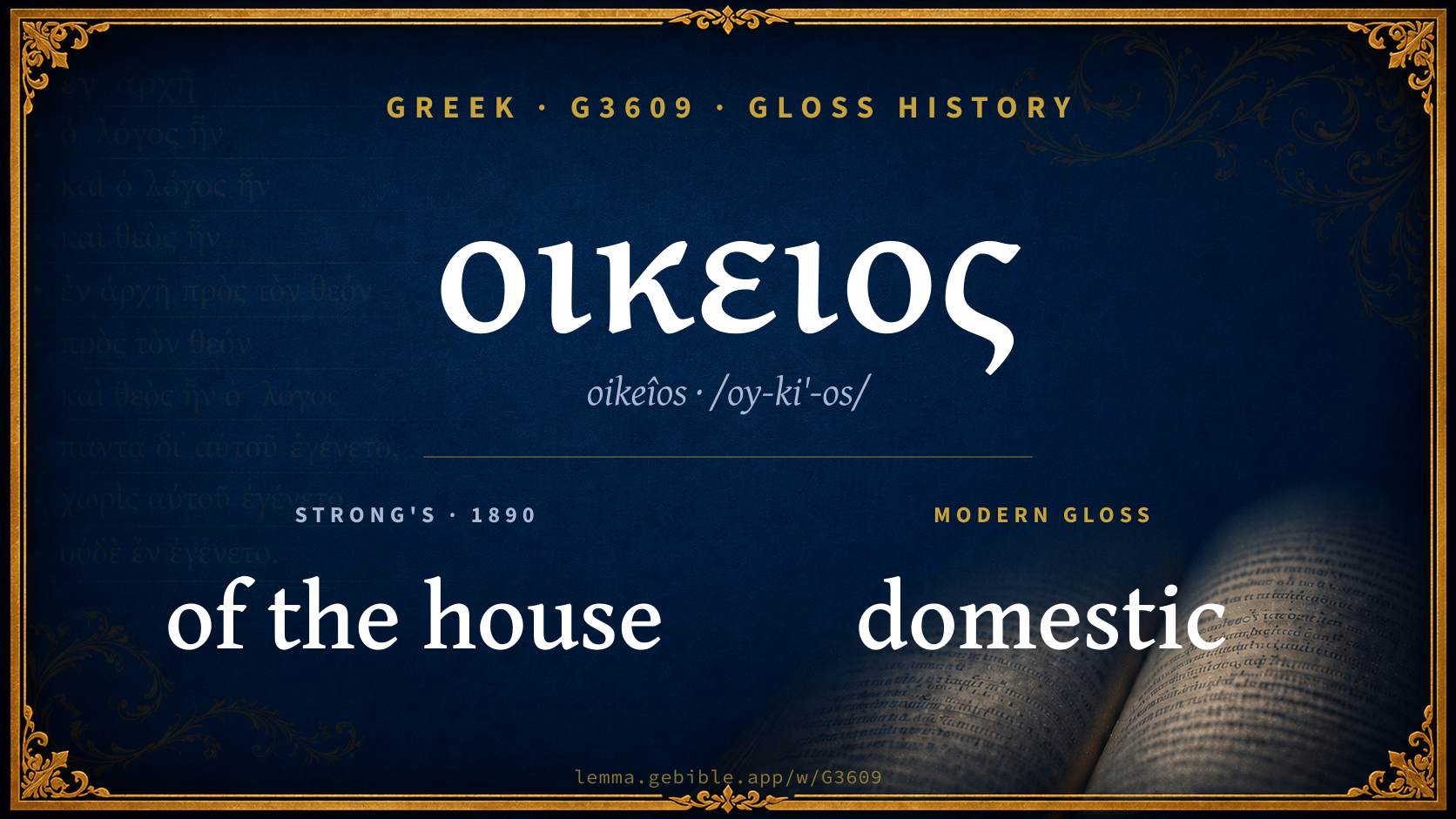
Gloss history
Strong's 1890 vs modern scholarship
About this word
Strong's G3609 catalogs a Greek word from the Greek New Testament.
These counts are not copied from any lexicon or concordance. They are computed here, from the morphology-tagged Greek New Testament. What Lemma adds →
- 3
- distinct verses
- The word appears in 3 distinct verses.
- 3 / 27
- NT books
- The word appears in 3 of 27 New Testament books.
- #2,203
- by frequency
- Top 2500 most frequent Greek words (rank 2,203 of 5,347 Greek words by occurrence).
View all 3 occurrences in the concordance →
By section of the New Testament
By traditional corpus
Conventional, traditional groupings — biblical authorship is debated, so this is a traditional corpus grouping, not an authorship claim. Some books belong to more than one corpus (Luke is in both the Gospels and the Lukan corpus, and so on), so these shares overlap and need not total 100%. Each figure is a share of the word’s 3 distinct verses.
- Pauline corpus 3 verses · 100%
How translations render this word
Counts come from each version’s own published word-to-Strong’s tagging or interlinear alignment — an approximate guide to how each version renders this word, not a word-level alignment the data otherwise carries. Because each total is that version’s own tagged count, the per-version totals vary from one another and need not match the appearance or distinct-verse counts above. These counts may also differ from a printed concordance because Lemma counts each distinctly tagged rendering and does not collapse phrase taggings into a single head-word total. This is a fixed set of word-tagged versions (KJV, ASV, BSB, ULT) and does not change with the reading translation you choose elsewhere. Each version’s license is shown beside its name below (and on Sources).
- King James Version: Are of the household 1×, Household 1×, Own house 1×
- American Standard Version: Household 2×
- Berean Standard Bible: Family 1×, Household 1×, Members of god’s household 1×
- unfoldingWord Literal Text: Household 2×
King James Version Public Domain
Renders G3609 across 3 tagged occurrences — most commonly:
American Standard Version Public Domain
Renders G3609 across 3 tagged occurrences — most commonly:
Plus 1 rendering that appears only once — usually multi-word phrases or single function words the recovered tagging swept in, not distinct renderings.
Berean Standard Bible Public Domain
Renders G3609 across 3 tagged occurrences — most commonly:
unfoldingWord Literal Text CC BY-SA 4.0
Renders G3609 across 4 tagged occurrences — most commonly:
Plus 2 renderings that appear only once — usually multi-word phrases or single function words the recovered tagging swept in, not distinct renderings.
Senses in Thayer's
The 1 sense Thayer's distinguishes for this word, in lexicon order (not ranked by frequency or importance). The full entry — with sub-senses — is in the Lexicon Entry tab.
- belonging to a house or family, domestic, intimate
Word origin
Derived from οικος (oîkos) (G3624) — house.
From G3624 ; domestic that is (as noun) a relative adherent : - (those) of the (his own) house (-hold).
— Strong’s Exhaustive Concordance (1890), public domain.
Forms in the corpus
The 3 distinct written forms G3609 takes in the Greek New Testament, most frequent first — each parse links to that case’s occurrences in the concordance.
| Form | Parsing | Example | Uses |
|---|---|---|---|
| οἰκείους oikeíous | Adjective, Accusative, Plural, Masculine | Galatians 6:10 | 1 |
| οἰκείων oikeíōn | Adjective, Genitive, Plural, Masculine | 1 Timothy 5:8 | 1 |
| οἰκεῖοι oikeîoi | Adjective, Nominative, Plural, Masculine | Ephesians 2:19 | 1 |
Same root — word family
Other Thayer's entries built from the same root as G3609, grouped by Strong’s listed origin. These share a root / origin per the lexicon — not necessarily a shared meaning. Each links to that word’s own entry.
Derives from
Shares the same root
- οικεω oikéō G3611 to dwell in
- οικια oikía G3614 house
- οικοδεσποτης oikodespótēs G3617 householder
- οικοδομη oikodomḗ G3619 building
- οικονομος oikonómos G3623 steward
- οικουρος oikourós G3626 domestic
Compare all same-root words → Showing 4 of 8 — not the complete family. They share a root, not necessarily a meaning.
Septuagint usage
The same Greek word οικειος appears 17 times in the Greek Old Testament (Septuagint), across 17 verses in 6 books.
- 17
- LXX occurrences
- Tagged occurrences of this Greek word in the Septuagint.
- 17
- verses
- Distinct Septuagint verses containing this word.
- 6 / 39
- OT books
- The word appears in 6 of the 39 Old Testament books.
Sample Septuagint occurrences
- Leviticus 18:6 οἰκεῖος
- Numbers 25:5 οἰκεῖος
- 1 Samuel 10:14 οἰκεῖος
- Proverbs 17:9 οἰκεῖος
- Isaiah 3:6 οἰκεῖος
- Amos 6:10 οἰκεῖος
Septuagint occurrences (same lexeme)
Every verse where the same Strong’s number (G3609) appears in the Greek Septuagint. Verse text shown in the World English Bible for context; the Greek form is the matched word — the English is not keyword-highlighted.
- Leviticus 18:6 οἰκεῖος "'None of you shall approach anyone who are his close relatives, to uncover their nakedness: I am Yahweh.
- Leviticus 18:12 οἰκεῖος You shall not uncover the nakedness of your father's sister: she is your father's near kinswoman.
- Leviticus 18:13 οἰκεῖος "'You shall not uncover the nakedness of your mother's sister: for she is your mother's near kinswoman.
- Leviticus 18:17 οἰκεῖος "'You shall not uncover the nakedness of a woman and her daughter. You shall not take her son's daughter, or her daughter's daughter, to uncover her nakedness; they are near kinswomen: it is wickedness.
- Leviticus 21:2 οἰκεῖος except for his relatives that are near to him: for his mother, for his father, for his son, for his daughter, for his brother,
- Leviticus 25:49 οἰκεῖος or his uncle, or his uncle's son, may redeem him, or any who is a close relative to him of his family may redeem him; or if he has grown rich, he may redeem himself.
- Numbers 25:5 οἰκεῖος Moses said to the judges of Israel, Kill you everyone his men who have joined themselves to Baal Peor.
- Numbers 27:11 οἰκεῖος If his father have no brothers, then you shall give his inheritance to his kinsman who is next to him of his family, and he shall possess it: and it shall be to the children of Israel a statute [and] ordinance, as Yahweh commanded Moses.
- 1 Samuel 10:14 οἰκεῖος Saul's uncle said to him and to his servant, Where went you? He said, To seek the donkeys; and when we saw that they were not found, we came to Samuel.
- 1 Samuel 10:15 οἰκεῖος Saul's uncle said, Tell me, Please, what Samuel said to you.
- 1 Samuel 10:16 οἰκεῖος Saul said to his uncle, He told us plainly that the donkeys were found. But concerning the matter of the kingdom, of which Samuel spoke, he didn't tell him.
- 1 Samuel 14:50 οἰκεῖος and the name of Saul's wife was Ahinoam the daughter of Ahimaaz. The name of the captain of his host was Abner the son of Ner, Saul's uncle.
- Proverbs 17:9 οἰκεῖος He who covers an offense promotes love; But he who repeats a matter separates best friends.
- Isaiah 3:6 οἰκεῖος Indeed a man shall take hold of his brother in the house of his father, saying, "You have clothing, you be our ruler, And let this ruin be under your hand."
- Isaiah 31:9 οἰκεῖος His rock shall pass away by reason of terror, and his princes shall be dismayed at the ensign, says Yahweh, whose fire is in Zion, and his furnace in Jerusalem.
- Isaiah 58:7 οἰκεῖος Isn't it to deal your bread to the hungry, and that you bring the poor who are cast out to your house? when you see the naked, that you cover him; and that you not hide yourself from your own flesh?
- Amos 6:10 οἰκεῖος "When a man's relative carries him, even he who burns him, to bring bodies out of the house, and asks him who is in the innermost parts of the house, 'Is there yet any with you?' And he says, 'No;' then he will say, 'Hush! Indeed we must not mention the name of Yahweh.'
These are occurrences of the same Greek lexeme (G3609) in the Septuagint — not a translation of any one Hebrew word. The store carries no word-level Hebrew↔Greek alignment, so no Hebrew original is asserted here. Counts come from the recovered LXX Strong's tagging — high-frequency vocabulary is well covered, while rare or late forms may be untagged — so they reflect tagged occurrences and may slightly undercount.