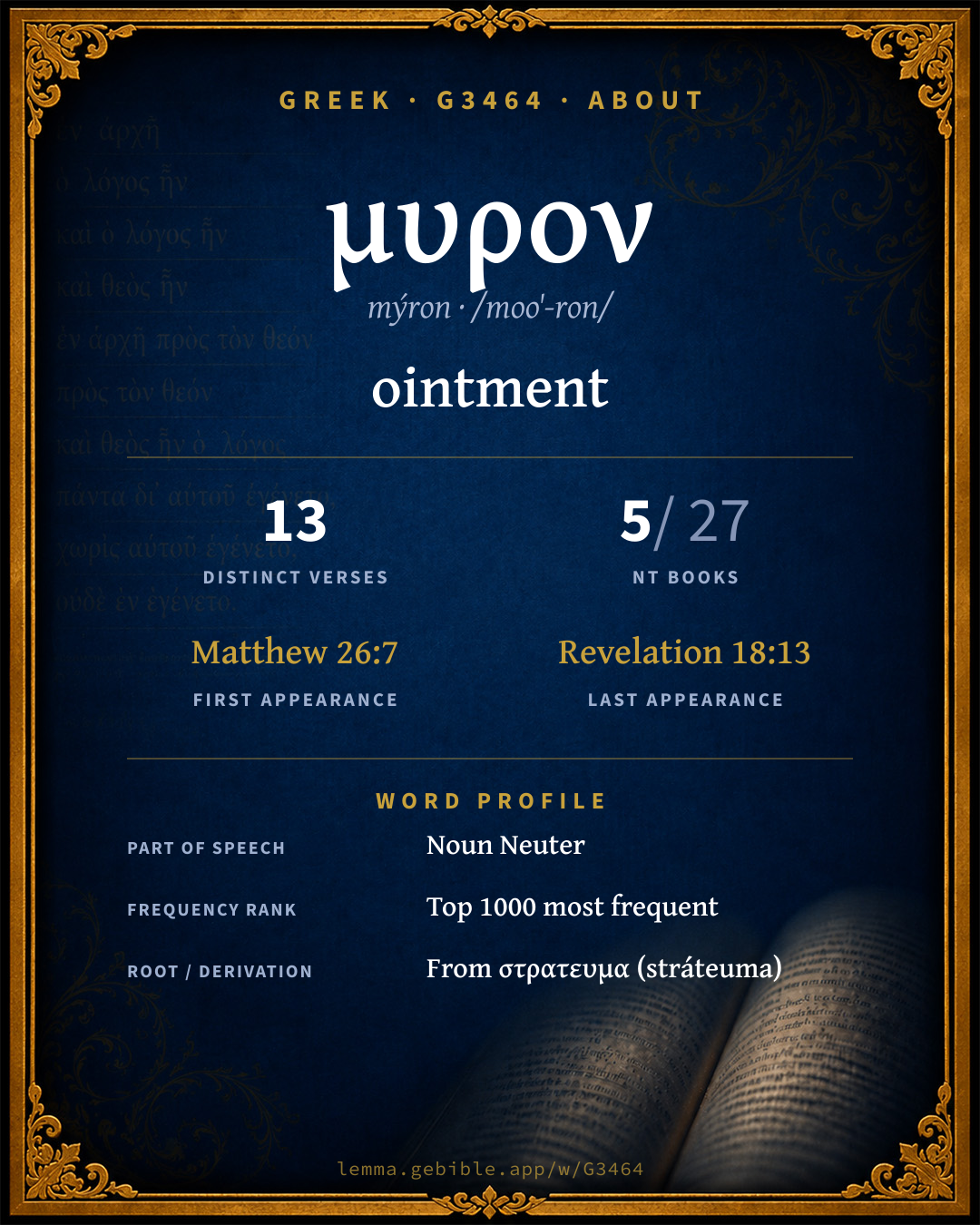
μύρον
ointment
Full lexicon entry — Thayer's Greek Lexicon
From Thayer's Greek Lexicon
Where this word appears
See every Genitive-case word in the Greek New Testament →
Grammar key — what these labels mean
Part of speech
- Noun
- A naming word — a person, place, thing, or idea.
Case
- Genitive
- The case of source, possession, or “of” — answers “whose / from what.”
- Dative
- The case of the indirect object, means, or location — “to / for / with / in.”
- Accusative
- The case of the direct object and of extent.
- Nominative
- The case of the subject (and the predicate nominative).
Gender
- Neuter
- Grammatically neuter.
Number
- Singular
- One.
- Plural
- More than one.
Grammatical forms
- Noun, Genitive, Singular, Neuter 6 times (43%)
- Noun, Dative, Singular, Neuter 3 times (21%)
- Noun, Accusative, Singular, Neuter 2 times (14%)
- Noun, Nominative, Singular, Neuter 2 times (14%)
- Noun, Accusative, Plural, Neuter 1 time (7%)
Parsed forms decoded from the imported morphology (Robinson–Tischendorf, public domain), counted across 14 parsed occurrences — not distinct verses.
Every verse where G3464 appears — 13 distinct verses across 5 books. Click any verse to open its interlinear word-by-word view. Verse text shown in the World English Bible for context — . Each verse’s Greek form is shown with its reference; the English is not keyword-highlighted, since the data carries no word-level English alignment. Use “Compare translations” on any verse to read it across multiple English versions. This concordance covers the Greek New Testament; Septuagint (Greek Old Testament) occurrences of this word are not indexed here.
Matthew 2 verses
Mark 3 verses
- Mark 14:3 μύρου n gen sg neut While he was at Bethany, in the house of Simon the leper, as he sat at the table, a woman came having an alabaster jar of ointment of pure nard-- very costly. She broke the jar, and poured it over his head.
- Mark 14:4 μύρου n gen sg neut But there were some who were indignant among themselves, saying, "Why has this ointment been wasted?
- Mark 14:5 μύρον n nom sg neut For this might have been sold for more than three hundred denarii, and given to the poor." They grumbled against her.
Luke 4 verses
- Luke 7:37 μύρου n gen sg neut Behold, a woman in the city who was a sinner, when she knew that he was reclining in the Pharisee's house, she brought an alabaster jar of ointment.
- Luke 7:38 μύρῳ n dat sg neut Standing behind at his feet weeping, she began to wet his feet with her tears, and she wiped them with the hair of her head, kissed his feet, and anointed them with the ointment.
- Luke 7:46 μύρῳ n dat sg neut You didn't anoint my head with oil, but she has anointed my feet with ointment.
- Luke 23:56 μύρα n acc pl neut They returned, and prepared spices and ointments. On the Sabbath they rested according to the commandment.
John 3 verses
- John 11:2 μύρῳ n dat sg neut It was that Mary who had anointed the Lord with ointment, and wiped his feet with her hair, whose brother, Lazarus, was sick.
- John 12:3 μύρου μύρου n gen sg neut n gen sg neut Mary, therefore, took a pound of ointment of pure nard, very precious, and anointed the feet of Jesus, and wiped his feet with her hair. The house was filled with the fragrance of the ointment.
- John 12:5 μύρον n nom sg neut "Why wasn't this ointment sold for three hundred denarii, and given to the poor?"
Revelation 1 verse
About this entry
At a glance — auto-summarized from this page’s data, not written by a person. Every figure links to its source below. This summary describes the numbers; it doesn’t interpret them.
“ointment” is the headline sense of the Greek noun μυρον (mýron). Where the King James Version says “ointment,” newer translations reach for “perfume” (Berean Standard Bible) and “perfumed oil” (unfoldingWord Literal Text); the renderings breakdown has the detail. It appears 13 verses across 5 books of the Greek New Testament, among its uncommon vocabulary. More than a quarter of its appearances fall in Luke. First canonically at Matthew 26:7, it enters the text early. The sections below give every sense, occurrence, and version rendering.
Gloss history
Strong's 1890 vs modern scholarship
About this word
Strong's G3464 catalogs a Greek word from the Greek New Testament.
These counts are not copied from any lexicon or concordance. They are computed here, from the morphology-tagged Greek New Testament. What Lemma adds →
- 13
- distinct verses
- The word appears in 13 distinct verses.
- 5 / 27
- NT books
- The word appears in 5 of 27 New Testament books.
- #814
- by frequency
- Top 1000 most frequent Greek words (rank 814 of 5,347 Greek words by occurrence).
View all 13 occurrences in the concordance →
By section of the New Testament
By traditional corpus
Conventional, traditional groupings — biblical authorship is debated, so this is a traditional corpus grouping, not an authorship claim. Some books belong to more than one corpus (Luke is in both the Gospels and the Lukan corpus, and so on), so these shares overlap and need not total 100%. Each figure is a share of the word’s 13 distinct verses.
- Gospels 12 verses · 92%
- Lukan (Luke–Acts) 4 verses · 31%
- Johannine 4 verses · 31%
- Revelation 1 verse · 8%
How translations render this word
Counts come from each version’s own published word-to-Strong’s tagging or interlinear alignment — an approximate guide to how each version renders this word, not a word-level alignment the data otherwise carries. Because each total is that version’s own tagged count, the per-version totals vary from one another and need not match the appearance or distinct-verse counts above. These counts may also differ from a printed concordance because Lemma counts each distinctly tagged rendering and does not collapse phrase taggings into a single head-word total. This is a fixed set of word-tagged versions (KJV, ASV, BSB, ULT) and does not change with the reading translation you choose elsewhere. Each version’s license is shown beside its name below (and on Sources).
- King James Version: Ointment 12×, Ointments 2×
- American Standard Version: Ointment 12×
- Berean Standard Bible: Perfume 11×
- unfoldingWord Literal Text: Perfumed oil 11×, Myrrh 2×, Of 2×
King James Version Public Domain
Renders G3464 across 14 tagged occurrences — most commonly:
American Standard Version Public Domain
Renders G3464 across 14 tagged occurrences — most commonly:
Plus 2 renderings that appear only once — usually multi-word phrases or single function words the recovered tagging swept in, not distinct renderings.
Berean Standard Bible Public Domain
Renders G3464 across 13 tagged occurrences — most commonly:
Plus 2 renderings that appear only once — usually multi-word phrases or single function words the recovered tagging swept in, not distinct renderings. Not rendered by a distinct English word in 1 further occurrence.
unfoldingWord Literal Text CC BY-SA 4.0
Renders G3464 across 16 tagged occurrences — most commonly:
Plus 1 rendering that appears only once — usually multi-word phrases or single function words the recovered tagging swept in, not distinct renderings.
Senses in Thayer's
The 1 sense Thayer's distinguishes for this word, in lexicon order (not ranked by frequency or importance). The full entry — with sub-senses — is in the Lexicon Entry tab.
- ointment
Word origin
Derived from στρατευμα (stráteuma) (G4753) — army.
Forms in the corpus
The 4 distinct written forms G3464 takes in the Greek New Testament, most frequent first — each parse links to that case’s occurrences in the concordance.
| Form | Parsing | Example | Uses |
|---|---|---|---|
| μύρου mýrou | Noun, Genitive, Singular, Neuter | Matthew 26:7 | 6 |
| μύρον mýron | Noun, Accusative, Singular, Neuter | Matthew 26:12 | 4 |
| μύρῳ mýrō | Noun, Dative, Singular, Neuter | Luke 7:38 | 3 |
| μύρα mýra | Noun, Accusative, Plural, Neuter | Luke 23:56 | 1 |
Same root — word family
Other Thayer's entries built from the same root as G3464, grouped by Strong’s listed origin. These share a root / origin per the lexicon — not necessarily a shared meaning. Each links to that word’s own entry.
Derives from
Derived from this word
Compare all same-root words → They share a root, not necessarily a meaning.
Septuagint usage
The same Greek word μυρον appears 14 times in the Greek Old Testament (Septuagint), across 13 verses in 10 books.
- 14
- LXX occurrences
- Tagged occurrences of this Greek word in the Septuagint.
- 13
- verses
- Distinct Septuagint verses containing this word.
- 10 / 39
- OT books
- The word appears in 10 of the 39 Old Testament books.
Sample Septuagint occurrences
- Exodus 30:25 μύρον
- 1 Chronicles 9:30 μύρον
- 2 Chronicles 16:14 μύρον
- Psalms 132:2 μύρον
- Proverbs 27:9 μύρον
- Song of Solomon 1:3 μύρον
- Isaiah 25:6 μύρον
- Jeremiah 25:10 μύρον
- Ezekiel 27:17 μύρον
- Amos 6:6 μύρον
Septuagint occurrences (same lexeme)
Every verse where the same Strong’s number (G3464) appears in the Greek Septuagint. Verse text shown in the World English Bible for context; the Greek form is the matched word — the English is not keyword-highlighted.
- Exodus 30:25 μύρον You shall make it a holy anointing oil, a perfume compounded after the art of the perfumer: it shall be a holy anointing oil.
- 1 Chronicles 9:30 μύρον Some of the sons of the priests prepared the confection of the spices.
- 2 Chronicles 16:14 μύρον They buried him in his own tombs, which he had hewn out for himself in the city of David, and laid him in the bed which was filled with sweet odors and various kinds [of spices] prepared by the perfumers' are: and they made a very great burning for him.
- Psalms 132:2 μύρον How he swore to Yahweh, And vowed to the Mighty One of Jacob:
- Proverbs 27:9 μύρον Perfume and incense bring joy to the heart; So does earnest counsel from a man's friend.
- Song of Solomon 1:3 μύρον Your oils have a pleasing fragrance. Your name is oil poured forth, Therefore the virgins love you.
- Song of Solomon 1:4 μύρον Take me away with you. Let us hurry. The king has brought me into his chambers. Friends We will be glad and rejoice in you. We will praise your love more than wine! Beloved They are right to love you.
- Song of Solomon 4:14 μύρον Spikenard and saffron, Calamus and cinnamon, with every kind of incense tree; Myrrh and aloes, with all the best spices,
- Isaiah 25:6 μύρον In this mountain will Yahweh of Hosts make to all peoples a feast of fat things, a feast of wines on the lees, of fat things full of marrow, of wines on the lees well refined.
- Isaiah 39:2 μύρον Hezekiah was glad of them, and shown them the house of his precious things, the silver, and the gold, and the spices, and the precious oil, and all the house of his armor, and all that was found in his treasures: there was nothing in his house, nor in all his dominion, that Hezekiah didn't show them.
- Jeremiah 25:10 μύρον Moreover I will take from them the voice of mirth and the voice of gladness, the voice of the bridegroom and the voice of the bride, the sound of the millstones, and the light of the lamp.
- Ezekiel 27:17 μύρον Judah, and the land of Israel, they were your traffickers: they traded for your merchandise wheat of Minnith, and confections, and honey, and oil, and balm.
- Amos 6:6 μύρον Who drink wine in bowls, And anoint themselves with the best oils; But they are not grieved for the affliction of Joseph.
These are occurrences of the same Greek lexeme (G3464) in the Septuagint — not a translation of any one Hebrew word. The store carries no word-level Hebrew↔Greek alignment, so no Hebrew original is asserted here. Counts come from the recovered LXX Strong's tagging — high-frequency vocabulary is well covered, while rare or late forms may be untagged — so they reflect tagged occurrences and may slightly undercount.