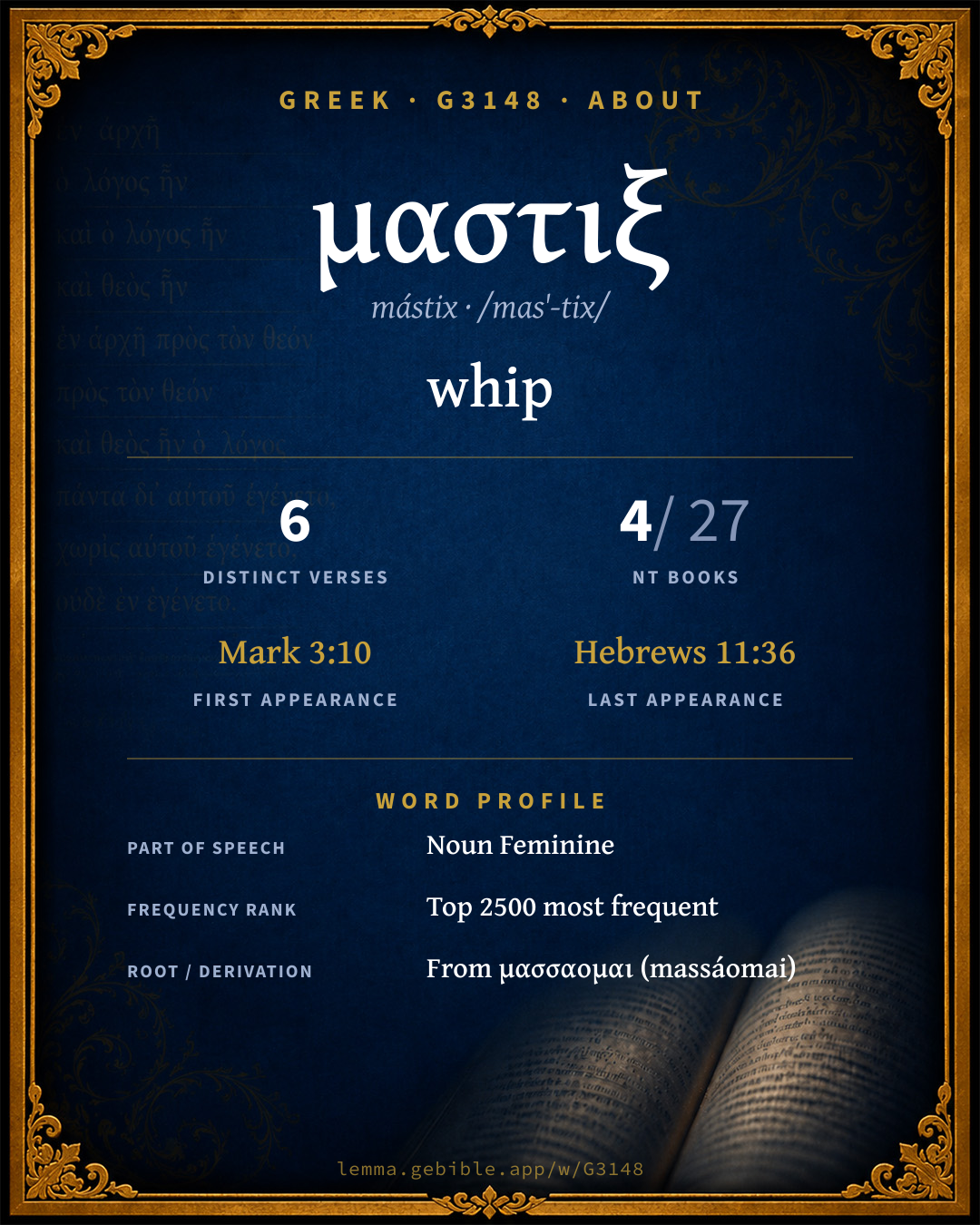
μάστιξ
whip
‘whip’ is one of 2 main senses fuller range ↓
Full lexicon entry — Thayer's Greek Lexicon
From Thayer's Greek Lexicon
Where this word appears
See every Genitive-case word in the Greek New Testament →
Grammar key — what these labels mean
Part of speech
- Noun
- A naming word — a person, place, thing, or idea.
Case
- Genitive
- The case of source, possession, or “of” — answers “whose / from what.”
- Accusative
- The case of the direct object and of extent.
- Dative
- The case of the indirect object, means, or location — “to / for / with / in.”
Gender
- Feminine
- Grammatically feminine.
Number
- Plural
- More than one.
- Singular
- One.
1 verse where G3148 appears in the Accusative case in the Book of Mark. Filtered view — show all forms. Click any verse to open its interlinear word-by-word view. Verse text shown in the World English Bible for context — . Each verse’s Greek form is shown with its reference; the English is not keyword-highlighted, since the data carries no word-level English alignment. Use “Compare translations” on any verse to read it across multiple English versions. This concordance covers the Greek New Testament; Septuagint (Greek Old Testament) occurrences of this word are not indexed here.
Mark
About this entry
At a glance — auto-summarized from this page’s data, not written by a person. Every figure links to its source below. This summary describes the numbers; it doesn’t interpret them.
At its core, μαστιξ (mástix) means “whip.” Its uses cluster heavily in Mark (50% of all occurrences). With 6 verses in 4 books, it is an uncommon word in the Greek New Testament. Scripture first uses it in Mark 3:10. Ranging over 2 senses, it is not a single-sense word. Dig into 6-verse concordance and the renderings breakdown below.
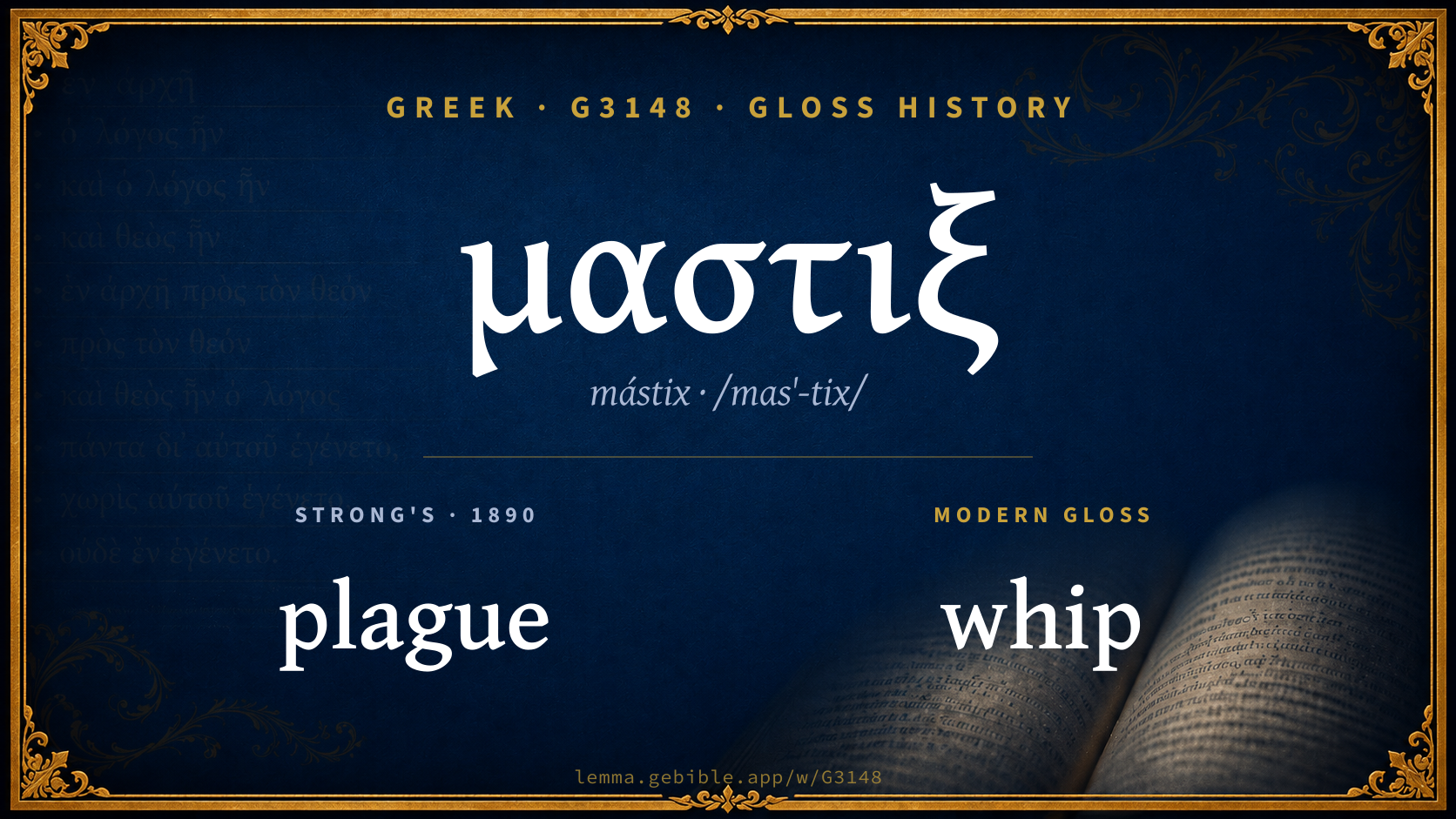
Gloss history
Strong's 1890 vs modern scholarship
About this word
Strong's G3148 catalogs a Greek word from the Greek New Testament.
These counts are not copied from any lexicon or concordance. They are computed here, from the morphology-tagged Greek New Testament. What Lemma adds →
- 6
- distinct verses
- The word appears in 6 distinct verses.
- 4 / 27
- NT books
- The word appears in 4 of 27 New Testament books.
- #1,476
- by frequency
- Top 2500 most frequent Greek words (rank 1,476 of 5,347 Greek words by occurrence).
View all 6 occurrences in the concordance →
By section of the New Testament
By traditional corpus
Conventional, traditional groupings — biblical authorship is debated, so this is a traditional corpus grouping, not an authorship claim. Some books belong to more than one corpus (Luke is in both the Gospels and the Lukan corpus, and so on), so these shares overlap and need not total 100%. Each figure is a share of the word’s 6 distinct verses.
- Gospels 4 verses · 67%
- Lukan (Luke–Acts) 2 verses · 33%
- Hebrews 1 verse · 17%
How translations render this word
Counts come from each version’s own published word-to-Strong’s tagging or interlinear alignment — an approximate guide to how each version renders this word, not a word-level alignment the data otherwise carries. Because each total is that version’s own tagged count, the per-version totals vary from one another and need not match the appearance or distinct-verse counts above. These counts may also differ from a printed concordance because Lemma counts each distinctly tagged rendering and does not collapse phrase taggings into a single head-word total. This is a fixed set of word-tagged versions (KJV, ASV, BSB, ULT) and does not change with the reading translation you choose elsewhere. Each version’s license is shown beside its name below (and on Sources).
- King James Version: Plague 2×, Plagues 2×
- American Standard Version: Plague 2×, Plagues 2×
- Berean Standard Bible: Affliction 2×
- unfoldingWord Literal Text: Affliction 2×, Afflictions 2×
King James Version Public Domain
Renders G3148 across 6 tagged occurrences — most commonly:
Plus 2 renderings that appear only once — usually multi-word phrases or single function words the recovered tagging swept in, not distinct renderings.
American Standard Version Public Domain
Renders G3148 across 6 tagged occurrences — most commonly:
Plus 2 renderings that appear only once — usually multi-word phrases or single function words the recovered tagging swept in, not distinct renderings.
Berean Standard Bible Public Domain
Renders G3148 across 6 tagged occurrences — most commonly:
Plus 4 renderings that appear only once — usually multi-word phrases or single function words the recovered tagging swept in, not distinct renderings.
unfoldingWord Literal Text CC BY-SA 4.0
Renders G3148 across 6 tagged occurrences — most commonly:
Plus 2 renderings that appear only once — usually multi-word phrases or single function words the recovered tagging swept in, not distinct renderings.
Senses in Thayer's
The 2 senses Thayer's distinguishes for this word, in lexicon order (not ranked by frequency or importance). The full entry — with sub-senses — is in the Lexicon Entry tab.
- a whip, scourge
- metaph. a scourge, plague
Word origin
Derived from μασσαομαι (massáomai) (G3145) — to chew.
Probably from the base of G3145 (through the idea of contact ); a whip (literally the Roman flagellum for criminals; figuratively a disease ): - plague scourging.
— Strong’s Exhaustive Concordance (1890), public domain.
Forms in the corpus
The 5 distinct written forms G3148 takes in the Greek New Testament, most frequent first — each parse links to that case’s occurrences in the concordance.
| Form | Parsing | Example | Uses |
|---|---|---|---|
| μαστίγων mastígōn | Noun, Genitive, Plural, Feminine | Luke 7:21 | 2 |
| μάστιγας mástigas | Noun, Accusative, Plural, Feminine | Mark 3:10 | 1 |
| μάστιγος mástigos | Noun, Genitive, Singular, Feminine | Mark 5:29 | 1 |
| μάστιγός mástigós | Noun, Genitive, Singular, Feminine | Mark 5:34 | 1 |
| μάστιξιν mástixin | Noun, Dative, Plural, Feminine | Acts 22:24 | 1 |
Same root — word family
Other Thayer's entries built from the same root as G3148, grouped by Strong’s listed origin. These share a root / origin per the lexicon — not necessarily a shared meaning. Each links to that word’s own entry.
Derives from
Shares the same root
Derived from this word
Compare all same-root words → Showing 4 of 6 — not the complete family. They share a root, not necessarily a meaning.
Septuagint usage
The same Greek word μαστιξ appears 19 times in the Greek Old Testament (Septuagint), across 19 verses in 8 books.
- 19
- LXX occurrences
- Tagged occurrences of this Greek word in the Septuagint.
- 19
- verses
- Distinct Septuagint verses containing this word.
- 8 / 39
- OT books
- The word appears in 8 of the 39 Old Testament books.
Sample Septuagint occurrences
- 1 Kings 12:11 μάστιξ
- 2 Chronicles 10:11 μάστιξ
- Job 5:21 μάστιξ
- Psalms 31:10 μάστιξ
- Proverbs 19:29 μάστιξ
- Isaiah 50:6 μάστιξ
- Jeremiah 6:7 μάστιξ
- Nahum 3:2 μάστιξ
Septuagint occurrences (same lexeme)
Every verse where the same Strong’s number (G3148) appears in the Greek Septuagint. Verse text shown in the World English Bible for context; the Greek form is the matched word — the English is not keyword-highlighted.
- 1 Kings 12:11 μάστιξ Now whereas my father did lade you with a heavy yoke, I will add to your yoke: my father chastised you with whips, but I will chastise you with scorpions.
- 1 Kings 12:14 μάστιξ and spoke to them after the counsel of the young men, saying, My father made your yoke heavy, but I will add to your yoke: my father chastised you with whips, but I will chastise you with scorpions.
- 1 Kings 12:24 μάστιξ Thus says Yahweh, You shall not go up, nor fight against your brothers the children of Israel: return every man to his house; for this thing is of me. So they listened to the word of Yahweh, and returned and went their way, according to the word of Yahweh.
- 2 Chronicles 10:11 μάστιξ Now whereas my father did lade you with a heavy yoke, I will add to your yoke: my father chastised you with whips, but I [will chastise you] with scorpions.
- 2 Chronicles 10:14 μάστιξ and spoke to them after the counsel of the young men, saying, My father made your yoke heavy, but I will add thereto: my father chastised you with whips, but I [will chastise you] with scorpions.
- Job 5:21 μάστιξ You shall be hidden from the scourge of the tongue, Neither shall you be afraid of destruction when it comes.
- Job 21:9 μάστιξ Their houses are safe from fear, Neither is the rod of God upon them.
- Psalms 31:10 μάστιξ For my life is spent with sorrow, My years with sighing. My strength fails because of my iniquity. My bones are wasted away.
- Psalms 34:15 μάστιξ Yahweh's eyes are toward the righteous. His ears listen to their cry.
- Psalms 37:18 μάστιξ Yahweh knows the days of the perfect. Their inheritance shall be forever.
- Psalms 38:11 μάστιξ My lovers and my friends stand aloof from my plague. My kinsmen stand far away.
- Psalms 72:4 μάστιξ He will judge the poor of the people. He will save the children of the needy, And will break the oppressor in pieces.
- Psalms 88:33 μάστιξ
- Psalms 90:10 μάστιξ The days of our years are seventy, Or even by reason of strength eighty years; Yet their pride is but labor and sorrow, For it passes quickly, and we fly away.
- Proverbs 19:29 μάστιξ Penalties are prepared for scoffers, And beatings for the backs of fools.
- Proverbs 26:3 μάστιξ A whip for the horse, A bridle for the donkey, And a rod for the back of fools!
- Isaiah 50:6 μάστιξ I gave my back to the strikers, and my cheeks to those who plucked off the hair; I didn't hide my face from shame and spitting.
- Jeremiah 6:7 μάστιξ As a well casts forth its waters, so she casts forth her wickedness: violence and destruction is heard in her; before me continually is sickness and wounds.
- Nahum 3:2 μάστιξ The noise of the whip, the noise of the rattling of wheels, prancing horses, and bounding chariots,
These are occurrences of the same Greek lexeme (G3148) in the Septuagint — not a translation of any one Hebrew word. The store carries no word-level Hebrew↔Greek alignment, so no Hebrew original is asserted here. Counts come from the recovered LXX Strong's tagging — high-frequency vocabulary is well covered, while rare or late forms may be untagged — so they reflect tagged occurrences and may slightly undercount.