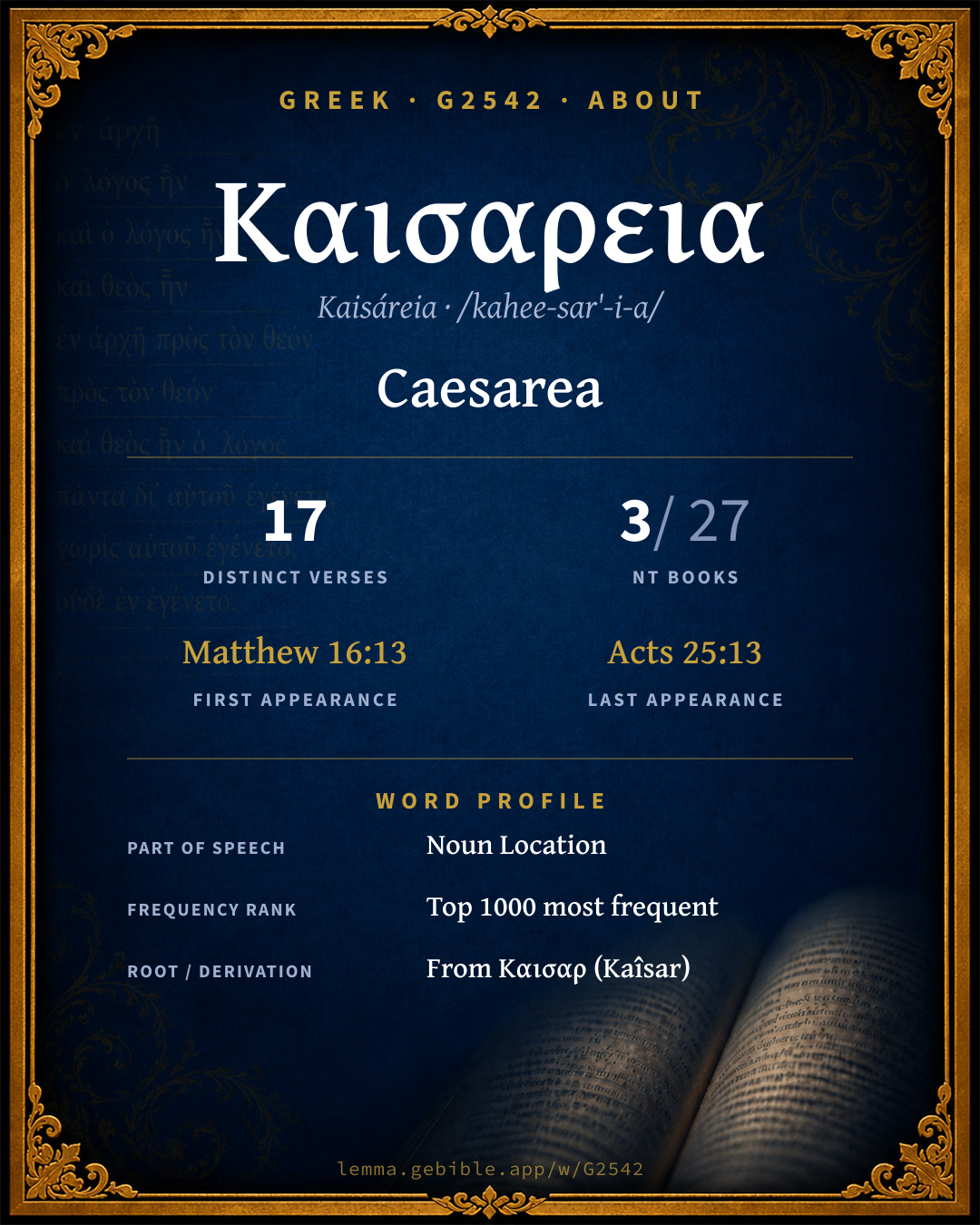
Καισάρεια
Caesarea
Thayer's lists 3 entries for ‘Caesarea’ fuller range ↓
Full lexicon entry — Thayer's Greek Lexicon
From Thayer's Greek Lexicon
Where this word appears
See every Accusative-case word in the Greek New Testament →
Grammar key — what these labels mean
Part of speech
- Noun
- A naming word — a person, place, thing, or idea.
Case
- Accusative
- The case of the direct object and of extent.
- Genitive
- The case of source, possession, or “of” — answers “whose / from what.”
- Dative
- The case of the indirect object, means, or location — “to / for / with / in.”
Gender
- Feminine
- Grammatically feminine.
Number
- Singular
- One.
Grammatical forms
- Noun, Accusative, Singular, Feminine 10 times (59%)
- Noun, Genitive, Singular, Feminine 6 times (35%)
- Noun, Dative, Singular, Feminine 1 time (6%)
Parsed forms decoded from the imported morphology (Robinson–Tischendorf, public domain), counted across 17 parsed occurrences — not distinct verses.
Every verse where G2542 appears — 17 distinct verses across 3 books. Click any verse to open its interlinear word-by-word view. Verse text shown in the World English Bible for context — . Each verse’s Greek form is shown with its reference; the English is not keyword-highlighted, since the data carries no word-level English alignment. Use “Compare translations” on any verse to read it across multiple English versions. This concordance covers the Greek New Testament; Septuagint (Greek Old Testament) occurrences of this word are not indexed here.
Matthew 1 verse
Mark 1 verse
Acts 15 verses
- Acts 8:40 Καισάριαν n acc sg fem But Philip was found at Azotus. Passing through, he preached the Gospel to all the cities, until he came to Caesarea.
- Acts 9:30 Καισάριαν n acc sg fem When the brothers knew it, they brought him down to Caesarea, and sent him off to Tarsus.
- Acts 10:1 Καισαρίᾳ n dat sg fem Now there was a certain man in Caesarea, Cornelius by name, a centurion of what was called the Italian Regiment,
- Acts 10:24 Καισάριαν n acc sg fem On the next day they entered into Caesarea. Cornelius was waiting for them, having called together his relatives and his near friends.
- Acts 11:11 Καισαρίας n gen sg fem Behold, immediately three men stood before the house where I was, having been sent from Caesarea to me.
- Acts 12:19 Καισάριαν n acc sg fem When Herod had sought for him, and didn't find him, he examined the guards, and commanded that they should be put to death. He went down from Judea to Caesarea, and stayed there.
- Acts 18:22 Καισάριαν n acc sg fem When he had landed at Caesarea, he went up and greeted the assembly, and went down to Antioch.
- Acts 21:8 Καισαρίαν n acc sg fem On the next day, we, who were Paul's companions, departed, and came to Caesarea. We entered into the house of Philip the evangelist, who was one of the seven, and stayed with him.
- Acts 21:16 Καισαρίας n gen sg fem Some of the disciples from Caesarea also went with us, bringing one Mnason of Cyprus, an early disciple, with whom we would stay.
- Acts 23:23 Καισαρίας n gen sg fem He called to himself two of the centurions, and said, "Prepare two hundred soldiers to go as far as Caesarea, with seventy horsemen, and two hundred men armed with spears, at the third hour of the night."
- Acts 23:33 Καισάριαν n acc sg fem When they came to Caesarea and delivered the letter to the governor, they also presented Paul to him.
- Acts 25:1 Καισαρίας n gen sg fem Festus therefore, having come into the province, after three days went up to Jerusalem from Caesarea.
- Acts 25:4 Καισάριαν n acc sg fem However Festus answered that Paul should be kept in custody at Caesarea, and that he himself was about to depart shortly.
- Acts 25:6 Καισάριαν n acc sg fem When he had stayed among them more than ten days, he went down to Caesarea, and on the next day he sat on the judgment seat, and commanded Paul to be brought.
- Acts 25:13 Καισάριαν n acc sg fem Now when some days had passed, Agrippa the King and Bernice arrived at Caesarea, and greeted Festus.
About this entry
At a glance — auto-summarized from this page’s data, not written by a person. Every figure links to its source below. This summary describes the numbers; it doesn’t interpret them.
Καισαρεια — transliterated Kaisáreia — is a Greek name carrying the sense “Caesarea.” More than three-quarters of its appearances fall in Acts. It appears 17 verses across 3 books of the Greek New Testament, among its uncommon vocabulary. Its earliest occurrence is Matthew 16:13. Each statement above links to its evidence; the full detail follows below.
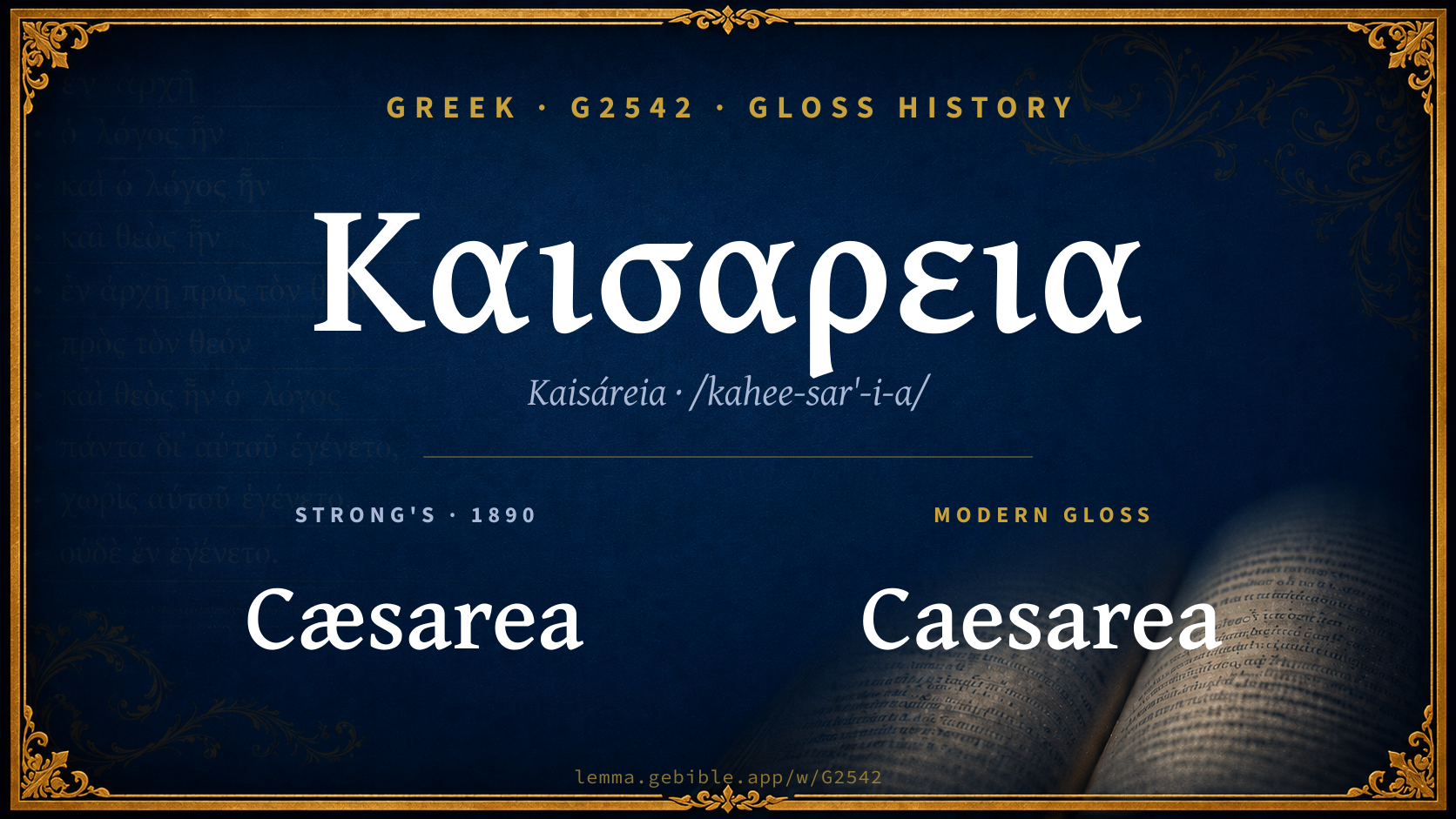
Gloss history
Strong's 1890 vs modern scholarship
About this word
Strong's G2542 catalogs a Greek word from the Greek New Testament.
These counts are not copied from any lexicon or concordance. They are computed here, from the morphology-tagged Greek New Testament. What Lemma adds →
- 17
- distinct verses
- The word appears in 17 distinct verses.
- 3 / 27
- NT books
- The word appears in 3 of 27 New Testament books.
- #697
- by frequency
- Top 1000 most frequent Greek words (rank 697 of 5,347 Greek words by occurrence).
View all 17 occurrences in the concordance →
By section of the New Testament
By traditional corpus
Conventional, traditional groupings — biblical authorship is debated, so this is a traditional corpus grouping, not an authorship claim. Some books belong to more than one corpus (Luke is in both the Gospels and the Lukan corpus, and so on), so these shares overlap and need not total 100%. Each figure is a share of the word’s 17 distinct verses.
- Lukan (Luke–Acts) 15 verses · 88%
- Gospels 2 verses · 12%
How translations render this word
Counts come from each version’s own published word-to-Strong’s tagging or interlinear alignment — an approximate guide to how each version renders this word, not a word-level alignment the data otherwise carries. Because each total is that version’s own tagged count, the per-version totals vary from one another and need not match the appearance or distinct-verse counts above. These counts may also differ from a printed concordance because Lemma counts each distinctly tagged rendering and does not collapse phrase taggings into a single head-word total. This is a fixed set of word-tagged versions (KJV, ASV, BSB, ULT) and does not change with the reading translation you choose elsewhere. Each version’s license is shown beside its name below (and on Sources).
- King James Version: Caesarea 17×
- American Standard Version: Caesarea 17×
- Berean Standard Bible: Caesarea 16×
- unfoldingWord Literal Text: Caesarea 17×
King James Version Public Domain
Renders G2542 across 17 tagged occurrences — most commonly:
American Standard Version Public Domain
Renders G2542 across 17 tagged occurrences — most commonly:
Berean Standard Bible Public Domain
Renders G2542 across 17 tagged occurrences — most commonly:
Plus 1 rendering that appears only once — usually multi-word phrases or single function words the recovered tagging swept in, not distinct renderings.
unfoldingWord Literal Text CC BY-SA 4.0
Renders G2542 across 17 tagged occurrences — most commonly:
Senses in Thayer's
The 3 senses Thayer's distinguishes for this word, in lexicon order (not ranked by frequency or importance). The full entry — with sub-senses — is in the Lexicon Entry tab.
- Caesarea = "severed"
- Caesarea of Philippi was situated at the foot of Lebanon near the sources of the Jordan in Gaulanitis…
- Caesarea of Palestine was built near the Mediterranean by Herod the Great on the site of Strabo's Tower…
Word origin
Derived from Καισαρ (Kaîsar) (G2541) — Caesar.
From G2541 ; Caesaria the name of two places in Palestine : - Csarea.
— Strong’s Exhaustive Concordance (1890), public domain.
Forms in the corpus
The 5 distinct written forms G2542 takes in the Greek New Testament, most frequent first — each parse links to that case’s occurrences in the concordance.
| Form | Parsing | Example | Uses |
|---|---|---|---|
| Καισάριαν Kaisárian | Noun, Accusative, Singular, Feminine | Acts 8:40 | 9 |
| Καισαρίας Kaisarías | Noun, Genitive, Singular, Feminine | Acts 11:11 | 4 |
| Καισαρείας Kaisareías | Noun, Genitive, Singular, Feminine | Matthew 16:13 | 2 |
| Καισαρίαν Kaisarían | Noun, Accusative, Singular, Feminine | Acts 21:8 | 1 |
| Καισαρίᾳ Kaisaría | Noun, Dative, Singular, Feminine | Acts 10:1 | 1 |
Bible dictionary
Public-domain dictionary articles matched to this entry by name (Caesarea). A biblical name can be shared by more than one person or place, so an article may treat several.
Easton's Bible Dictionary · M. G. Easton, 1897
(Palestinae), a city on the shore of the Mediterranean, on the great road from Tyre to Egypt, about 70 miles northwest of Jerusalem, at the northern extremity of the plain of Sharon. It was built by Herod the Great (B.C. 10), who named it after Caesar Augustus, hence called Caesarea Sebaste (Gr. Sebastos = "Augustus"), on the site of an old town called "Strato's Tower." It was the capital of the Roman province of Judaea, the seat of the governors or procurators, and the headquarters of the Roman troops. It was the great Gentile city of Palestine, with a spacious artificial harbour. It was adorned with many buildings of great splendour, after the manner of the Roman cities of the West. Here Cornelius the centurion was converted through the instrumentality of Peter (Acts 10:1, 24), and thus for the first time the door of faith was opened to the Gentiles. Philip the evangelist resided here with his four daughters (21:8). From this place Saul sailed for his native Tarsus when forced to flee from Jerusalem (9:30), and here he landed when returning from his second missionary journey (18:22). He remained as a prisoner here for two years before his voyage to Rome (Acts 24:27; 25:1, 4, 6, 13). Here on a "set day," when games were celebrated in the theatre in honour of the emperor Claudius, Herod Agrippa I. appeared among the people in great pomp, and in the midst of the idolatrous homage paid to him was suddenly smitten by an angel, and carried out a dying man. He was "eaten of worms" (12:19-23), thus perishing by the same loathsome disease as his granfather, Herod the Great. It still retains its ancient name Kaiseriyeh, but is now desolate. "The present inhabitants of the ruins are snakes, scorpions, lizards, wild boars, and jackals." It is described as the most desolate city of all Palestine.
Smith's Bible Dictionary · William Smith, 1863
(Acts 8:40; 9:30; 10:1,24; 11:11; 12:19; 18:22; 21:8,16; 23:23,33; 25:1,4,6,13) was situated on the coast of Palestine, on the line of the great road from Tyre to Egypt, and about halfway between Joppa and Dora. The distance from Jerusalem was about 70 miles; Josephus states it in round numbers as 600 stadia. In Strabo's time there was on this point of the coast merely a town called "Strato's Tower," with a landing-place, whereas in the time of Tacitus Caesarea is spoken of as being the head of Judea. It was in this interval that the city was built by Herod the Great. It was the official residence of the Herodian kings, and of Festus, Felix and the other Roman procurators of Judea. Here also lived Philip the deacon and his four prophesying daughters. Caesarea continued to be a city of some importance even in the time of the Crusades, and the name still lingers on the site (Kaisariyeh), which is a complete desolation, many of the building-stones having been carried to other towns.
Classic public-domain reference works; full attribution on Sources.