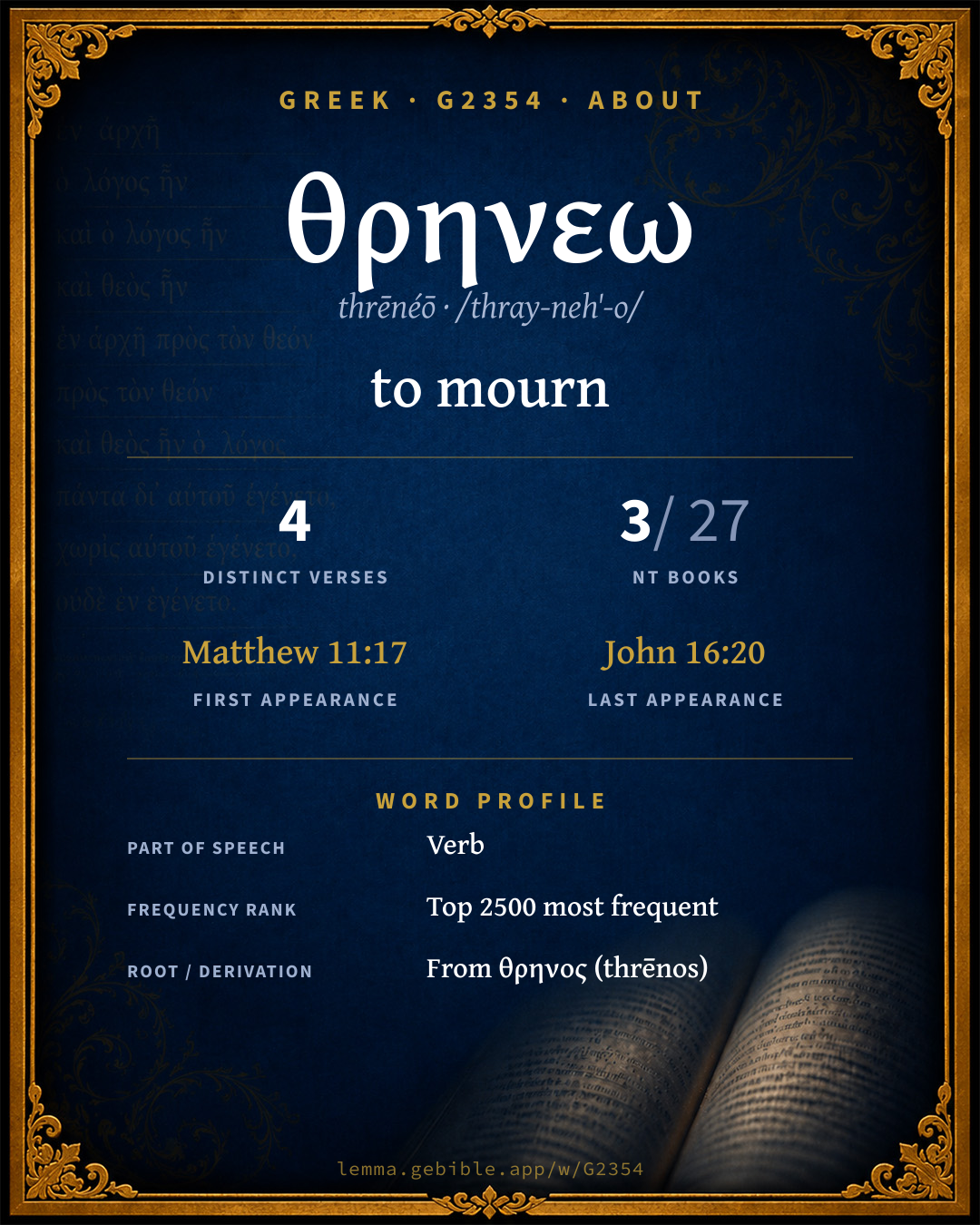
θρηνέω
to mourn
‘to mourn’ is one of 2 main senses fuller range ↓
Full lexicon entry — Thayer's Greek Lexicon
From Thayer's Greek Lexicon
Where this word appears
Grammar key — what these labels mean
Part of speech
- Verb
- An action or state-of-being word.
Tense
- Aorist
- Action viewed as a simple whole, without regard to duration — often past (perfective aspect).
- Future
- Action expected in future time.
- Imperfect
- Continuous or repeated action in past time (“was writing”).
Voice
- Active
- The subject performs the action.
Mood
- Indicative
- States a fact or asks a factual question (the mood of reality).
Person
- 1st person
- The speaker (“I / we”).
- 2nd person
- The one addressed (“you”).
- 3rd person
- The one spoken about (“he / she / it / they”).
Number
- Plural
- More than one.
Every verse where G2354 appears in the Book of Matthew — 1 distinct verse. Click any verse to open its interlinear word-by-word view. Verse text shown in the World English Bible for context — . Each verse’s Greek form is shown with its reference; the English is not keyword-highlighted, since the data carries no word-level English alignment. Use “Compare translations” on any verse to read it across multiple English versions. This concordance covers the Greek New Testament; Septuagint (Greek Old Testament) occurrences of this word are not indexed here.
Matthew
About this entry
At a glance — auto-summarized from this page’s data, not written by a person. Every figure links to its source below. This summary describes the numbers; it doesn’t interpret them.
θρηνεω (thrēnéō) is a Greek verb most often rendered “to mourn.” The Greek New Testament uses it only 4 verses. It clusters heavily in Luke, which alone accounts for 50% of its uses. Scripture first uses it in Matthew 11:17. Ranging over 2 senses, it is not a single-sense word. For the data behind this summary, explore the sense tree and the renderings breakdown below.
Gloss history
Strong's 1890 vs modern scholarship

About this word
Strong's G2354 catalogs a Greek word from the Greek New Testament.
These counts are not copied from any lexicon or concordance. They are computed here, from the morphology-tagged Greek New Testament. What Lemma adds →
- 4
- distinct verses
- The word appears in 4 distinct verses.
- 3 / 27
- NT books
- The word appears in 3 of 27 New Testament books.
- #1,877
- by frequency
- Top 2500 most frequent Greek words (rank 1,877 of 5,347 Greek words by occurrence).
View all 4 occurrences in the concordance →
By section of the New Testament
By traditional corpus
Conventional, traditional groupings — biblical authorship is debated, so this is a traditional corpus grouping, not an authorship claim. Some books belong to more than one corpus (Luke is in both the Gospels and the Lukan corpus, and so on), so these shares overlap and need not total 100%. Each figure is a share of the word’s 4 distinct verses.
- Gospels 4 verses · 100%
- Lukan (Luke–Acts) 2 verses · 50%
- Johannine 1 verse · 25%
How translations render this word
Counts come from each version’s own published word-to-Strong’s tagging or interlinear alignment — an approximate guide to how each version renders this word, not a word-level alignment the data otherwise carries. Because each total is that version’s own tagged count, the per-version totals vary from one another and need not match the appearance or distinct-verse counts above. These counts may also differ from a printed concordance because Lemma counts each distinctly tagged rendering and does not collapse phrase taggings into a single head-word total. This is a fixed set of word-tagged versions (KJV, ASV, BSB, ULT) and does not change with the reading translation you choose elsewhere. Each version’s license is shown beside its name below (and on Sources).
- King James Version: We have mourned 2×
- American Standard Version: We wailed 2×
- Berean Standard Bible: We sang a dirge 2×
- unfoldingWord Literal Text: We sang a funeral song 2×
King James Version Public Domain
Renders G2354 across 4 tagged occurrences — most commonly:
Plus 2 renderings that appear only once — usually multi-word phrases or single function words the recovered tagging swept in, not distinct renderings.
American Standard Version Public Domain
Renders G2354 across 4 tagged occurrences — most commonly:
Plus 2 renderings that appear only once — usually multi-word phrases or single function words the recovered tagging swept in, not distinct renderings.
Berean Standard Bible Public Domain
Renders G2354 across 4 tagged occurrences — most commonly:
Plus 2 renderings that appear only once — usually multi-word phrases or single function words the recovered tagging swept in, not distinct renderings.
unfoldingWord Literal Text CC BY-SA 4.0
Renders G2354 across 4 tagged occurrences — most commonly:
Plus 2 renderings that appear only once — usually multi-word phrases or single function words the recovered tagging swept in, not distinct renderings.
Senses in Thayer's
The 2 senses Thayer's distinguishes for this word, in lexicon order (not ranked by frequency or importance). The full entry — with sub-senses — is in the Lexicon Entry tab.
- of singers of dirges, [to wail]
- to bewail, deplore
Word origin
Derived from θρηνος (thrēnos) (G2355) — lamentation.
From G2355 ; to bewail : - lament mourn.
— Strong’s Exhaustive Concordance (1890), public domain.
Forms in the corpus
The 3 distinct written forms G2354 takes in the Greek New Testament, most frequent first — each parse links to that tense’s occurrences in the concordance.
| Form | Parsing | Example | Uses |
|---|---|---|---|
| ἐθρηνήσαμεν ethrēnḗsamen | Verb, Aorist, Active, Indicative, 1st person, Plural | Matthew 11:17 | 2 |
| θρηνήσετε thrēnḗsete | Verb, Future, Active, Indicative, 2nd person, Plural | John 16:20 | 1 |
| ἐθρήνουν ethrḗnoun | Verb, Imperfect, Active, Indicative, 3rd person, Plural | Luke 23:27 | 1 |
Septuagint usage
The same Greek word θρηνεω appears 21 times in the Greek Old Testament (Septuagint), across 19 verses in 9 books.
- 21
- LXX occurrences
- Tagged occurrences of this Greek word in the Septuagint.
- 19
- verses
- Distinct Septuagint verses containing this word.
- 9 / 39
- OT books
- The word appears in 9 of the 39 Old Testament books.
Sample Septuagint occurrences
- Judges 11:40 θρηνέω
- 2 Samuel 1:17 θρηνέω
- 2 Chronicles 35:25 θρηνέω
- Jeremiah 9:16 θρηνέω
- Ezekiel 7:12 θρηνέω
- Joel 1:5 θρηνέω
- Micah 1:8 θρηνέω
- Zephaniah 1:11 θρηνέω
- Zechariah 11:3 θρηνέω
Septuagint occurrences (same lexeme)
Every verse where the same Strong’s number (G2354) appears in the Greek Septuagint. Verse text shown in the World English Bible for context; the Greek form is the matched word — the English is not keyword-highlighted.
- Judges 11:40 θρηνέω that the daughters of Israel went yearly to celebrate the daughter of Jephthah the Gileadite four days in a year.
- 2 Samuel 1:17 θρηνέω David lamented with this lamentation over Saul and over Jonathan his son
- 2 Samuel 3:33 θρηνέω The king lamented for Abner, and said, Should Abner die as a fool dies?
- 2 Chronicles 35:25 θρηνέω Jeremiah lamented for Josiah: and all the singing men and singing women spoke of Josiah in their lamentations to this day; and they made them an ordinance in Israel: and, behold, they are written in the lamentations.
- Jeremiah 9:16 θρηνέω I will scatter them also among the nations, whom neither they nor their fathers have known; and I will send the sword after them, until I have consumed them.
- Jeremiah 22:10 θρηνέω Don't you weep for the dead, neither bemoan him; but weep sore for him who goes away; for he shall return no more, nor see his native country.
- Jeremiah 28:8 θρηνέω The prophets who have been before me and before you of old prophesied against many countries, and against great kingdoms, of war, and of evil, and of pestilence.
- Ezekiel 7:12 θρηνέω The time is come, the day draws near: don't let the buyer rejoice, nor the seller mourn; for wrath is on all the multitude of it.
- Ezekiel 8:14 θρηνέω Then he brought me to the door of the gate of Yahweh's house which was toward the north; and see, there sat the women weeping for Tammuz.
- Ezekiel 32:16 θρηνέω This is the lamentation with which they shall lament; the daughters of the nations shall lament therewith; over Egypt, and over all her multitude, shall they lament therewith, says the Lord Yahweh.
- Ezekiel 32:18 θρηνέω Son of man, wail for the multitude of Egypt, and cast them down, even her, and the daughters of the famous nations, to the lower parts of the earth, with those who go down into the pit.
- Joel 1:5 θρηνέω Wake up, you drunkards, and weep! Wail, all you drinkers of wine, because of the sweet wine; For it is cut off from your mouth.
- Joel 1:8 θρήνέω Mourn like a virgin dressed in sackcloth for the husband of her youth!
- Joel 1:11 θρηνέω Be confounded, you farmers! Wail, you vineyard keepers; For the wheat and for the barley; For the harvest of the field has perished.
- Joel 1:13 θρηνέω Put on sackcloth and mourn, you priests! Wail, you ministers of the altar. Come, lie all night in sackcloth, you ministers of my God, For the meal offering and the drink offering are withheld from your God's house.
- Micah 1:8 θρηνέω For this I will lament and wail; I will go stripped and naked; I will howl like the jackals, And moan like the daughters of owls.
- Micah 2:4 θρηνέω In that day they will take up a parable against you, And lament with a doleful lamentation, saying, 'We are utterly ruined! My people's possession is divided up. Indeed he takes it from me and assigns our fields to traitors!'"
- Zephaniah 1:11 θρηνέω Wail, you inhabitants of Maktesh, for all the people of Canaan are undone! All those who were loaded with silver are cut off.
- Zechariah 11:3 θρηνέω A voice of the wailing of the shepherds! For their glory is destroyed: a voice of the roaring of young lions! For the pride of the Jordan is ruined.
These are occurrences of the same Greek lexeme (G2354) in the Septuagint — not a translation of any one Hebrew word. The store carries no word-level Hebrew↔Greek alignment, so no Hebrew original is asserted here. Counts come from the recovered LXX Strong's tagging — high-frequency vocabulary is well covered, while rare or late forms may be untagged — so they reflect tagged occurrences and may slightly undercount.