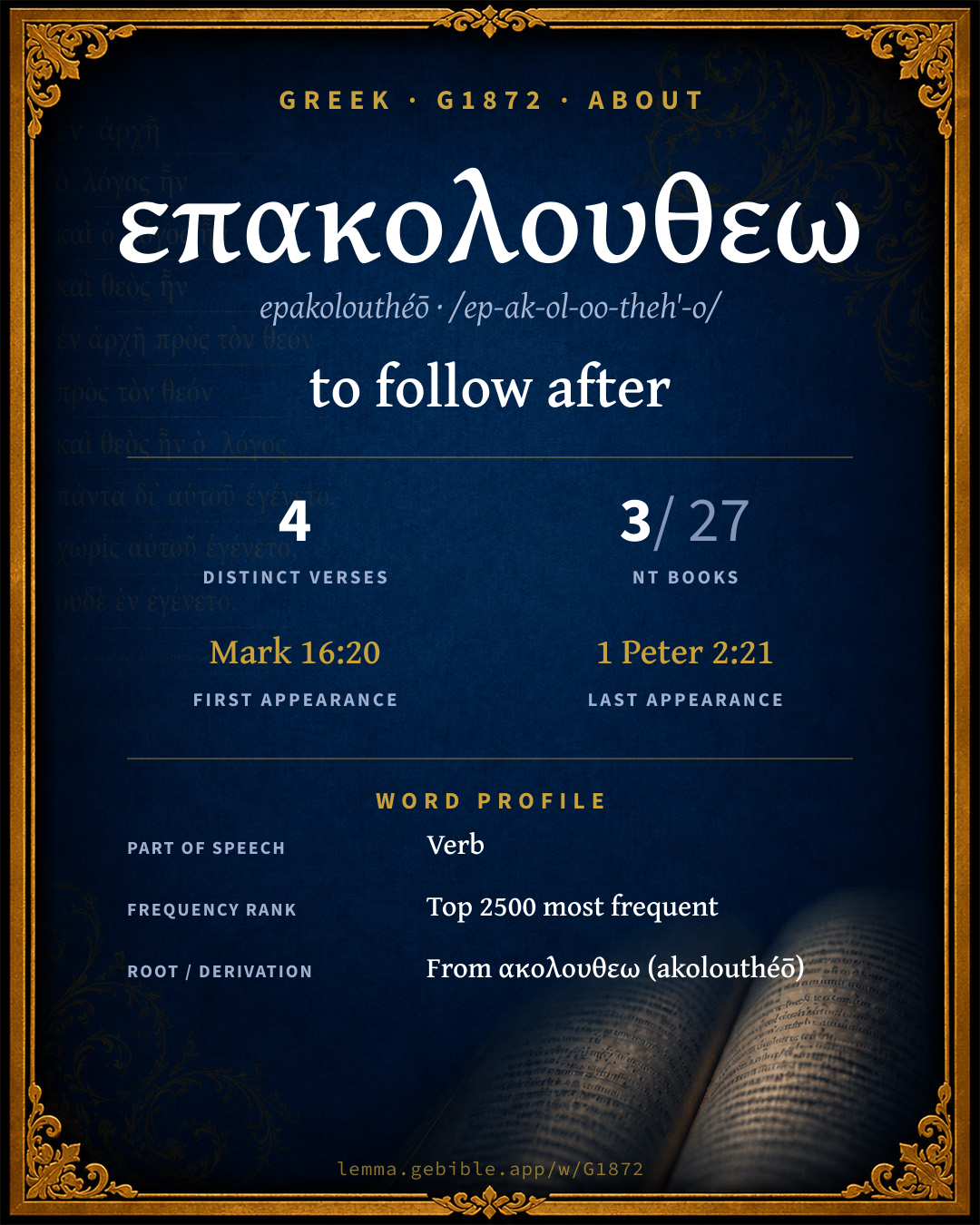
ἐπακολουθέω
to follow after
‘to follow after’ is one of 2 main senses fuller range ↓
Full lexicon entry — Thayer's Greek Lexicon
From Thayer's Greek Lexicon
Where this word appears
See every Aorist-tense verb in the Greek New Testament →
Grammar key — what these labels mean
Part of speech
- Verb
- An action or state-of-being word.
Tense
- Aorist
- Action viewed as a simple whole, without regard to duration — often past (perfective aspect).
- Present
- Ongoing or general action in present time (imperfective aspect).
Voice
- Active
- The subject performs the action.
Mood
- Indicative
- States a fact or asks a factual question (the mood of reality).
- Subjunctive
- Expresses probability, purpose, or possibility (the mood of contingency).
- Participle
- A verbal adjective (“writing,” “having written”).
Case
- Genitive
- The case of source, possession, or “of” — answers “whose / from what.”
Person
- 3rd person
- The one spoken about (“he / she / it / they”).
- 2nd person
- The one addressed (“you”).
Gender
- Neuter
- Grammatically neuter.
Number
- Singular
- One.
- Plural
- More than one.
Grammatical forms
- Verb, Aorist, Active, Indicative, 3rd person, Singular 1 time (25%)
- Verb, Aorist, Active, Subjunctive, 2nd person, Plural 1 time (25%)
- Verb, Present, Active, Indicative, 3rd person, Plural 1 time (25%)
- Verb, Present, Active, Participle, Genitive, Plural, Neuter 1 time (25%)
Parsed forms decoded from the imported morphology (Robinson–Tischendorf, public domain), counted across 4 parsed occurrences — not distinct verses.
Every verse where G1872 appears — 4 distinct verses across 3 books. Click any verse to open its interlinear word-by-word view. Verse text shown in the World English Bible for context — . Each verse’s Greek form is shown with its reference; the English is not keyword-highlighted, since the data carries no word-level English alignment. Use “Compare translations” on any verse to read it across multiple English versions. This concordance covers the Greek New Testament; Septuagint (Greek Old Testament) occurrences of this word are not indexed here.
Mark 1 verse
1 Timothy 2 verses
- 1 Timothy 5:10 ἐπηκολούθησεν aor act ind 3sg being approved by good works, if she has brought up children, if she has been hospitable to strangers, if she has washed the saints' feet, if she has relieved the afflicted, and if she has diligently followed every good work.
- 1 Timothy 5:24 ἐπακολουθοῦσιν pres act ind 3pl Some men's sins are evident, preceding them to judgment, and some also follow later.
1 Peter 1 verse
About this entry
At a glance — auto-summarized from this page’s data, not written by a person. Every figure links to its source below. This summary describes the numbers; it doesn’t interpret them.
At its core, επακολουθεω (epakolouthéō) means “to follow after.” With only 4 verses it sits in the long tail of Greek New Testament vocabulary. Its uses cluster heavily in 1 Timothy (50% of all occurrences). Scripture first uses it in Mark 16:20. Ranging over 2 senses, it is not a single-sense word. Dig into 4-verse concordance and the renderings breakdown below.
Gloss history
Strong's 1890 vs modern scholarship
About this word
Strong's G1872 catalogs a Greek word from the Greek New Testament.
These counts are not copied from any lexicon or concordance. They are computed here, from the morphology-tagged Greek New Testament. What Lemma adds →
- 4
- distinct verses
- The word appears in 4 distinct verses.
- 3 / 27
- NT books
- The word appears in 3 of 27 New Testament books.
- #1,877
- by frequency
- Top 2500 most frequent Greek words (rank 1,877 of 5,347 Greek words by occurrence).
View all 4 occurrences in the concordance →
By section of the New Testament
By traditional corpus
Conventional, traditional groupings — biblical authorship is debated, so this is a traditional corpus grouping, not an authorship claim. Some books belong to more than one corpus (Luke is in both the Gospels and the Lukan corpus, and so on), so these shares overlap and need not total 100%. Each figure is a share of the word’s 4 distinct verses.
- Pauline corpus 2 verses · 50%
- Gospels 1 verse · 25%
- General (Catholic) Epistles 1 verse · 25%
How translations render this word
Counts come from each version’s own published word-to-Strong’s tagging or interlinear alignment — an approximate guide to how each version renders this word, not a word-level alignment the data otherwise carries. Because each total is that version’s own tagged count, the per-version totals vary from one another and need not match the appearance or distinct-verse counts above. These counts may also differ from a printed concordance because Lemma counts each distinctly tagged rendering and does not collapse phrase taggings into a single head-word total. This is a fixed set of word-tagged versions (KJV, ASV, BSB, ULT) and does not change with the reading translation you choose elsewhere. Each version’s license is shown beside its name below (and on Sources).
- King James Version: Following 1×, Men they follow after 1×, She have diligently followed 1×
- American Standard Version: Followed 1×, Men also they follow after 1×, She hath diligently followed 1×
- Berean Standard Bible: Accompanied 1×, Devoting herself to 1×, Do surface until later 1×
- unfoldingWord Literal Text: Accompanying 1×, She has followed 1×, They follow after 1×
King James Version Public Domain
Renders G1872 across 4 tagged occurrences — most commonly:
American Standard Version Public Domain
Renders G1872 across 4 tagged occurrences — most commonly:
Berean Standard Bible Public Domain
Renders G1872 across 4 tagged occurrences — most commonly:
unfoldingWord Literal Text CC BY-SA 4.0
Renders G1872 across 4 tagged occurrences — most commonly:
Senses in Thayer's
The 2 senses Thayer's distinguishes for this word, in lexicon order (not ranked by frequency or importance). The full entry — with sub-senses — is in the Lexicon Entry tab.
- to follow (close) upon, follow after
- to tread in one's footsteps i.e. to imitate his example
Word origin
Derived from ακολουθεω (akolouthéō) (G190) — to follow.
Forms in the corpus
The 4 distinct written forms G1872 takes in the Greek New Testament, most frequent first — each parse links to that tense’s occurrences in the concordance.
| Form | Parsing | Example | Uses |
|---|---|---|---|
| ἐπακολουθήσητε epakolouthḗsēte | Verb, Aorist, Active, Subjunctive, 2nd person, Plural | 1 Peter 2:21 | 1 |
| ἐπακολουθούντων epakolouthoúntōn | Verb, Present, Active, Participle, Genitive, Plural, Neuter | Mark 16:20 | 1 |
| ἐπακολουθοῦσιν epakolouthoûsin | Verb, Present, Active, Indicative, 3rd person, Plural | 1 Timothy 5:24 | 1 |
| ἐπηκολούθησεν epēkoloúthēsen | Verb, Aorist, Active, Indicative, 3rd person, Singular | 1 Timothy 5:10 | 1 |
Septuagint usage
The same Greek word επακολουθεω appears 15 times in the Greek Old Testament (Septuagint), across 15 verses in 7 books.
- 15
- LXX occurrences
- Tagged occurrences of this Greek word in the Septuagint.
- 15
- verses
- Distinct Septuagint verses containing this word.
- 7 / 39
- OT books
- The word appears in 7 of the 39 Old Testament books.
Sample Septuagint occurrences
- Leviticus 19:4 ἐπιἀκολουθέω
- Numbers 14:24 ἐπιἀκολουθέω
- Deuteronomy 12:30 ἐπιἀκολουθέω
- Joshua 6:8 ἐπιἀκολουθέω
- Job 26:3 ἐπιἀκολουθέω
- Proverbs 7:22 ἐπιἀκολουθέω
- Isaiah 55:3 ἐπιἀκολουθέω
Septuagint occurrences (same lexeme)
Every verse where the same Strong’s number (G1872) appears in the Greek Septuagint. Verse text shown in the World English Bible for context; the Greek form is the matched word — the English is not keyword-highlighted.
- Leviticus 19:4 ἐπιἀκολουθέω "'Don't turn to idols, nor make molten gods for yourselves. I am Yahweh your God.
- Leviticus 19:31 ἐπιἀκολουθέω "'Don't turn to those who are mediums, nor to the wizards. Don't seek them out, to be defiled by them. I am Yahweh your God.
- Leviticus 20:6 ἐπιἀκολουθέω "'The person that turns to those who are mediums, and to the wizards, to play the prostitute after them, I will even set my face against that person, and will cut him off from among his people.
- Numbers 14:24 ἐπιἀκολουθέω but my servant Caleb, because he had another spirit with him, and has followed me fully, him will I bring into the land into which he went; and his seed shall possess it.
- Numbers 32:11 ἐπιἀκολουθέω Surely none of the men who came up out of Egypt, from twenty years old and upward, shall see the land which I swore to Abraham, to Isaac, and to Jacob; because they have not wholly followed me:
- Numbers 32:12 ἐπιἀκολουθέω save Caleb the son of Jephunneh the Kenizzite, and Joshua the son of Nun; because they have wholly followed Yahweh.
- Deuteronomy 12:30 ἐπιἀκολουθέω take heed to yourself that you not be ensnared to follow them, after that they are destroyed from before you; and that you not inquire after their gods, saying, How do these nations serve their gods? even so will I do likewise.
- Joshua 6:8 ἐπιἀκολουθέω It was so, that when Joshua had spoken to the people, the seven priests bearing the seven trumpets of rams' horns before Yahweh passed on, and blew the trumpets: and the ark of the covenant of Yahweh followed them.
- Joshua 14:8 ἐπιἀκολουθέω Nevertheless my brothers who went up with me made the heart of the people melt; but I wholly followed Yahweh my God.
- Joshua 14:9 ἐπιἀκολουθέω Moses swore on that day, saying, Surely the land whereon your foot has trodden shall be an inheritance to you and to your children forever, because you have wholly followed Yahweh my God.
- Joshua 14:14 ἐπιἀκολουθέω Therefore Hebron became the inheritance of Caleb the son of Jephunneh the Kenizzite to this day; because that he wholly followed Yahweh, the God of Israel.
- Job 26:3 ἐπιἀκολουθέω How have you counseled him who has no wisdom, And plentifully declared sound knowledge!
- Job 31:7 ἐπιἀκολουθέω If my step has turned out of the way, If my heart walked after my eyes, If any defilement has stuck to my hands,
- Proverbs 7:22 ἐπιἀκολουθέω He followed her immediately, As an ox goes to the slaughter, As a fool stepping into a noose.
- Isaiah 55:3 ἐπιἀκολουθέω Turn your ear, and come to me; hear, and your soul shall live: and I will make an everlasting covenant with you, even the sure mercies of David.
These are occurrences of the same Greek lexeme (G1872) in the Septuagint — not a translation of any one Hebrew word. The store carries no word-level Hebrew↔Greek alignment, so no Hebrew original is asserted here. Counts come from the recovered LXX Strong's tagging — high-frequency vocabulary is well covered, while rare or late forms may be untagged — so they reflect tagged occurrences and may slightly undercount.