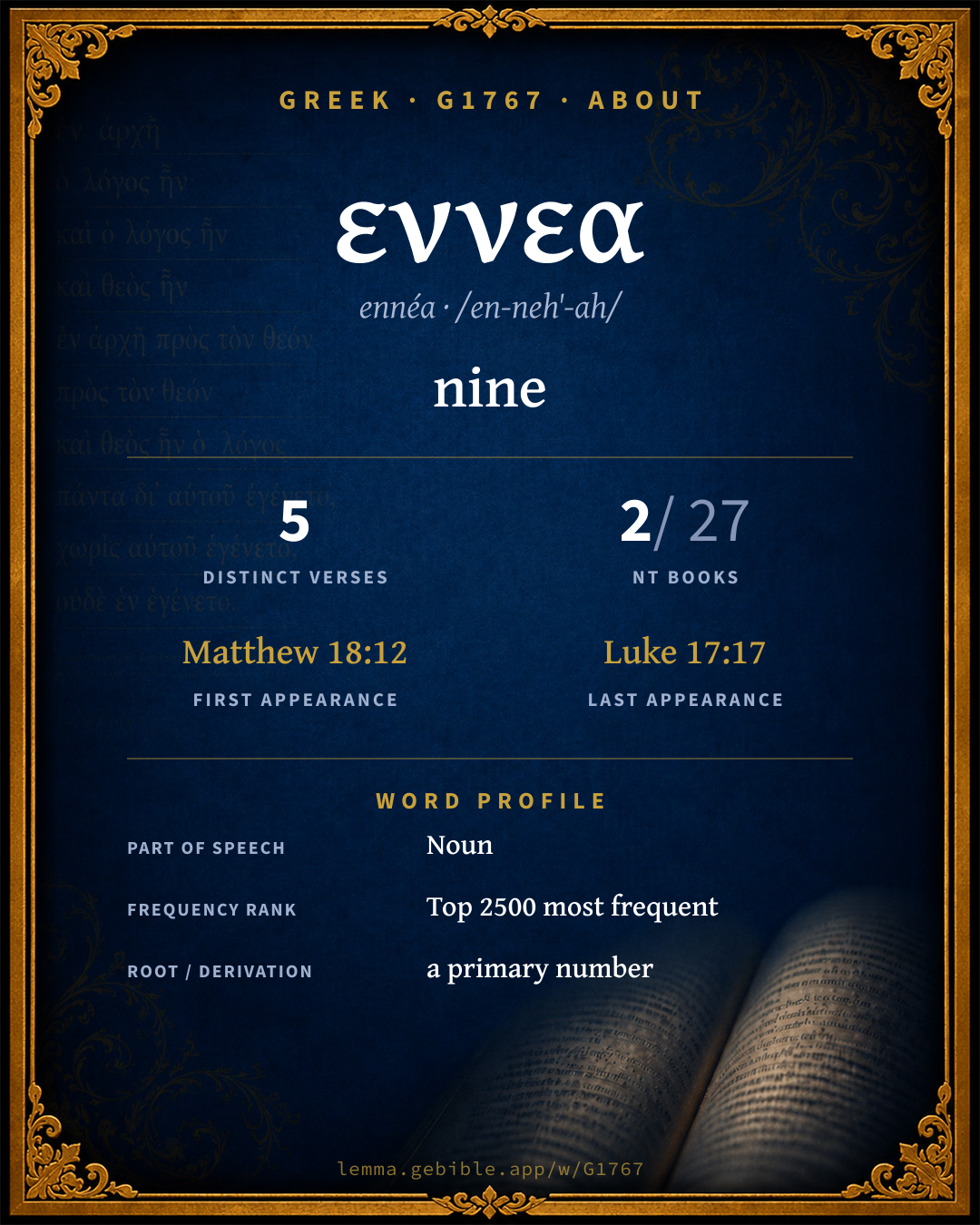
ἐννέα
nine
Full lexicon entry — Thayer's Greek Lexicon
From Thayer's Greek Lexicon
Where this word appears
Every verse where G1767 appears — 5 distinct verses across 2 books. Click any verse to open its interlinear word-by-word view. Verse text shown in the World English Bible for context — . Each verse’s Greek form is shown with its reference; the English is not keyword-highlighted, since the data carries no word-level English alignment. Use “Compare translations” on any verse to read it across multiple English versions. This concordance covers the Greek New Testament; Septuagint (Greek Old Testament) occurrences of this word are not indexed here.
Matthew 2 verses
- Matthew 18:12 ἐννέα adj num indecl "What do you think? If a man has one hundred sheep, and one of them goes astray, doesn't he leave the ninety-nine, go to the mountains, and seek that which has gone astray?
- Matthew 18:13 ἐννέα adj num indecl If he finds it, most assuredly I tell you, he rejoices over it more than over the ninety-nine which have not gone astray.
Luke 3 verses
- Luke 15:4 ἐννέα adj num indecl "Which of you men, if you had one hundred sheep, and lost one of them, wouldn't leave the ninety-nine in the wilderness, and go after the one that was lost, until he found it?
- Luke 15:7 ἐννέα adj num indecl I tell you that even so there will be more joy in heaven over one sinner who repents, than over ninety-nine righteous people who need no repentance.
- Luke 17:17 ἐννέα adj num indecl Jesus answered, "Weren't the ten cleansed? But where are the nine?
About this entry
At a glance — auto-summarized from this page’s data, not written by a person. Every figure links to its source below. This summary describes the numbers; it doesn’t interpret them.
At its core, εννεα (ennéa) means “nine.” A scarce word — 5 verses in all of the Greek New Testament. Its uses cluster heavily in Luke (60% of all occurrences). It first appears in Matthew 18:12. Sharing its root, it stands alongside εννατος and εννενηκονταεννεα. Each statement above links to its evidence; the full detail follows below.
Gloss history
Strong's 1890 vs modern scholarship
About this word
Strong's G1767 catalogs a Greek word from the Greek New Testament.
These counts are not copied from any lexicon or concordance. They are computed here, from the morphology-tagged Greek New Testament. What Lemma adds →
- 5
- distinct verses
- The word appears in 5 distinct verses.
- 2 / 27
- NT books
- The word appears in 2 of 27 New Testament books.
- #1,648
- by frequency
- Top 2500 most frequent Greek words (rank 1,648 of 5,347 Greek words by occurrence).
View all 5 occurrences in the concordance →
By traditional corpus
Conventional, traditional groupings — biblical authorship is debated, so this is a traditional corpus grouping, not an authorship claim. Some books belong to more than one corpus (Luke is in both the Gospels and the Lukan corpus, and so on), so these shares overlap and need not total 100%. Each figure is a share of the word’s 5 distinct verses.
- Gospels 5 verses · 100%
- Lukan (Luke–Acts) 3 verses · 60%
How translations render this word
Counts come from each version’s own published word-to-Strong’s tagging or interlinear alignment — an approximate guide to how each version renders this word, not a word-level alignment the data otherwise carries. Because each total is that version’s own tagged count, the per-version totals vary from one another and need not match the appearance or distinct-verse counts above. These counts may also differ from a printed concordance because Lemma counts each distinctly tagged rendering and does not collapse phrase taggings into a single head-word total. This is a fixed set of word-tagged versions (KJV, ASV, BSB, ULT) and does not change with the reading translation you choose elsewhere. Each version’s license is shown beside its name below (and on Sources).
- King James Version: Are the nine 1×
- American Standard Version: Are the nine 1×
- Berean Standard Bible: Nine 1×
- unfoldingWord Literal Text: Nine 1×
King James Version Public Domain
Renders G1767 across 1 tagged occurrence — most commonly:
American Standard Version Public Domain
Renders G1767 across 1 tagged occurrence — most commonly:
Berean Standard Bible Public Domain
Renders G1767 across 1 tagged occurrence — most commonly:
Not rendered by a distinct English word in 4 further occurrences.
unfoldingWord Literal Text CC BY-SA 4.0
Renders G1767 across 1 tagged occurrence — most commonly:
Not rendered by a distinct English word in 4 further occurrences.
Senses in Thayer's
The 1 sense Thayer's distinguishes for this word, in lexicon order (not ranked by frequency or importance). The full entry — with sub-senses — is in the Lexicon Entry tab.
- nine
Word origin
Origin: a primary number
A primary number; nine : - nine.
— Strong’s Exhaustive Concordance (1890), public domain.
Same root — word family
Other Thayer's entries built from the same root as G1767, grouped by Strong’s listed origin. These share a root / origin per the lexicon — not necessarily a shared meaning. Each links to that word’s own entry.
Derived from this word
Compare all same-root words → They share a root, not necessarily a meaning.
Septuagint usage
The same Greek word εννεα appears 31 times in the Greek Old Testament (Septuagint), across 31 verses in 12 books.
- 31
- LXX occurrences
- Tagged occurrences of this Greek word in the Septuagint.
- 31
- verses
- Distinct Septuagint verses containing this word.
- 12 / 39
- OT books
- The word appears in 12 of the 39 Old Testament books.
Sample Septuagint occurrences
- Genesis 5:27 ἐννέα
- Exodus 39:1 ἐννέα
- Leviticus 25:8 ἐννέα
- Numbers 1:23 ἐννέα
- Deuteronomy 3:11 ἐννέα
- Joshua 12:24 ἐννέα
- 2 Samuel 24:8 ἐννέα
- 2 Kings 14:2 ἐννέα
- 1 Chronicles 3:8 ἐννέα
- 2 Chronicles 25:1 ἐννέα
- Ezra 1:9 ἐννέα
- Daniel 3:47 ἐννέα
Septuagint occurrences (same lexeme)
Every verse where the same Strong’s number (G1767) appears in the Greek Septuagint. Verse text shown in the World English Bible for context; the Greek form is the matched word — the English is not keyword-highlighted.
- Genesis 5:27 ἐννέα All the days of Methuselah were nine hundred sixty-nine years, then he died.
- Genesis 11:19 ἐννέα Peleg lived after he became the father of Reu two hundred nine years, and became the father of sons and daughters.
- Genesis 11:24 ἐννέα Nahor lived twenty-nine years, and became the father of Terah.
- Genesis 11:25 ἐννέα Nahor lived after he became the father of Terah one hundred nineteen years, and became the father of sons and daughters.
- Genesis 17:1 ἐννέα When Abram was ninety-nine years old, Yahweh appeared to Abram, and said to him, "I am God Almighty. Walk before me, and be blameless.
- Genesis 17:24 ἐννέα Abraham was ninety-nine years old, when he was circumcised in the flesh of his foreskin.
- Genesis 46:27 ἐννέα The sons of Joseph, who were born to him in Egypt, were two souls. All the souls of the house of Jacob, who came into Egypt, were seventy.
- Exodus 39:1 ἐννέα Of the blue, purple, and scarlet, they made finely worked garments, for ministering in the holy place, and made the holy garments for Aaron; as Yahweh commanded Moses.
- Leviticus 25:8 ἐννέα "'You shall count off seven Sabbaths of years, seven times seven years; and there shall be to you the days of seven Sabbaths of years, even forty-nine years.
- Numbers 1:23 ἐννέα those who were numbered of them, of the tribe of Simeon, were fifty-nine thousand three hundred.
- Numbers 2:13 ἐννέα His division, and those who were numbered of them, were fifty-nine thousand three hundred.
- Numbers 29:26 ἐννέα On the fifth day nine bulls, two rams, fourteen he-lambs a year old without blemish;
- Numbers 34:13 ἐννέα Moses commanded the children of Israel, saying, This is the land which you shall inherit by lot, which Yahweh has commanded to give to the nine tribes, and to the half-tribe;
- Deuteronomy 3:11 ἐννέα (For only Og king of Bashan remained of the remnant of the Rephaim; behold, his bedstead was a bedstead of iron; isn't it in Rabbah of the children of Ammon? nine cubits was the length of it, and four cubits the breadth of it, after the cubit of a man.)
- Joshua 12:24 ἐννέα the king of Tirzah, one: all the kings thirty-one.
- Joshua 13:7 ἐννέα Now therefore divide this land for an inheritance to the nine tribes, and the half-tribe of Manasseh.
- Joshua 14:2 ἐννέα by the lot of their inheritance, as Yahweh commanded by Moses, for the nine tribes, and for the half-tribe.
- Joshua 15:54 ἐννέα and Humtah, and Kiriath Arba (the same is Hebron), and Zior; nine cities with their villages.
- Joshua 15:57 ἐννέα Kain, Gibeah, and Timnah; ten cities with their villages.
- Joshua 21:16 ἐννέα and Ain with its suburbs, and Juttah with its suburbs, [and] Beth-shemesh with its suburbs; nine cities out of those two tribes.
- 2 Samuel 24:8 ἐννέα So when they had gone back and forth through all the land, they came to Jerusalem at the end of nine months and twenty days.
- 2 Kings 14:2 ἐννέα He was twenty-five years old when he began to reign; and he reigned twenty-nine years in Jerusalem: and his mother's name was Jehoaddin of Jerusalem.
- 2 Kings 17:1 ἐννέα In the twelfth year of Ahaz king of Judah began Hoshea the son of Elah to reign in Samaria over Israel, [and reigned] nine years.
- 2 Kings 18:2 ἐννέα He was twenty-five years old when he began to reign; and he reigned twenty-nine years in Jerusalem: and his mother's name was Abi the daughter of Zechariah.
- 1 Chronicles 3:8 ἐννέα and Elishama, and Eliada, and Eliphelet, nine.
- 2 Chronicles 25:1 ἐννέα Amaziah was twenty-five years old when he began to reign; and he reigned twenty-nine years in Jerusalem: and his mother's name was Jehoaddan, of Jerusalem.
- 2 Chronicles 29:1 ἐννέα Hezekiah began to reign when he was twenty-five years old; and he reigned twenty-nine years in Jerusalem: and his mother's name was Abijah, the daughter of Zechariah.
- Ezra 1:9 ἐννέα This is the number of them: thirty platters of gold, one thousand platters of silver, twenty-nine knives,
- Ezra 2:42 ἐννέα The children of the porters: the children of Shallum, the children of Ater, the children of Talmon, the children of Akkub, the children of Hatita, the children of Shobai, in all one hundred thirty-nine.
- Ezra 21:1 ἐννέα
- Daniel 3:47 ἐννέα
These are occurrences of the same Greek lexeme (G1767) in the Septuagint — not a translation of any one Hebrew word. The store carries no word-level Hebrew↔Greek alignment, so no Hebrew original is asserted here. Counts come from the recovered LXX Strong's tagging — high-frequency vocabulary is well covered, while rare or late forms may be untagged — so they reflect tagged occurrences and may slightly undercount.