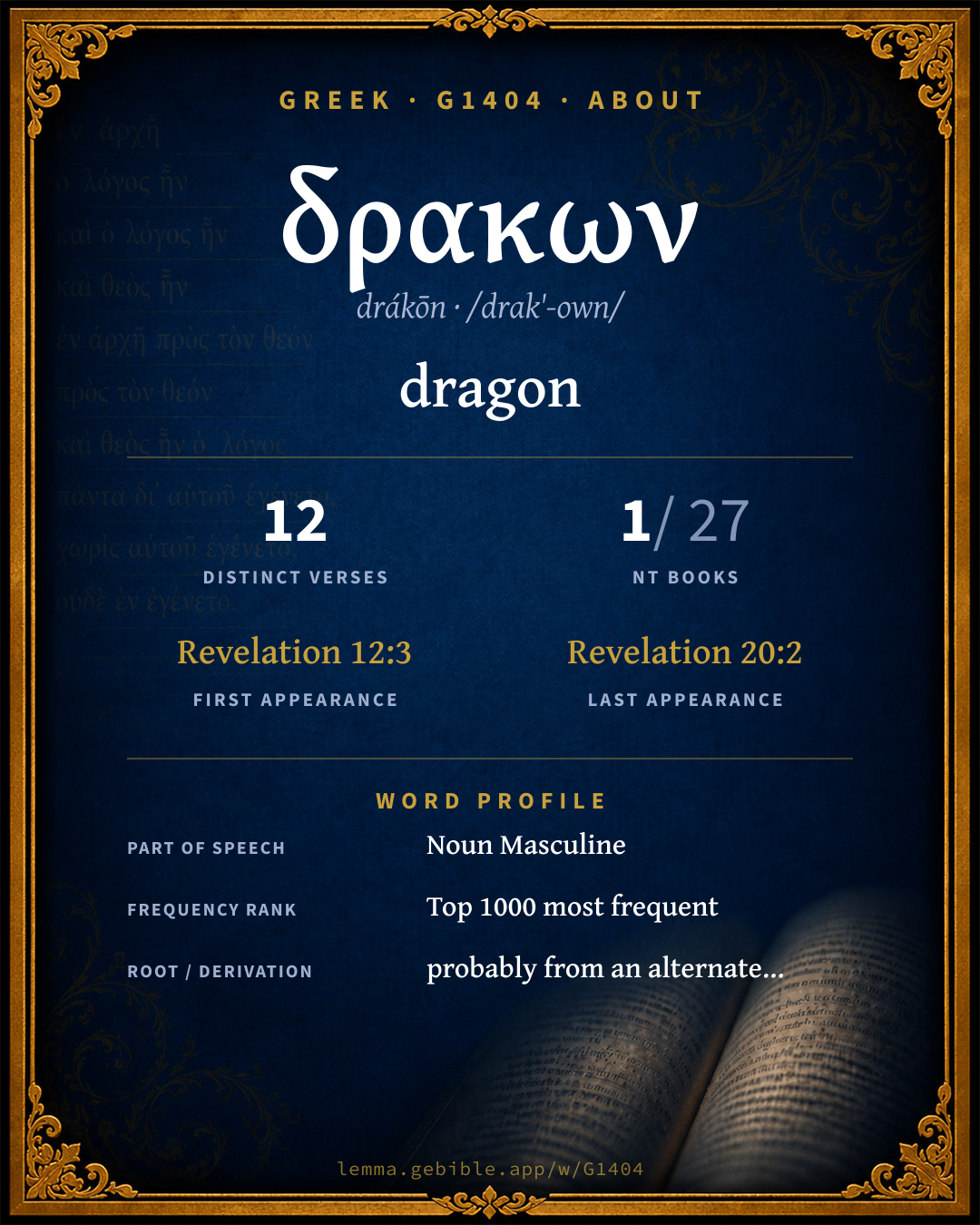
δράκων
dragon
Full lexicon entry — Thayer's Greek Lexicon
From Thayer's Greek Lexicon
Where this word appears
See every Nominative-case word in the Greek New Testament →
Grammar key — what these labels mean
Part of speech
- Noun
- A naming word — a person, place, thing, or idea.
Case
- Nominative
- The case of the subject (and the predicate nominative).
- Genitive
- The case of source, possession, or “of” — answers “whose / from what.”
- Accusative
- The case of the direct object and of extent.
- Dative
- The case of the indirect object, means, or location — “to / for / with / in.”
Gender
- Masculine
- Grammatically masculine.
Number
- Singular
- One.
1 distinct verse where G1404 appears in the Dative case, across 1 book. Filtered view — show all forms. Click any verse to open its interlinear word-by-word view. Verse text shown in the World English Bible for context — . Each verse’s Greek form is shown with its reference; the English is not keyword-highlighted, since the data carries no word-level English alignment. Use “Compare translations” on any verse to read it across multiple English versions. This concordance covers the Greek New Testament; Septuagint (Greek Old Testament) occurrences of this word are not indexed here.
Revelation 1 verse
About this entry
At a glance — auto-summarized from this page’s data, not written by a person. Every figure links to its source below. This summary describes the numbers; it doesn’t interpret them.
“dragon” is the headline sense of the Greek noun δρακων (drákōn). More than three-quarters of its appearances fall in Revelation. It appears 12 verses across 1 book of the Greek New Testament, among its uncommon vocabulary. Scripture first uses it in Revelation 12:3. It shares a root with δρασσομαι. See the sense tree, 12-verse concordance, and the renderings breakdown below.
Gloss history
Strong's 1890 vs modern scholarship
About this word
Strong's G1404 catalogs a Greek word from the Greek New Testament.
These counts are not copied from any lexicon or concordance. They are computed here, from the morphology-tagged Greek New Testament. What Lemma adds →
- 12
- distinct verses
- The word appears in 12 distinct verses.
- 1 / 27
- NT books
- The word appears in 1 of 27 New Testament books.
- #863
- by frequency
- Top 1000 most frequent Greek words (rank 863 of 5,347 Greek words by occurrence).
View all 12 occurrences in the concordance →
Most concentrated in
- Revelation 12 verses 100%
By section of the New Testament
By traditional corpus
Conventional, traditional groupings — biblical authorship is debated, so this is a traditional corpus grouping, not an authorship claim. Some books belong to more than one corpus (Luke is in both the Gospels and the Lukan corpus, and so on), so these shares overlap and need not total 100%. Each figure is a share of the word’s 12 distinct verses.
- Johannine 12 verses · 100%
- Revelation 12 verses · 100%
How translations render this word
Counts come from each version’s own published word-to-Strong’s tagging or interlinear alignment — an approximate guide to how each version renders this word, not a word-level alignment the data otherwise carries. Because each total is that version’s own tagged count, the per-version totals vary from one another and need not match the appearance or distinct-verse counts above. These counts may also differ from a printed concordance because Lemma counts each distinctly tagged rendering and does not collapse phrase taggings into a single head-word total. This is a fixed set of word-tagged versions (KJV, ASV, BSB, ULT) and does not change with the reading translation you choose elsewhere. Each version’s license is shown beside its name below (and on Sources).
- King James Version: Dragon 13×
- American Standard Version: Dragon 12×
- Berean Standard Bible: Dragon 13×
- unfoldingWord Literal Text: Dragon 13×
King James Version Public Domain
Renders G1404 across 13 tagged occurrences — most commonly:
American Standard Version Public Domain
Renders G1404 across 12 tagged occurrences — most commonly:
Berean Standard Bible Public Domain
Renders G1404 across 13 tagged occurrences — most commonly:
unfoldingWord Literal Text CC BY-SA 4.0
Renders G1404 across 14 tagged occurrences — most commonly:
Plus 1 rendering that appears only once — usually multi-word phrases or single function words the recovered tagging swept in, not distinct renderings.
Senses in Thayer's
The 1 sense Thayer's distinguishes for this word, in lexicon order (not ranked by frequency or importance). The full entry — with sub-senses — is in the Lexicon Entry tab.
- a dragon, a great serpent, a name for Satan
Word origin
Origin: probably from an alternate form of derkomai (to look)
Probably from an alternate form of δέρκομαι derkomai (to look ); a fabulous kind of serpent (perhaps as supposed to fascinate ): - dragon.
— Strong’s Exhaustive Concordance (1890), public domain.
Forms in the corpus
The 4 distinct written forms G1404 takes in the Greek New Testament, most frequent first — each parse links to that case’s occurrences in the concordance.
| Form | Parsing | Example | Uses |
|---|---|---|---|
| δράκων drákōn | Noun, Nominative, Singular, Masculine | Revelation 12:3 | 9 |
| δράκοντος drákontos | Noun, Genitive, Singular, Masculine | Revelation 12:7 | 2 |
| δράκοντα drákonta | Noun, Accusative, Singular, Masculine | Revelation 20:2 | 1 |
| δράκοντι drákonti | Noun, Dative, Singular, Masculine | Revelation 13:4 | 1 |
Same root — word family
Other Thayer's entries built from the same root as G1404, grouped by Strong’s listed origin. These share a root / origin per the lexicon — not necessarily a shared meaning. Each links to that word’s own entry.
Derived from this word
Compare all same-root words → They share a root, not necessarily a meaning.
Septuagint usage
The same Greek word δρακων appears 26 times in the Greek Old Testament (Septuagint), across 24 verses in 10 books.
- 26
- LXX occurrences
- Tagged occurrences of this Greek word in the Septuagint.
- 24
- verses
- Distinct Septuagint verses containing this word.
- 10 / 39
- OT books
- The word appears in 10 of the 39 Old Testament books.
Sample Septuagint occurrences
- Exodus 7:9 δράκων
- Deuteronomy 32:33 δράκων
- Job 4:10 δράκων
- Psalms 73:13 δράκων
- Isaiah 27:1 δράκων
- Jeremiah 9:10 δράκων
- Lamentations 4:3 δράκων
- Ezekiel 29:3 δράκων
- Amos 9:3 δράκων
- Micah 1:8 δράκων
Septuagint occurrences (same lexeme)
Every verse where the same Strong’s number (G1404) appears in the Greek Septuagint. Verse text shown in the World English Bible for context; the Greek form is the matched word — the English is not keyword-highlighted.
- Exodus 7:9 δράκων "When Pharaoh speaks to you, saying, 'Perform a miracle!' then you shall tell Aaron, 'Take your rod, and cast it down before Pharaoh, that it become a serpent.'"
- Exodus 7:10 δράκων Moses and Aaron went in to Pharaoh, and they did so, as Yahweh had commanded: and Aaron cast down his rod before Pharaoh and before his servants, and it became a serpent.
- Exodus 7:12 δράκων For they cast down every man his rod, and they became serpents: but Aaron's rod swallowed up their rods.
- Deuteronomy 32:33 δράκων Their wine is the poison of serpents, The cruel venom of asps.
- Job 4:10 δράκων The roaring of the lion, and the voice of the fierce lion, The teeth of the young lions, are broken.
- Job 7:12 δράκων Am I a sea, or a sea-monster, That you put a guard over me?
- Job 20:16 δράκων He shall suck cobra venom. The viper's tongue shall kill him.
- Job 26:13 δράκων By his Spirit the heavens are garnished. His hand has pierced the swift serpent.
- Job 38:39 δράκων "Can you hunt the prey for the lioness, Or satisfy the appetite of the young lions,
- Job 40:25 δράκων
- Psalms 73:13 δράκων Surely in vain I have cleansed my heart, And washed my hands in innocence,
- Psalms 73:14 δράκων For all day long have I been plagued, And punished every morning.
- Psalms 90:13 δράκων Relent, Yahweh! How long? Have compassion on your servants!
- Psalms 103:26 δράκων
- Psalms 148:7 δράκων Praise Yahweh from the earth, You great sea creatures, and all depths!
- Isaiah 27:1 δράκων In that day Yahweh with his hard and great and strong sword will punish leviathan the swift serpent, and leviathan the crooked serpent; and he will kill the monster that is in the sea.
- Jeremiah 9:10 δράκων For the mountains will I take up a weeping and wailing, and for the pastures of the wilderness a lamentation, because they are burned up, so that none passes through; neither can men hear the voice of the cattle; both the birds of the sky and the animals are fled, they are gone.
- Jeremiah 27:8 δράκων It shall happen, that the nation and the kingdom which will not serve the same Nebuchadnezzar king of Babylon, and that will not put their neck under the yoke of the king of Babylon, that nation will I punish, says Yahweh, with the sword, and with the famine, and with the pestilence, until I have consumed them by his hand.
- Jeremiah 28:34 δράκων
- Lamentations 4:3 δράκων Even the jackals draw out the breast, they give suck to their young ones: The daughter of my people is become cruel, like the ostriches in the wilderness.
- Ezekiel 29:3 δράκων speak, and say, Thus says the Lord Yahweh: Behold, I am against you, Pharaoh king of Egypt, the great monster that lies in the midst of his rivers, that has said, My river is my own, and I have made it for myself.
- Ezekiel 32:2 δράκων Son of man, take up a lamentation over Pharaoh king of Egypt, and tell him, You were likened to a young lion of the nations: yet are you as a monster in the seas; and you did break forth with your rivers, and troubled the waters with your feet, and fouled their rivers.
- Amos 9:3 δράκων Though they hide themselves in the top of Carmel, I will search and take them out there; and though they be hid from my sight in the bottom of the sea, there I will command the serpent, and it will bite them.
- Micah 1:8 δράκων For this I will lament and wail; I will go stripped and naked; I will howl like the jackals, And moan like the daughters of owls.
These are occurrences of the same Greek lexeme (G1404) in the Septuagint — not a translation of any one Hebrew word. The store carries no word-level Hebrew↔Greek alignment, so no Hebrew original is asserted here. Counts come from the recovered LXX Strong's tagging — high-frequency vocabulary is well covered, while rare or late forms may be untagged — so they reflect tagged occurrences and may slightly undercount.