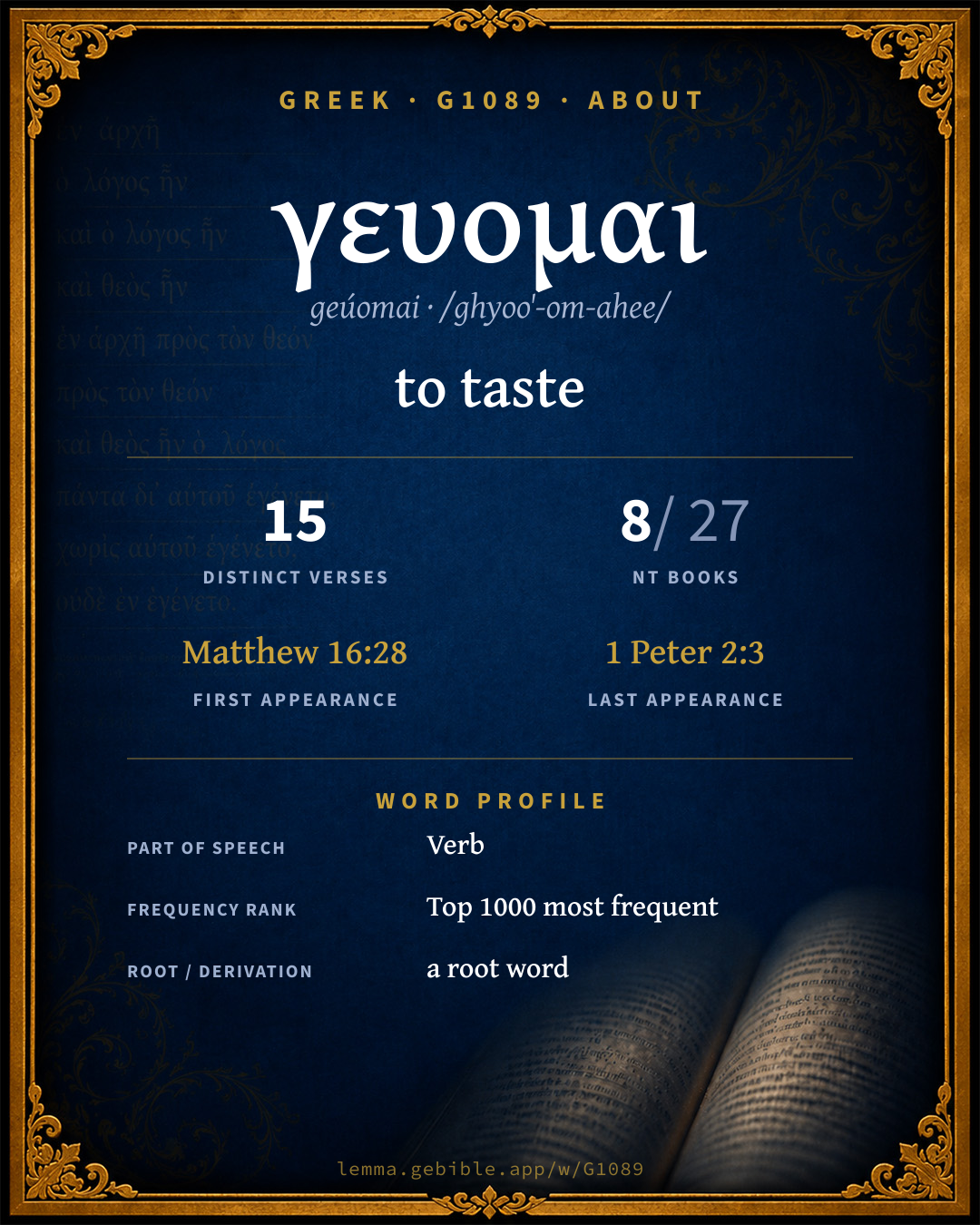
γεύομαι
to taste
‘to taste’ is one of 4 main senses fuller range ↓
Full lexicon entry — Thayer's Greek Lexicon
From Thayer's Greek Lexicon
Where this word appears
See every Aorist-tense verb in the Greek New Testament →
Grammar key — what these labels mean
Part of speech
- Verb
- An action or state-of-being word.
Tense
- Aorist
- Action viewed as a simple whole, without regard to duration — often past (perfective aspect).
- Future
- Action expected in future time.
Voice
- Middle deponent
- Middle in form but active in meaning.
Mood
- Subjunctive
- Expresses probability, purpose, or possibility (the mood of contingency).
- Infinitive
- A verbal noun (“to write”), unmarked for person or number.
- Participle
- A verbal adjective (“writing,” “having written”).
- Indicative
- States a fact or asks a factual question (the mood of reality).
Case
- Accusative
- The case of the direct object and of extent.
- Nominative
- The case of the subject (and the predicate nominative).
Person
- 3rd person
- The one spoken about (“he / she / it / they”).
- 2nd person
- The one addressed (“you”).
Gender
- Masculine
- Grammatically masculine.
Number
- Plural
- More than one.
- Singular
- One.
Grammatical forms 9 distinct
- Verb, Aorist, Middle deponent, Subjunctive, 3rd person, Plural 3 times (20%)
- Verb, Aorist, Middle deponent, Infinitive 2 times (13%)
- Verb, Aorist, Middle deponent, Participle, Accusative, Plural, Masculine 2 times (13%)
- Verb, Aorist, Middle deponent, Participle, Nominative, Singular, Masculine 2 times (13%)
- Verb, Aorist, Middle deponent, Subjunctive, 3rd person, Singular 2 times (13%)
- Verb, Aorist, Middle deponent, Indicative, 2nd person, Plural 1 time (7%)
- Verb, Aorist, Middle deponent, Indicative, 3rd person, Singular 1 time (7%)
- Verb, Aorist, Middle deponent, Subjunctive, 2nd person, Singular 1 time (7%)
+1 more form (1 occurrence)
Parsed forms decoded from the imported morphology (Robinson–Tischendorf, public domain), counted across 15 parsed occurrences — not distinct verses.
Every verse where G1089 appears — 15 distinct verses across 8 books. Click any verse to open its interlinear word-by-word view. Verse text shown in the World English Bible for context — . Each verse’s Greek form is shown with its reference; the English is not keyword-highlighted, since the data carries no word-level English alignment. Use “Compare translations” on any verse to read it across multiple English versions. This concordance covers the Greek New Testament; Septuagint (Greek Old Testament) occurrences of this word are not indexed here.
Matthew 2 verses
- Matthew 16:28 γεύσωνται aor mid.dep subj 3pl Most assuredly I tell you, there are some standing here who will in no way taste of death, until they see the Son of Man coming in his Kingdom."
- Matthew 27:34 γευσάμενος aor mid.dep ptcp nom sg masc They gave him sour wine to drink mixed with gall. When he had tasted it, he would not drink.
Mark 1 verse
Luke 2 verses
John 2 verses
- John 2:9 ἐγεύσατο aor mid.dep ind 3sg When the ruler of the feast tasted the water now become wine, and didn't know where it came from (but the servants who had drawn the water knew), the ruler of the feast called the bridegroom,
- John 8:52 γεύσηται aor mid.dep subj 3sg Then the Jews said to him, "Now we know that you have a demon. Abraham died, and the prophets; and you say, 'If a man keeps my word, he will never taste of death.'
Acts 3 verses
- Acts 10:10 γεύσασθαι aor mid.dep inf He became hungry and desired to eat, but while they were preparing, he fell into a trance.
- Acts 20:11 γευσάμενος aor mid.dep ptcp nom sg masc When he had gone up, and had broken bread, and eaten, and had talked with them a long while, even until break of day, he departed.
- Acts 23:14 γεύσασθαι aor mid.dep inf They came to the chief priests and the elders, and said, "We have bound ourselves under a great curse, to taste nothing until we have killed Paul.
Colossians 1 verse
Hebrews 3 verses
- Hebrews 2:9 γεύσηται aor mid.dep subj 3sg But we see him who has been made a little lower than the angels, Jesus, because of the suffering of death crowned with glory and honor, that by the grace of God he should taste of death for everyone.
- Hebrews 6:4 γευσαμένους aor mid.dep ptcp acc pl masc For concerning those who were once enlightened and tasted of the heavenly gift, and were made partakers of the Holy Spirit,
- Hebrews 6:5 γευσαμένους aor mid.dep ptcp acc pl masc and tasted the good word of God, and the powers of the age to come,
1 Peter 1 verse
About this entry
At a glance — auto-summarized from this page’s data, not written by a person. Every figure links to its source below. This summary describes the numbers; it doesn’t interpret them.
At its core, γευομαι (geúomai) means “to taste.” Catalogued under 4 senses, its meaning is not single-sense. It appears 15 verses across 8 books of the Greek New Testament, among its uncommon vocabulary. First canonically at Matthew 16:28, it enters the text early. Each statement above links to its evidence; the full detail follows below.
Gloss history
Strong's 1890 vs modern scholarship

About this word
Strong's G1089 catalogs a Greek word from the Greek New Testament.
These counts are not copied from any lexicon or concordance. They are computed here, from the morphology-tagged Greek New Testament. What Lemma adds →
- 15
- distinct verses
- The word appears in 15 distinct verses.
- 8 / 27
- NT books
- The word appears in 8 of 27 New Testament books.
- #768
- by frequency
- Top 1000 most frequent Greek words (rank 768 of 5,347 Greek words by occurrence).
View all 15 occurrences in the concordance →
By section of the New Testament
By traditional corpus
Conventional, traditional groupings — biblical authorship is debated, so this is a traditional corpus grouping, not an authorship claim. Some books belong to more than one corpus (Luke is in both the Gospels and the Lukan corpus, and so on), so these shares overlap and need not total 100%. Each figure is a share of the word’s 15 distinct verses.
- Gospels 7 verses · 47%
- Lukan (Luke–Acts) 5 verses · 33%
- Hebrews 3 verses · 20%
- Johannine 2 verses · 13%
- Pauline corpus 1 verse · 7%
- General (Catholic) Epistles 1 verse · 7%
How translations render this word
Counts come from each version’s own published word-to-Strong’s tagging or interlinear alignment — an approximate guide to how each version renders this word, not a word-level alignment the data otherwise carries. Because each total is that version’s own tagged count, the per-version totals vary from one another and need not match the appearance or distinct-verse counts above. These counts may also differ from a printed concordance because Lemma counts each distinctly tagged rendering and does not collapse phrase taggings into a single head-word total. This is a fixed set of word-tagged versions (KJV, ASV, BSB, ULT) and does not change with the reading translation you choose elsewhere. Each version’s license is shown beside its name below (and on Sources).
- King James Version: Taste 5×, Shall 3×, Have tasted 2×
- American Standard Version: Taste 4×, Tasted 4×, Shall 3×
- Berean Standard Bible: Will not taste 3×, Eat 2×, Have tasted 2×
- unfoldingWord Literal Text: Taste 5×, Having tasted 4×, Will 3×
King James Version Public Domain
Renders G1089 across 20 tagged occurrences — most commonly:
Plus 10 renderings that appear only once — usually multi-word phrases or single function words the recovered tagging swept in, not distinct renderings.
American Standard Version Public Domain
Renders G1089 across 20 tagged occurrences — most commonly:
Plus 9 renderings that appear only once — usually multi-word phrases or single function words the recovered tagging swept in, not distinct renderings.
Berean Standard Bible Public Domain
Renders G1089 across 15 tagged occurrences — most commonly:
Plus 8 renderings that appear only once — usually multi-word phrases or single function words the recovered tagging swept in, not distinct renderings.
unfoldingWord Literal Text CC BY-SA 4.0
Renders G1089 across 20 tagged occurrences — most commonly:
Plus 6 renderings that appear only once — usually multi-word phrases or single function words the recovered tagging swept in, not distinct renderings.
Senses in Thayer's
The 4 senses Thayer's distinguishes for this word, in lexicon order (not ranked by frequency or importance). The full entry — with sub-senses — is in the Lexicon Entry tab.
- to taste, to try the flavour of
- i.e. perceive the flavour of, partake of, enjoy
- to feel, make trial of, experience
- to take food, eat, to take nourishment, eat
Word origin
Origin: a root word
A primary verb; to taste ; by implication to eat ; figuratively to experience (good or ill): - eat taste.
— Strong’s Exhaustive Concordance (1890), public domain.
Forms in the corpus
The 9 distinct written forms G1089 takes in the Greek New Testament, most frequent first — each parse links to that tense’s occurrences in the concordance.
| Form | Parsing | Example | Uses |
|---|---|---|---|
| γεύσωνται geúsōntai | Verb, Aorist, Middle deponent, Subjunctive, 3rd person, Plural | Matthew 16:28 | 3 |
| γευσάμενος geusámenos | Verb, Aorist, Middle deponent, Participle, Nominative, Singular, Masculine | Matthew 27:34 | 2 |
| γευσαμένους geusaménous | Verb, Aorist, Middle deponent, Participle, Accusative, Plural, Masculine | Hebrews 6:4 | 2 |
| γεύσασθαι geúsasthai | Verb, Aorist, Middle deponent, Infinitive | Acts 10:10 | 2 |
| γεύσηται geúsētai | Verb, Aorist, Middle deponent, Subjunctive, 3rd person, Singular | John 8:52 | 2 |
| γεύσεταί geúsetaí | Verb, Future, Middle deponent, Indicative, 3rd person, Singular | Luke 14:24 | 1 |
| γεύσῃ geúsē | Verb, Aorist, Middle deponent, Subjunctive, 2nd person, Singular | Colossians 2:21 | 1 |
| ἐγεύσασθε egeúsasthe | Verb, Aorist, Middle deponent, Indicative, 2nd person, Plural | 1 Peter 2:3 | 1 |
| ἐγεύσατο egeúsato | Verb, Aorist, Middle deponent, Indicative, 3rd person, Singular | John 2:9 | 1 |
Septuagint usage
The same Greek word γευομαι appears 13 times in the Greek Old Testament (Septuagint), across 12 verses in 7 books.
- 13
- LXX occurrences
- Tagged occurrences of this Greek word in the Septuagint.
- 12
- verses
- Distinct Septuagint verses containing this word.
- 7 / 39
- OT books
- The word appears in 7 of the 39 Old Testament books.
Sample Septuagint occurrences
- Genesis 25:30 γεύω
- 1 Samuel 14:24 γεύω
- 2 Samuel 3:35 γεύω
- Job 12:11 γεύω
- Psalms 33:9 γεύω
- Proverbs 31:18 γεύω
- Jonah 3:7 γεύω
Septuagint occurrences (same lexeme)
Every verse where the same Strong’s number (G1089) appears in the Greek Septuagint. Verse text shown in the World English Bible for context; the Greek form is the matched word — the English is not keyword-highlighted.
- Genesis 25:30 γεύω Esau said to Jacob, "Please feed me with that same red stew, for I am famished." Therefore his name was called Edom.
- 1 Samuel 14:24 γεύω The men of Israel were distressed that day; for Saul had adjured the people, saying, Cursed be the man who eats any food until it be evening, and I be avenged on my enemies. So none of the people tasted food.
- 1 Samuel 14:29 γεύω Then said Jonathan, My father has troubled the land. Please look how my eyes have been enlightened, because I tasted a little of this honey.
- 1 Samuel 14:43 γεύω Then Saul said to Jonathan, Tell me what you have done. Jonathan told him, and said, I did certainly taste a little honey with the end of the rod that was in my hand; and, behold, I must die.
- 2 Samuel 3:35 γεύω All the people came to cause David to eat bread while it was yet day; but David swore, saying, God do so to me, and more also, if I taste bread, or anything else, until the sun be down.
- 2 Samuel 19:36 γεύω Your servant would but just go over the Jordan with the king: and why should the king recompense it me with such a reward?
- Job 12:11 γεύω Doesn't the ear try words, Even as the palate tastes its food?
- Job 20:18 γεύω That for which he labored he shall restore, and shall not swallow it down; According to the substance that he has gotten, he shall not rejoice.
- Job 34:3 γεύω For the ear tries words, As the palate tastes food.
- Psalms 33:9 γεύω For he spoke, and it was done. He commanded, and it stood firm.
- Proverbs 31:18 γεύω She perceives that her merchandise is profitable. Her lamp doesn't go out by night.
- Jonah 3:7 γεύω He made a proclamation and published through Nineveh by the decree of the king and his nobles, saying, "Let neither man nor animal, herd nor flock, taste anything; let them not feed, nor drink water;
These are occurrences of the same Greek lexeme (G1089) in the Septuagint — not a translation of any one Hebrew word. The store carries no word-level Hebrew↔Greek alignment, so no Hebrew original is asserted here. Counts come from the recovered LXX Strong's tagging — high-frequency vocabulary is well covered, while rare or late forms may be untagged — so they reflect tagged occurrences and may slightly undercount.