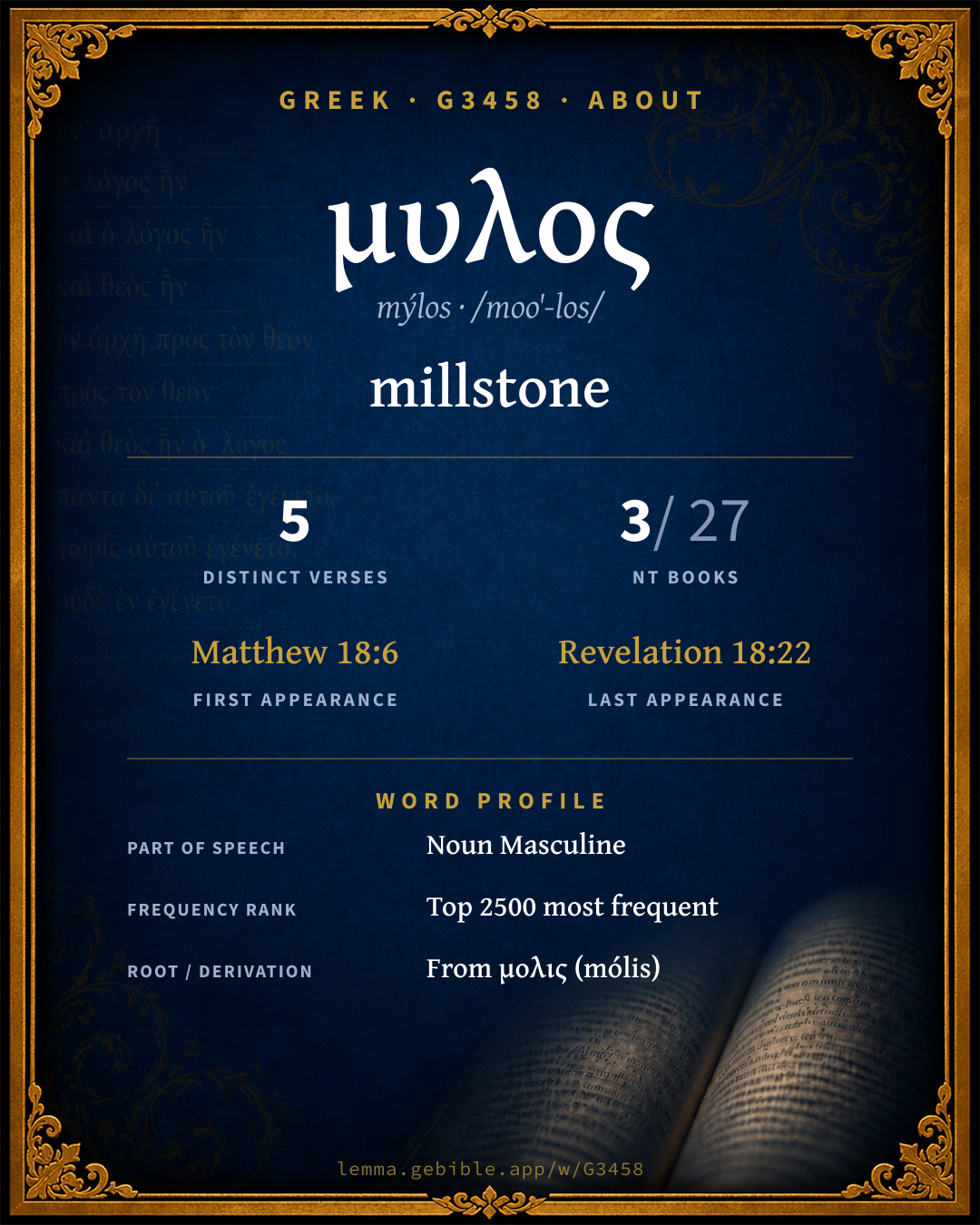
μύλος
millstone
‘millstone’ is one of 3 main senses fuller range ↓
Full lexicon entry — Thayer's Greek Lexicon
From Thayer's Greek Lexicon
Where this word appears
See every Nominative-case word in the Greek New Testament →
Grammar key — what these labels mean
Part of speech
- Noun
- A naming word — a person, place, thing, or idea.
- Adjective
- A word that describes or qualifies a noun.
Case
- Nominative
- The case of the subject (and the predicate nominative).
- Accusative
- The case of the direct object and of extent.
- Dative
- The case of the indirect object, means, or location — “to / for / with / in.”
- Genitive
- The case of source, possession, or “of” — answers “whose / from what.”
Gender
- Masculine
- Grammatically masculine.
Number
- Singular
- One.
Grammatical forms
- Noun, Nominative, Singular, Masculine 2 times (40%)
- Adjective, Accusative, Singular, Masculine 1 time (20%)
- Noun, Dative, Singular, Masculine 1 time (20%)
- Noun, Genitive, Singular, Masculine 1 time (20%)
Parsed forms decoded from the imported morphology (Robinson–Tischendorf, public domain), counted across 5 parsed occurrences — not distinct verses.
Every verse where G3458 appears — 5 distinct verses across 3 books. Click any verse to open its interlinear word-by-word view. Verse text shown in the World English Bible for context — . Each verse’s Greek form is shown with its reference; the English is not keyword-highlighted, since the data carries no word-level English alignment. Use “Compare translations” on any verse to read it across multiple English versions. This concordance covers the Greek New Testament; Septuagint (Greek Old Testament) occurrences of this word are not indexed here.
Matthew 2 verses
- Matthew 18:6 μύλος n nom sg masc but whoever causes one of these little ones who believe in me to stumble, it would be better for him that a huge millstone should be hung around his neck, and that he should be sunk in the depths of the sea.
- Matthew 24:41 μύλῳ n dat sg masc two women grinding at the mill, one will be taken and one will be left.
Mark 1 verse
Revelation 2 verses
- Revelation 18:21 μύλον adj acc sg masc A mighty angel took up a stone like a great millstone and cast it into the sea, saying, "Thus with violence will Babylon, the great city, be thrown down, and will be found no more at all.
- Revelation 18:22 μύλου n gen sg masc The voice of harpists, minstrels, flute players, and trumpeters will be heard no more at all in you. No craftsman, of whatever craft, will be found any more at all in you. The sound of a mill will be heard no more at all in you.
About this entry
At a glance — auto-summarized from this page’s data, not written by a person. Every figure links to its source below. This summary describes the numbers; it doesn’t interpret them.
μυλος (mýlos) is a Greek noun most often rendered “millstone.” It occurs a mere 5 verses across Scripture. It concentrates in Matthew, which alone accounts for 40% of its uses. Scripture first uses it in Matthew 18:6. Ranging over 3 senses, it is not a single-sense word. The sections below give every sense, occurrence, and version rendering.
Gloss history
Strong's 1890 vs modern scholarship
About this word
Strong's G3458 catalogs a Greek word from the Greek New Testament.
These counts are not copied from any lexicon or concordance. They are computed here, from the morphology-tagged Greek New Testament. What Lemma adds →
- 5
- distinct verses
- The word appears in 5 distinct verses.
- 3 / 27
- NT books
- The word appears in 3 of 27 New Testament books.
- #1,648
- by frequency
- Top 2500 most frequent Greek words (rank 1,648 of 5,347 Greek words by occurrence).
View all 5 occurrences in the concordance →
Most concentrated in
- Matthew 2 verses 40%
- Revelation 2 verses 40%
- Mark 1 verse 20%
By section of the New Testament
By traditional corpus
Conventional, traditional groupings — biblical authorship is debated, so this is a traditional corpus grouping, not an authorship claim. Some books belong to more than one corpus (Luke is in both the Gospels and the Lukan corpus, and so on), so these shares overlap and need not total 100%. Each figure is a share of the word’s 5 distinct verses.
- Gospels 3 verses · 60%
- Johannine 2 verses · 40%
- Revelation 2 verses · 40%
How translations render this word
Counts come from each version’s own published word-to-Strong’s tagging or interlinear alignment — an approximate guide to how each version renders this word, not a word-level alignment the data otherwise carries. Because each total is that version’s own tagged count, the per-version totals vary from one another and need not match the appearance or distinct-verse counts above. These counts may also differ from a printed concordance because Lemma counts each distinctly tagged rendering and does not collapse phrase taggings into a single head-word total. This is a fixed set of word-tagged versions (KJV, ASV, BSB, ULT) and does not change with the reading translation you choose elsewhere. Each version’s license is shown beside its name below (and on Sources).
- King James Version: Millstone 4×
- American Standard Version: Millstone 2×
- Berean Standard Bible: Millstone 4×
- unfoldingWord Literal Text: Mill 2×, Millstone 2×
King James Version Public Domain
Renders G3458 across 4 tagged occurrences — most commonly:
American Standard Version Public Domain
Renders G3458 across 3 tagged occurrences — most commonly:
Plus 1 rendering that appears only once — usually multi-word phrases or single function words the recovered tagging swept in, not distinct renderings.
Berean Standard Bible Public Domain
Renders G3458 across 5 tagged occurrences — most commonly:
Plus 1 rendering that appears only once — usually multi-word phrases or single function words the recovered tagging swept in, not distinct renderings.
unfoldingWord Literal Text CC BY-SA 4.0
Renders G3458 across 4 tagged occurrences — most commonly:
Senses in Thayer's
The 3 senses Thayer's distinguishes for this word, in lexicon order (not ranked by frequency or importance). The full entry — with sub-senses — is in the Lexicon Entry tab.
- a large mill consisted of two stones, an upper and an under one
- the "nether" stone was stationary, but the upper one was turned by an ass
- a mill, the noise made by a mill
Word origin
Derived from μολις (mólis) (G3433) — scarcely.
Probably ultimately from the base of G3433 (through the idea of hardship ); a mill that is (by implication) a grinder ( millstone ): - millstone.
— Strong’s Exhaustive Concordance (1890), public domain.
Forms in the corpus
The 4 distinct written forms G3458 takes in the Greek New Testament, most frequent first — each parse links to that case’s occurrences in the concordance.
| Form | Parsing | Example | Uses |
|---|---|---|---|
| μύλος mýlos | Noun, Nominative, Singular, Masculine | Matthew 18:6 | 2 |
| μύλον mýlon | Adjective, Accusative, Singular, Masculine | Revelation 18:21 | 1 |
| μύλου mýlou | Noun, Genitive, Singular, Masculine | Revelation 18:22 | 1 |
| μύλῳ mýlō | Noun, Dative, Singular, Masculine | Matthew 24:41 | 1 |
Same root — word family
Other Thayer's entries built from the same root as G3458, grouped by Strong’s listed origin. These share a root / origin per the lexicon — not necessarily a shared meaning. Each links to that word’s own entry.
Derives from
Shares the same root
Derived from this word
Compare all same-root words → Showing 4 of 5 — not the complete family. They share a root, not necessarily a meaning.
Septuagint usage
The same Greek word μυλος appears 6 times in the Greek Old Testament (Septuagint), across 6 verses in 5 books.
- 6
- LXX occurrences
- Tagged occurrences of this Greek word in the Septuagint.
- 6
- verses
- Distinct Septuagint verses containing this word.
- 5 / 39
- OT books
- The word appears in 5 of the 39 Old Testament books.
Sample Septuagint occurrences
- Exodus 11:5 μύλος
- Numbers 11:8 μύλος
- Deuteronomy 24:6 μύλος
- 2 Samuel 11:21 μύλος
- Isaiah 47:2 μύλος
Septuagint occurrences (same lexeme)
Every verse where the same Strong’s number (G3458) appears in the Greek Septuagint. Verse text shown in the World English Bible for context; the Greek form is the matched word — the English is not keyword-highlighted.
- Exodus 11:5 μύλος and all the firstborn in the land of Egypt shall die, from the firstborn of Pharaoh who sits on his throne, even to the firstborn of the maid-servant who is behind the mill; and all the firstborn of cattle.
- Numbers 11:8 μύλος The people went about, and gathered it, and ground it in mills, or beat it in mortars, and boiled it in pots, and made cakes of it: and the taste of it was as the taste of fresh oil.
- Deuteronomy 24:6 μύλος No man shall take the mill or the upper millstone to pledge; for he takes [a man's] life to pledge.
- 2 Samuel 11:21 μύλος who struck Abimelech the son of Jerubbesheth? Didn't a woman cast an upper millstone on him from the wall, so that he died at Thebez? Why did you go so near the wall?' then shall you say, 'Your servant Uriah the Hittite is dead also.'"
- 2 Samuel 11:22 μύλος So the messenger went, and came and shown David all that Joab had sent him for.
- Isaiah 47:2 μύλος Take the millstones, and grind meal; remove your veil, strip off the train, uncover the leg, pass through the rivers.
These are occurrences of the same Greek lexeme (G3458) in the Septuagint — not a translation of any one Hebrew word. The store carries no word-level Hebrew↔Greek alignment, so no Hebrew original is asserted here. Counts come from the recovered LXX Strong's tagging — high-frequency vocabulary is well covered, while rare or late forms may be untagged — so they reflect tagged occurrences and may slightly undercount.