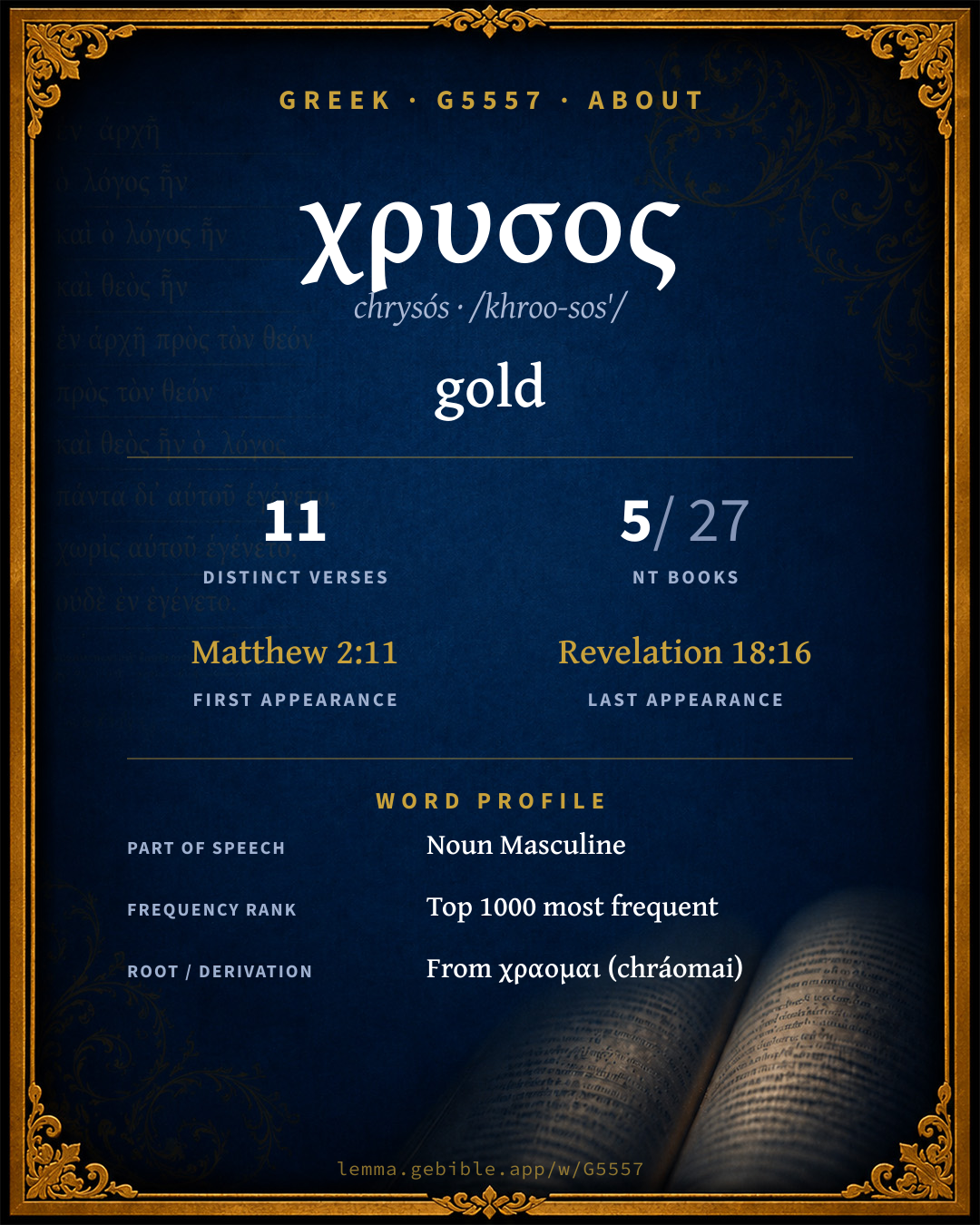
χρυσός
gold
Full lexicon entry — Thayer's Greek Lexicon
From Thayer's Greek Lexicon
Where this word appears
See every Dative-case word in the Greek New Testament →
Grammar key — what these labels mean
Part of speech
- Noun
- A naming word — a person, place, thing, or idea.
Case
- Dative
- The case of the indirect object, means, or location — “to / for / with / in.”
- Accusative
- The case of the direct object and of extent.
- Nominative
- The case of the subject (and the predicate nominative).
- Genitive
- The case of source, possession, or “of” — answers “whose / from what.”
Gender
- Masculine
- Grammatically masculine.
Number
- Singular
- One.
Grammatical forms
- Noun, Dative, Singular, Masculine 6 times (50%)
- Noun, Accusative, Singular, Masculine 3 times (25%)
- Noun, Nominative, Singular, Masculine 2 times (17%)
- Noun, Genitive, Singular, Masculine 1 time (8%)
Parsed forms decoded from the imported morphology (Robinson–Tischendorf, public domain), counted across 12 parsed occurrences — not distinct verses.
Every verse where G5557 appears — 11 distinct verses across 5 books. Click any verse to open its interlinear word-by-word view. Verse text shown in the World English Bible for context — . Each verse’s Greek form is shown with its reference; the English is not keyword-highlighted, since the data carries no word-level English alignment. Use “Compare translations” on any verse to read it across multiple English versions. This concordance covers the Greek New Testament; Septuagint (Greek Old Testament) occurrences of this word are not indexed here.
Matthew 4 verses
- Matthew 2:11 χρυσὸν n acc sg masc They came into the house and saw the young child with Mary, his mother, and they fell down and worshiped him. Opening their treasures, they offered to him gifts: gold, frankincense, and myrrh.
- Matthew 10:9 χρυσὸν n acc sg masc Don't take any gold, nor silver, nor brass in your money belts.
- Matthew 23:16 χρυσῷ n dat sg masc "Woe to you, you blind guides, who say, 'Whoever swears by the temple, it is nothing; but whoever swears by the gold of the temple, he is obligated.'
- Matthew 23:17 χρυσὸς χρυσόν n nom sg masc n acc sg masc You blind fools! For which is greater, the gold, or the temple that sanctifies the gold?
Acts 1 verse
1 Timothy 1 verse
James 1 verse
Revelation 4 verses
- Revelation 9:7 χρυσῷ n dat sg masc The shapes of the locusts were like horses prepared for war. On their heads were something like golden crowns, and their faces were like people's faces.
- Revelation 17:4 χρυσῷ n dat sg masc The woman was dressed in purple and scarlet, and decked with gold and precious stones and pearls, having in her hand a golden cup full of abominations and the impurities of the sexual immorality of the earth.
- Revelation 18:12 χρυσοῦ n gen sg masc merchandise of gold, silver, precious stones, pearls, fine linen, purple, silk, scarlet, all expensive wood, every vessel of ivory, every vessel made of most precious wood, and of brass, and iron, and marble;
- Revelation 18:16 χρυσῷ n dat sg masc saying, 'Woe, woe, the great city, she who was dressed in fine linen, purple, and scarlet, and decked with gold and precious stones and pearls!
About this entry
At a glance — auto-summarized from this page’s data, not written by a person. Every figure links to its source below. This summary describes the numbers; it doesn’t interpret them.
“gold” is the headline sense of the Greek noun χρυσος (chrysós). Its earliest occurrence is Matthew 2:11. The Greek New Testament uses it across 11 verses — uncommon. More than a third of its appearances fall in Matthew. Related forms include χραομαι, χραω and χρεια. See the sense tree, 11-verse concordance, and the renderings breakdown below.
Gloss history
Strong's 1890 vs modern scholarship
About this word
Strong's G5557 catalogs a Greek word from the Greek New Testament.
These counts are not copied from any lexicon or concordance. They are computed here, from the morphology-tagged Greek New Testament. What Lemma adds →
- 11
- distinct verses
- The word appears in 11 distinct verses.
- 5 / 27
- NT books
- The word appears in 5 of 27 New Testament books.
- #904
- by frequency
- Top 1000 most frequent Greek words (rank 904 of 5,347 Greek words by occurrence).
View all 11 occurrences in the concordance →
Most concentrated in
- Matthew 4 verses 36%
- Revelation 4 verses 36%
- Acts 1 verse 9%
By section of the New Testament
By traditional corpus
Conventional, traditional groupings — biblical authorship is debated, so this is a traditional corpus grouping, not an authorship claim. Some books belong to more than one corpus (Luke is in both the Gospels and the Lukan corpus, and so on), so these shares overlap and need not total 100%. Each figure is a share of the word’s 11 distinct verses.
- Gospels 4 verses · 36%
- Johannine 4 verses · 36%
- Revelation 4 verses · 36%
- Lukan (Luke–Acts) 1 verse · 9%
- Pauline corpus 1 verse · 9%
- General (Catholic) Epistles 1 verse · 9%
How translations render this word
Counts come from each version’s own published word-to-Strong’s tagging or interlinear alignment — an approximate guide to how each version renders this word, not a word-level alignment the data otherwise carries. Because each total is that version’s own tagged count, the per-version totals vary from one another and need not match the appearance or distinct-verse counts above. These counts may also differ from a printed concordance because Lemma counts each distinctly tagged rendering and does not collapse phrase taggings into a single head-word total. This is a fixed set of word-tagged versions (KJV, ASV, BSB, ULT) and does not change with the reading translation you choose elsewhere. Each version’s license is shown beside its name below (and on Sources).
- King James Version: Gold 13×
- American Standard Version: Gold 13×
- Berean Standard Bible: Gold 9×
- unfoldingWord Literal Text: Gold 12×
King James Version Public Domain
Renders G5557 across 13 tagged occurrences — most commonly:
American Standard Version Public Domain
Renders G5557 across 13 tagged occurrences — most commonly:
Berean Standard Bible Public Domain
Renders G5557 across 9 tagged occurrences — most commonly:
Not rendered by a distinct English word in 1 further occurrence.
unfoldingWord Literal Text CC BY-SA 4.0
Renders G5557 across 12 tagged occurrences — most commonly:
Senses in Thayer's
The 1 sense Thayer's distinguishes for this word, in lexicon order (not ranked by frequency or importance). The full entry — with sub-senses — is in the Lexicon Entry tab.
- precious things made of gold, golden ornaments
Word origin
Derived from χραομαι (chráomai) (G5530) — to borrow.
Perhaps from the base of G5530 (through the idea of the utility of the metal); gold ; by extension a golden article as an ornament or coin : - gold.
— Strong’s Exhaustive Concordance (1890), public domain.
Forms in the corpus
The 5 distinct written forms G5557 takes in the Greek New Testament, most frequent first — each parse links to that case’s occurrences in the concordance.
| Form | Parsing | Example | Uses |
|---|---|---|---|
| χρυσῷ chrysō̂ | Noun, Dative, Singular, Masculine | Matthew 23:16 | 6 |
| χρυσὸν chrysòn | Noun, Accusative, Singular, Masculine | Matthew 2:11 | 2 |
| χρυσὸς chrysòs | Noun, Nominative, Singular, Masculine | Matthew 23:17 | 2 |
| χρυσοῦ chrysoû | Noun, Genitive, Singular, Masculine | Revelation 18:12 | 1 |
| χρυσόν chrysón | Noun, Accusative, Singular, Masculine | Matthew 23:17 | 1 |
Same root — word family
Other Thayer's entries built from the same root as G5557, grouped by Strong’s listed origin. These share a root / origin per the lexicon — not necessarily a shared meaning. Each links to that word’s own entry.
Derives from
Shares the same root
- χραω chráō G5531 to lend
- χρεια chreía G5532 necessity
- χρη chrḗ G5534 it is necessary
- χρησις chrēsis G5540 use
- χρηστος chrēstós G5543 fit
- χριω chríō G5548 to anoint
- χρως chrṓs G5559 skin
Derived from this word
- χρυσεος chrýseos G5552 golden
- χρυσιον chrysíon G5553 gold
- χρυσοδακτυλιος chrysodaktýlios G5554 gold-ringed
- χρυσολιθος chrysólithos G5555 chrysolite
- χρυσοπρασος chrysóprasos G5556 chrysoprase
- χρυσοω chrysóō G5558 to gild
Compare all same-root words → Showing 4 of 15 — not the complete family. They share a root, not necessarily a meaning.
Septuagint usage
The same Greek word χρυσος appears 6 times in the Greek Old Testament (Septuagint), across 6 verses in 5 books.
- 6
- LXX occurrences
- Tagged occurrences of this Greek word in the Septuagint.
- 6
- verses
- Distinct Septuagint verses containing this word.
- 5 / 39
- OT books
- The word appears in 5 of the 39 Old Testament books.
Sample Septuagint occurrences
- 1 Kings 10:2 χρυσός
- Job 3:15 χρυσός
- Proverbs 17:3 χρυσός
- Isaiah 60:9 χρυσός
- Daniel 2:45 χρυσός
Septuagint occurrences (same lexeme)
Every verse where the same Strong’s number (G5557) appears in the Greek Septuagint. Verse text shown in the World English Bible for context; the Greek form is the matched word — the English is not keyword-highlighted.
- 1 Kings 10:2 χρυσός She came to Jerusalem with a very great train, with camels that bore spices, and very much gold, and precious stones; and when she was come to Solomon, she talked with him of all that was in her heart.
- Job 3:15 χρυσός Or with princes who had gold, Who filled their houses with silver:
- Job 41:22 χρυσός In his neck there is strength. Terror dances before him.
- Proverbs 17:3 χρυσός The refining pot is for silver, and the furnace for gold, But Yahweh tests the hearts.
- Isaiah 60:9 χρυσός Surely the isles shall wait for me, and the ships of Tarshish first, to bring your sons from far, their silver and their gold with them, for the name of Yahweh your God, and for the Holy One of Israel, because he has glorified you.
- Daniel 2:45 χρυσός Because you saw that a stone was cut out of the mountain without hands, and that it broke in pieces the iron, the brass, the clay, the silver, and the gold; the great God has made known to the king what shall happen hereafter: and the dream is certain, and the interpretation of it sure.
These are occurrences of the same Greek lexeme (G5557) in the Septuagint — not a translation of any one Hebrew word. The store carries no word-level Hebrew↔Greek alignment, so no Hebrew original is asserted here. Counts come from the recovered LXX Strong's tagging — high-frequency vocabulary is well covered, while rare or late forms may be untagged — so they reflect tagged occurrences and may slightly undercount.