
Psalms 121:2

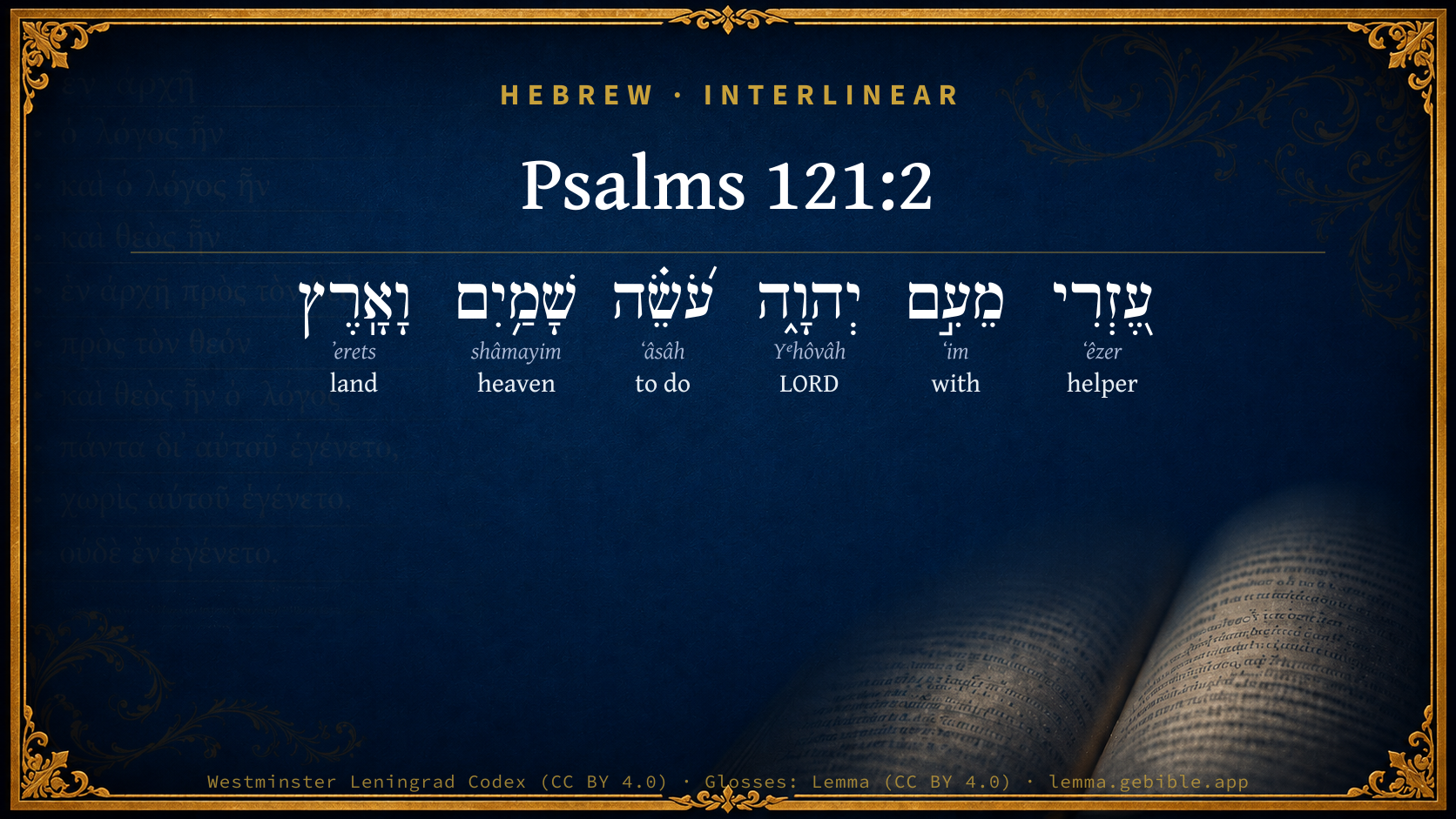
Hebrew (Westminster Leningrad Codex) Psalms 121:2 appears in the Hebrew Old Testament. The text above is from the Westminster Leningrad Codex. Each word links to its Strong’s number, a concise gloss, and parsing drawn from the Open Scriptures Hebrew Bible morphology. Click any word for its full Brown-Driver-Briggs (BDB) entry.
Download image
Cite this verse

Psalms 121:2 (World English Bible). Public Domain. Lemma interlinear Bible study tool, https://lemma.gebible.app/v/psalms/121/2.

Show BibTeX & RIS
BibTeX
RIS
English Translation
My help comes from Yahweh, Who made heaven and earth.
World English Bible · Public Domain
Download a study sheet

One document with this verse’s original text, its word-by-word gloss line, the meaning frame, cross-references with their text, attributed commentary, and full source and license credits — printable, and it pastes into notes with its structure intact.

This verse Autodidact and up

Study sheet (.html) Plain text (.txt)

A passage Seminary Student

Up to 50 verses in one chapter. A passage sheet keeps up to 6 commentary sources and 12 cross-references per verse, in the order this page ranks them, and says so on the sheet whenever that leaves anything out. Ask for a single verse and you get the Autodidact verse sheet above.

Everything on this page stays free to read, with no account — the sheet is a download of what is already on screen, not access to it.

Want to remove ads? Support Godless Engineer
Compare translations 3

The same verse in 3 English versions, stacked beneath the original-language interlinear above. Click any original word for its lexicon entry.

Each is an independent rendering of the whole verse — the interlinear is not word-aligned to these translations.

Highlighted words mark where these versions differ — a whole-verse word diff, not a word-by-word alignment.

  • World English Bible Public Domain
    My help comes from Yahweh, Who made heaven and earth.
  • King James Version Public Domain
    My help cometh from the LORD, which made heaven and earth.
  • unfoldingWord Literal Text CC BY-SA 4.0
    My help from with Yahweh, maker of heaven and earth.

unfoldingWord Literal Text — © unfoldingWord, licensed CC BY-SA 4.0. Word-aligned USFM3 via Door43 (git.door43.org/unfoldingWord/en_ult).

Versions to compare (up to 4)

3 of 4 selected

Show all 18 translations

Every available English version of this verse, each an independent rendering of the whole verse.

  • World English Bible Public Domain
    My help comes from Yahweh, Who made heaven and earth.
  • Berean Standard Bible Public Domain
    My help comes from the LORD, the Maker of heaven and earth.
  • Majority Standard Bible Public Domain
    My help comes from the LORD, the Maker of heaven and earth.
  • King James Version Public Domain
    My help cometh from the LORD, which made heaven and earth.
  • American Standard Version (1901) Public Domain
    My help `cometh' from Jehovah, Who made heaven and earth.
  • Revised Version (1885) Public Domain
    My help cometh from the LORD, which made heaven and earth.
  • Geneva Bible (1599) Public Domain
    Mine helpe commeth from the Lord, which hath made the heauen and the earth.
  • Douay-Rheims (1899) Public Domain
    O Lord, deliver my soul from wicked lips, and a deceitful tongue.
  • Young's Literal Translation Public Domain
    My help `is' from Jehovah, maker of heaven and earth,
  • Literal Standard Version CC BY-SA 4.0
    My help [is] from YHWH, || Maker of the heavens and earth,
  • Unlocked Literal Bible CC BY-SA 4.0
    My help comes from Yahweh, who made heaven and earth.
  • unfoldingWord Literal Text CC BY-SA 4.0
    My help from with Yahweh, maker of heaven and earth.
  • Darby Bible Public Domain
    My help [cometh] from Jehovah, who made the heavens and the earth.
  • World Messianic Bible Public Domain
    My help comes from the LORD, who made heaven and earth.
  • Webster's Bible Public Domain
    My help cometh from the LORD, who made heaven and earth.
  • Free Bible Version CC BY-SA 4.0
    My help comes from the Lord, who made heaven and earth.
  • Bible in Basic English Public Domain
    Your help comes from the Lord, who made heaven and earth.
  • JPS Tanakh (1917) Public Domain
    My help cometh from the LORD, who made heaven and earth.

Literal Standard Version (2020), Covenant Press — licensed CC BY-SA 4.0. Text via the HelloAO Bible API (eBible.org). Unlocked Literal Bible (unfoldingWord) — licensed CC BY-SA 4.0. Text via the HelloAO Bible API (eBible.org). unfoldingWord Literal Text — © unfoldingWord, licensed CC BY-SA 4.0. Word-aligned USFM3 via Door43 (git.door43.org/unfoldingWord/en_ult). Free Bible Version, Dr. Jonathan Gallagher — licensed CC BY-SA 4.0. Text via the HelloAO Bible API (eBible.org).

Word by word

More ways to search: Search by grammar → Find every occurrence → Compare this word →

Practice this passage: Drill this verse → Learn its vocabulary →

About this verse

These counts appear in no published source. They are computed here, from the morphology-tagged text and Lemma’s own curated glosses. What Lemma adds →

6
words
6
distinct lemmas
Wisdom
section

Notable vocabulary

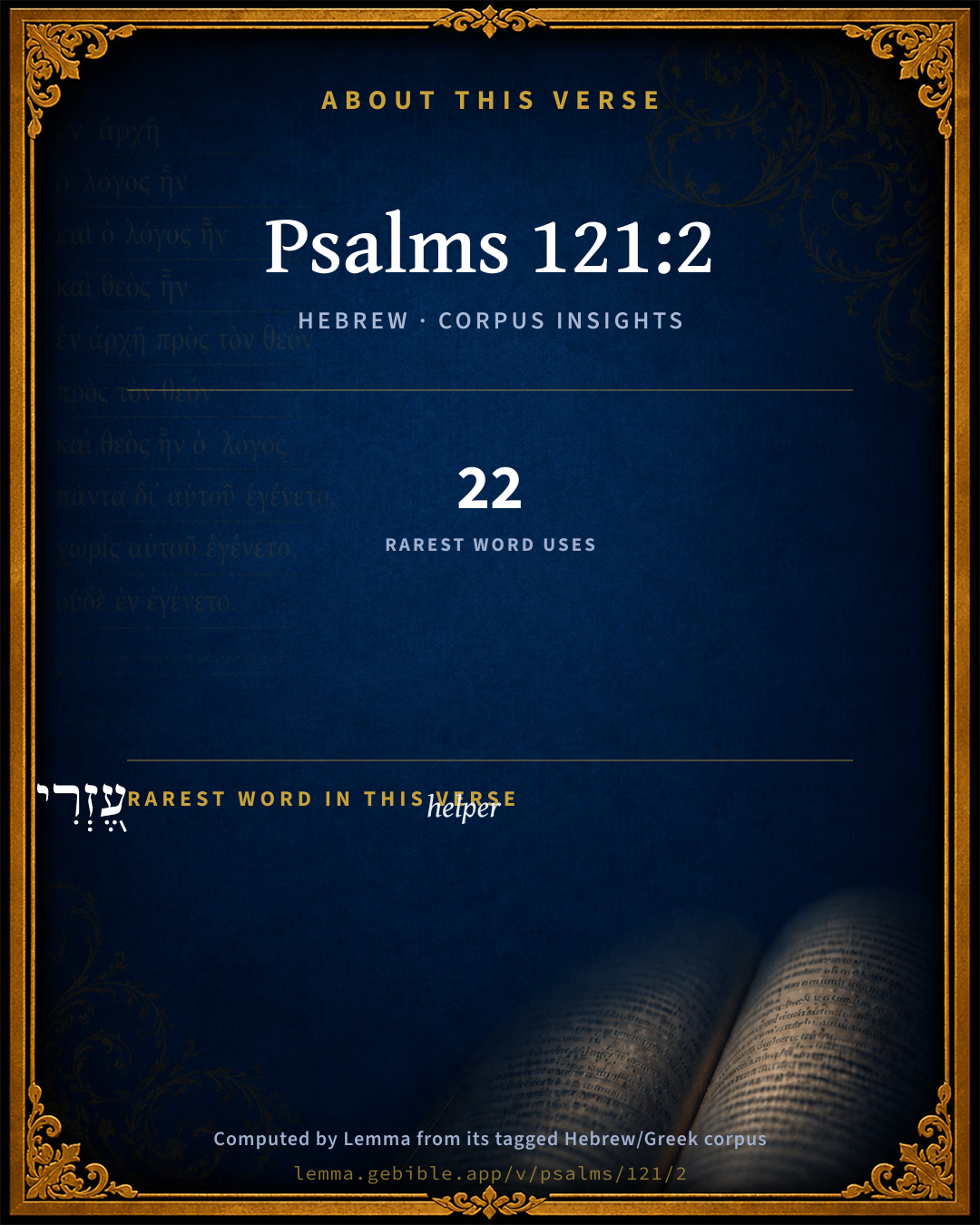
The rarest word here is עֶ֭זְרִי helper H5828 — appearing just 22 times in the whole Hebrew Bible.

Shared distinctive vocabulary

עֶ֭זְרִי helper H5828 occurs in 21 verses of the Hebrew Bible. Also found in:

Grammatical profile

  • 1 verb
  • 4 nouns
  • 1 preposition

Verb forms

  • עֹ֝שֵׂ֗ה Qal · Participle Active

Hebrew & Septuagint length

In English translation the verse runs 10 words from the Hebrew and 14 from the Septuagint (LXX English) — closely comparable.

A rough comparison of the two English renderings, which tokenize alike — not a word-level alignment.

Word counts can differ between the Hebrew and the Greek without any difference in meaning — e.g. the Hebrew direct-object marker אֵת has no separate Greek word, and Greek often adds the article ὁ.

Cross-references

9

Topical passages linked to Psalms 121:2 in the Treasury of Scripture Knowledge — connected by theme and wording, ordered by reader-vote popularity; previews shown in the World English Bible.

  • Isaiah 41:13 For I, Yahweh your God, will hold your right hand, saying to you, Don't be afraid; I will help you.
  • Psalms 124:8 Our help is in the name of Yahweh, Who made heaven and earth.
  • Hebrews 13:6 So that with good courage we say, "The Lord is my helper. I will not fear. What can man do to me?"
  • Isaiah 40:28–29 Have you not known? have you not heard? The everlasting God, Yahweh, the Creator of the ends of the earth, doesn't faint, neither is weary; there is no searching of his understanding.
  • Psalms 146:5–6 Happy is he who has the God of Jacob for his help, Whose hope is in Yahweh, his God:
  • Psalms 46:1 God is our refuge and strength, A very present help in trouble.
  • Psalms 115:15 Blessed are you by Yahweh, Who made heaven and earth.
  • Jeremiah 20:11 But Yahweh is with me as an awesome mighty one: therefore my persecutors shall stumble, and they shall not prevail; they shall be utterly disappointed, because they have not dealt wisely, even with an everlasting dishonor which shall never be forgotten.
  • Hosea 13:9 You are destroyed, Israel, because you are against me, Against your help.

Cross-references courtesy of OpenBible.info (CC BY 4.0).

Hebrew and Greek witnesses Masoretic Hebrew ↔ Greek Septuagint

The same verse in the two great witnesses to the Old Testament, shown verse-for-verse.

You’re reading Greek Psalm 120 (Hebrew Psalm 121). The Septuagint counts the superscription, so verse numbers can differ from the Hebrew — chapter-level alignment, not verse-by-verse. Numbering follows Rahlfs.

These are two independent witnesses, not word-aligned to each other, and the Septuagint is shown in lemma (dictionary) form.

Hebrew Psalms 121:2 Masoretic · Westminster Leningrad Codex

עֶ֭זְרִי מֵעִ֣ם יְהוָ֑ה עֹ֝שֵׂ֗ה שָׁמַ֥יִם וָאָֽרֶץ

My help comes from Yahweh, Who made heaven and earth.

World English Bible · Public Domain

Greek LXX Greek Psalm 120:2 Septuagint · lemma form

ὁ βοήθεια ἐγώ παρά κύριος ὁ ποιέω ὁ οὐρανός καί ὁ γῆ

My help shall come from the Lord, who made the heaven and the earth.

LXX2012 (modern English Septuagint) · Public Domain

Hebrew: Westminster Leningrad Codex (CC BY 4.0). Greek: Septuagint (public domain); English from LXX2012 (modern English Septuagint) (Public Domain). How the Septuagint differs from the Hebrew →

Commentary

Notes on Psalms 121:2 from classic Christian and Jewish commentators (each source and its license shown beneath its notes). The classic Christian expositions comment on the surrounding passage and are grouped to its opening verse, so a note may address several verses; the Jewish commentaries on the Tanakh (Rashi and others) are per-verse, so they appear only where the commentator wrote on this verse.

Lemma curates 59 commentaries, every one of them public domain or Creative Commons licensed, each selected and text-cleaned for this edition rather than reprinted as found. About our sources →

Trapp's Complete Commentary

John Trapp

Psa 121:2 My help [cometh] from the LORD, which made heaven and earth.

Ver. 2. My help cometh from the Lord] To whom, therefore, alone I must look for help. Sursum corda, sursum etiam capita. Naturalists tell us, that of those twenty-eight muscles whereby the head is moved, twelve lift up the head behind, and two only before let it downward; to teach us to contemplate heaven more and earth less (Bodin. Theat. Naturae, 413). Others advertise us, that it is one main end why God hath set in man’s eye a fifth muscle; whereas other creatures have but four; one to turn downward, another to hold forwards, a third to turn the eye to the right hand, a fourth to the left hand; but no unreasonable creature can turn the eye upward, as man can, that he may look up to God (Columb. de re Anatom. l. 5, c. 9).

Which made heaven and earth] And will rather unmake both again, than his people shall want seasonable help.

John Trapp, A Commentary or Exposition upon All the Books of the Old and New Testament (1647–1656) — public domain. Text from a community e-Sword module.

The Biblical Illustrator

Joseph S. Exell

Psa_121:2

My help cometh from the Lord, which made heaven and earth.

Turning creation to account

This, indeed, is turning creation to account. It is thought a great thing to have a patron who is distinguished by his rank or his deeds. The man is envied who can look up for help to kings, or princes, or nobles; but the meanest believer may say of the Lord who made heaven and earth that He is engaged for his succour and protection. This, we say, is turning creation to account. This is pressing the forests, the mountains and stars into our service; and making them minister to our comfort and assurance. There is not an impress of power on the visible universe but is a message to the Christian, telling him not to be afraid. Every glorious demonstration of Almightiness which is set forth in the processes of nature, or in the revolutions of systems, does but announce to him what a guardian and upholder he has. Yea, and it is not only when God is revealed as a God of providence--a God who is about our path and about our bed--that it is comforting and elevating to think of Him as the Lord who made heaven and earth. I like to remember that it is said of the Redeemer, even of our Lord Jesus Christ--By Him were all things created, that are in heaven and that are in earth, visible and invisible. If He was crucified in weakness, he was nevertheless the Being at whose word arose all the magnificence of the material universe, and the thrones, dominions, principalities and powers of the spiritual creation. And, therefore, when it is even the hill of Calvary to which I look up, where there seems presented no spectacle but one of ignominy and death, I can gain confidence from the fact with which the psalmist was encouraged. Yes, blessed Saviour, our help is indeed from Thee! We must lift up our eyes to Thee--to Thee extended on the cross--if we would be enabled to escape Divine wrath, and obtain an inheritance in the kingdom of heaven. But we recognize in Thee more than the persecuted man, borne down by the malice and fury of the powers of darkness; we behold in Thee, even when we see Thee on Calvary, the brightness of the Fathers glory and the express image of His person. And the proud and the unbelieving may wonder at, or even ridicule, our expecting assistance from one who died the death of a malefactor; but we bow before Thee on the cross; we look towards Thee on the cross; and owning the ever-living God in the suffering man, we exclaim in holy confidence, our help cometh from the Lord, which made heaven and earth. (H. Melvill, B. D.)

The Biblical Illustrator, edited by Joseph S. Exell (c. 1880s–1900s) — public domain. Text from a community e-Sword module.

J. A. Alexander on Psalms

Joseph Addison Alexander

2. (Psa 121:2) My help is from Jehovah, Maker of heaven and earth. The creative power of Jehovah is particularly mentioned, to demonstrate his ability to help his people. Compare Psa 115:15.

Joseph Addison Alexander, The Psalms Translated and Explained (1850) — public domain. Text from a community e-Sword module.

Geneva Bible (1599)

Geneva Bible translators

He accuseth man’s ingratitude, which cannot depend on God’s power.

Geneva Bible (1599) marginal notes — public domain. Text via Bolls.life.

Adam Clarke's Commentary

Verse 2. My help cometh from the Lord] There is no help for me but in my God; and I expect it from no other quarter.

Adam Clarke's Commentary on the Bible (1810–1826) — public domain. Text from a community e-Sword/MySword module.

Ellicott's Commentary for English Readers

(2) My help cometh . . .—Not as the superstition of the Canaanite said, from the sacred summits themselves, but from their Creator’s Lord. It is noticeable that the style, “maker of heaven and earth,” is a peculiarity of psalms which are certainly post-exile, and show how strongly the contrast with heathenism impressed the creative power of God on the Hebrew mind. When the idolater, pointing to his visible god, taunted the Israelite with having no god, the reply, that He made the heavens, and the earth, and all things, and that these were the proofs of His being, was most natural. (See Jer_10:11.)

A Bible Commentary for English Readers, edited by Charles John Ellicott (1878–1897) — public domain. Text from a community e-Sword module.

The Cambridge Bible for Schools and Colleges

gen. ed. J. J. S. Perowne

2. Maker of heaven and earth is a frequent epithet of Jehovah in the later Psalms (Psa_115:15; Psa_124:8; Psa_134:3; Psa_146:6). It is the guarantee of His power to help. It contrasts His omnipotence with the impotence of the heathen gods “that have not made the heavens and the earth” (Jer_10:11).

The Cambridge Bible for Schools and Colleges (gen. ed. J. J. S. Perowne; Cambridge University Press, 1878–1918) — public domain. Text from a community e-Sword module.

John Gill's Exposition

My help cometh from the Lord, which made heaven and earth. Who helps his people out of the hands of all their enemies, and out of all their troubles and afflictions; he helps them in the performance of duty, in the exercise of grace, in bearing the cross, in fighting the Lord's battles, and on in their journey; he helps them to all blessings, temporal and spiritual; to all needful supplies of grace here, and glory hereafter; and this help he gives is quick and present, suitable and seasonable, is sufficient, and sometimes with, and sometimes without means; and they have great encouragement to expect it from him, since he is able to give it, being the Maker of heaven and earth; for what is it that he cannot do, who has made both them? And besides, he has promised to help them, and he is faithful that has promised; he has laid help on Christ for them, and set up a throne of grace, where they may hope to find grace and mercy, to help them in time of need; and they have had past experiences of his help and salvation. Arama connects this with the preceding psalm, and interprets this help of help from an evil tongue.

My help cometh from the Lord, which made heaven and earth. Who helps his people out of the hands of all their enemies, and out of all their troubles and afflictions; he helps them in the performance of duty, in the exercise of grace, in bearing the cross, in fighting the Lord's battles, and on in their journey; he helps them to all blessings, temporal and spiritual; to all needful supplies of grace here, and glory hereafter; and this help he gives is quick and present, suitable and seasonable, is sufficient, and sometimes with, and sometimes without means; and they have great encouragement to expect it from him, since he is able to give it, being the Maker of heaven and earth; for what is it that he cannot do, who has made both them? And besides, he has promised to help them, and he is faithful that has promised; he has laid help on Christ for them, and set up a throne of grace, where they may hope to find grace and mercy, to help them in time of need; and they have had past experiences of his help and salvation. Arama connects this with the preceding psalm, and interprets this help of help from an evil tongue.

Psalms 121:3

psa 121:3

psa 121:3

psa 121:3He wilt not suffer thy foot to be moved,.... This is either an address of the psalmist to his own soul; or to any other good man, his friend and acquaintance, assuring of stability, and of final perseverance in grace to glory. The Lord keeps the feet of his saints from falling: he will not suffer them to be moved out of the spiritual estate in which they stand; nor off of the Foundation and Rock of ages, on which their feet are set, and their goings established; nor out of the house of God, where they are as pillars; nor out of his ways, where he upholds their goings; moved in some sense they may be, yet not "greatly moved"; their feet may be "almost" gone, and their steps "well nigh" slipped, and yet shall not fall finally and totally, or so as to perish; see Psa 62:2;

he that keepeth thee will not slumber; neither angels nor men are the keepers of the saints, but the Lord himself; he is the keeper of every individual saint, of every regenerate person, of everyone of his sheep, of every member of his church; he keeps them by his power, he preserves them by his grace, he holds them with his right hand; guides them by his counsel, keeps their feet from falling, and brings them safe to glory: and a watchful keeper he is, he does not so much as slumber; he keeps them night and day, lest any harm them, Isa 27:3. Gussetius reads the whole as a prayer, "let him not suffer thy foot", &c. "let not thy keeper slumber" (i); to which the answer follows.

(i) "ne permittat--ne dormitet", Junius & Tremellius, Piscator; so Ainsworth.

John Gill's Exposition of the Whole Bible (1746–1763) — public domain (CC PDM 1.0). Text via the HelloAO Bible API.

Albert Barnes' Notes on the Bible

My help cometh from the Lord - From Yahweh. This is the answer to the anxious inquiry in Psa 121:1. It indicates

(a) a consciousness that help could come only from God;

(b) a belief that it would come from him; and a confident yet humble reliance on him.

Which made heaven and earth - The great Creator of the universe. He must, therefore, be able to protect me. The Creator of all can defend all.

Albert Barnes' Notes on the Bible (1834–1885) — public domain. Text from a community e-Sword/MySword module.

Matthew Poole's English Annotations

From God alone, and therefore to him alone will I turn mine eyes.

Matthew Poole's English Annotations on the Holy Bible (1683–1685) — public domain. Text from a community e-Sword/MySword module.

The Treasury of David

Charles H. Spurgeon

Ver. 2. My help cometh from the LORD, which made heaven and earth. What we need is help, help powerful, efficient, constant: we need a very present help in trouble. What a mercy that we have it in our God. Our hope is in Jehovah, for our help comes from him. Help is on the road, and will not fail to reach us in due time, for he who sends it to us was never known to be too late. Jehovah who created all things is equal to every emergency; heaven and earth are at the disposal of him who made them, therefore let us be very joyful in our infinite helper. He will sooner destroy heaven and earth than permit his people to be destroyed, and the perpetual hills themselves shall bow rather than he shall fail whose ways are everlasting. We are bound to look beyond heaven and earth to him who made them both: it is vain to trust the creatures: it is wise to trust the Creator.

Ver. 2. My help cometh from the Lord. I requite to remember that my, help cometh from the Lord, not only when seemingly there is no outward help from men or otherwise, but also and especially when all seems to go well with me, when abundance of friends and help are at hand. For then, surely, I am most in danger of making an arm of flesh my trust, and thus reaping its curse; or else of saying to my soul, "Take thine ease", and finding the destruction which attends such folly. Alfred Edersheim.

Ver. 2. Maker of heaven and earth, and therefore mighty to help. James G. Murphy.

Ver. 2. The Creator the creature's helper.

Ver. 2.

1. God is his people's "help".

2. He helps them in proportion as they feel their need of his help.

3. His help is never ill vain. "My help cometh." not from the earth merely, or the skies, but "from the Lord, which made heaven and earth". Isa 40:26-31.

G.R.

Psalms 121:3*

Charles H. Spurgeon's The Treasury of David (1869–1885) — public domain. Psalms only. Text from a community e-Sword/MySword module.

Whedon's Commentary on the Bible

Daniel D. Whedon

2. My help cometh from the Lord—It was not a superstitious reverence for places and sacred mountains, but trust in Jehovah, which sustained the psalmist’s hope. In this confession there is an underlying rebuke of the Gentile idolatry, which sought high places and mountain summits for their altars and worship. See Lev_26:30; Psa_78:58; Jer_3:2.

Heaven and earth—The allusion is made to show the all sufficiency of God his helper, unlike the local tutelary gods of the heathen, to which were assigned limited jurisdictions.

Daniel D. Whedon (gen. ed.), Commentary on the Old and New Testaments (1874–1909) — public domain. Text from a community e-Sword module.

The Pulpit Commentary

My help cometh from the Lord; literally, my help is from the Lord. He alone has both the power and the will to assist me. Which made heaven and earth; i.e. "which is omnipotent."

The Pulpit Commentary (1880–1919), ed. H.D.M. Spence-Jones & Joseph S. Exell — public domain. Text from a community e-Sword module.

Lesson kit

Teaching starters — assembled from the data on this page, not authored interpretation. Every prompt links to the verse data it draws on. Edit before teaching.

Psalms, in the Wisdom, opens this verse with 6 words (6 distinct Hebrew lemmas). Its most distinctive word is ʻêzer (“helper”). A historical commentator’s framing appears above. Read the whole chapter for the surrounding context.

Discussion questions

  1. The word ʻêzer carries the sense “helper.” How does it shape the verse?
  2. Genesis 2:18 shares the word «helper» with this verse. How do the two illuminate each other?
  3. These translations render this verse differently. What is at stake in choosing one wording over another?
  4. The verb «עֹ֝שֵׂ֗ה» is Qal Participle Active. How does its form color the action?
  5. Reading how Trapp's Complete Commentary and The Biblical Illustrator read this verse, where do the two commentators agree and where do they part?

Things to notice

Reading settings

Reading text

Shown beneath each verse's original-language words.

Old Testament
Old Testament edition

Read the OT as the Masoretic Hebrew (MT) or the Greek Septuagint (LXX).

English shown for the Greek Septuagint (in the Hebrew ↔ Greek comparison).

Comparing translations? Open the Compare panel on any verse page to stack up to four side by side.