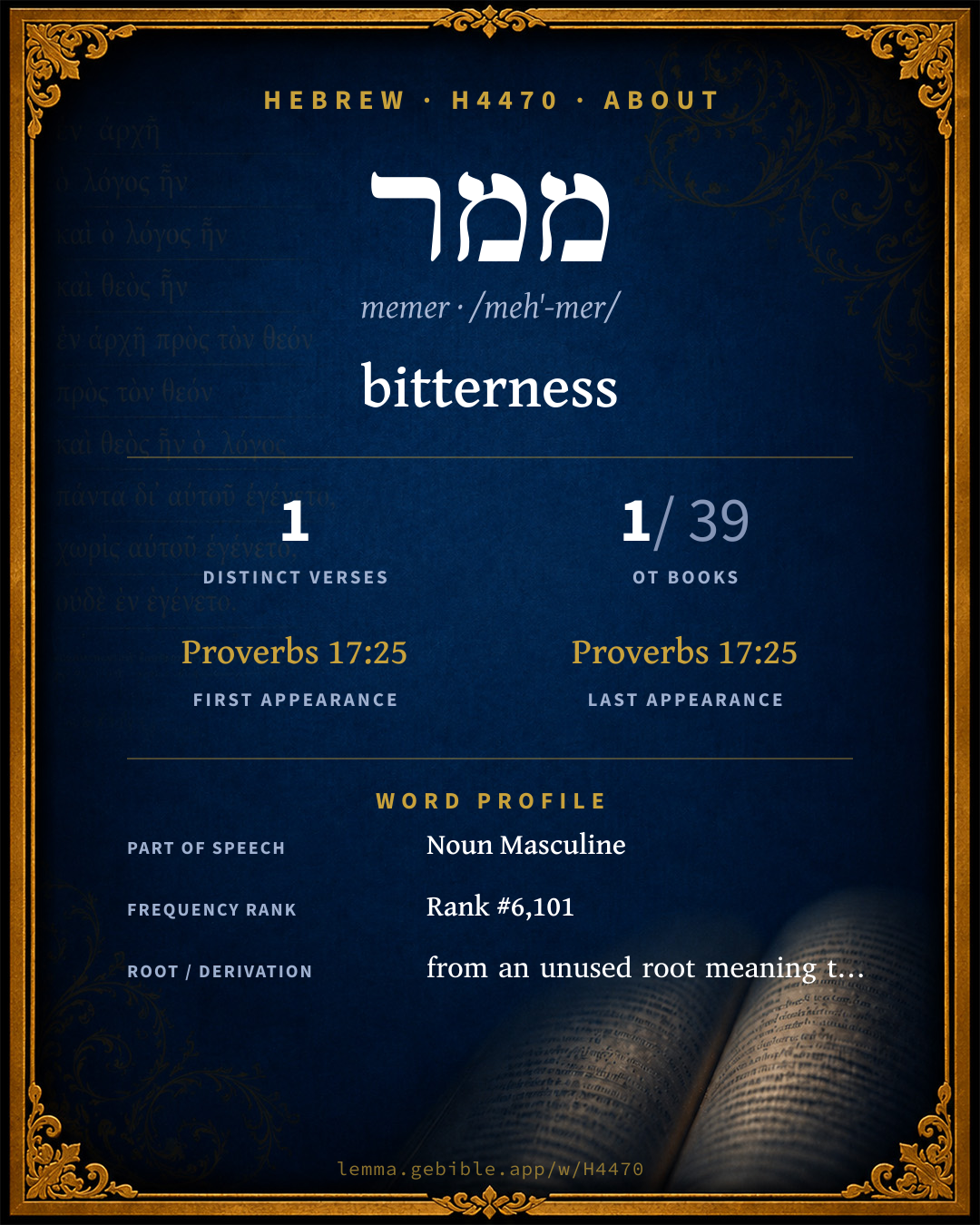
מֶ֫מֶר
bitterness
Full lexicon entry — Brown-Driver-Briggs (BDB)
From Brown-Driver-Briggs (BDB)
Where this word appears
Grammar key — what these labels mean
Noun type
- Common
- A common noun — a general class of person, place, or thing (“king,” “city,” “water”), not a specific name.
State
- Absolute
- The independent form of a noun, not bound to a following word.
Gender
- Masculine
- Grammatically masculine.
Number
- Singular
- One.
Every verse where H4470 appears — 1 distinct verse across 1 book. Click any verse to open its interlinear word-by-word view. Verse text shown in the World English Bible for context — . Each verse’s Hebrew form is shown with its reference; the English is not keyword-highlighted, since the data carries no word-level English alignment. Use “Compare translations” on any verse to read it across multiple English versions. This concordance covers the Hebrew Bible; Septuagint (Greek Old Testament) occurrences are not indexed here.
Proverbs 1 verse
About this entry
At a glance — auto-summarized from this page’s data, not written by a person. Every figure links to its source below. This summary describes the numbers; it doesn’t interpret them.
ממר — transliterated memer — is a Hebrew noun carrying the sense “bitterness.” The Hebrew Bible uses it only 1 verse. Its uses cluster heavily in Proverbs (100% of all occurrences). Found nowhere else but Proverbs 17:25. See the sense tree, 1-verse concordance, and the renderings breakdown below.
Gloss history
Strong's 1890 vs modern scholarship
About this word
Strong's H4470 catalogs a Hebrew word from the Hebrew Old Testament.
These counts are not copied from any lexicon or concordance. They are computed here, from the morphology-tagged Hebrew Old Testament. What Lemma adds →
- 1
- distinct verses
- The word appears in 1 distinct verse.
- 1 / 39
- OT books
- The word appears in 1 of 39 Old Testament books.
- #6,101
- by frequency
- Rank #6,101 (rank 6,101 of 8,640 Hebrew words by occurrence).
View all 1 occurrence in the concordance →
Most concentrated in
- Proverbs 1 verse 100%
By section of the Old Testament
By traditional corpus
Conventional, traditional groupings — biblical authorship is debated, so this is a traditional corpus grouping, not an authorship claim. Each share is this word’s portion of its verses in that division of the Hebrew canon. Each figure is a share of the word’s 1 distinct verse.
- Writings (Ketuvim) 1 verse · 100%
How translations render this word
Counts come from each version’s own published word-to-Strong’s tagging or interlinear alignment — an approximate guide to how each version renders this word, not a word-level alignment the data otherwise carries. Because each total is that version’s own tagged count, the per-version totals vary from one another and need not match the appearance or distinct-verse counts above. These counts may also differ from a printed concordance because Lemma counts each distinctly tagged rendering and does not collapse phrase taggings into a single head-word total. This is a fixed set of word-tagged versions (KJV, ASV, BSB, ULT) and does not change with the reading translation you choose elsewhere. Each version’s license is shown beside its name below (and on Sources).
- King James Version: Bitterness 1×
- American Standard Version: Bitterness 1×
- Berean Standard Bible: Bitterness 1×
- unfoldingWord Literal Text: Bitterness 1×
King James Version Public Domain
Renders H4470 across 1 tagged occurrence — most commonly:
American Standard Version Public Domain
Renders H4470 across 1 tagged occurrence — most commonly:
Berean Standard Bible Public Domain
Renders H4470 across 1 tagged occurrence — most commonly:
unfoldingWord Literal Text CC BY-SA 4.0
Renders H4470 across 1 tagged occurrence — most commonly:
Senses in BDB
The 1 sense BDB distinguishes for this word, in lexicon order (not ranked by frequency or importance). The full entry — with sub-senses — is in the Lexicon Entry tab.
- bitterness
Word origin
Origin: from an unused root meaning to grieve
Jastrow Dictionary
A second Hebrew/Aramaic lexicon for comparison, covering Aramaic and post-biblical (Talmudic, Targumic, Midrashic) usage that the biblical-Hebrew BDB does not. Matched by lemma rather than by Strong’s number, so a lemma may carry more than one Jastrow headword (shown separately below), and the entries cover usage well beyond the Bible.
מֹר
- myrrh, מוֹר.
מַר I
- = אֲמַר, to speak, say. Y. Sabb. I, 3ᵇ top חזר ומר again he said. Y. B. Bath. X, 17ᶜ bot. מְדְּמַר הונא (not מרמר) from what H. said (we learn). Y. Snh. III, 21ᵇ bot. מאן דמר he who said. Ib. X, 27ᵈ bot., v. דַּתְּ.—Y. Ter. VIII, 46ᵃ חמון מה אתון מָרִין observe what you say. Y. Ber. II, 5ᶜ top אית דמָרִין (not דמריי) some say; a. fr.
מַר II
- 1. bitter. Pes. 39ᵃ כל ירק מר וכ׳ every bitter herb contains a gum (won by impissation). Lev. R. s. 31 מר מזה מתחת ידו וכ׳ rather something bitterer than this out of the hand of the Lord, than sweets out of thine; Yalk. Gen. 59; Gen. R. s. 33 (corr. acc.); a. fr.—Y. Snh. X, 27ᵈ מר לי woe is me. Keth. 69ᵇ (play on וס̇ר מ̇ר̇ז̇ח סרוחים, Am. VI, 7) מ̇ר̇ וז̇ח̇ נעשה שר לסרוחים he who is bitter (of soul) and distracted (through bereavement) is made the chief of those banqueting (i.e. the mourner must sit at the head at the comforting meal); M. Kat. 28ᵇ (not מרזח, Ms. M. מרוזח); Yalk. Am. 545. e.g. Amos 6:7
- 2. corrosive substance; trnsf. care, worry. Sabb. 30ᵇ; Pes. 117ᵃ (play on מוֹר, Cant. V, 13) a student before his teacher, ואין שפתותיו נוטפות מר whose lips to not drip from care; (Cant. R. l. c. ששפתיו נוטפות מור).—3) mar, name of a bitter herb, ferula. Pes. l. c. מר ירואר, expl. מר זה הוא י׳ mar is y’roar, v. יְרוֹאָר; [for. Var. lect. v. Rabb. D. S. a. l. note].—Fem. מָרָה, q. v. e.g. Song of Solomon 5:13
מַר III
- (or מָר) m. (מוּר) exchange; במֹר ד־ instead of; as. Ḥull. 94ᵃ ויהבה ניהליה במר דשחוטה and he gave her (the ritually forbidden hen) to him (the gentile) pretending that it was ritually cut. B. Kam. 113ᵇ, v. פְּלִיזָא. Bekh. 30ᵃ מזבין ליה במר דכנתא sold it for fat of the ileum (which is permitted; Ar. מרכנתא, suggesting מַדְכַנְתָּא, q. v.).
מַר IV
- (pl. forms מָרֵא, מָרֵי, מָארֵי) (Arab. marua, cmp. מָרָא, to be strong; cmp. גָּבַר a. גֶּבֶר) man, lord, master; somebody; (as a title) Mar. Tosef. Shek. II, 15 מפני שמר על הכל because he was ruler &c., v. אֲמַרְכּוֹל; Hor. 13ᵃ אמר כולא (prob. to be read מרא כולא).—Lev. R. s. 31 מָרִי נח my lord Noah. Y. Peah VIII, end, 21ᵇ לא יכעוס מָרִי עלי let my lord not be angry &c.; a. e.—Targ. Gen. XXXVII, 19. Targ. Prov. XXIII, 2; a. fr.—Snh. 109ᵇ אי מר רבה … ואי מר וכ׳ if the one (Moses) is teacher (leader), thou art a pupil (subordinate), and if the other (Korah) is &c. Ḥull. 105ᵃ, a. fr. מר אמר חדא ומר אמר וכ׳ one said one thing, another another thing, but they do not differ. Yoma 20ᵇ ומר אמר לי Ms. M. (ed. ואת אמרת) and you, Sir, say to me &c. Ib. מר ניהו רב נינח מר (Rashi מר הוא) the man (you speak of) is a teacher; sit down, Sir. B. Kam. 60ᵇ מר אמר ליה לימא מר וכ׳ one said to him, tell us, Sir &c.—Ber. 2ᵃ, a. fr. אמר מר it has been said (introducing a discussion on a subject previously touched upon). Y. Snh. I, 18ᶜ bot., a. e. אכן מָרָהּ דשמעתא וכ׳ in such a case the author of the rule would not have maintained it. Y. Ter. VIII, 45ᶜ הא מרי שמועתא והא מ׳ עובדא here is a master of traditions and a master of practice. Gen. R. s. 58 (expl. תושב, Gen. XXIII, 4) מארי ביתא (= בעל הבית) owner of a house, citizen, opp. דיירא. Succ. 32ᵇ, a. fr. שרי ליה מָרֵיה ל־ the Lord forgive him (he is mistaken).—Ned. 50ᵃ יעביד מָרָנָא עליה let our lord do with this (be contented for the present). Y. Ab. Zar. V, 44ᵈ [read:] אין את מָרָהּ דנפשך (cmp. Prov. XXIII, 2) if thou art master over thy desire; אי נפשך מָרָתָךְ if thy desire is master over thee; Deut. R. s. 2 אנא מָרֵי דנפשי אנא I am master over my desire; a. fr.—Pl. מָרֵי = בַּעֲלִים (used as sing. a. pl.; v. supra). Targ. Is. III, 12; a. fr.—מָרָוָותָא, מָרָוָתָא (pl. of מָרוּתָא). Targ. Prov. V, 13 (h. text מוֹרָי).—Gitt. 40ᵃ כלו מ׳ בתראי the owners at second hand (of the settlement of slaves) died out; אהדרו אבני מ׳ קדמאי apply (for emancipation) to the heirs of the original owners. B. Bath. 3ᵇ קטלינהו לכולהו מָרָוָתֵיה (Var. לכולהו בני מרותיה) he (Herod) killed all of his master’s family. B. Kam. 103ᵃ מ׳ דכיתנא Ms. M. (ed. מָרָוָותֵיה) the owner of the flax; a. fr.—Mar Samuel, Mar Ukban &c., v. respect. pr. nouns.—Fem. מָרְתָא, מָרְתָה e.g. Genesis 23:4
- 1. mistress, constr. מָרַת. Targ. I Kings XVII, 17. Targ. Is. XXIV, 2; a. fr.—Gen. R. s. 52, v. בַּעֲלָה. Y. Ḥag. II, 77ᵈ מ׳ דביתא the hostess. Y. Peah VIII, 21ᵇ top [read:] הב ליה יתיר דנפשיה מָרָתֵיה give him (the poor man) more, for his appetite is his master (he is used to good living). Y. Ab. Zar. l. c., v. supra; a. fr.
- 2. pr. n. f. Martha. Gitt. 56ᵃ; a. fr. מ׳ בת ביתוס, v. בַּיְתוֹס.—M. Kat. 26ᵇ bot. אבא בר מ׳ (Ms. M. מָרַת); Yeb. 120ᵃ; Sabb. 121ᵇ; Yoma 84ᵃ (v. Rabb. D. S. a. l. note 60); a. e.
- 3. pr. n. m. (?). Snh. 5ᵃ bot. B. Bath. 52ᵃ (v. Rabb. D. S. a. l. note 8). Pes. 103ᵃ top מ׳ אמר (Ms. M. 1 רב ברונא; Ms. M. 2 מרונא, v. Rabb. D. S. a. l. note).
מָר
- 1. (= מארא, v. אָרָה) hoe, rake. Erub. 77ᵇ דבעי מ׳ וחצינא it requires hoe or pick-axe (to get it out). Meg. 28ᵃ, v. דְּרֵי II. Taan. 23ᵇ top ציבי ומ׳ the wood (he had collected) and the rake. B. Mets. 82ᵇ מ׳ ופסל וקרדום (Ms. מר, Ar. מר פסל) hoe and mattock and axe; Ber. 57ᵇ מר פסל וקרדום. Keth. 64ᵃ בעינא … ומָרָה לקבורה I want a staff to lean on and a hoe to make my grave, i.e. a son to support me in old age and to provide for my burial; Yeb. 65ᵇ. Taan. 21ᵇ, v. זְבִילָא; a. e.—
- *2. (= מארא, denom. of אוּרָא; cmp. Arab. marvu silices &c.) flint for striking a light. Zeb. 116ᵇ אפיקו נורא ממ׳ חדתא (Ms. M. ממַגָּאנָא, Yalk. Lev. 579 ממַגָּנָה, v. מַנְגָּנָא; Ms. K. ממָאנָא; En Yaăk. ממָנָא) produce fire with a flint-stone which has not been used before.
A Dictionary of the Targumim, the Talmud Babli and Yerushalmi, and the Midrashic Literature (Marcus Jastrow; London, Luzac, 1903) — Public Domain. Digitized via Sefaria. Digitized via Sefaria. Full attribution on Sources.
Septuagint verse parallels
This word appears in 1 verse that also exists in the Greek Old Testament (Septuagint), out of the 1 Hebrew verse it occurs in. You can read those verses in Greek by switching the Old Testament edition to the Septuagint.
Read these verses in the Septuagint
This is a verse-level parallel only — the same verses exist in both the Hebrew and Greek Old Testaments. No word-level Hebrew↔Greek correspondence is claimed: the data carries no such alignment, so no Greek word is shown as this Hebrew word’s translation. Coverage is not total — the Septuagint omits the deuterocanon and renumbers the Psalms, so some Hebrew verses have no direct Greek parallel.