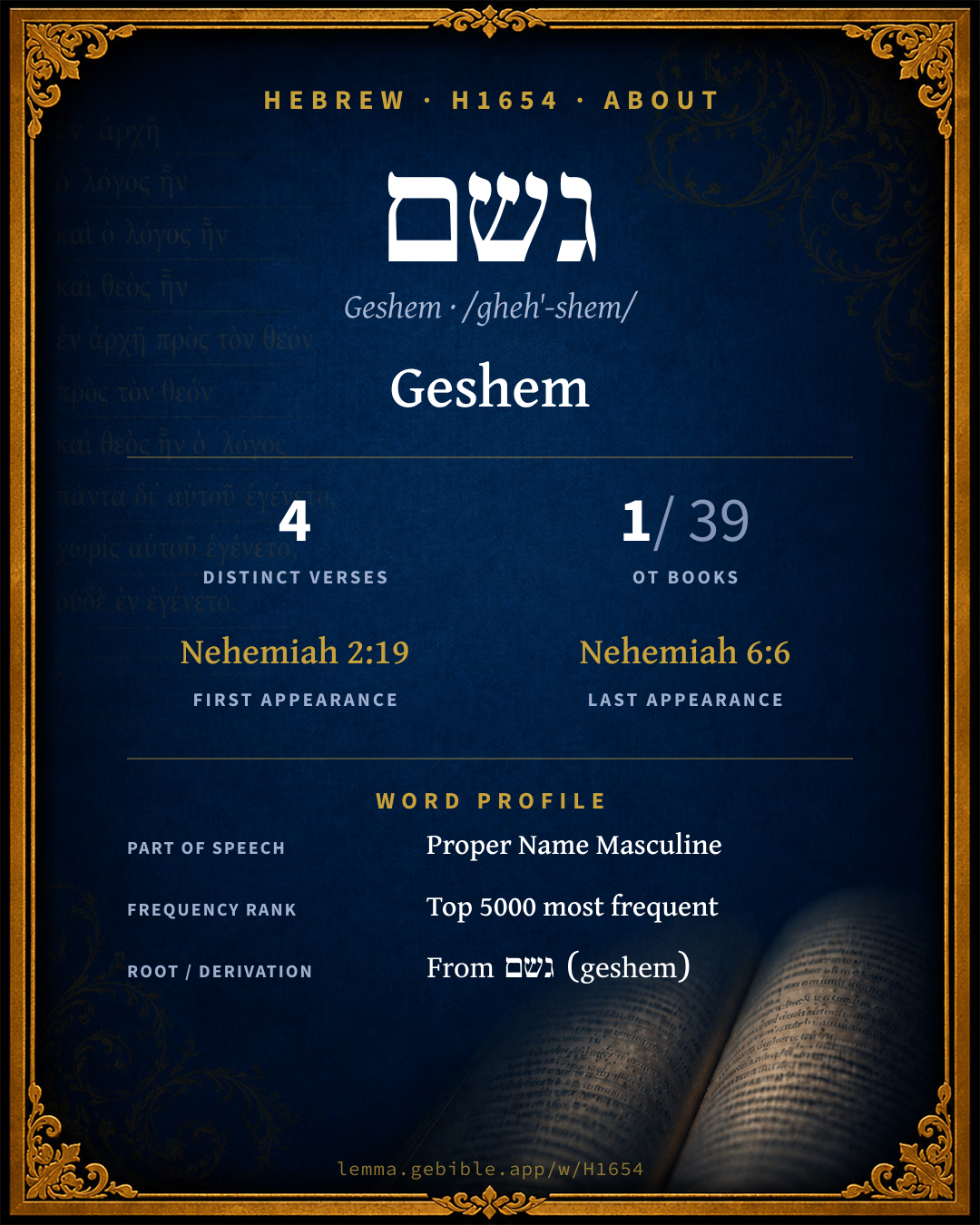
גֶּ֫שֶׁם
Geshem
BDB lists 2 entries for ‘Geshem’ fuller range ↓
Full lexicon entry — Brown-Driver-Briggs (BDB)
From Brown-Driver-Briggs (BDB)
Where this word appears
Grammar key — what these labels mean
Noun type
- Proper
- A name of a specific person, place, or people (e.g. Abraham, Zion, Israel).
Every verse where H1654 appears — 4 distinct verses across 1 book. Click any verse to open its interlinear word-by-word view. Verse text shown in the World English Bible for context — . Each verse’s Hebrew form is shown with its reference; the English is not keyword-highlighted, since the data carries no word-level English alignment. Use “Compare translations” on any verse to read it across multiple English versions. This concordance covers the Hebrew Bible; Septuagint (Greek Old Testament) occurrences are not indexed here.
Nehemiah 4 verses
- Nehemiah 2:19 וְ/גֶ֨שֶׁם֙ conj + n Proper But when Sanballat the Horonite, and Tobiah the servant, the Ammonite, and Geshem the Arabian, heard it, they ridiculed us, and despised us, and said, What is this thing that you do? will you rebel against the king?
- Nehemiah 6:1 וּ/לְ/גֶ֨שֶׁם conj + prep + n Proper Now it happened, when it was reported to Sanballat and Tobiah, and to Geshem the Arabian, and to the rest of our enemies, that I had built the wall, and that there was no breach left therein; (though even to that time I had not set up the doors in the gates;)
- Nehemiah 6:2 וְ/גֶ֨שֶׁם֙ conj + n Proper that Sanballat and Geshem sent to me, saying, Come, let us meet together in [one of] the villages in the plain of Ono. But they thought to do me mischief.
- Nehemiah 6:6 וְ/גַשְׁמ֣וּ conj + n Proper in which was written, It is reported among the nations, and Gashmu says it, that you and the Jews think to rebel; for which cause you are building the wall: and you would be their king, according to these words.
About this entry
At a glance — auto-summarized from this page’s data, not written by a person. Every figure links to its source below. This summary describes the numbers; it doesn’t interpret them.
The Hebrew name גשם centers on the idea of “Geshem.” It occurs a mere 4 verses across Scripture. The word gravitates to Nehemiah (100%). First canonically at Nehemiah 2:19, it enters the text early. For the data behind this summary, explore 4-verse concordance and the renderings breakdown below.
Gloss history
Strong's 1890 vs modern scholarship
About this word
Strong's H1654 catalogs a Hebrew word from the Hebrew Old Testament.
These counts are not copied from any lexicon or concordance. They are computed here, from the morphology-tagged Hebrew Old Testament. What Lemma adds →
- 4
- distinct verses
- The word appears in 4 distinct verses.
- 1 / 39
- OT books
- The word appears in 1 of 39 Old Testament books.
- #3,696
- by frequency
- Top 5000 most frequent Hebrew words (rank 3,696 of 8,640 Hebrew words by occurrence).
View all 4 occurrences in the concordance →
Most concentrated in
- Nehemiah 4 verses 100%
By section of the Old Testament
By traditional corpus
Conventional, traditional groupings — biblical authorship is debated, so this is a traditional corpus grouping, not an authorship claim. Each share is this word’s portion of its verses in that division of the Hebrew canon. Each figure is a share of the word’s 4 distinct verses.
- Writings (Ketuvim) 4 verses · 100%
How translations render this word
Counts come from each version’s own published word-to-Strong’s tagging or interlinear alignment — an approximate guide to how each version renders this word, not a word-level alignment the data otherwise carries. Because each total is that version’s own tagged count, the per-version totals vary from one another and need not match the appearance or distinct-verse counts above. These counts may also differ from a printed concordance because Lemma counts each distinctly tagged rendering and does not collapse phrase taggings into a single head-word total. This is a fixed set of word-tagged versions (KJV, ASV, BSB, ULT) and does not change with the reading translation you choose elsewhere. Each version’s license is shown beside its name below (and on Sources).
BDB lists this Strong’s number as 3 distinct words (homographs). Each count above pools all of them and is not split by sense — see the Senses section below. A low-frequency rendering may belong to a different one of those words, not the primary meaning.
- King James Version†: Geshem 3×
- American Standard Version†: Geshem 3×
- Berean Standard Bible†: Geshem 4×
- unfoldingWord Literal Text†: Geshem 3×
King James Version Public Domain
Renders H1654 across 4† tagged occurrences — most commonly:
Plus 1 rendering that appears only once — usually multi-word phrases or single function words the recovered tagging swept in, not distinct renderings.
American Standard Version Public Domain
Renders H1654 across 4† tagged occurrences — most commonly:
Plus 1 rendering that appears only once — usually multi-word phrases or single function words the recovered tagging swept in, not distinct renderings.
Berean Standard Bible Public Domain
Renders H1654 across 4† tagged occurrences — most commonly:
unfoldingWord Literal Text CC BY-SA 4.0
Renders H1654 across 4† tagged occurrences — most commonly:
Plus 1 rendering that appears only once — usually multi-word phrases or single function words the recovered tagging swept in, not distinct renderings.
Senses in BDB
The 2 senses BDB distinguishes for this word, in lexicon order (not ranked by frequency or importance). The full entry — with sub-senses — is in the Lexicon Entry tab.
- Geshem or Gashmu = "rain"
- an Arabian foe of Nehemiah
Word origin
I. n.pr.m. an opponent of Nehemiah Ne 2:19; 6:1 (in both called הָעַרְבִּי); v 2; also גַּשְׁמוּ 6:6; וּ as in Nab. n.pr. cf. Nö in Eut Nab 73.
II. n.m. Gn 7:12 rain, shower (NH id., conn. wi. above √ dub.)—abs. ג׳ Gn 7:12 +; גָּ֑שֶׁם 1 K 18:41 +; cstr. גֶּשֶׁם Jb 37:6(×2) +; pl. גְּשָׁמִים Ezr 10:9, 13; cstr. גִּשְׁמֵי Ez 34:26; sf. גִּשְׁמֵיכֶם Lv 26:4; גִּשְׁמֵיהֶם ψ 105:32;—rain, shower Gn 7:12; 8:2 (both J) Lv 26:4 (H) Ho 6:3 Am 4:7; Je 5:24; 14:4; Is 44:14; 55:10; Ez 1:28 Jo 2:23 (‖ מוֹרֶה, מַלְקוֹשׁ); 1 K 17:7, 14; 18:45 (ג׳ גדול) 2 K 3:17; Pr 25:14, 23; Ec 11:3; Ct 2:11 ψ 105:32 וּמֵהַגּ׳ Ezr 10:9 and because of the rains, cf. v 13; קוֹל הֲמוֹן הַגּ׳ 1 K 18:41 cf. v 44 Zc 14:17; Ec 12:2; גֶּשֶׁם מָטָ֑ר וְג׳ מִטְרוֹת עֻזּוֹ Jb 37:6; מְטַר־גֶּשֶׁם Zc 10:1; cf. ג׳ נְדָבוֹת ψ 68:10; fig. of blessing Ez 34:26, ג׳ בְּרָכָה v 26; of destruction ג׳ שֹׁטֵף Ez 13:11, 13 cf. 38:22.
— Brown-Driver-Briggs (Oxford 1906, public domain), digitized via Sefaria, supplemented by the OpenScriptures HebrewLexicon (CC BY 4.0). See Sources.
Derived from גשם (geshem) (H1653) — rain.
Jastrow Dictionary
A second Hebrew/Aramaic lexicon for comparison, covering Aramaic and post-biblical (Talmudic, Targumic, Midrashic) usage that the biblical-Hebrew BDB does not. Matched by lemma rather than by Strong’s number, so a lemma may carry more than one Jastrow headword (shown separately below), and the entries cover usage well beyond the Bible.
גָּשַׁם
- v. גּוּשׁ) to make the earth cloddy (v. Ges. H. Dict.10 s. v.).—Part. pass. גָּשׁוּם cloddy in consequence of ample rains. Y. Yoma V, 42ᶜ top שנת גְּשׁוּמָה שחונה וכ׳ (sub. ארץ) a year in which the earth forms clods, then is parched so as to form scabs, and then moistened with dew; Bab. ib. 53ᵇ שנת שחונה שנת ג׳ Ms. M. (ed. שנה ג׳ ושח׳, v. Rabb. D. S. a. l. note), expl. אם שח׳ (היא) תהא ג׳ if it is to be parched, let it first be soaked with heavy rains; Lev. R. s. 20; Tanḥ. Aḥăré 3 (corr. acc.); ed. Bub. ib. 4.
- (denom. of גֶּשֶׁם) to be frought with rain, rain-bringing. B. Bath. 25ᵇ since the destruction of the Temple לא הוּגְשְׁמָה וכ׳ the south wind has not been rain-bringing.
גֶּשֶׁם I
- preced.) heavy, continuous rain. Taan. 3ᵇ לא אמר מוריד הַגָּ׳ if he failed to insert in the second benediction (v. גְּבוּרָה) ‘Who sendeth rain’.—Pl. גְּשָׁמִים. Taan. I, 1, a. fr. גבורות ג׳, v. גְּבוּרָה. Ib. 2 שואלין את הג׳ we insert the petition for rain in the ninth benediction, v. שַׁאֲלָה.—ימות הג׳ rainy season, autumn and winter. Ib. 3ᵇ. Toh. VI, 7, v. בִּקְעָה; a. v. fr.—שְׂדֵה גְ׳ (or sub. שדה) a field naturally watered by rain, opp. שלחין. Bekh. VI, 3 של ג׳ from fields with natural irrigation; cmp. בַּעַל. [In later Hebr. literature גֶּשֶׁם substance, v. next w.].
גֶּשֶׁם II
- (גשם, v. גּוּשְׁמָא) body, self. Dan. IV, 30.—Pl. גִּשְׁמַיָּא. Lam. R. to I, 5 לא יהבין גִּשְׁמֵיהוֹן (Koh. R. to VII, 11 גרמיהון) they will not devote themselves to warfare. e.g. Daniel 4:30
A Dictionary of the Targumim, the Talmud Babli and Yerushalmi, and the Midrashic Literature (Marcus Jastrow; London, Luzac, 1903) — Public Domain. Digitized via Sefaria. Digitized via Sefaria. Full attribution on Sources.
Forms in the corpus
The 3 distinct written forms H1654 takes in the Hebrew Bible, most frequent first — each parse links to that state’s occurrences in the concordance. Hebrew forms include their vowel points and cantillation, so a single lemma takes many written forms.
| Form | Parsing | Example | Uses |
|---|---|---|---|
| וְ/גֶ֨שֶׁם֙ | Noun, Proper | Nehemiah 2:19 | 2 |
| וְ/גַשְׁמ֣וּ | Noun, Proper | Nehemiah 6:6 | 1 |
| וּ/לְ/גֶ֨שֶׁם | Noun, Proper | Nehemiah 6:1 | 1 |
Same root — word family
Other BDB entries built from the same root as H1654, grouped by Strong’s listed origin. These share a root / origin per the lexicon — not necessarily a shared meaning. Each links to that word’s own entry.
Derives from
Shares the same root
Compare all same-root words → They share a root, not necessarily a meaning.
Bible dictionary
Public-domain dictionary articles matched to this entry by name (Geshem). A biblical name can be shared by more than one person or place, so an article may treat several.
Easton's Bible Dictionary · M. G. Easton, 1897
Or Gashmu, firmness, probably chief of the Arabs south of Palestine, one of the enemies of the Jews after the return from Babylon (Neh. 2:19; 6:1, 2). He united with Sanballat and Tobiah in opposing the rebuilding of the wall of Jerusalem.
Smith's Bible Dictionary · William Smith, 1863
and Gash'mu (rain), an Arabian, mentioned in (Nehemiah 2:19) and Nehe 6:1,2,6 (B.C. 446.) We may conclude that he was an inhabitant of Arabia Petraea or of the Arabian desert, and probably the chief of a tribe." Gashum said it" made him a type of those who create a common report.
Classic public-domain reference works; full attribution on Sources.