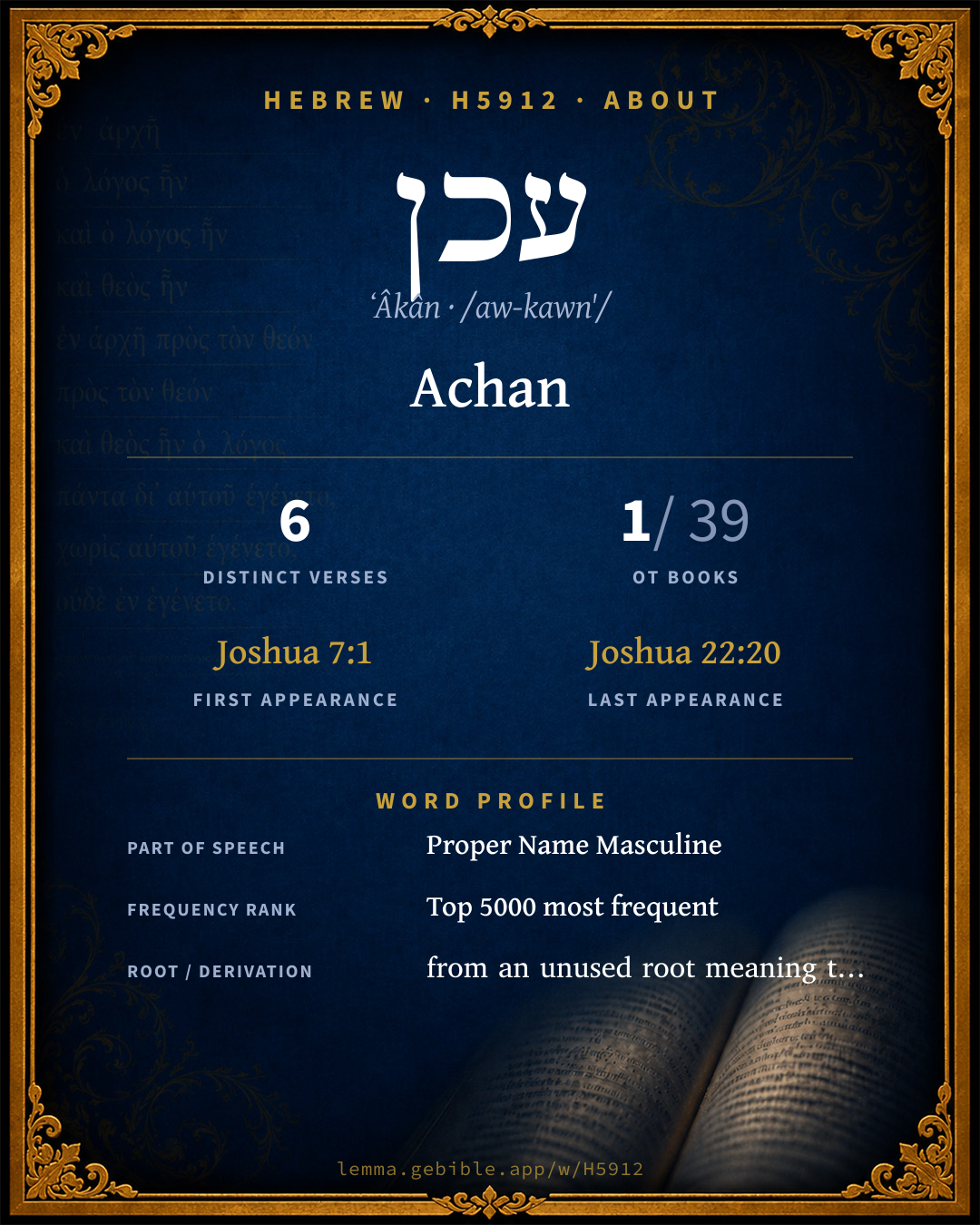
עָכָן
Achan
BDB lists 2 entries for ‘Achan’ fuller range ↓
Full lexicon entry — Brown-Driver-Briggs (BDB)
From Brown-Driver-Briggs (BDB)
Where this word appears
Grammar key — what these labels mean
Part of speech
- Noun
- A naming word — a person, place, thing, or idea.
Noun type
- Proper
- A name of a specific person, place, or people (e.g. Abraham, Zion, Israel).
Every verse where H5912 appears — 6 distinct verses across 1 book. Click any verse to open its interlinear word-by-word view. Verse text shown in the World English Bible for context — . Each verse’s Hebrew form is shown with its reference; the English is not keyword-highlighted, since the data carries no word-level English alignment. Use “Compare translations” on any verse to read it across multiple English versions. This concordance covers the Hebrew Bible; Septuagint (Greek Old Testament) occurrences are not indexed here.
Joshua 6 verses
- Joshua 7:1 עָכָ֣ן n Proper But the children of Israel committed a trespass in the devoted thing; for Achan, the son of Carmi, the son of Zabdi, the son of Zerah, of the tribe of Judah, took of the devoted thing: and the anger of Yahweh was kindled against the children of Israel.
- Joshua 7:18 עָכָ֞ן n Proper and he brought near his household man by man; and Achan, the son of Carmi, the son of Zabdi, the son of Zerah, of the tribe of Judah, was taken.
- Joshua 7:19 עָכָ֗ן n Proper Joshua said to Achan, My son, please give glory to Yahweh, the God of Israel, and make confession to him; and tell me now what you have done; don't hide it from me.
- Joshua 7:20 עָכָ֛ן n Proper Achan answered Joshua, and said, Of a truth I have sinned against Yahweh, the God of Israel, and thus and thus have I done:
- Joshua 7:24 עָכָ֣ן n Proper Joshua, and all Israel with him, took Achan the son of Zerah, and the silver, and the mantle, and the wedge of gold, and his sons, and his daughters, and his oxen, and his donkeys, and his sheep, and his tent, and all that he had: and they brought them up to the valley of Achor.
- Joshua 22:20 עָכָ֣ן n Proper Didn't Achan the son of Zerah commit a trespass in the devoted thing, and wrath fell on all the congregation of Israel? and that man didn't perish alone in his iniquity.
About this entry
At a glance — auto-summarized from this page’s data, not written by a person. Every figure links to its source below. This summary describes the numbers; it doesn’t interpret them.
The Hebrew name עכן centers on the idea of “Achan.” The word gravitates to Joshua (100%). It appears 6 verses across 1 book of the Hebrew Bible, among its uncommon vocabulary. Debuting at Joshua 7:1, it then recurs through the corpus. Dig into 6-verse concordance and the renderings breakdown below.
Gloss history
Strong's 1890 vs modern scholarship
About this word
Strong's H5912 catalogs a Hebrew word from the Hebrew Old Testament.
These counts are not copied from any lexicon or concordance. They are computed here, from the morphology-tagged Hebrew Old Testament. What Lemma adds →
- 6
- distinct verses
- The word appears in 6 distinct verses.
- 1 / 39
- OT books
- The word appears in 1 of 39 Old Testament books.
- #3,040
- by frequency
- Top 5000 most frequent Hebrew words (rank 3,040 of 8,640 Hebrew words by occurrence).
View all 6 occurrences in the concordance →
Most concentrated in
- Joshua 6 verses 100%
By section of the Old Testament
By traditional corpus
Conventional, traditional groupings — biblical authorship is debated, so this is a traditional corpus grouping, not an authorship claim. Each share is this word’s portion of its verses in that division of the Hebrew canon. Each figure is a share of the word’s 6 distinct verses.
- Prophets (Nevi'im) 6 verses · 100%
How translations render this word
Counts come from each version’s own published word-to-Strong’s tagging or interlinear alignment — an approximate guide to how each version renders this word, not a word-level alignment the data otherwise carries. Because each total is that version’s own tagged count, the per-version totals vary from one another and need not match the appearance or distinct-verse counts above. These counts may also differ from a printed concordance because Lemma counts each distinctly tagged rendering and does not collapse phrase taggings into a single head-word total. This is a fixed set of word-tagged versions (KJV, ASV, BSB, ULT) and does not change with the reading translation you choose elsewhere. Each version’s license is shown beside its name below (and on Sources).
- King James Version: Achan 5×
- American Standard Version: Achan 4×
- Berean Standard Bible: Achan 6×
- unfoldingWord Literal Text: Achan 6×
King James Version Public Domain
Renders H5912 across 6 tagged occurrences — most commonly:
Plus 1 rendering that appears only once — usually multi-word phrases or single function words the recovered tagging swept in, not distinct renderings.
American Standard Version Public Domain
Renders H5912 across 6 tagged occurrences — most commonly:
Plus 2 renderings that appear only once — usually multi-word phrases or single function words the recovered tagging swept in, not distinct renderings.
Berean Standard Bible Public Domain
Renders H5912 across 6 tagged occurrences — most commonly:
unfoldingWord Literal Text CC BY-SA 4.0
Renders H5912 across 6 tagged occurrences — most commonly:
Senses in BDB
The 2 senses BDB distinguishes for this word, in lexicon order (not ranked by frequency or importance). The full entry — with sub-senses — is in the Lexicon Entry tab.
- Achan = "troubler"
- a Judaite who violated God's specific ban on taking any loot from the captured city of Jericho and was stoned to death…
Word origin
n.pr.m. man of Judah;—Jos 7:1 (P), v 18, 19, 20, 24 (JE), 22:20 (P); = עָכָר 1 Ch 2:7 (from עָבוֹר Jos 7:26, v. also עָכָר); Αχαρ, Αχαν.
— Brown-Driver-Briggs (Oxford 1906, public domain), digitized via Sefaria, supplemented by the OpenScriptures HebrewLexicon (CC BY 4.0). See Sources.
Origin: from an unused root meaning to trouble
Jastrow Dictionary
A second Hebrew/Aramaic lexicon for comparison, covering Aramaic and post-biblical (Talmudic, Targumic, Midrashic) usage that the biblical-Hebrew BDB does not. Matched by lemma rather than by Strong’s number, so a lemma may carry more than one Jastrow headword (shown separately below), and the entries cover usage well beyond the Bible.
עָכַן
- (cmp. עכב) to be curved, curled.
- (cmp. עִילָה, סִיבָּה end) to bring about, to cause. Snh. 44ᵇ (play on עָכָן, Josh. VII, 24) זמרי … שעי׳ עוונותיהם וכ׳ his name was Zimri (I Chr. II, 6), but he was named ʿAkhan (Circle), because he caused the punishment of Israel’s sins. e.g. Joshua 7:24
עָכָן
- (b. h.) pr. n. m. Akhan, who secreted a portion of the spoils of Jericho. Snh. 44ᵇ, v. preced. Num. R. s. 23. Lev. R. s. 9; a. fr.
עֶכֶן
- (עָכַן; cmp. חֲכִינָא) annulated snake. [Lam. R. to I, 3 אמר עכן בית, read, as Num. R. s. 12 אמרו אעפ"כ מת.]—Lev. R. s. 16 (play on תעכסנה, Is. III, 16, v. עֶכֶס) והיה אותו הריח … כארס של ע׳ and the scent (of the balsam) permeated them like the venom of a snake; Sabb. 62ᵇ כארס של ע׳ Ms. O. (ed. כארס בכעוס, v. כָּעוּס); Yalk. Lam. 1031 ונצרר עכנה בהם (a misplaced corrupt. of כארס של ע׳).—Pl. עֲכָנִים, עֲכָנִין. Sifré Deut. 321 (ref. to זחלי עפר, Deut. XXXII, 24) אלו ע׳ וכ׳ (not עשנים, Var. הכינים, read: חֲכִינִים) that means the snakes whose rulership is in the dust; Yalk. ib. 945 עֲכִינִין. e.g. Isaiah 3:16
A Dictionary of the Targumim, the Talmud Babli and Yerushalmi, and the Midrashic Literature (Marcus Jastrow; London, Luzac, 1903) — Public Domain. Digitized via Sefaria. Digitized via Sefaria. Full attribution on Sources.
Forms in the corpus
The 4 distinct written forms H5912 takes in the Hebrew Bible, most frequent first — each parse links to that state’s occurrences in the concordance. Hebrew forms include their vowel points and cantillation, so a single lemma takes many written forms.
| Form | Parsing | Example | Uses |
|---|---|---|---|
| עָכָ֣ן | Noun, Proper | Joshua 7:1 | 3 |
| עָכָ֗ן | Noun, Proper | Joshua 7:19 | 1 |
| עָכָ֛ן | Noun, Proper | Joshua 7:20 | 1 |
| עָכָ֞ן | Noun, Proper | Joshua 7:18 | 1 |
Same root — word family
Other BDB entries built from the same root as H5912, grouped by Strong’s listed origin. These share a root / origin per the lexicon — not necessarily a shared meaning. Each links to that word’s own entry.
Proper names from this root
People and places named from this root — a name, not an additional meaning of the word.
Compare all same-root words → 1 of the same-root words is a proper name (a person or place). They share a root, not necessarily a meaning.
Bible dictionary
Public-domain dictionary articles matched to this entry by name (Achan). A biblical name can be shared by more than one person or place, so an article may treat several.
Easton's Bible Dictionary · M. G. Easton, 1897
Called also Achar, i.e., one who troubles (1 Chr. 2:7), in commemoration of his crime, which brought upon him an awful destruction (Josh. 7:1). On the occasion of the fall of Jericho, he seized, contrary to the divine command, an ingot of gold, a quantity of silver, and a costly Babylonish garment, which he hid in his tent. Joshua was convinced that the defeat which the Israelites afterwards sustained before Ai was a proof of the divine displeasure on account of some crime, and he at once adopted means by the use of the lot for discovering the criminal. It was then found that Achan was guilty, and he was stoned to death in the valley of Achor. He and all that belonged to him were then consumed by fire, and a heap of stones was raised over the ashes.
Smith's Bible Dictionary · William Smith, 1863
(troubler), an Israelite of the tribe of Judah, who, when Jericho and all that it contained were accursed and devoted to destruction, secreted a portion of the spoil in his tent. For this sin he was stoned to death with his whole family by the people, in a valley situated between Ai and Jericho, and their remains, together with his property, were burnt. (Joshua 7:19-26) From this event the valley received the name of Achor (i.e. trouble). [Achor, Valley Of] (B.C. 1450.)
Hitchcock's Bible Names Dictionary · Roswell D. Hitchcock, 1869
or Achar, he that troubleth
Classic public-domain reference works; full attribution on Sources.
Septuagint verse parallels
This word appears in 6 verses that also exist in the Greek Old Testament (Septuagint), out of the 6 Hebrew verses it occurs in. You can read those verses in Greek by switching the Old Testament edition to the Septuagint.
Read these verses in the Septuagint
This is a verse-level parallel only — the same verses exist in both the Hebrew and Greek Old Testaments. No word-level Hebrew↔Greek correspondence is claimed: the data carries no such alignment, so no Greek word is shown as this Hebrew word’s translation. Coverage is not total — the Septuagint omits the deuterocanon and renumbers the Psalms, so some Hebrew verses have no direct Greek parallel.