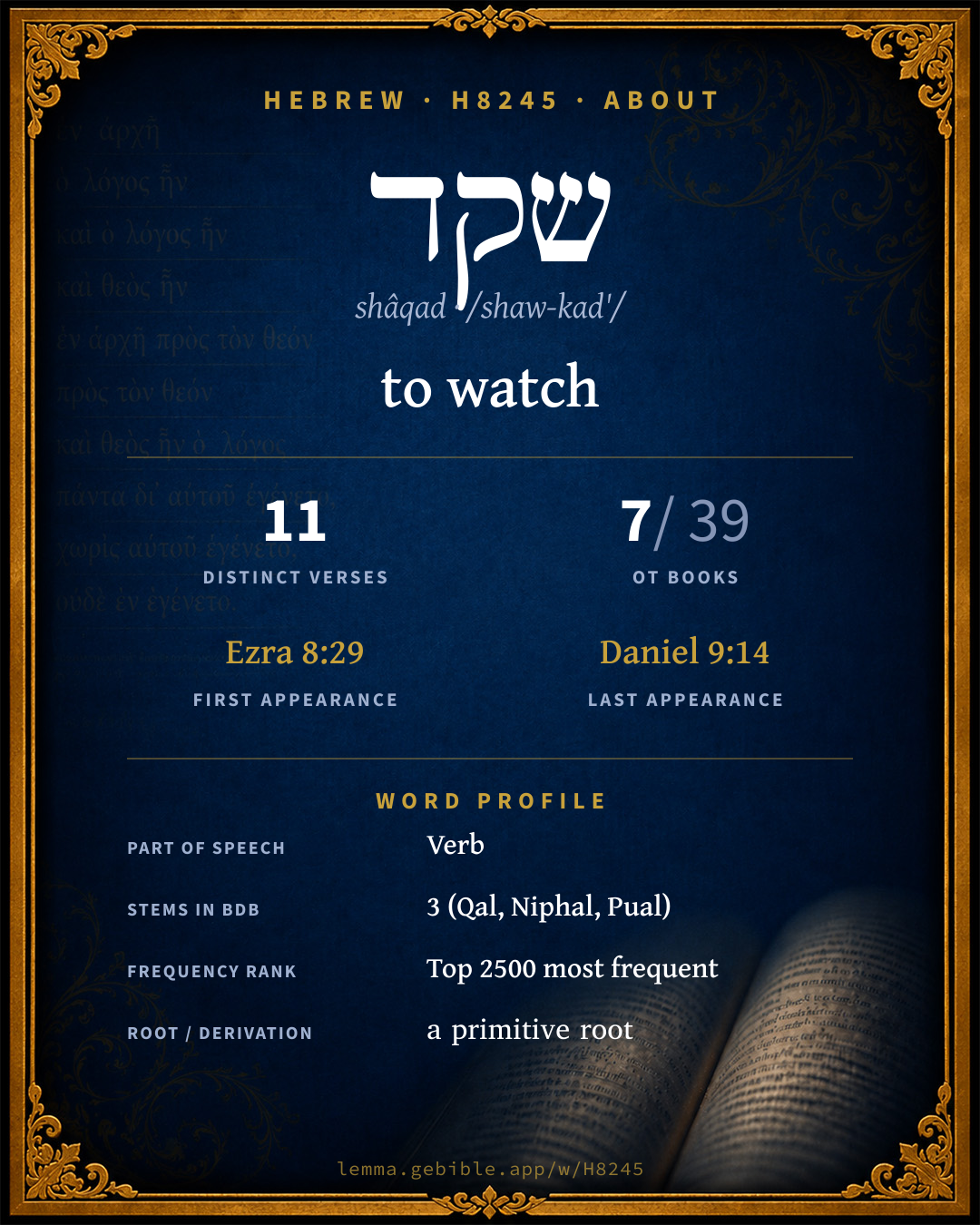
שָׁקַד
to watch
‘to watch’ is one of 3 main senses fuller range ↓
Full lexicon entry — Brown-Driver-Briggs (BDB)
From Brown-Driver-Briggs (BDB)
Where this word appears
Grammar key — what these labels mean
Part of speech
- Verb
- An action or state-of-being word.
Stem
- Qal
- The basic, simple active stem — the plain form of the verb (“he wrote”). Here: ‘keep watch of’
Form
- Participle Active
- A verbal adjective expressing ongoing or characteristic action (“writing / one who writes”).
- Perfect
- A completed action or state — Hebrew marks aspect (completeness) more than strict tense (“he wrote”).
- Sequential Imperfect
- An imperfect with prefixed waw — the standard past-narrative form (waw-consecutive imperfect).
- Infinitive Construct
- A bound verbal noun, frequently with prepositions (“to write / in writing”).
- Imperfect
- An incomplete, ongoing, or future action (“he will / would write”).
- Imperative
- A direct command (“write!”).
State
- Absolute
- The independent form of a noun, not bound to a following word.
- Construct
- A noun bound to a following noun in a possessive / “of” relationship (the construct chain).
Person
- 1st Person
- The speaker (“I / we”).
- 3rd Person
- The one spoken about (“he / she / it / they”).
- 2nd Person
- The one addressed (“you”).
Gender
- Masculine
- Grammatically masculine.
- Common
- Either gender — not distinguished for this form.
Number
- Singular
- One.
- Plural
- More than one (in Hebrew, generally three or more).
Grammatical forms 9 distinct
- Verb, Qal, Participle Active, Masculine, Singular, Absolute 3 times (25%)
- Verb, Qal, Perfect, 1st Person, Common, Singular 2 times (17%)
- Verb, Qal, Sequential Imperfect, 3rd Person, Masculine, Singular 1 time (8%)
- Verb, Qal, Infinitive Construct 1 time (8%)
- Verb, Qal, Imperfect, 1st Person, Common, Singular 1 time (8%)
- Verb, Qal, Imperfect, 3rd Person, Masculine, Singular 1 time (8%)
- Verb, Qal, Perfect, 3rd Person, Masculine, Singular 1 time (8%)
- Verb, Qal, Participle Active, Masculine, Plural, Construct 1 time (8%)
+1 more form (1 occurrence)
Parsed forms decoded from the imported morphology (morphhb / Westminster Leningrad Codex — WLC text public domain, morphhb tagging CC BY 4.0), counted across 12 parsed occurrences — not distinct verses.
Every verse where H8245 appears — 11 distinct verses across 7 books. Click any verse to open its interlinear word-by-word view. Verse text shown in the World English Bible for context — . Each verse’s Hebrew form is shown with its reference; the English is not keyword-highlighted, since the data carries no word-level English alignment. Use “Compare translations” on any verse to read it across multiple English versions. This concordance covers the Hebrew Bible; Septuagint (Greek Old Testament) occurrences are not indexed here.
Ezra 1 verse
Job 1 verse
Psalms 2 verses
Proverbs 1 verse
Isaiah 1 verse
Jeremiah 4 verses
- Jeremiah 1:12 שֹׁקֵ֥ד Qal ptcp.act ms Then said Yahweh to me, You have well seen: for I watch over my word to perform it.
- Jeremiah 5:6 שֹׁקֵד֙ Qal ptcp.act ms Therefore a lion out of the forest shall kill them, a wolf of the evenings shall destroy them, a leopard shall watch against their cities; everyone who goes out there shall be torn in pieces; because their transgressions are many, [and] their backsliding is increased.
- Jeremiah 31:28 שָׁקַ֣דְתִּי אֶשְׁקֹ֧ד Qal pf 1cs Qal impf 1cs It shall happen that, like as I have watched over them to pluck up and to break down and to overthrow and to destroy and to afflict, so will I watch over them to build and to plant, says Yahweh.
- Jeremiah 44:27 שֹׁקֵ֧ד Qal ptcp.act ms Behold, I watch over them for evil, and not for good; and all the men of Judah who are in the land of Egypt shall be consumed by the sword and by the famine, until there be an end of them.
Daniel 1 verse
About this entry
At a glance — auto-summarized from this page’s data, not written by a person. Every figure links to its source below. This summary describes the numbers; it doesn’t interpret them.
The Hebrew verb שקד centers on the idea of “to watch.” Debuting at Ezra 8:29, it then recurs through the corpus. It appears 11 verses across 7 books of the Hebrew Bible, among its uncommon vocabulary. The word gravitates to Jeremiah (36%), then Psalms and Ezra. Read the stem: it spans 3 stems, including Qal and Niphal. For the data behind this summary, explore the sense tree and the renderings breakdown below.
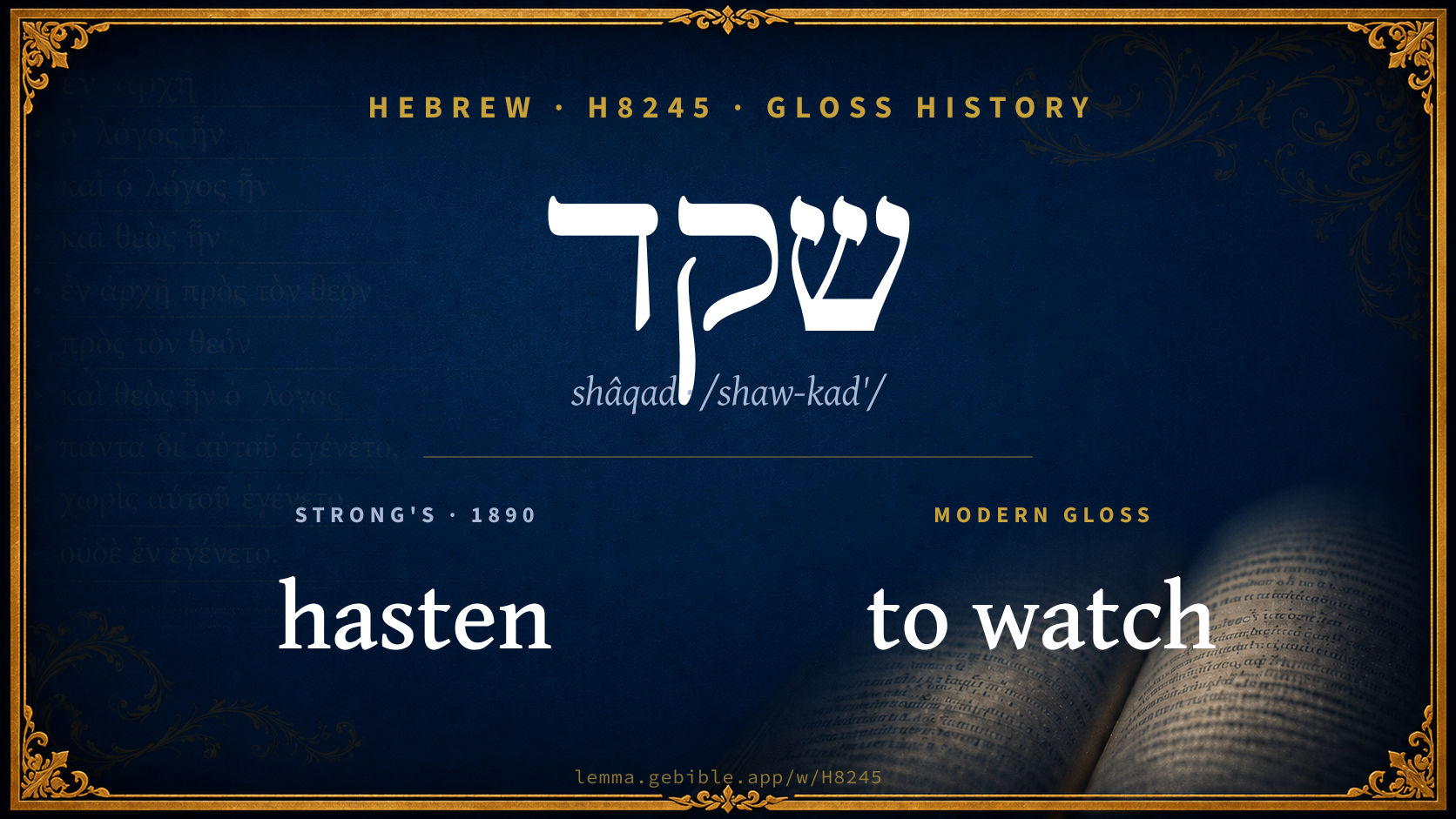
Gloss history
Strong's 1890 vs modern scholarship
About this word
Strong's H8245 catalogs a Hebrew word from the Hebrew Old Testament.
These counts are not copied from any lexicon or concordance. They are computed here, from the morphology-tagged Hebrew Old Testament. What Lemma adds →
- 11
- distinct verses
- The word appears in 11 distinct verses.
- 7 / 39
- OT books
- The word appears in 7 of 39 Old Testament books.
- #2,101
- by frequency
- Top 2500 most frequent Hebrew words (rank 2,101 of 8,640 Hebrew words by occurrence).
View all 11 occurrences in the concordance →
By section of the Old Testament
By traditional corpus
Conventional, traditional groupings — biblical authorship is debated, so this is a traditional corpus grouping, not an authorship claim. Each share is this word’s portion of its verses in that division of the Hebrew canon. Each figure is a share of the word’s 11 distinct verses.
- Writings (Ketuvim) 6 verses · 55%
- Prophets (Nevi'im) 5 verses · 45%
How translations render this word
Counts come from each version’s own published word-to-Strong’s tagging or interlinear alignment — an approximate guide to how each version renders this word, not a word-level alignment the data otherwise carries. Because each total is that version’s own tagged count, the per-version totals vary from one another and need not match the appearance or distinct-verse counts above. These counts may also differ from a printed concordance because Lemma counts each distinctly tagged rendering and does not collapse phrase taggings into a single head-word total. This is a fixed set of word-tagged versions (KJV, ASV, BSB, ULT) and does not change with the reading translation you choose elsewhere. Each version’s license is shown beside its name below (and on Sources).
BDB lists this Strong’s number as 2 distinct words (homographs). Each count above pools all of them and is not split by sense — see the Senses section below. A low-frequency rendering may belong to a different one of those words, not the primary meaning.
- King James Version†: All that watch 1×, Behold i will watch 1×, I watch 1×
- American Standard Version†: I watch 2×
- Berean Standard Bible†: Am watching 1×, Guard them 1×, I am watching 1×
- unfoldingWord Literal Text†: Am watching 1×, Has kept 1×, Has stayed awake 1×
King James Version Public Domain
Renders H8245 across 12† tagged occurrences — most commonly:
American Standard Version Public Domain
Renders H8245 across 12† tagged occurrences — most commonly:
Plus 10 renderings that appear only once — usually multi-word phrases or single function words the recovered tagging swept in, not distinct renderings.
Berean Standard Bible Public Domain
Renders H8245 across 12† tagged occurrences — most commonly:
unfoldingWord Literal Text CC BY-SA 4.0
Renders H8245 across 11† tagged occurrences — most commonly:
Senses in the full BDB
Hebrew verbs can shift meaning by stem (binyan): Qal is the basic action, Niphal is often passive or reflexive, Piel often intensifies or makes it factitive, and Hiphil is typically causative. The senses below are grouped under the stem BDB assigns to each. This entry also uses Pual (the passive of Piel).
What do BDB’s symbols mean?
BDB uses these scholarly abbreviations:
| Symbol | Meaning |
|---|---|
| 𝔊 | the Septuagint (the ancient Greek translation, LXX) |
| 𝔙 | the Vulgate (the Latin translation) |
| 𝔖 | the Syriac version (the Peshitta) |
| 𝔗 | the Targum (the Aramaic translation) |
| ψ | the Psalms |
| √ | root (the underlying root or stem) |
| ‖ | parallel passage (a synonymous or contrasted parallel) |
| † | the dagger: every passage where the word occurs is cited |
The 6 senses and sub-senses the full Brown-Driver-Briggs lexicon distinguishes for this word, in lexicon order (not ranked by frequency), with BDB’s own verbatim wording and sub-sense lettering. Shown in Hebrew script with BDB’s own scholarly abbreviations. The condensed entry is in the Lexicon Entry tab. See also the Forms in the corpus table below.
שקד I watch, wake (Ph. שקד be circumspect
Qal
- Pf. 3 ms. שׁ׳ ψ 127:1, שָׁקַ֫דְתִּי Je 31:28 ψ 102:8; Impf. 3 ms. יִשְׁק֑וֹד Jb 21:32 (Me Bu יִשְׁקֹ֑דוּ), וַיִּשְׁקֹד Dn 9:14, 1 s. אֶשְׁקֹד Je 31:28; Imv. mpl. שִׁקְדוּ Ezr 8:29; Inf. cstr. לִשְׁקֹד Pr 8:34; Pt. act. שֹׁקֵד Je 1:12 +; pl. cstr. שֹׁקְדֵי Is 29:20;— e.g. Psalms 127:1
- 1. keep watch of, be wakeful over, י׳ subj., עַל pers., to benefit or injure Je 31:28(×2); 44:27; עַל rei, to perform it 1:12; Dn 9:14; so (men subj.) שֹׁקְדֵי אָוֶן Is 29:20; of leopard watching עַל־עָרֵיהֶם Je 5:6 (to seize prey, fig.); of man watching (for admission) at (עַל) wisdom’s doors Pr 8:34 (‖ שָׁמַר); = keep guard over (עַל) Jb 21:32, cf. (abs.) שׁ׳ וְשִׁמְרוּ Ezr 8:29, and (of watchman, שֹׁמֵר) ψ 127:1. e.g. Jeremiah 31:28
- 2. be wakeful, wake, as mourner, sufferer ψ 102:3.—La 1:14 read perhaps e.g. Psalms 102:8
Niphal
- Pf. נִשְׁקַד עַל־פְּשָׁעַי (𝔊 Bu) watch has been kept over my transgressions (cf. 1 supra), for MT נִשְׂקַד עֹל פ׳.—
Pual
- denom. v. infra.
שקד II
Pual
- denom.—only Pt. pl. in גְּבִעִים מְשֻׁקָּדִים cups shaped like almond (blossoms) Ex 25:33(×2), 34; 37:19(×2), 20 (all P). e.g. Exodus 25:33
Senses from the full Brown-Driver-Briggs lexicon (Brown, Driver, Briggs; Oxford 1906 — public domain), digitized via Sefaria, supplemented by the OpenScriptures HebrewLexicon (CC BY 4.0). Full attribution on Sources.
Word origin
vb. watch, wake (Ph. שקד be circumspect; NH שָׁקַד be insistent; 𝔗 שְׁקֵד = BH);—
— Brown-Driver-Briggs (Oxford 1906, public domain), digitized via Sefaria, supplemented by the OpenScriptures HebrewLexicon (CC BY 4.0). See Sources.
Origin: a primitive root
Jastrow Dictionary
A second Hebrew/Aramaic lexicon for comparison, covering Aramaic and post-biblical (Talmudic, Targumic, Midrashic) usage that the biblical-Hebrew BDB does not. Matched by lemma rather than by Strong’s number, so a lemma may carry more than one Jastrow headword (shown separately below), and the entries cover usage well beyond the Bible.
שָׂקַד
- Nif.; cmp. next w.) to bend, twist, plait. —Part. pass. שָׂקוּד; f. שְׂקוּדָה (cmp. שְׁבֶשְׁתָּא) confused, mistaken. Lam. R. to I, 14 (ref. to נשקד, ib.) ש׳ הייתי מעונותי וכ׳ I was in error as to my sins, I thought that he would forgive me all my sins, when I heard that my verdict was torn up.
שָׁקַד
- (b. h; v. קדד) [to bend, be bent; trnsf.] to be bent upon, be intent, studious, anxious; to watch. Lam. R. to I, 14 (ref. to נשקד, v. preced.) שי"ן כתיב ש׳ הקב"ה וכ׳ it is written with Shin, the Lord considered well how to bring the evil upon me (so as not to consume me). Midr. Till. to Ps. CXIX, 9 ששׁוֹקְדִים וכ׳, v. שָׁחַר I. Y. Ber. IV, 7ᵈ אני שׁוֹקֵד והן שׁוֹקְרִין I am industrious (rise early), and so are they; (Bab. ib. 28ᵇ משכים … משכימים). Tosef. ib. VII (VI), 2 כמה אומניות שׁוֹקְדוֹת משכימות וכ׳ how many trades (tradesmen) are anxious, rise early (to sell their goods), and I rise and find all these &c.; Bab. Ber. 58ᵃ כל אומניות שוקדות ובאות וכ׳ (not אומות) all trades are anxious and come to the door of my house &c. Keth. 2ᵃ; 3ᵇ שָׁקְדוּ … על בנות וכ׳ the scholars were considerate towards the daughters of Israel (in ordaining weddings to be held on the fourth day of the week), in order that a man may make preparations &c. Ib. 3ᵃ bot. הא בעינן שקדו but (how may weddings take place any day of the week?) must we not consider shaḳ’du (the scholars’ institution for the honor of woman)?; a. e.—Part. pass. שָׁקוּד anxious, industrious, conscientious. Ab. II, 14 הוי ש׳ ללמוד וכ׳ be anxious to learn the Law. Keth. 43ᵇ ש׳ אמרה the industrious scholar said it; ש׳ מנו שמואל who is meant by shaḳud? Samuel. Y. Ned. VIII, 40ᵈ bot. ולא עמד שׁוֹקֵד וכ׳ and no conscientious student arose, until (R.) Jeremiah arose; Y. Kidd. III, 64ᶜ top שָׁקֵד.
שְׁקַד
- , to watch, be anxious, careful. Targ. Ps. CII, 8. Targ. Prov. VIII, 34.
- to be anxious, wait for an opportunity. Snh. 14ᵃ הוה קא מִשְׁתְּקֵיד ר׳ וכ׳ (Ms. M. מִשְׁתְּקַד) R. J. was anxious to ordain them; Yalk. Sam. 96.
שָׁקֵד I
- industrious, anxious, v. שָׁקַד.
שָׁקֵד II
- (b. h.) almond-tree, almond. Gen. R. s. 42. Koh. R. to XII, 7 (ref. to Jer. I, 11) מה הש׳ הזה משעה וכ׳ as the almond-tree takes twenty-one days from the time it blossoms to mature its fruit &c.; Lam. R. introd. (R. Josh. 2); a. fr.—Pl. שְׁקֵדִים, שְׁקֵדִין, שְׁקֵי׳. Maasr. I, 4 ש׳ המרים bitter almonds. Y. Orl. III, 63ᵇ top שְׁקֵידֵי פרך soft-shell almonds (v. פֶּרֶךְ); a. e. e.g. Jeremiah 1:11
A Dictionary of the Targumim, the Talmud Babli and Yerushalmi, and the Midrashic Literature (Marcus Jastrow; London, Luzac, 1903) — Public Domain. Digitized via Sefaria. Digitized via Sefaria. Full attribution on Sources.
Forms in the corpus
The 12 distinct written forms H8245 takes in the Hebrew Bible, most frequent first — each parse links to that stem’s occurrences in the concordance. Hebrew forms include their vowel points and cantillation, so a single lemma takes many written forms.
| Form | Parsing | Example | Uses |
|---|---|---|---|
| אֶשְׁקֹ֧ד | Verb, Qal, Imperfect, 1st Person, Common, Singular | Jeremiah 31:28 | 1 |
| וַ/יִּשְׁקֹ֤ד | Verb, Qal, Sequential Imperfect, 3rd Person, Masculine, Singular | Daniel 9:14 | 1 |
| יִשְׁקֽוֹד | Verb, Qal, Imperfect, 3rd Person, Masculine, Singular | Job 21:32 | 1 |
| לִ/שְׁקֹ֣ד | Verb, Qal, Infinitive Construct | Proverbs 8:34 | 1 |
| שִׁקְד֣וּ | Verb, Qal, Imperative, 2nd Person, Masculine, Plural | Ezra 8:29 | 1 |
| שָׁקַ֣דְתִּי | Verb, Qal, Perfect, 1st Person, Common, Singular | Jeremiah 31:28 | 1 |
| שָׁקַ֥דְתִּי | Verb, Qal, Perfect, 1st Person, Common, Singular | Psalms 102:7 | 1 |
| שָׁקַ֬ד | Verb, Qal, Perfect, 3rd Person, Masculine, Singular | Psalms 127:1 | 1 |
| שֹׁ֥קְדֵי | Verb, Qal, Participle Active, Masculine, Plural, Construct | Isaiah 29:20 | 1 |
| שֹׁקֵ֥ד | Verb, Qal, Participle Active, Masculine, Singular, Absolute | Jeremiah 1:12 | 1 |
| שֹׁקֵ֧ד | Verb, Qal, Participle Active, Masculine, Singular, Absolute | Jeremiah 44:27 | 1 |
| שֹׁקֵד֙ | Verb, Qal, Participle Active, Masculine, Singular, Absolute | Jeremiah 5:6 | 1 |
Same root — word family
Other BDB entries built from the same root as H8245, grouped by Strong’s listed origin. These share a root / origin per the lexicon — not necessarily a shared meaning. Each links to that word’s own entry.
Derived from this word
Compare all same-root words → They share a root, not necessarily a meaning.
Septuagint verse parallels
This word appears in 10 verses that also exist in the Greek Old Testament (Septuagint), out of the 11 Hebrew verses it occurs in. You can read those verses in Greek by switching the Old Testament edition to the Septuagint.
Read these verses in the Septuagint
This is a verse-level parallel only — the same verses exist in both the Hebrew and Greek Old Testaments. No word-level Hebrew↔Greek correspondence is claimed: the data carries no such alignment, so no Greek word is shown as this Hebrew word’s translation. Coverage is not total — the Septuagint omits the deuterocanon and renumbers the Psalms, so some Hebrew verses have no direct Greek parallel.