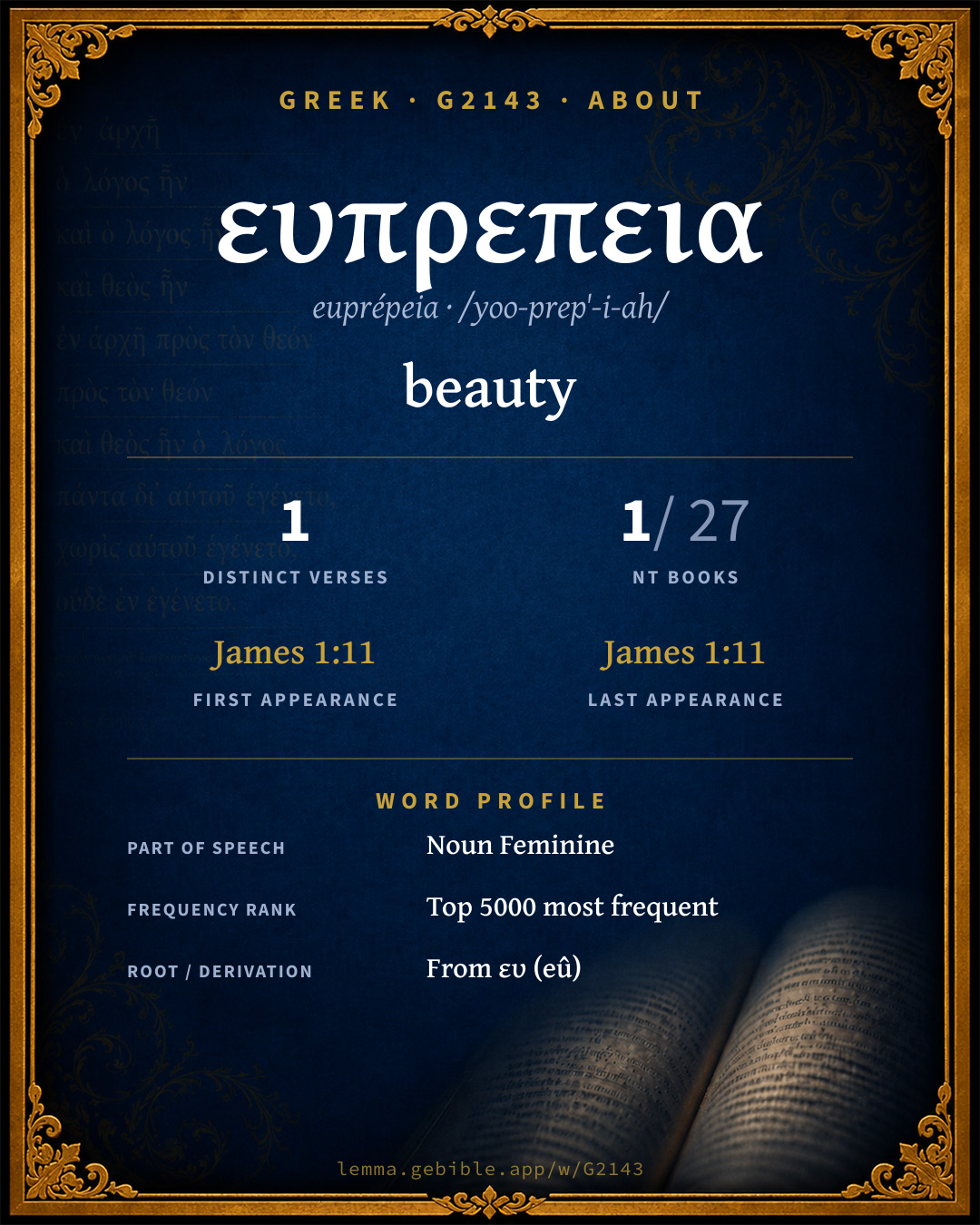
εὐπρέπεια
beauty
Full lexicon entry — Thayer's Greek Lexicon
From Thayer's Greek Lexicon
Where this word appears
Grammar key — what these labels mean
Part of speech
- Noun
- A naming word — a person, place, thing, or idea.
Case
- Nominative
- The case of the subject (and the predicate nominative).
Gender
- Feminine
- Grammatically feminine.
Number
- Singular
- One.
Every verse where G2143 appears — 1 distinct verse across 1 book. Click any verse to open its interlinear word-by-word view. Verse text shown in the World English Bible for context — . Each verse’s Greek form is shown with its reference; the English is not keyword-highlighted, since the data carries no word-level English alignment. Use “Compare translations” on any verse to read it across multiple English versions. This concordance covers the Greek New Testament; Septuagint (Greek Old Testament) occurrences of this word are not indexed here.
James 1 verse
About this entry
At a glance — auto-summarized from this page’s data, not written by a person. Every figure links to its source below. This summary describes the numbers; it doesn’t interpret them.
ευπρεπεια — transliterated euprépeia — is a Greek noun carrying the sense “beauty.” A scarce word — 1 verse in all of the Greek New Testament. More than three-quarters of its appearances fall in James. It occurs only once, in James 1:11. It shares a root with ευ, ευαγγελιζω and ευαρεστος. See the sense tree, 1-verse concordance, and the renderings breakdown below.
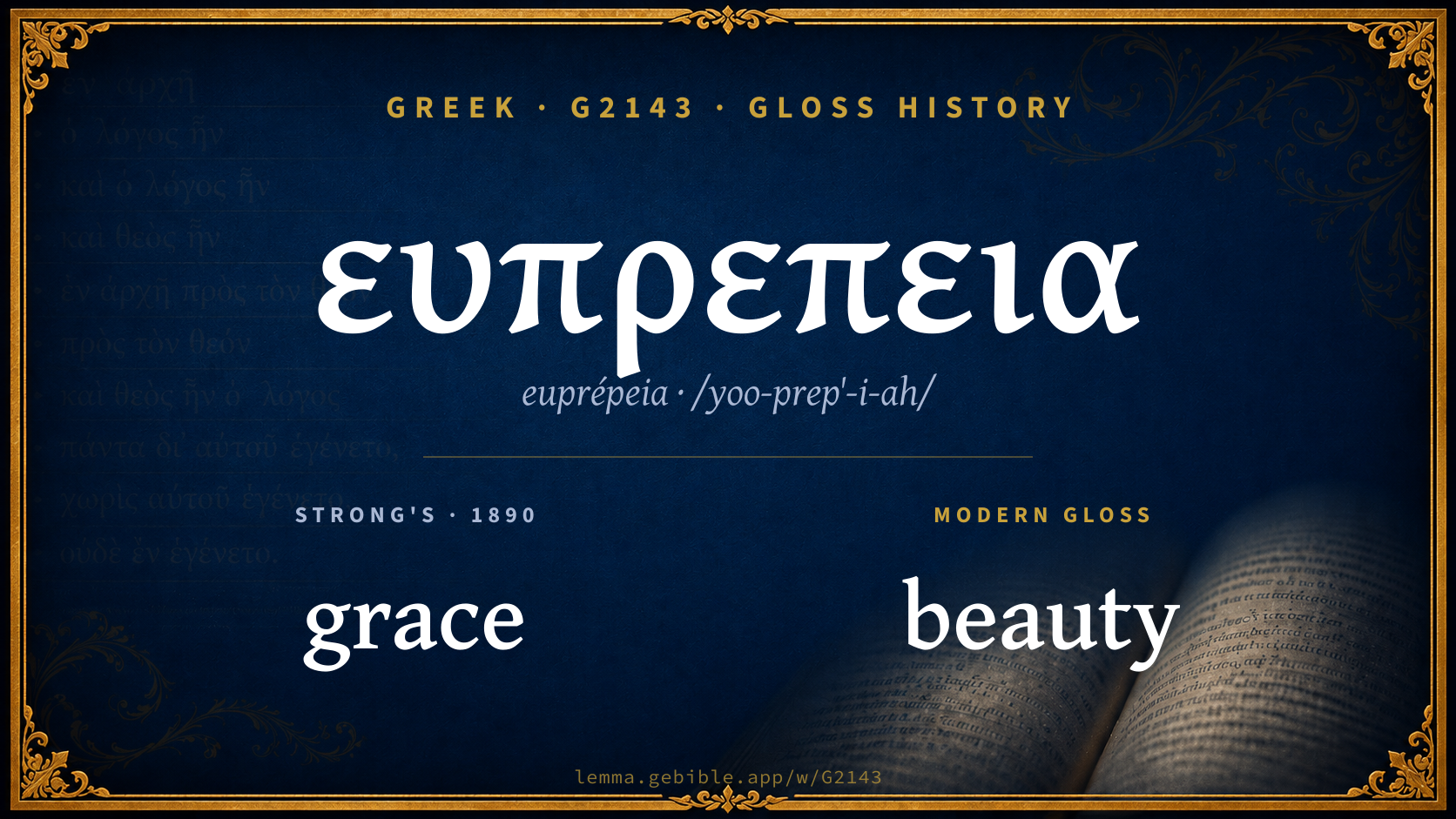
Gloss history
Strong's 1890 vs modern scholarship
About this word
Strong's G2143 catalogs a Greek word from the Greek New Testament.
These counts are not copied from any lexicon or concordance. They are computed here, from the morphology-tagged Greek New Testament. What Lemma adds →
- 1
- distinct verses
- The word appears in 1 distinct verse.
- 1 / 27
- NT books
- The word appears in 1 of 27 New Testament books.
- #3,503
- by frequency
- Top 5000 most frequent Greek words (rank 3,503 of 5,347 Greek words by occurrence).
View all 1 occurrence in the concordance →
Most concentrated in
- James 1 verse 100%
By section of the New Testament
By traditional corpus
Conventional, traditional groupings — biblical authorship is debated, so this is a traditional corpus grouping, not an authorship claim. Some books belong to more than one corpus (Luke is in both the Gospels and the Lukan corpus, and so on), so these shares overlap and need not total 100%. Each figure is a share of the word’s 1 distinct verse.
- General (Catholic) Epistles 1 verse · 100%
How translations render this word
Counts come from each version’s own published word-to-Strong’s tagging or interlinear alignment — an approximate guide to how each version renders this word, not a word-level alignment the data otherwise carries. Because each total is that version’s own tagged count, the per-version totals vary from one another and need not match the appearance or distinct-verse counts above. These counts may also differ from a printed concordance because Lemma counts each distinctly tagged rendering and does not collapse phrase taggings into a single head-word total. This is a fixed set of word-tagged versions (KJV, ASV, BSB, ULT) and does not change with the reading translation you choose elsewhere. Each version’s license is shown beside its name below (and on Sources).
- King James Version: Grace 1×
- American Standard Version: Grace 1×
- Berean Standard Bible: Beauty 1×
- unfoldingWord Literal Text: Beauty 1×
King James Version Public Domain
Renders G2143 across 1 tagged occurrence — most commonly:
American Standard Version Public Domain
Renders G2143 across 1 tagged occurrence — most commonly:
Berean Standard Bible Public Domain
Renders G2143 across 1 tagged occurrence — most commonly:
unfoldingWord Literal Text CC BY-SA 4.0
Renders G2143 across 1 tagged occurrence — most commonly:
Senses in Thayer's
The 1 sense Thayer's distinguishes for this word, in lexicon order (not ranked by frequency or importance). The full entry — with sub-senses — is in the Lexicon Entry tab.
- goodly appearance, shapeliness, beauty, comeliness
Word origin
Derived from ευ (eû) (G2095) — to prosper.
Same root — word family
Other Thayer's entries built from the same root as G2143, grouped by Strong’s listed origin. These share a root / origin per the lexicon — not necessarily a shared meaning. Each links to that word’s own entry.
Derives from
Shares the same root
- ευαγγελιζω euangelízō G2097 to evangelize
- ευαρεστος euárestos G2101 pleasing
- ευγενης eugenḗs G2104 noble
- ευδια eudía G2105 fair weather
- ευδοκεω eudokéō G2106 to be pleased
- ευδοκια eudokía G2107 pleasure
- ευεργετης euergétēs G2110 benefactor
- ευθετος eúthetos G2111 well situated
- ευθυμος eúthymos G2115 courageous
- ευθυς euthýs G2117 straight
- ευκαιρος eúkairos G2121 opportune
- ευκοπωτερος eukopṓteros G2123 easy
- ευλαβης eulabḗs G2126 devout
- ευλογεω eulogéō G2127 to praise
- ευμεταδοτος eumetádotos G2130 generous
- ευνοεω eunoéō G2132 to wish well
- ευοδοω euodóō G2137 to prosper
- ευπειθης eupeithḗs G2138 obedient
- ευπεριστατος euperístatos G2139 besetting
- ευποιΐα eupoiḯa G2140 doing good
- ευπροσδεκτος euprósdektos G2144 acceptable
- ευπροσεδρος euprósedros G2145 devoted
- ευπροσωπεω euprosōpéō G2146 to please
- ευσεβης eusebḗs G2152 pious
+13 more words share this root (not shown).
Proper names from this root
People and places named from this root — a name, not an additional meaning of the word.
Compare all same-root words → Showing 4 of 42 — not the complete family. 3 of the same-root words are proper names (people or places). They share a root, not necessarily a meaning.
Septuagint usage
The same Greek word ευπρεπεια appears 10 times in the Greek Old Testament (Septuagint), across 10 verses in 7 books.
- 10
- LXX occurrences
- Tagged occurrences of this Greek word in the Septuagint.
- 10
- verses
- Distinct Septuagint verses containing this word.
- 7 / 39
- OT books
- The word appears in 7 of the 39 Old Testament books.
Sample Septuagint occurrences
- 2 Samuel 15:25 εὐπρέπεια
- Job 36:11 εὐπρέπεια
- Psalms 25:8 εὐπρέπεια
- Proverbs 31:26 εὐπρέπεια
- Jeremiah 23:9 εὐπρεπεία
- Lamentations 1:6 εὐπρέπεια
- Ezekiel 16:14 εὐπρέπεια
Septuagint occurrences (same lexeme)
Every verse where the same Strong’s number (G2143) appears in the Greek Septuagint. Verse text shown in the World English Bible for context; the Greek form is the matched word — the English is not keyword-highlighted.
- 2 Samuel 15:25 εὐπρέπεια The king said to Zadok, Carry back the ark of God into the city: if I shall find favor in the eyes of Yahweh, he will bring me again, and show me both it, and his habitation:
- Job 36:11 εὐπρέπεια If they listen and serve him, They shall spend their days in prosperity, And their years in pleasures.
- Psalms 25:8 εὐπρέπεια Good and upright is Yahweh, Therefore he will instruct sinners in the way.
- Psalms 49:2 εὐπρέπεια Both low and high, Rich and poor together.
- Psalms 92:1 εὐπρέπεια It is a good thing to give thanks to Yahweh, To sing praises to your name, Most High;
- Psalms 103:1 εὐπρέπεια Praise Yahweh, my soul! All that is within me, praise his holy name!
- Proverbs 31:26 εὐπρέπεια She opens her mouth with wisdom. Faithful instruction is on her tongue.
- Jeremiah 23:9 εὐπρεπεία Concerning the prophets. My heart within me is broken, all my bones shake; I am like a drunken man, and like a man whom wine has overcome, because of Yahweh, and because of his holy words.
- Lamentations 1:6 εὐπρέπεια From the daughter of Zion all her majesty is departed: Her princes are become like harts that find no pasture, They are gone without strength before the pursuer.
- Ezekiel 16:14 εὐπρέπεια Your renown went forth among the nations for your beauty; for it was perfect, through my majesty which I had put on you, says the Lord Yahweh.
These are occurrences of the same Greek lexeme (G2143) in the Septuagint — not a translation of any one Hebrew word. The store carries no word-level Hebrew↔Greek alignment, so no Hebrew original is asserted here. Counts come from the recovered LXX Strong's tagging — high-frequency vocabulary is well covered, while rare or late forms may be untagged — so they reflect tagged occurrences and may slightly undercount.