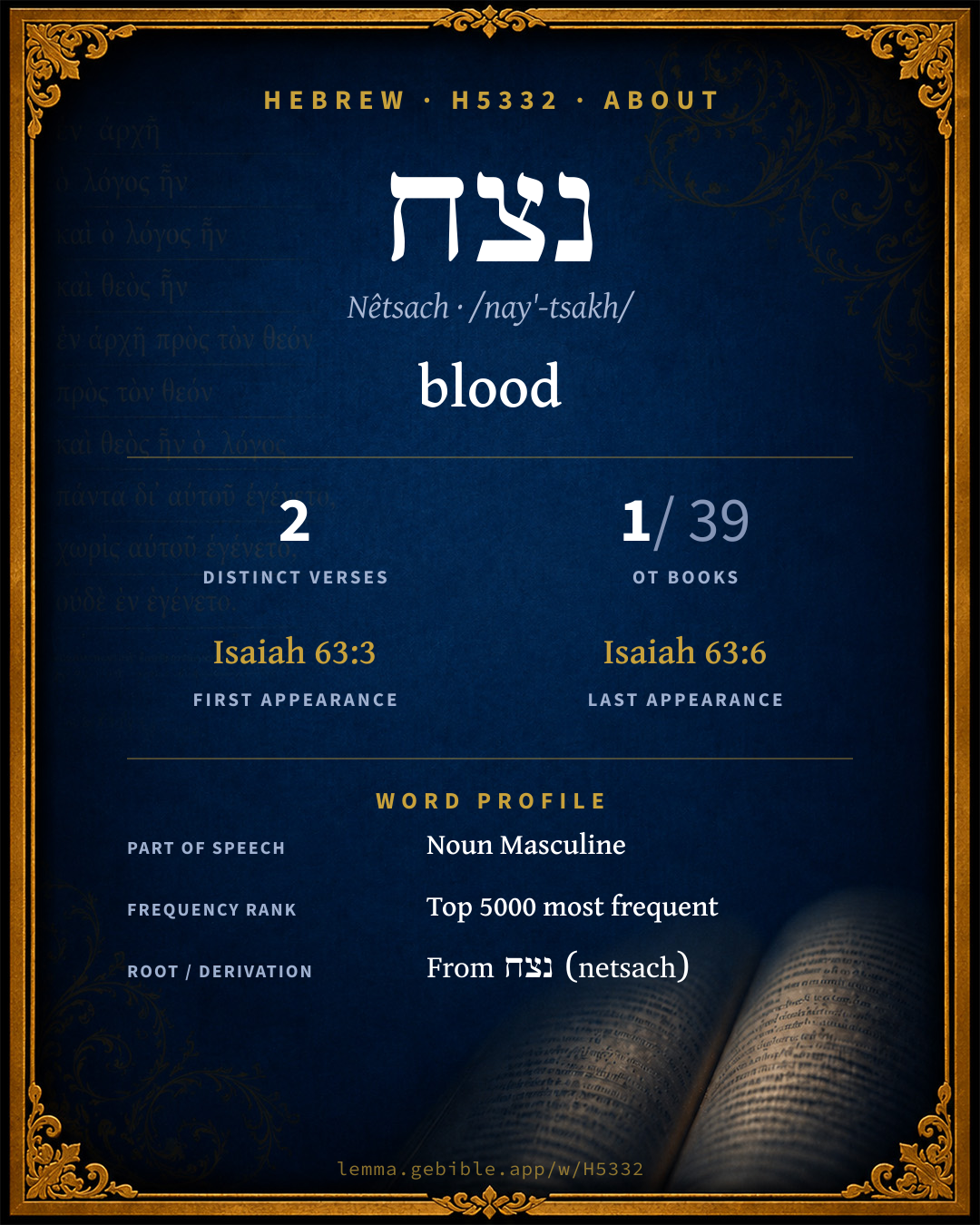
נֵ֫צַח
blood
‘blood’ is one of 3 main senses fuller range ↓
Full lexicon entry — Brown-Driver-Briggs (BDB)
From Brown-Driver-Briggs (BDB)
Where this word appears
Grammar key — what these labels mean
Part of speech
- Noun
- A naming word — a person, place, thing, or idea.
Noun type
- Common
- A common noun — a general class of person, place, or thing (“king,” “city,” “water”), not a specific name.
State
- Construct
- A noun bound to a following noun in a possessive / “of” relationship (the construct chain).
Gender
- Masculine
- Grammatically masculine.
Number
- Singular
- One.
Every verse where H5332 appears — 2 distinct verses across 1 book. Click any verse to open its interlinear word-by-word view. Verse text shown in the World English Bible for context — . Each verse’s Hebrew form is shown with its reference; the English is not keyword-highlighted, since the data carries no word-level English alignment. Use “Compare translations” on any verse to read it across multiple English versions. This concordance covers the Hebrew Bible; Septuagint (Greek Old Testament) occurrences are not indexed here.
Isaiah 2 verses
- Isaiah 63:3 נִצְחָ/ם֙ n c ms cs + sfx pers 3mp I have trodden the winepress alone; and of the peoples there was no man with me: yes, I trod them in my anger, and trampled them in my wrath; and their lifeblood is sprinkled on my garments, and I have stained all my clothing.
- Isaiah 63:6 נִצְחָֽ/ם n c ms cs + sfx pers 3mp I trod down the peoples in my anger, and made them drunk in my wrath, and I poured out their lifeblood on the earth.
About this entry
At a glance — auto-summarized from this page’s data, not written by a person. Every figure links to its source below. This summary describes the numbers; it doesn’t interpret them.
נצח (Nêtsach) is a Hebrew noun most often rendered “blood.” With only 2 verses it sits in the long tail of Hebrew Bible vocabulary. Isaiah dominates its distribution — 2 of 2 verses. Scripture first uses it in Isaiah 63:3. Not a single-sense word: explore its full sense range. For the data behind this summary, explore the sense tree and the renderings breakdown below.
Gloss history
Strong's 1890 vs modern scholarship
About this word
Strong's H5332 catalogs a Hebrew word from the Hebrew Old Testament.
These counts are not copied from any lexicon or concordance. They are computed here, from the morphology-tagged Hebrew Old Testament. What Lemma adds →
- 2
- distinct verses
- The word appears in 2 distinct verses.
- 1 / 39
- OT books
- The word appears in 1 of 39 Old Testament books.
- #4,807
- by frequency
- Top 5000 most frequent Hebrew words (rank 4,807 of 8,640 Hebrew words by occurrence).
View all 2 occurrences in the concordance →
Most concentrated in
- Isaiah 2 verses 100%
By section of the Old Testament
By traditional corpus
Conventional, traditional groupings — biblical authorship is debated, so this is a traditional corpus grouping, not an authorship claim. Each share is this word’s portion of its verses in that division of the Hebrew canon. Each figure is a share of the word’s 2 distinct verses.
- Prophets (Nevi'im) 2 verses · 100%
How translations render this word
Counts come from each version’s own published word-to-Strong’s tagging or interlinear alignment — an approximate guide to how each version renders this word, not a word-level alignment the data otherwise carries. Because each total is that version’s own tagged count, the per-version totals vary from one another and need not match the appearance or distinct-verse counts above. These counts may also differ from a printed concordance because Lemma counts each distinctly tagged rendering and does not collapse phrase taggings into a single head-word total. This is a fixed set of word-tagged versions (KJV, ASV, BSB, ULT) and does not change with the reading translation you choose elsewhere. Each version’s license is shown beside its name below (and on Sources).
BDB lists this Strong’s number as 2 distinct words (homographs). Each count above pools all of them and is not split by sense — see the Senses section below. A low-frequency rendering may belong to a different one of those words, not the primary meaning.
- King James Version†: Blood 1×, Strength 1×
- American Standard Version†: Lifeblood 2×
- Berean Standard Bible†: Blood 2×
- unfoldingWord Literal Text†: Blood 1×, Juice 1×
King James Version Public Domain
Renders H5332 across 2† tagged occurrences — most commonly:
American Standard Version Public Domain
Renders H5332 across 2† tagged occurrences — most commonly:
Berean Standard Bible Public Domain
Renders H5332 across 2† tagged occurrences — most commonly:
unfoldingWord Literal Text CC BY-SA 4.0
Renders H5332 across 2† tagged occurrences — most commonly:
Senses in the full BDB
What do BDB’s symbols mean?
BDB uses these scholarly abbreviations:
| Symbol | Meaning |
|---|---|
| 𝔊 | the Septuagint (the ancient Greek translation, LXX) |
| 𝔙 | the Vulgate (the Latin translation) |
| 𝔖 | the Syriac version (the Peshitta) |
| 𝔗 | the Targum (the Aramaic translation) |
| ψ | the Psalms |
| √ | root (the underlying root or stem) |
| ‖ | parallel passage (a synonymous or contrasted parallel) |
| † | the dagger: every passage where the word occurs is cited |
The 4 senses and sub-senses the full Brown-Driver-Briggs lexicon distinguishes for this word, in lexicon order (not ranked by frequency), with BDB’s own verbatim wording and sub-sense lettering. Shown in Hebrew script with BDB’s own scholarly abbreviations. The condensed entry is in the Lexicon Entry tab. See also the Forms in the corpus table below.
נצח I
- 1. eminence: נצח ישׂראל the Eminence of Israel (י׳) 1 S 15:29 (DrSam 98 glory of Israel); attribute of God 1 Ch 29:11 (‖ הוד, תפארת et al.). e.g. 1 Samuel 15:29
- 2. enduring of life, and so life itself as enduring: אָבַד נִצְחִי La 3:18 my endurance doth vanish (De sap of life, v. ii. נ׳). e.g. Lamentations 3:18
- 3. endurance in time: משׁאות נ׳ ψ 74:3 perpetual desolations; לנ׳ יְדַבֵּר Pr 21:28 speaketh continually (?; v. Toy); עד־נ׳ ψ 49:20 unto the end (a long duration), so Jb 34:36. e.g. Psalms 74:3
- 4. everlastingness, ever, usually לָנֶצַח for ever, 2 S 2:26; Is 13:20; 25:8; 28:28; 33:20; 57:16 Je 3:5; 50:39 Am 8:7; Hb 1:4 ψ 9:7, 19; 10:11; 44:24; 49:10; 52:7; 68:17; 74:1, 10, 19; 77:9; 79:5; 89:47; 103:9 Jb 4:20; 14:20; 20:7; 23:7; 36:7 La 5:20; לנצח נצחים (cf. עולם עולמים) Is 34:10; seldom abbr. נֶצַח Am 1:11 (לָנ׳ 𝔊 We Now GASm), Je 15:18 ψ 13:2; 16:11. e.g. 2 Samuel 2:26
נצח II juice of grapes, fig. of blood, gore
Senses from the full Brown-Driver-Briggs lexicon (Brown, Driver, Briggs; Oxford 1906 — public domain), digitized via Sefaria, supplemented by the OpenScriptures HebrewLexicon (CC BY 4.0). Full attribution on Sources.
Word origin
I. n.m. La 3:18 eminence, enduring, everlastingness, perpetuity (לנצח Ecclus 40:14 as 4 infr.);—נֵ֫צַח 1 S 15:29 + 3 times; נֶ֫צַח Am 1:11 + 36 times; sf. נִצְחִי La 3:18; pl. נְצָחִים Is 34:10;—
II. n.m. juice of grapes, fig. of blood, gore;—only sf. נִצְחָם Is 63:3, 6.
— Brown-Driver-Briggs (Oxford 1906, public domain), digitized via Sefaria, supplemented by the OpenScriptures HebrewLexicon (CC BY 4.0). See Sources.
Derived from נצח (netsach) (H5331) — perpetuity.
Jastrow Dictionary
A second Hebrew/Aramaic lexicon for comparison, covering Aramaic and post-biblical (Talmudic, Targumic, Midrashic) usage that the biblical-Hebrew BDB does not. Matched by lemma rather than by Strong’s number, so a lemma may carry more than one Jastrow headword (shown separately below), and the entries cover usage well beyond the Bible.
נָצַח
- [to be bright, pure,] (cmp. זָכָה) to be victorious, win, prevail. Y. Sabb. VII, 5ᵇ top אם לִנְצוֹחַ אם להִינָּצֵחַ whether to conquer or to be conquered. Pes. 119ᵃ (play on לַמְנַצֵּחַ) זמרו למי שנוֹצְחִין אותו ושמח sing to him who rejoices when they conquer him (prevail over him to change his evil decrees); Midr. Till. to Ps. IV. Pesik. R. s. 40 נָצַחְתִּי לדור וכ׳ I conquered the generation of the flood and was the loser by it, because I destroyed &c. Ib. נְצָחַנִי משה וכ׳ Moses conquered me …, and I gained all those masses; a. fr.—Part. pass. נָצוּחַ. Ib.Pesik. R. s. 40 נָצַחְתִּי לדור וכ׳ I conquered the generation of the flood and was the loser by it, because I destroyed &c. Ib. נְצָחַנִי משה וכ׳ Moses conquered me …, and I gained all those masses; a. fr.—Part. pass. נָצוּחַ. Ib. בשעה שאני נוצח … ובשעה שאני נ׳ וכ׳ when I prevail, I lose, but when I am prevailed over, I gain; a. e.
- 1. to make illustrious, to glorify. Midr. Till. l. c. (expl. למנצח) למי שהוא נאה לנַצֵּחַ to him whom it is befitting to glorify.
- 2. to conquer, prevail over. Ib. מלך ב"וד מְנַצְּחִים אותו וכ׳ a human king is angry when people defeat him (in argument; cmp. זְכֵי Pa.); Pes. l. c.—B. Mets. 59ᵇ נִצְּחוּנִי בני (or נְצָחוּנִי) my children have won over me. Ib. תלמידי חכמים שמנצחים וכ׳ scholars who defeat one another in discussion. Snh. 91ᵃ אם יְנַּצְּחוּנִי … נַצַּחְתֶּם if they defeat me, say to them, you have defeated an ignoramus among us; ואם אני אֲנַצֵּחַ … תורת משה נִצְּחַתְכֶם and if I defeat them, say to them, the law of Moses has defeated you; a. fr.—Part. pass. מְנוּצָּח. Midr. Till. l. c. למי שמנ׳ וכ׳ to him who allows himself to be won over by his creatures (v. supra); a. e.
- to be defeated. Y. Sabb. II, 5ᵇ top v. supra.
נְצַח
- 1. to be glad, to sing. Targ. II Esth. I, 2 והוה נָצַח וכ׳ it flew singing among &c.
- 2. to succeed, thrive. Targ. Koh. XI, 2.
- 3. to be victorious. Targ. O. Ex. XXXII, 18, v. נַצְחָא; a. e.—Y. Sot. IX, 24ᵇ נַצְחוּ טליא the boys (John Hyrcan’s sons) have won the battle; Bab. Sot. 33ᵃ; Tosef. ib. XIII, 5. Tam. 32ᵃ, v. סִטְנָא; a. e.
- to conquer, overpower. Targ. Y. Num. XVI, 14; a. e.—Lam. R. to I, 13 (expl. וירדנה ib.) נַצְּחָהּ (not נצחא) he conquered her.
- to cheer up, play. Y. Ter. VIII, end, 46ᶜ וא׳ קדמיהון and played before them; (Gen. R. s. 63 מוזגה, v. מְזַג).
- 1. to be bright, shine, excel. Targ. Ez. XIX, 11. Ib. XXXI, 8; a. e.
- 2. to be defeated. Targ. Y. Ex. XXXII, 18.
נִצֵּחַ
- preced.) successful, convincing, irrefutable. Snh. 105ᵃ (ref. to Jer. VIII, 5) תשובה נ׳ השיבה וכ׳ the congregation of Israel defeated the prophets with an irrefutable argument. e.g. Jeremiah 8:5
נֶצַח
- preced.) success, endurance; (adv.) forever. Erub. 54ᵃ כל מקום שנאמר נ׳ וכ׳ wherever the Biblical text has the words netsaḥ, selah, or vaʿed, it means &c., v. הֶפְסֵק.—Pl. נְצָחִים. Midr. Till. to Ps. IV, v. נִיצּוּחַ.
A Dictionary of the Targumim, the Talmud Babli and Yerushalmi, and the Midrashic Literature (Marcus Jastrow; London, Luzac, 1903) — Public Domain. Digitized via Sefaria. Digitized via Sefaria. Full attribution on Sources.
Forms in the corpus
The 2 distinct written forms H5332 takes in the Hebrew Bible, most frequent first — each parse links to that state’s occurrences in the concordance. Hebrew forms include their vowel points and cantillation, so a single lemma takes many written forms.
| Form | Parsing | Example | Uses |
|---|---|---|---|
| נִצְחָ/ם֙ | Noun, Common, Masculine, Singular, Construct | Isaiah 63:3 | 1 |
| נִצְחָֽ/ם | Noun, Common, Masculine, Singular, Construct | Isaiah 63:6 | 1 |
Septuagint verse parallels
This word appears in 2 verses that also exist in the Greek Old Testament (Septuagint), out of the 2 Hebrew verses it occurs in. You can read those verses in Greek by switching the Old Testament edition to the Septuagint.
Read these verses in the Septuagint
This is a verse-level parallel only — the same verses exist in both the Hebrew and Greek Old Testaments. No word-level Hebrew↔Greek correspondence is claimed: the data carries no such alignment, so no Greek word is shown as this Hebrew word’s translation. Coverage is not total — the Septuagint omits the deuterocanon and renumbers the Psalms, so some Hebrew verses have no direct Greek parallel.