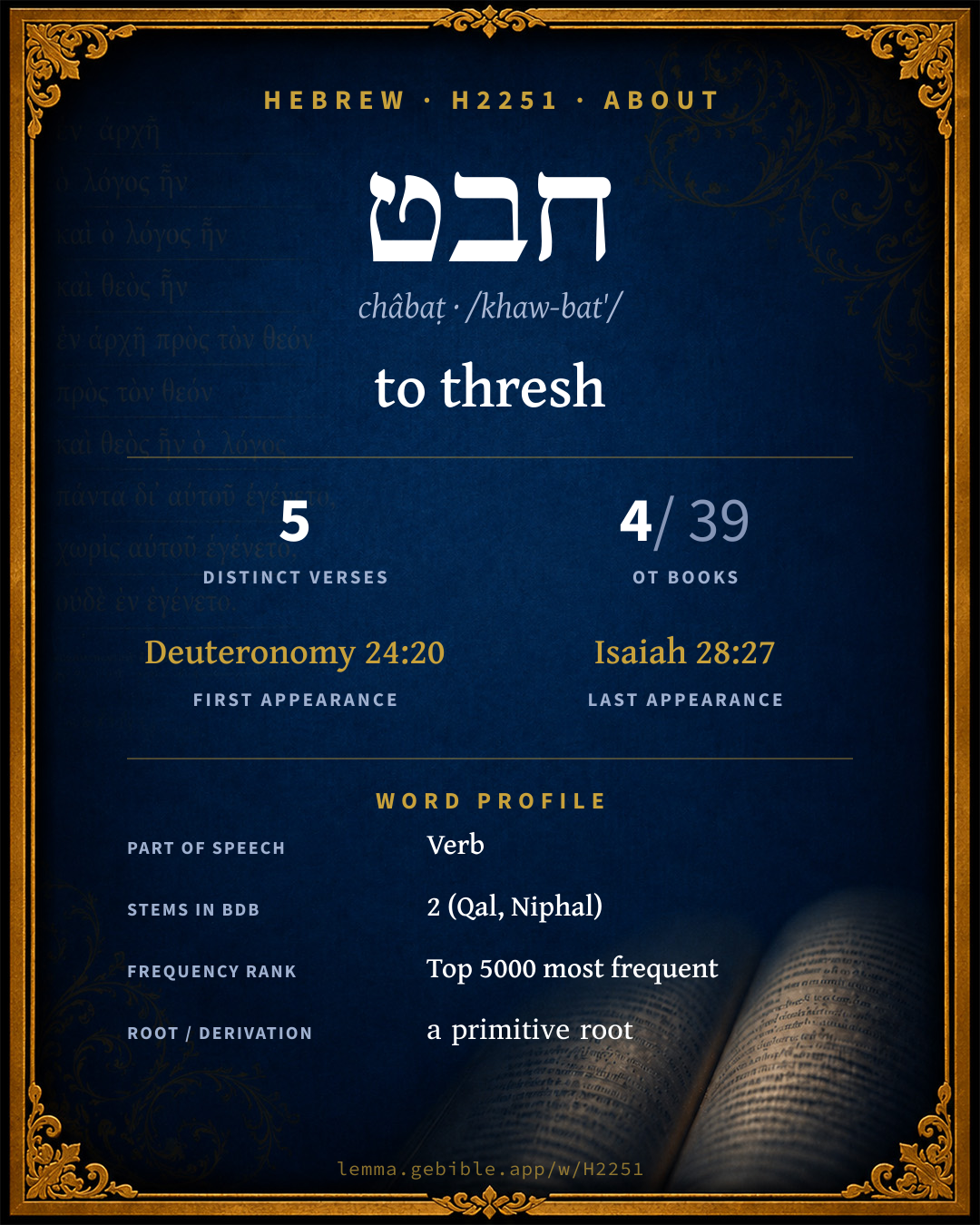
חָבַט
to thresh
‘to thresh’ is one of 2 main senses fuller range ↓
Full lexicon entry — Brown-Driver-Briggs (BDB)
From Brown-Driver-Briggs (BDB)
Where this word appears
See every Qal verb in the Hebrew Bible →
Grammar key — what these labels mean
Part of speech
- Verb
- An action or state-of-being word.
Stem
- Qal
- The basic, simple active stem — the plain form of the verb (“he wrote”). Here: ‘beat off’
- Niphal
- Usually the simple passive or reflexive of the Qal (“he was written”).
Form
- Sequential Imperfect
- An imperfect with prefixed waw — the standard past-narrative form (waw-consecutive imperfect).
- Imperfect
- An incomplete, ongoing, or future action (“he will / would write”).
- Participle Active
- A verbal adjective expressing ongoing or characteristic action (“writing / one who writes”).
State
- Absolute
- The independent form of a noun, not bound to a following word.
Person
- 3rd Person
- The one spoken about (“he / she / it / they”).
- 2nd Person
- The one addressed (“you”).
Gender
- Feminine
- Grammatically feminine.
- Masculine
- Grammatically masculine.
Number
- Singular
- One.
Grammatical forms
- Verb, Qal, Sequential Imperfect, 3rd Person, Feminine, Singular 1 time (20%)
- Verb, Niphal, Imperfect, 3rd Person, Masculine, Singular 1 time (20%)
- Verb, Qal, Imperfect, 2nd Person, Masculine, Singular 1 time (20%)
- Verb, Qal, Imperfect, 3rd Person, Masculine, Singular 1 time (20%)
- Verb, Qal, Participle Active, Masculine, Singular, Absolute 1 time (20%)
Parsed forms decoded from the imported morphology (morphhb / Westminster Leningrad Codex — WLC text public domain, morphhb tagging CC BY 4.0), counted across 5 parsed occurrences — not distinct verses.
Every verse where H2251 appears — 5 distinct verses across 4 books. Click any verse to open its interlinear word-by-word view. Verse text shown in the World English Bible for context — . Each verse’s Hebrew form is shown with its reference; the English is not keyword-highlighted, since the data carries no word-level English alignment. Use “Compare translations” on any verse to read it across multiple English versions. This concordance covers the Hebrew Bible; Septuagint (Greek Old Testament) occurrences are not indexed here.
Deuteronomy 1 verse
Judges 1 verse
Ruth 1 verse
Isaiah 2 verses
- Isaiah 27:12 יַחְבֹּ֧ט Qal impf 3ms It shall happen in that day, that Yahweh will beat off [his fruit] from the flood of the River to the brook of Egypt; and you shall be gathered one by one, you children of Israel.
- Isaiah 28:27 יֵחָ֥בֶט Niphal impf 3ms For the dill are not threshed with a sharp [threshing] instrument, neither is a cart wheel turned about on the cumin; but the dill are beaten out with a staff, and the cumin with a rod.
About this entry
At a glance — auto-summarized from this page’s data, not written by a person. Every figure links to its source below. This summary describes the numbers; it doesn’t interpret them.
At its core, חבט (châbaṭ) means “to thresh.” With only 5 verses it sits in the long tail of Hebrew Bible vocabulary. The word gravitates to Isaiah (40%), then Deuteronomy and Judges. It first appears in Deuteronomy 24:20. Read the stem: it spans 2 stems, including Qal and Niphal. Each statement above links to its evidence; the full detail follows below.
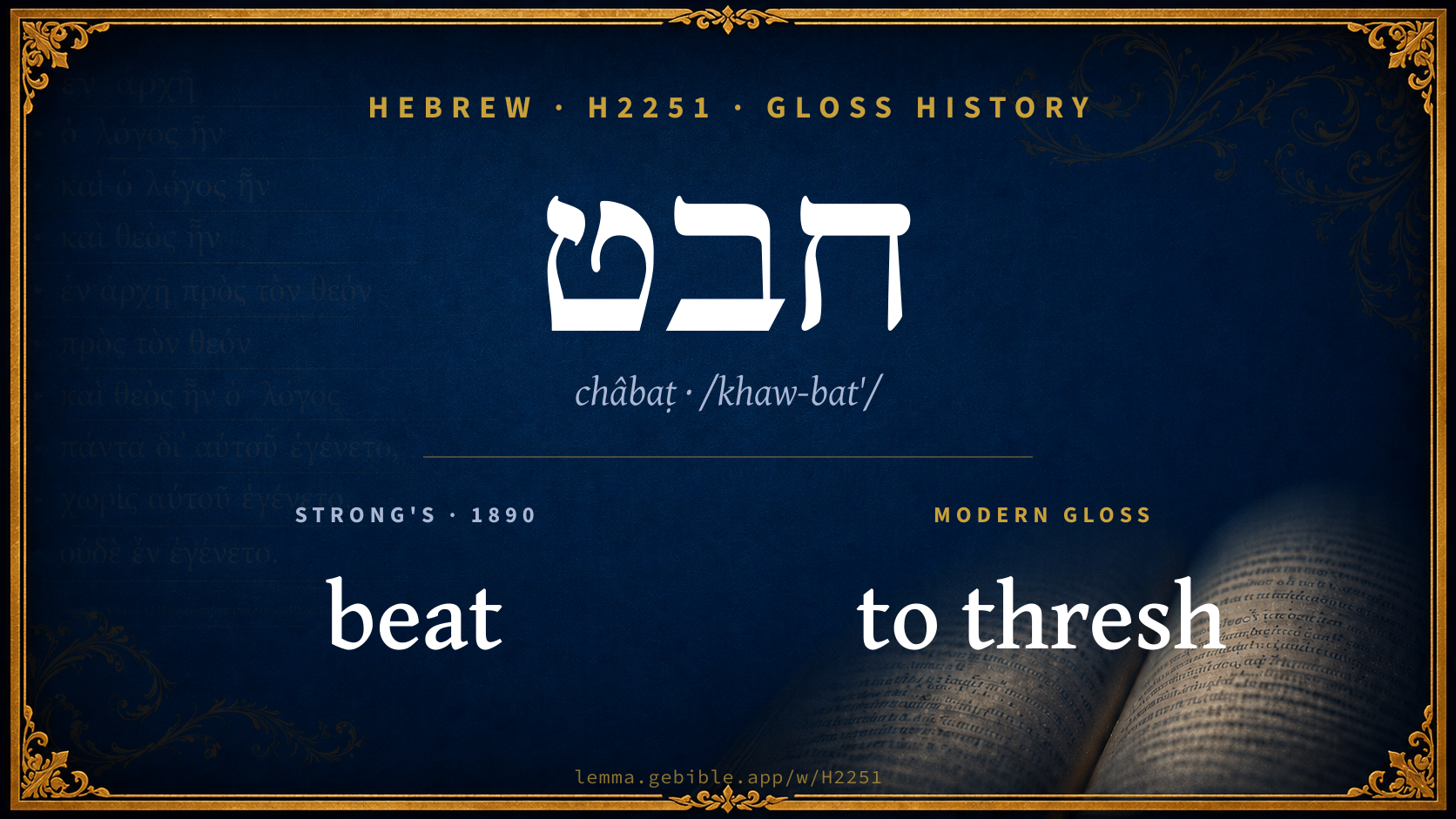
Gloss history
Strong's 1890 vs modern scholarship
About this word
Strong's H2251 catalogs a Hebrew word from the Hebrew Old Testament.
These counts are not copied from any lexicon or concordance. They are computed here, from the morphology-tagged Hebrew Old Testament. What Lemma adds →
- 5
- distinct verses
- The word appears in 5 distinct verses.
- 4 / 39
- OT books
- The word appears in 4 of 39 Old Testament books.
- #3,337
- by frequency
- Top 5000 most frequent Hebrew words (rank 3,337 of 8,640 Hebrew words by occurrence).
View all 5 occurrences in the concordance →
Most concentrated in
- Isaiah 2 verses 40%
- Deuteronomy 1 verse 20%
- Judges 1 verse 20%
By section of the Old Testament
By traditional corpus
Conventional, traditional groupings — biblical authorship is debated, so this is a traditional corpus grouping, not an authorship claim. Each share is this word’s portion of its verses in that division of the Hebrew canon. Each figure is a share of the word’s 5 distinct verses.
- Prophets (Nevi'im) 3 verses · 60%
- Torah (Pentateuch) 1 verse · 20%
- Writings (Ketuvim) 1 verse · 20%
How translations render this word
Counts come from each version’s own published word-to-Strong’s tagging or interlinear alignment — an approximate guide to how each version renders this word, not a word-level alignment the data otherwise carries. Because each total is that version’s own tagged count, the per-version totals vary from one another and need not match the appearance or distinct-verse counts above. These counts may also differ from a printed concordance because Lemma counts each distinctly tagged rendering and does not collapse phrase taggings into a single head-word total. This is a fixed set of word-tagged versions (KJV, ASV, BSB, ULT) and does not change with the reading translation you choose elsewhere. Each version’s license is shown beside its name below (and on Sources).
- King James Version: Are beaten out 1×, Beat out 1×, Shall beat off 1×
- American Standard Version: Are beaten out 1×, She beat out 1×, Thou beatest 1×
- Berean Standard Bible: Is beaten out 1×, She beat out 1×, Was threshing 1×
- unfoldingWord Literal Text: Is beaten 1×, She beat out 1×, Was threshing 1×
King James Version Public Domain
Renders H2251 across 5 tagged occurrences — most commonly:
American Standard Version Public Domain
Renders H2251 across 5 tagged occurrences — most commonly:
Berean Standard Bible Public Domain
Renders H2251 across 5 tagged occurrences — most commonly:
unfoldingWord Literal Text CC BY-SA 4.0
Renders H2251 across 5 tagged occurrences — most commonly:
Senses in the full BDB
Hebrew verbs can shift meaning by stem (binyan): Qal is the basic action, Niphal is often passive or reflexive, Piel often intensifies or makes it factitive, and Hiphil is typically causative. The senses below are grouped under the stem BDB assigns to each.
What do BDB’s symbols mean?
BDB uses these scholarly abbreviations:
| Symbol | Meaning |
|---|---|
| 𝔊 | the Septuagint (the ancient Greek translation, LXX) |
| 𝔙 | the Vulgate (the Latin translation) |
| 𝔖 | the Syriac version (the Peshitta) |
| 𝔗 | the Targum (the Aramaic translation) |
| ψ | the Psalms |
| √ | root (the underlying root or stem) |
| ‖ | parallel passage (a synonymous or contrasted parallel) |
| † | the dagger: every passage where the word occurs is cited |
The 3 senses and sub-senses the full Brown-Driver-Briggs lexicon distinguishes for this word, in lexicon order (not ranked by frequency), with BDB’s own verbatim wording and sub-sense lettering. Shown in Hebrew script with BDB’s own scholarly abbreviations. The condensed entry is in the Lexicon Entry tab. See also the Forms in the corpus table below.
Qal
- 1. beat off
- 2. beat out (grain)
Niphal
- . fennel beaten out
Senses from the full Brown-Driver-Briggs lexicon (Brown, Driver, Briggs; Oxford 1906 — public domain), digitized via Sefaria, supplemented by the OpenScriptures HebrewLexicon (CC BY 4.0). Full attribution on Sources.
Word origin
[ חָבַט ] vb. beat off, beat out
— Brown-Driver-Briggs (Oxford 1906, public domain), digitized via Sefaria, supplemented by the OpenScriptures HebrewLexicon (CC BY 4.0). See Sources.
Origin: a primitive root
Jastrow Dictionary
A second Hebrew/Aramaic lexicon for comparison, covering Aramaic and post-biblical (Talmudic, Targumic, Midrashic) usage that the biblical-Hebrew BDB does not. Matched by lemma rather than by Strong’s number, so a lemma may carry more than one Jastrow headword (shown separately below), and the entries cover usage well beyond the Bible.
חָבַט
- [to use force,]
- 1. to press down. Erub. 42ᵇ תקרת … חוֹבֶטֶת the roofing of the house presses upon him (keeps him mindful of the Sabbath limit); v. חָבוּט. B. Mets. 80ᵇ חֲבָטוֹ לאלתר (Ar. חבסו, v. חָבַס) the load pressed him down immediately (before he could find out that it was too heavy for him). Snh. 19ᵇ חֲבָטָן בקרקע pressed them into the ground. Succ. IV, 6 (45ᵃ) חוֹבְטִין אותן ע"ג קרקע בצידי המזבח Ms. M. (v. Rabb. D. S. a. l. note 10) they laid them down closely upon one another on the ground by the altar (opp. to זוקפין, ib. IV, 4). Keth. 39ᵃ צער שחֲבָטָהּ ע"ג וכ׳ ‘the pain’ (Mish. ib. III, 4) refers to his pressing her down on the hard ground.
- 2. to force, to knock open, esp. to knock upon olives to make them burst, before putting them under the press, or upon ears to thresh the grain out. Ex. R. s. 36, beg. מורידין … ונחבט ומשחוֹבְטִין וכ׳ they take the olive down and it is knocked upon, and after knocking it, they put it into the vat (corresp. to כתש, Men. VIII, 4). Ib. באין או"ה … וחובטין … ממקום וכ׳ the gentiles come and knock them (the Israelites) from place to place. Men. X, 4; a. e.—Part. pass. חָבוּט mashed. Sabb. 80ᵇ בח׳ when the lime is mashed (and mixed with water); Y. ib. VIII, 11ᵇ bot. בחביט (corr. acc.).
- 3. to lay down for receiving lashes, in gen. to punish, bind over. Gitt. IX, 8 ובנכרים חובטין אותו וכ׳ but when the gentile authorities bind him over and say, Do as the Israelites tell thee, (the letter of divorce so enforced) is valid (differ. vers. in Y. ed.); Tosef. Yeb. XII, 13.—Tosef. Sot. XV, 7 מסרוהו לבעל זמורה וחֲבָטוֹ ed. Zuck. Var. (Y. ib. IX, 24ᵇ top וחבשו) they gave him in charge of the rod-bearer (v. זְמוֹרָה), and he tried to force him (into submission). Midd. I, 2 חוֹבְטוֹ במקלו he punishes him with his cane.
- to be knocked upon; to strike against. Ex. R. s. 36, v. supra.—Keth. 36ᵇ מפני שנֶחְבֶּטֶת וכ׳ because the blind girl may have struck against something (and fallen, so as to have lost her virginity by the shock). Ḥull. 51ᵇ עוף שנ׳ על וכ׳ a bird that fell with force upon water.—Koh. R. to VII, 8, v. infra.
- to press down, throw down. Keth. l. c. חִיבְּטָהּ ע"ג שיראין if he forced her down on (soft) silk garments.
- to prostrate one’s self (in prayer, in deep commotion). Gen. R. s. 91 היה מִתְחַבֵּט לפני רגליו וכ׳ he threw himself to the feet of every one &c. (with ref. to Gen. XLII, 21). Gen. R. s. 70; Num. R. s. 8, end; Yalk. Gen. 123 דבר שנתח׳ וכ׳ a thing for which that patriarch (Jacob) begged in prostration; Koh. R. to VII, 8 שנֶחְבַּט. Deut. R. s. 2, beg. עכשיו הוא מתחנן ומתח׳ now he supplicates and prostrates himself; a. fr. e.g. Genesis 42:21
חֲבַט
- 1. to knock; to strike, punish. Targ. O. Deut. XXIV, 20. Targ. Jud. VI, 11. Targ. Is. XXVIII, 27 (Regia: מְחַבְּטִין Pa.).—Targ. Prov. XXVIII, 3 מטרא חָבֵיטָא (not חֲבִיטָא) a prostrating rain (h. text סחף). Y. Sabb. XVII, 16ᵇ top דו חָבֵיט ביה; Y. Bets. I, 60ᶜ חֲבַט, v. זַיָּירָא.—Gen. R. s. 7, a. e. חֲבוֹט חבטך, v. חֲבָטָא. B. Bath. 58ᵃ חֲבוֹטוּ (not חובטו), v. חֲבִיטָא.
- 2. to throw down. Y. Snh. VI, 23ᶜ top חַבְטִין תורא בחילא Ash. to Ḥull. 51ᵃ (ed. בחייליה) threw an ox down with force (before slaughtering).—Part. pass. חְבִיט, f. חֲבִיטָא prostrated. Keth. 10ᵃ מברכתא ח׳ ליה is Mabrakhta (i.e. all the women of ill repute of M.) prostrated before him (so that he is an expert in such matters)? [Y. Sabb. VIII, 11ᵇ bot. בחביט, v. preced.]
- to shake, agitate. Targ. Y. Num. XXV, 8 (ed. Amst. Pe.) he shook (the spear). Targ. Esth. VI, 1.—Succ. 44ᵇ ח׳ ח׳ ולא וכ׳ he shook it repeatedly but said no benediction.
- as preced. Nif. Keth. 36ᵇ כולהו במי חַבּוּטֵי מִיחַבְּטֵי all girls (even if not blind) may receive a shock by falling.
חֶבֶט I
- c. (חָבַט 1) fastening; ח׳ של סנדל thongs of a sandal joined in a knot (v. Sm. Ant. s. v. Sandalium). Mikv. X, 3.—Pl. (חוֹבְטִין) חֲבָטִין. Y. Yeb. XII, 12ᵈ top והן שיהו חו׳ של עץ this means that the thongs be of wood (of the vegetable kingdom; oth. vers. מעמידין, תרסיות). Ib. נפסקו חֲבָטָיו (omitted Tosef. Kel. B. Bath. IV, 5, a. Sabb. 112ᵃ) if its thongs are broken; נפסקה … אחת מח׳ if one set of its thongs is broken; Y. Sabb. V, 8ᵃ חבתיו (corr. acc.; omitted Tosef. ib. XII (XIII), 14).
חֶבֶט II
- (חָבַט, v. Nif.) shock, lesion through a fall. B. Kam. 50ᵇ לחֲבָטוֹ, v. הֶבֶל. Ib. חבטו קרקע וכ׳ (not חבטה or חבטא, v. Rabb. D. S. a. l. note 1; Yalk. Ex. 341) as to the shock which the animal suffered, it is the natural ground which injured it, v. קַרְקַע
A Dictionary of the Targumim, the Talmud Babli and Yerushalmi, and the Midrashic Literature (Marcus Jastrow; London, Luzac, 1903) — Public Domain. Digitized via Sefaria. Digitized via Sefaria. Full attribution on Sources.
Forms in the corpus
The 5 distinct written forms H2251 takes in the Hebrew Bible, most frequent first — each parse links to that stem’s occurrences in the concordance. Hebrew forms include their vowel points and cantillation, so a single lemma takes many written forms.
| Form | Parsing | Example | Uses |
|---|---|---|---|
| וַ/תַּחְבֹּט֙ | Verb, Qal, Sequential Imperfect, 3rd Person, Feminine, Singular | Ruth 2:17 | 1 |
| חֹבֵ֤ט | Verb, Qal, Participle Active, Masculine, Singular, Absolute | Judges 6:11 | 1 |
| יֵחָ֥בֶט | Verb, Niphal, Imperfect, 3rd Person, Masculine, Singular | Isaiah 28:27 | 1 |
| יַחְבֹּ֧ט | Verb, Qal, Imperfect, 3rd Person, Masculine, Singular | Isaiah 27:12 | 1 |
| תַחְבֹּט֙ | Verb, Qal, Imperfect, 2nd Person, Masculine, Singular | Deuteronomy 24:20 | 1 |
Septuagint verse parallels
This word appears in 5 verses that also exist in the Greek Old Testament (Septuagint), out of the 5 Hebrew verses it occurs in. You can read those verses in Greek by switching the Old Testament edition to the Septuagint.
Read these verses in the Septuagint
This is a verse-level parallel only — the same verses exist in both the Hebrew and Greek Old Testaments. No word-level Hebrew↔Greek correspondence is claimed: the data carries no such alignment, so no Greek word is shown as this Hebrew word’s translation. Coverage is not total — the Septuagint omits the deuterocanon and renumbers the Psalms, so some Hebrew verses have no direct Greek parallel.