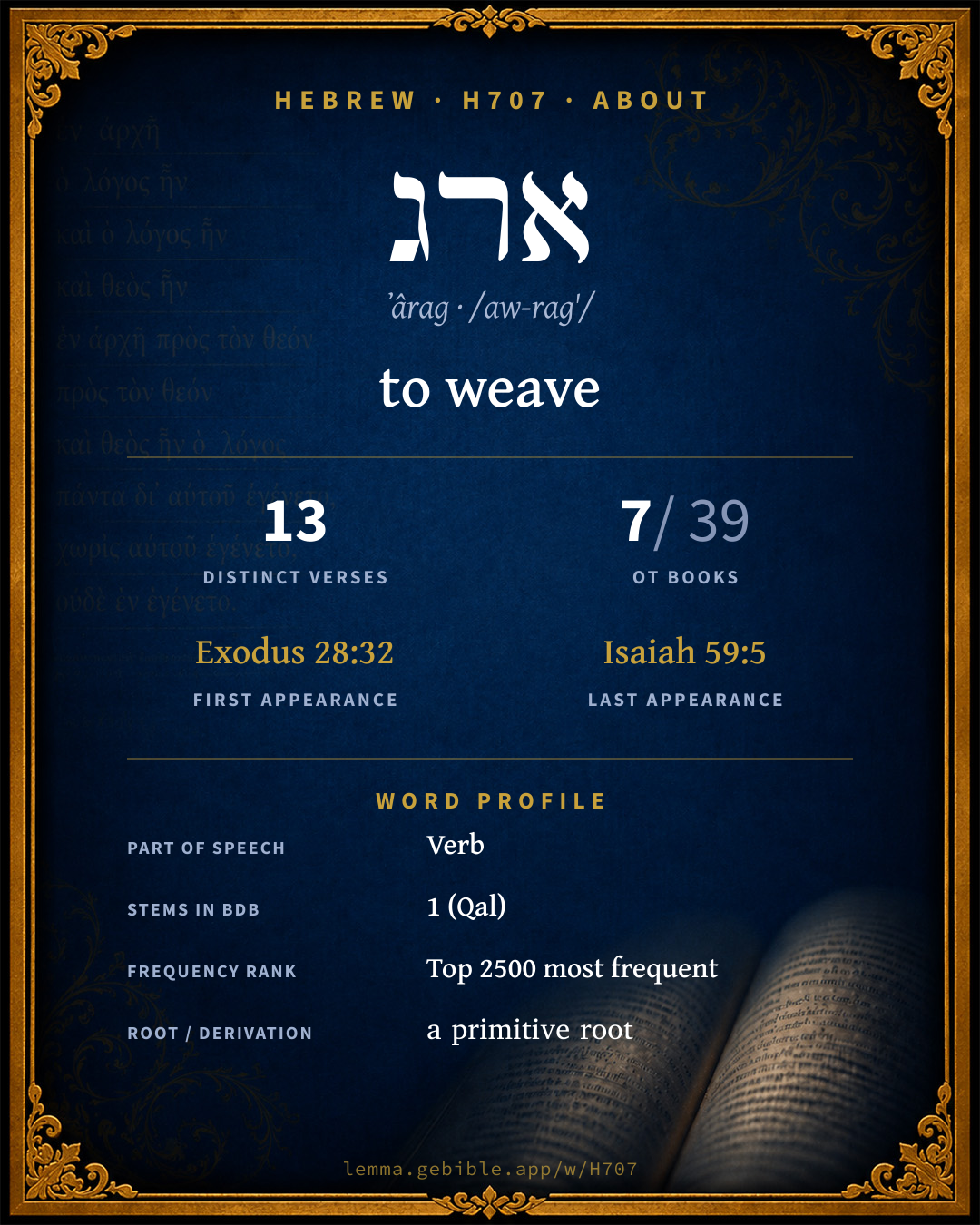
אָרַג
to weave
‘to weave’ is one of 5 main senses fuller range ↓
Full lexicon entry — Brown-Driver-Briggs (BDB)
From Brown-Driver-Briggs (BDB)
Where this word appears
Grammar key — what these labels mean
Part of speech
- Verb
- An action or state-of-being word.
Stem
- Qal
- The basic, simple active stem — the plain form of the verb (“he wrote”).
Form
- Participle Active
- A verbal adjective expressing ongoing or characteristic action (“writing / one who writes”).
- Imperfect
- An incomplete, ongoing, or future action (“he will / would write”).
State
- Absolute
- The independent form of a noun, not bound to a following word.
Person
- 2nd Person
- The one addressed (“you”).
- 3rd Person
- The one spoken about (“he / she / it / they”).
Gender
- Masculine
- Grammatically masculine.
- Feminine
- Grammatically feminine.
Number
- Plural
- More than one (in Hebrew, generally three or more).
- Singular
- One.
Grammatical forms
- Verb, Qal, Participle Active, Masculine, Plural, Absolute 5 times (38%)
- Verb, Qal, Participle Active, Masculine, Singular, Absolute 5 times (38%)
- Verb, Qal, Imperfect, 2nd Person, Feminine, Singular 1 time (8%)
- Verb, Qal, Imperfect, 3rd Person, Masculine, Plural 1 time (8%)
- Verb, Qal, Participle Active, Feminine, Plural, Absolute 1 time (8%)
Parsed forms decoded from the imported morphology (morphhb / Westminster Leningrad Codex — WLC text public domain, morphhb tagging CC BY 4.0), counted across 13 parsed occurrences — not distinct verses.
Every verse where H707 appears — 13 distinct verses across 7 books. Click any verse to open its interlinear word-by-word view. Verse text shown in the World English Bible for context — . Each verse’s Hebrew form is shown with its reference; the English is not keyword-highlighted, since the data carries no word-level English alignment. Use “Compare translations” on any verse to read it across multiple English versions. This concordance covers the Hebrew Bible; Septuagint (Greek Old Testament) occurrences are not indexed here.
Exodus 4 verses
- Exodus 28:32 אֹרֵ֗ג Qal ptcp.act ms It shall have a hole for the head in the midst of it: it shall have a binding of woven work round about the hole of it, as it were the hole of a coat of mail, that it not be torn.
- Exodus 35:35 וְ/אֹרֵ֑ג conj + Qal ptcp.act ms He has filled them with wisdom of heart, to work all manner of workmanship, of the engraver, of the skillful workman, and of the embroiderer, in blue, in purple, in scarlet, and in fine linen, and of the weaver, even of those who do any workmanship, and of those who make skillful works.
- Exodus 39:22 אֹרֵ֑ג Qal ptcp.act ms He made the robe of the ephod of woven work, all of blue.
- Exodus 39:27 אֹרֵ֑ג Qal ptcp.act ms They made the coats of fine linen of woven work for Aaron, and for his sons,
Judges 1 verse
1 Samuel 1 verse
2 Samuel 1 verse
2 Kings 1 verse
1 Chronicles 2 verses
- 1 Chronicles 11:23 אֹרְגִ֔ים Qal ptcp.act mp He killed an Egyptian, a man of great stature, five cubits high; and in the Egyptian's hand was a spear like a weaver's beam; and he went down to him with a staff, and plucked the spear out of the Egyptian's hand, and killed him with his own spear.
- 1 Chronicles 20:5 אֹרְגִֽים Qal ptcp.act mp There was again war with the Philistines; and Elhanan the son of Jair killed Lahmi the brother of Goliath the Gittite, the staff of whose spear was like a weaver's beam.
Isaiah 3 verses
- Isaiah 19:9 וְ/אֹרְגִ֖ים conj + Qal ptcp.act mp Moreover those who work in combed flax, and those who weave white cloth, shall be confounded.
- Isaiah 38:12 כָ/אֹרֵ֤ג prep det + Qal ptcp.act ms My dwelling is removed, and is carried away from me as a shepherd's tent: I have rolled up, like a weaver, my life; he will cut me off from the loom: From day even to night will you make an end of me.
- Isaiah 59:5 יֶאֱרֹ֑גוּ Qal impf 3mp They hatch adders' eggs, and weave the spider's web: he who eats of their eggs dies; and that which is crushed breaks out into a viper.
About this entry
At a glance — auto-summarized from this page’s data, not written by a person. Every figure links to its source below. This summary describes the numbers; it doesn’t interpret them.
“to weave” is the headline sense of the Hebrew verb ארג (ʼârag). Carrying more than one sense, it rewards its full sense range. With 13 verses in 7 books, it is an uncommon word in the Hebrew Bible. It concentrates in Exodus, which alone accounts for 31% of its uses. Scripture first uses it in Exodus 28:32. The sections below give every sense, occurrence, and version rendering.
Gloss history
Strong's 1890 vs modern scholarship
About this word
Strong's H707 catalogs a Hebrew word from the Hebrew Old Testament.
These counts are not copied from any lexicon or concordance. They are computed here, from the morphology-tagged Hebrew Old Testament. What Lemma adds →
- 13
- distinct verses
- The word appears in 13 distinct verses.
- 7 / 39
- OT books
- The word appears in 7 of 39 Old Testament books.
- #2,001
- by frequency
- Top 2500 most frequent Hebrew words (rank 2,001 of 8,640 Hebrew words by occurrence).
View all 13 occurrences in the concordance →
Most concentrated in
- Exodus 4 verses 31%
- Isaiah 3 verses 23%
- 1 Chronicles 2 verses 15%
By section of the Old Testament
By traditional corpus
Conventional, traditional groupings — biblical authorship is debated, so this is a traditional corpus grouping, not an authorship claim. Each share is this word’s portion of its verses in that division of the Hebrew canon. Each figure is a share of the word’s 13 distinct verses.
- Prophets (Nevi'im) 7 verses · 54%
- Torah (Pentateuch) 4 verses · 31%
- Writings (Ketuvim) 2 verses · 15%
How translations render this word
Counts come from each version’s own published word-to-Strong’s tagging or interlinear alignment — an approximate guide to how each version renders this word, not a word-level alignment the data otherwise carries. Because each total is that version’s own tagged count, the per-version totals vary from one another and need not match the appearance or distinct-verse counts above. These counts may also differ from a printed concordance because Lemma counts each distinctly tagged rendering and does not collapse phrase taggings into a single head-word total. This is a fixed set of word-tagged versions (KJV, ASV, BSB, ULT) and does not change with the reading translation you choose elsewhere. Each version’s license is shown beside its name below (and on Sources).
- King James Version: Was like a weaver's 3×, Woven 3×
- American Standard Version: Was like a weaver 3×, Woven 2×
- Berean Standard Bible: Was like a weaver’s 3×, Weaver 2×, Weavers 2×
- unfoldingWord Literal Text: Weaver 4×, Weavers 4×
King James Version Public Domain
Renders H707 across 13 tagged occurrences — most commonly:
Plus 7 renderings that appear only once — usually multi-word phrases or single function words the recovered tagging swept in, not distinct renderings.
American Standard Version Public Domain
Renders H707 across 13 tagged occurrences — most commonly:
Plus 8 renderings that appear only once — usually multi-word phrases or single function words the recovered tagging swept in, not distinct renderings.
Berean Standard Bible Public Domain
Renders H707 across 12 tagged occurrences — most commonly:
Plus 5 renderings that appear only once — usually multi-word phrases or single function words the recovered tagging swept in, not distinct renderings. Not rendered by a distinct English word in 1 further occurrence.
unfoldingWord Literal Text CC BY-SA 4.0
Renders H707 across 14 tagged occurrences — most commonly:
Plus 6 renderings that appear only once — usually multi-word phrases or single function words the recovered tagging swept in, not distinct renderings.
Senses in the full BDB
What do BDB’s symbols mean?
BDB uses these scholarly abbreviations:
| Symbol | Meaning |
|---|---|
| 𝔊 | the Septuagint (the ancient Greek translation, LXX) |
| 𝔙 | the Vulgate (the Latin translation) |
| 𝔖 | the Syriac version (the Peshitta) |
| 𝔗 | the Targum (the Aramaic translation) |
| ψ | the Psalms |
| √ | root (the underlying root or stem) |
| ‖ | parallel passage (a synonymous or contrasted parallel) |
| † | the dagger: every passage where the word occurs is cited |
The 1 sense the full Brown-Driver-Briggs lexicon distinguishes for this word, in lexicon order (not ranked by frequency), with BDB’s own verbatim wording and sub-sense lettering. Shown in Hebrew script with BDB’s own scholarly abbreviations. The condensed entry is in the Lexicon Entry tab. See also the Forms in the corpus table below.
Qal
- Impf. 2 fs. תַּאַרְגִי Ju 16:13, 3 mpl. יֶאֱרֹ֑גוּ Is 59:5; Pt. אֹרֵג Ex 28:32 + 4 times; pl. אֹרְגִים Is 19:9 + 5 times; אֹרְגוֹת 2 K 23:7;—weave cloth, etc. Is 19:9 (in Egypt) 2 K 23:7, Samson’s locks Ju 16:13; metaph. weave spider’s web = intrigue Is 59:5; most often Pt. used as subst. = weaver Is 38:12; work of the weaver מעשׂה א׳ Ex 28:32; 39:22, 27 cf. 35:35; weavers’ beam (pl.) מְנוֹר א׳ 1 S 17:7; 2 S 21:19 1 Ch 11:23; 20:5 (sim. of huge spear-shaft)—cf. also sub יַעֲרֵי ארגים. e.g. Judges 16:13
Senses from the full Brown-Driver-Briggs lexicon (Brown, Driver, Briggs; Oxford 1906 — public domain), digitized via Sefaria, supplemented by the OpenScriptures HebrewLexicon (CC BY 4.0). Full attribution on Sources.
Word origin
vb. weave (Mish. id. cf. Ph. ארג weaver)—
— Brown-Driver-Briggs (Oxford 1906, public domain), digitized via Sefaria, supplemented by the OpenScriptures HebrewLexicon (CC BY 4.0). See Sources.
Origin: a primitive root
Jastrow Dictionary
A second Hebrew/Aramaic lexicon for comparison, covering Aramaic and post-biblical (Talmudic, Targumic, Midrashic) usage that the biblical-Hebrew BDB does not. Matched by lemma rather than by Strong’s number, so a lemma may carry more than one Jastrow headword (shown separately below), and the entries cover usage well beyond the Bible.
אָרָג
- , constr. אֲרַג m. (v. רגג, h. ערג) something desirable … שפר א׳ the choicest of … Targ. Ps. XLV, 14. Targ. Y. Gen. XLV, 18.
אָרַג
- , v. ארב; cmp. חרג) to plait, braid, weave. Sabb. VII, 2 האוֹרֵג he who weaves on the Sabbath; a. fr.—Metaph. (cmp. טרי) to argue, conclude, spin out, deduct &c. Ruth R., Par. 2, beg. (play on or’gim II Sam. XXI, 19) they brought a subject up והוא אוֹרְגָהּ and he carried it to a conclusive decision. Ib. שהיו אוֹרְגִין עמו they argued with him.—Num. R. s. 4 (play on argaman, purple) שהוא היה א̇ור̇ג̇ … מ̇ן̇ וכ׳ for it (the purple-covered altar) argued Israel free from sin (pleaded in his behalf). Num. R. s. 12 (same play on the word) והוא אורג וכ׳ and He wove (planned) the world so that all creatures should come forth each according to its kind. Ib. א׳ מַן the Sun weaves (ripens) food. e.g. 2 Samuel 21:19
- to be woven. Y. Ter. XI, end, 48ᵇ. Ex. R. s. 50; a. fr.
- , part. מְאָרֵג (cmp. עֲרוּגָה) to follow the grooves of the garden bed, to range, esp. to select the green and tender onions (v. חָלַק Hif.). Tosef. Peah I, 9 המארג, quoted in Y. ib. III, 17ᶜ top המירוג (corr. acc.; v. מֵירוּג) a. explained ibid. המחליק וכ׳ he who takes out the green onions for sale and leaves the others to ripen for storage.
אֲרַג
- Snh. 48ᵇ וא׳ בגד וכ׳ and where they weave a garment (directly) for a corpse.
A Dictionary of the Targumim, the Talmud Babli and Yerushalmi, and the Midrashic Literature (Marcus Jastrow; London, Luzac, 1903) — Public Domain. Digitized via Sefaria. Digitized via Sefaria. Full attribution on Sources.
Forms in the corpus
The 11 distinct written forms H707 takes in the Hebrew Bible, most frequent first — each parse links to that stem’s occurrences in the concordance. Hebrew forms include their vowel points and cantillation, so a single lemma takes many written forms.
| Form | Parsing | Example | Uses |
|---|---|---|---|
| אֹרְגִֽים | Verb, Qal, Participle Active, Masculine, Plural, Absolute | 1 Chronicles 20:5 | 2 |
| אֹרֵ֑ג | Verb, Qal, Participle Active, Masculine, Singular, Absolute | Exodus 39:22 | 2 |
| אֹֽרְגִ֔ים | Verb, Qal, Participle Active, Masculine, Plural, Absolute | 1 Samuel 17:7 | 1 |
| אֹרְג֥וֹת | Verb, Qal, Participle Active, Feminine, Plural, Absolute | 2 Kings 23:7 | 1 |
| אֹרְגִ֔ים | Verb, Qal, Participle Active, Masculine, Plural, Absolute | 1 Chronicles 11:23 | 1 |
| אֹרֵ֗ג | Verb, Qal, Participle Active, Masculine, Singular, Absolute | Exodus 28:32 | 1 |
| וְ/אֹרְגִ֖ים | Verb, Qal, Participle Active, Masculine, Plural, Absolute | Isaiah 19:9 | 1 |
| וְ/אֹרֵ֑ג | Verb, Qal, Participle Active, Masculine, Singular, Absolute | Exodus 35:35 | 1 |
| יֶאֱרֹ֑גוּ | Verb, Qal, Imperfect, 3rd Person, Masculine, Plural | Isaiah 59:5 | 1 |
| כָ/אֹרֵ֤ג | Verb, Qal, Participle Active, Masculine, Singular, Absolute | Isaiah 38:12 | 1 |
| תַּאַרְגִ֗י | Verb, Qal, Imperfect, 2nd Person, Feminine, Singular | Judges 16:13 | 1 |
Same root — word family
Other BDB entries built from the same root as H707, grouped by Strong’s listed origin. These share a root / origin per the lexicon — not necessarily a shared meaning. Each links to that word’s own entry.
Derived from this word
Compare all same-root words → They share a root, not necessarily a meaning.
Septuagint verse parallels
This word appears in 12 verses that also exist in the Greek Old Testament (Septuagint), out of the 13 Hebrew verses it occurs in. You can read those verses in Greek by switching the Old Testament edition to the Septuagint.
Read these verses in the Septuagint
This is a verse-level parallel only — the same verses exist in both the Hebrew and Greek Old Testaments. No word-level Hebrew↔Greek correspondence is claimed: the data carries no such alignment, so no Greek word is shown as this Hebrew word’s translation. Coverage is not total — the Septuagint omits the deuterocanon and renumbers the Psalms, so some Hebrew verses have no direct Greek parallel.