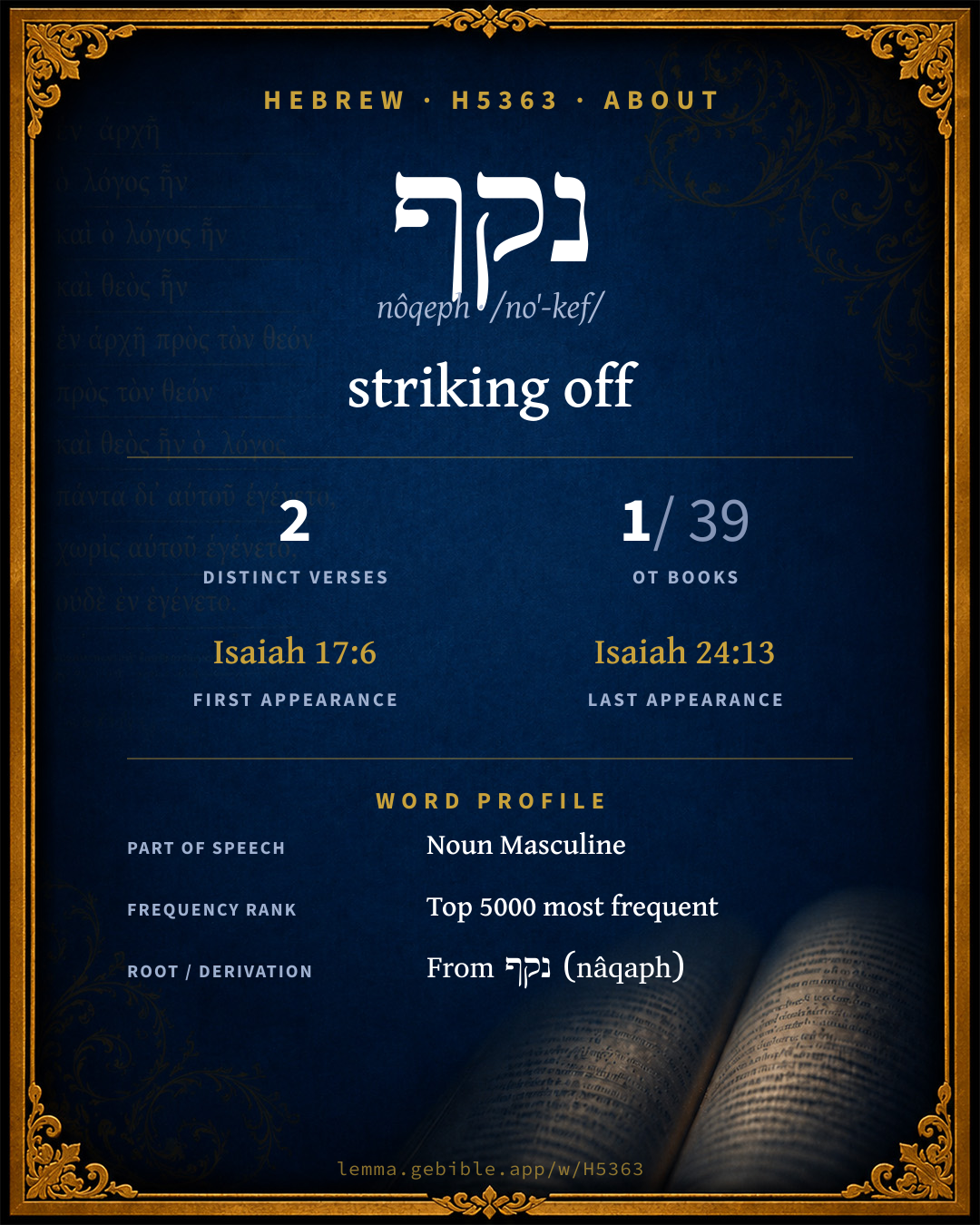
נֹ֫קֶף
striking off
Full lexicon entry — Brown-Driver-Briggs (BDB)
From Brown-Driver-Briggs (BDB)
Where this word appears
Grammar key — what these labels mean
Noun type
- Common
- A common noun — a general class of person, place, or thing (“king,” “city,” “water”), not a specific name.
State
- Construct
- A noun bound to a following noun in a possessive / “of” relationship (the construct chain).
Gender
- Masculine
- Grammatically masculine.
Number
- Singular
- One.
Every verse where H5363 appears — 2 distinct verses across 1 book. Click any verse to open its interlinear word-by-word view. Verse text shown in the World English Bible for context — . Each verse’s Hebrew form is shown with its reference; the English is not keyword-highlighted, since the data carries no word-level English alignment. Use “Compare translations” on any verse to read it across multiple English versions. This concordance covers the Hebrew Bible; Septuagint (Greek Old Testament) occurrences are not indexed here.
Isaiah 2 verses
- Isaiah 17:6 כְּ/נֹ֣קֶף prep + n c ms cs Yet there shall be left therein gleanings, as the shaking of an olive tree, two or three berries in the top of the uppermost bough, four or five in the outmost branches of a fruitful tree, says Yahweh, the God of Israel.
- Isaiah 24:13 כְּ/נֹ֣קֶף prep + n c ms cs For thus shall it be in the midst of the earth among the peoples, as the shaking of an olive tree, as the gleanings when the vintage is done.
About this entry
At a glance — auto-summarized from this page’s data, not written by a person. Every figure links to its source below. This summary describes the numbers; it doesn’t interpret them.
At its core, נקף (nôqeph) means “striking off.” It occurs a mere 2 verses across Scripture. The word gravitates to Isaiah (100%). Scripture first uses it in Isaiah 17:6. It clusters with נקף, נקפה and תקופה under a shared root. Dig into 2-verse concordance and the renderings breakdown below.
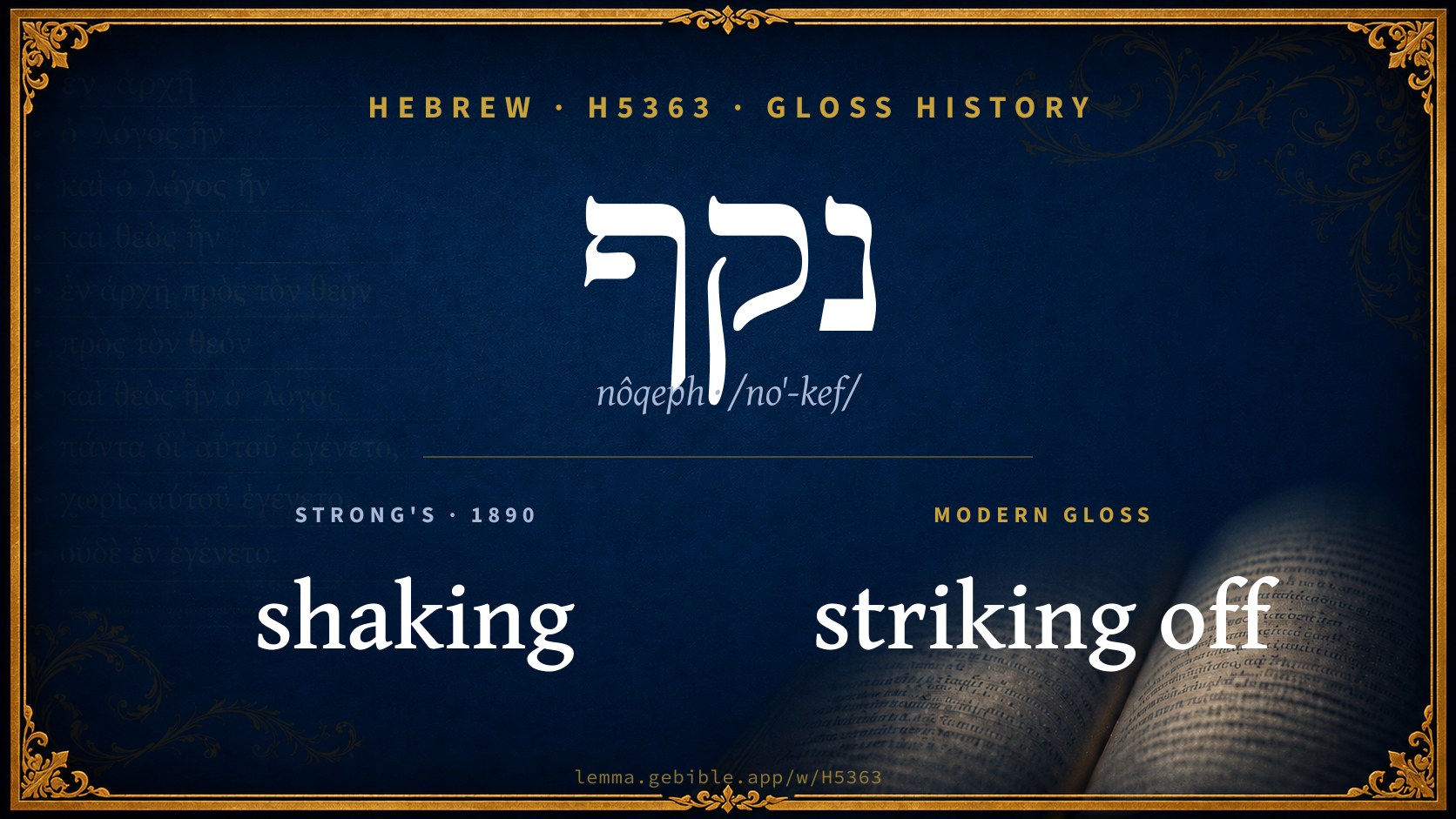
Gloss history
Strong's 1890 vs modern scholarship
About this word
Strong's H5363 catalogs a Hebrew word from the Hebrew Old Testament.
These counts are not copied from any lexicon or concordance. They are computed here, from the morphology-tagged Hebrew Old Testament. What Lemma adds →
- 2
- distinct verses
- The word appears in 2 distinct verses.
- 1 / 39
- OT books
- The word appears in 1 of 39 Old Testament books.
- #4,807
- by frequency
- Top 5000 most frequent Hebrew words (rank 4,807 of 8,640 Hebrew words by occurrence).
View all 2 occurrences in the concordance →
Most concentrated in
- Isaiah 2 verses 100%
By section of the Old Testament
By traditional corpus
Conventional, traditional groupings — biblical authorship is debated, so this is a traditional corpus grouping, not an authorship claim. Each share is this word’s portion of its verses in that division of the Hebrew canon. Each figure is a share of the word’s 2 distinct verses.
- Prophets (Nevi'im) 2 verses · 100%
How translations render this word
Counts come from each version’s own published word-to-Strong’s tagging or interlinear alignment — an approximate guide to how each version renders this word, not a word-level alignment the data otherwise carries. Because each total is that version’s own tagged count, the per-version totals vary from one another and need not match the appearance or distinct-verse counts above. These counts may also differ from a printed concordance because Lemma counts each distinctly tagged rendering and does not collapse phrase taggings into a single head-word total. This is a fixed set of word-tagged versions (KJV, ASV, BSB, ULT) and does not change with the reading translation you choose elsewhere. Each version’s license is shown beside its name below (and on Sources).
- King James Version: Shaking 1×, Shall be as the shaking 1×
- American Standard Version: Shaking 2×
- Berean Standard Bible: Has been beaten 1×, Like a harvested 1×
- unfoldingWord Literal Text: Like the shaking of 2×
King James Version Public Domain
Renders H5363 across 2 tagged occurrences — most commonly:
American Standard Version Public Domain
Renders H5363 across 2 tagged occurrences — most commonly:
Berean Standard Bible Public Domain
Renders H5363 across 2 tagged occurrences — most commonly:
unfoldingWord Literal Text CC BY-SA 4.0
Renders H5363 across 2 tagged occurrences — most commonly:
Senses in BDB
The 1 sense BDB distinguishes for this word, in lexicon order (not ranked by frequency or importance). The full entry — with sub-senses — is in the Lexicon Entry tab.
- striking off
Word origin
נֹ֫קֶף n.[m.] striking off;—only cstr. Is 17:6 24:13
— Brown-Driver-Briggs (Oxford 1906, public domain), digitized via Sefaria, supplemented by the OpenScriptures HebrewLexicon (CC BY 4.0). See Sources.
Derived from נקף (nâqaph) (H5362) — to strike.
Jastrow Dictionary
A second Hebrew/Aramaic lexicon for comparison, covering Aramaic and post-biblical (Talmudic, Targumic, Midrashic) usage that the biblical-Hebrew BDB does not. Matched by lemma rather than by Strong’s number, so a lemma may carry more than one Jastrow headword (shown separately below), and the entries cover usage well beyond the Bible.
נָקַף I
- to bring in close contact; to knock, strike against, wound. Ḥull. 7ᵇ אין אדם נוֹקֵף וכ׳ no one on earth bruises his finger, unless it is decreed &c. Ber. 7ᵇ; Meg. 6ᵇ מי שלבו נוֹקְפוֹ he whom his heart smites (who has no clear conscience). Nidd. 3ᵇ, a. e. לבו נוקפו ופורש he may have scruples and separate himself entirely from his wife. Midr. Till. to Ps. IX, v. נֶקֶף.—Maas. Sh. V, 15; Sot. IX, 10 הנוֹקְפִים those who knocked the sacrifices on their heads; expl. ib. 48ᵃ; Y. ib. IX, 24ᵃ bot.—Part. pass. נָקוּף; f. נְקוּפָה; pl. נְקוּפִים, נְקוּפִין; נְקוּפוֹת. Tosef. Ḥull. III, 24 ביצים נ׳ לקערה eggs cracked open into a dish (Ḥull. 64ᵃ טרופות).
- 1. to cause a knocking together. Sot. 22ᵇ (expl. נקפי) המַנְקִיף את רגליו he who knocks his feet against each other (by his mincing walk; Rashi: who causes his feet to strike against objects on the road); cmp. נָקַשׁ.
- 2. to bring closely together. Bekh. VII, 6 שמַקִּיף, v. נָקַשׁ. Nidd. X, 7 ומַקֶּפֶת and brings the vessel which contains the Ḥallah near the dough; T’bul Yom IV, 3, sq. Bets. IV, 5 ואין מַקִּיפִין שתי וכ׳ and you must not move two wine vessels together to put upon them &c.—Esp. (ritual law, in examining an organic defect found in a slaughtered animal) to create a defect similar and near to the one found, in order to ascertain whether the latter was not the result of an accident after slaughtering; in gen. to compare. Ḥull. 50ᵃ מַקִּיפִים בבני מעים we may compare defects in entrails in which was found a perforation the origin of which is doubtful by making a hole next to it. Ib. מקיפין בקנה we may compare defects in windpipes; a. fr.—Kidd. 40ᵃ אין מקיפין בחילול השם no comparing (balancing of sins against good deeds) is granted when the Name of God is profaned; (oth. interpret., v. נָקַף II).—Part. pass. מוּקָּף brought near. Erub. 30ᵇ; Ḥull. 7ᵃ; a. fr. לתרום שלא מן המ׳ to take T’rumah out of a mass which is not in close neighborhood of those products which are to be redeemed; Bicc. II, 5; Ter. IV, 3; a. e.
נְקַף
- , to strike, knock, push down. Targ. Ps. CXL, 5. Targ. O. Ex. XXXIV, 20 ותִיקְּפֵיה ed. Berl. (oth. ed., a Y. ותִנְקְ׳; ed. Vien. ותַנְקְ׳ Af.; h. text וערפתו). Targ. Deut. XXI, 4 (O. ed. Berl. ויַקְּ׳, Af.); a. e.—Part. pass. נְקִיף; f. נְקִיפָא. Ib. 6 (O. ed. Vien. נְקֶפְתָּא).—Erub. 53ᵇ (enigmatic speech) עלת נַקְפַת בכד ידאון וכ׳ the ladle strikes against the jug, shall the eagles fly to their nests (the wine is gone, shall the students go home)?
- same. Targ. Ps. CXL, 12 (Ms. Pe.).—Part. pass. מְנַקַּף. Ber. 6ᵃ כרעי דמְנַקְּפֵי bruised feet; Yoma 53ᵃ, v. נְגַף.
- 1. same; v. supra.—2)
- to knock the feet against each other, to mince (v. preced.Hif.). Targ. Is. III, 16 (h. text טפף).
- 2. to compare defects (v. preced.Hif.). Ḥull. 50ᵃ אַקְּפִינְהוּ ולא וכ׳ they compared them, and they did not look alike.
- to knock against, to stumble. Targ. II Esth. IV, 13.—Yoma l. c. מִינַּקְּפִין Ar. ed. Koh., v. נְגַף.
נָקַף II
- to circle; to bore.—Part. pass. נָקוּף; f. נְקוּפָה. Gen. R. s. 100, v. נָקַב.
- 1. to surround. Erub. I, 8 (15ᵇ) והִקִּיפוּהָ (ב)כלי בהמה and they surrounded it (the camp) with utensils of travel (wagons, saddles &c.). Ib. 9 מַקִּיפִין שלשה וכ׳ you may surround the camp with three ropes &c. (for Sabbath purposes). Ib. 53ᵇ מצאתי שמקיפין אותה גנות וכ׳ I found that gardens and orchards surrounded the town (making it inaccessible); a. fr.
- 2. to cause to go around. Mekh. B’shall. s. 1 אַקִּיפֵם במדבר וכ׳ I shall make them go around in the desert forty years; ib. הריני מַקִּיפָן וכ׳. Snh. VIII, 1 עד שיַקִּיף וכ׳ until he has grown hair around &c., v. זָקֵן.
- 3. to cut all around, esp. (with ref. to Lev. XIX, 27) to cut around the corners of the hair of the head. Naz. 57ᵇ אחד המַקִּיף ואחד הנִיקָּף he who cuts and he whose hair is cut are alike guilty; a. fr. e.g. Leviticus 19:27
- 4. to sell on terms (v. תְּקוּפָה), to lend. Ab. III, 16 החנוני מַקִּיף the shopkeeper allows credit (the Lord is long-suffering). B. Kam. 79ᵃ top גנב וה׳ if he stole an animal and sold it on credit (and has received no pay); a. fr.—Kidd. 40ᵃ אין מַקִּיפִין וכ׳ no loan on time is granted (no chance for repentance is allowed), when the Name of the Lord is profaned; (oth. interpret., v. נָקַף I).
- to be surrounded. Arakh. 33ᵇ; Meg. 3ᵇ שה׳ ולבסוף וכ׳ it was surrounded (a fort was built) and then settled; a. fr.—Part. מוּקָּף; f. מוּקֶּפֶת; pl. מוּקָּפִין; מוּקָּפוֹת. Ib. I, 1 המ׳ חומה וכ׳ fortified since the days of Joshua. Ib. 2ᵇ. Ib. 4ᵇ. Gen. R. s. 39, v. פָּתִיל; a. fr.—Mekh. B’shall., s. 1 מוקפות semicircular
- to have one’s hair cut all around. Naz. l. c., v. supra. Ib. כל היכא דנ׳ מיחייב וכ׳ whenever he who has his hair cut &c. is punishable (is not a minor or a woman), the cutter is punishable; a. e.
- 1. to collect fruit which remained in the crown of the tree (v. נִיקּוּף II), to glean olives (corresp. to פֵּאֵר, Deut. XXIV, 20). Gitt. V, 8 עני המְנַקֵּף … מה שתחתיו גזל when the poor man does the gleaning on the top of the olive tree, what falls down under him is forbidden to any other person; Y. ed. המנ׳ בראש הזית גזל (corr. acc.; v. ib. 47ᶜ top). e.g. Deuteronomy 24:20
- 2. to cut all around, trim. B. Kam. 119ᵇ; Tosef. ib. XI, 18 מְנַקְּפֵי היגין those who trim shrubs. Ib. השוכר … לנַקֵּף עמו וכ׳ if one hires a laborer to help him trim &c.
נְקַף ²
- —Af. אַקֵּף as preced. Hif. Targ. Jud. XI, 18.—Targ. Lev. XIX, 27; a. fr. Part. pass. מַקֵּף (= h. מוּקָּף, v. preced. Hof.). Ib. XXV, 31. Targ. Is. XXIX, 2; a. fr.—Snh. 69ᵃ מקמיה דלַקִּיף זקן before his hair around the genitals is grown.—Y. Ber. IX, 14ᵇ bot., a. e. (expl. ניקפי) אַקֵּיף לי וכ׳ (the Pharisee that says,) Lend me that I may do a certain pious work; a. fr.
נֶקֶף
- (נָקַף I)
- 1. bruise.—Pl. נְקָפִים. Sabb. 62ᵇ (expl. נקפה, Is. III, 24); Yalk. Is. 264. e.g. Isaiah 3:24
- 2. beating (of the heart), scruples, doubt. Midr. Till. to Ps. IX, 2 שלא יהא בלבי נ׳ that there be no struggle in my heart (ed. Bub., a. Yalk. ib. 642: שלא יהא לבי נוֹקֵף, v. נָקַף I).
A Dictionary of the Targumim, the Talmud Babli and Yerushalmi, and the Midrashic Literature (Marcus Jastrow; London, Luzac, 1903) — Public Domain. Digitized via Sefaria. Digitized via Sefaria. Full attribution on Sources.
Same root — word family
Other BDB entries built from the same root as H5363, grouped by Strong’s listed origin. These share a root / origin per the lexicon — not necessarily a shared meaning. Each links to that word’s own entry.
Derives from
Shares the same root
Compare all same-root words → They share a root, not necessarily a meaning.
Septuagint verse parallels
This word appears in 2 verses that also exist in the Greek Old Testament (Septuagint), out of the 2 Hebrew verses it occurs in. You can read those verses in Greek by switching the Old Testament edition to the Septuagint.
Read these verses in the Septuagint
This is a verse-level parallel only — the same verses exist in both the Hebrew and Greek Old Testaments. No word-level Hebrew↔Greek correspondence is claimed: the data carries no such alignment, so no Greek word is shown as this Hebrew word’s translation. Coverage is not total — the Septuagint omits the deuterocanon and renumbers the Psalms, so some Hebrew verses have no direct Greek parallel.